Nishi Family › Compare › Librarian and Data Trust
Nishi Compare · capabilities, evidence and delivery
Librarian and Data Trust
Compare capabilities and delivery evidence. Source discovery, qualification, deployment and accepted outcomes are separate; an open contract names work still to verify.
Nishi vs DataHub and OpenMetadata and Collibra and Atlan
Overview
The purpose, declared position and evidence coverage of this domain. Source presence and completed acceptance are different measures.
Where we are. The librarian and data-trust plane is structurally ahead of the catalogs: content-addressed identity (exceed), tamper-evident append-only store (exceed), silicon-up genesis lineage (exceed), C2PA-class signed provenance with deny-by-default verification (two exceeds), the no-new-TSV live guard (exceed), the format-sprawl audit (exceed), universal library foundationing of 1,314 of 1,314 docs (exceed), plus dataset lineage, dedup, freshness state machine, schema drift, compaction, BM25 over the library, the librarian review with RACI handoff and a live cross-team orchestration engine (exceed). Behind the catalogs on: applied subject classification, a RUNNING freshness beat, the MCP orchestration API, column-level lineage, contract enforcement at ingest, and a catalog UI.
Where we need to go. A library that is CLASSIFIED and BROWSABLE, kept fresh by a beat rather than a session, enforced at the door by data contracts, traced to the column, and engaged by any team through one MCP door -- on the same signed content-addressed substrate that already exceeds the field.
Research bar. DataHub and OpenMetadata is measured on column-level lineage, catalog UI, freshness SLAs. Theirs: the open-source catalog bar. Ours: LI2 LI3 LI5 measured on this page.
Research bar. Collibra and Atlan is measured on data contracts, active metadata, agentic engagement. Theirs: the enterprise bar. Ours: LI4 LI6.
Research bar. OpenLineage is measured on the lineage model. Theirs: the interchange reference. Ours: LI5.
Latest recorded release
No valid dated release entry is recorded for this domain.
Release entries describe recorded changes; they do not establish that every capability passed evaluation.
23 of 30 capability source symbols found|15 of them authored stronger-claims|7 open|coverage 766/1000|adoption 13 full / 10 partial
Evidence profile — what the gaps on this board actually are
Measured by nx_swcompare_evidence, read back by nx_evprofile_lib. Every figure is a count with its denominator — there is deliberately no score, no grade and no percentage anywhere in this band, because a stored scalar is a field a seat can edit and a counted partition is not.
evidence|grounded 23/23|unsupported 0|gates green 4/4|proven able to fail 4/4|never bitten 0|green at 0/0 2|open gaps 7|of them unnamed 0|of them proof withheld 0|flips ready 0
proven able to fail counts the gates that have a RECORDED RED — nx_gate_bite mutated the gate subject, rebuilt it, watched the gate go red, and that record is inside the shared TTL. never bitten is its complement over the same denominator: those gates ran and were green, and nothing has ever shown them able to detect anything, so their green is a statement about this run and not about the gate. green at 0/0 is a separate and much weaker observation — the gate printed GREEN on a zero denominator, so its own tooth counter says it examined nothing. A gate can be green, non-zero, and still never bitten; that is the common case and it is now visible instead of implied.
partition: grounded + unsupported = 23 vs present 23 · named + unnamed + withheld = 7 vs open 7 · both reconcile
liar-kill conj=GPQN · all four conjuncts held
graded document: BUILDROOT tree, 9456 bytes · gates map: PRIMARY · stamped 3d 10h ago · source ../knowledge/status/evstamp_librarian.verdict
| Gap class | What it is, and the work it names |
|---|---|
| VACUOUS-GATE | A gate reported GREEN on a ZERO denominator. A gate with real teeth and a broken counter, and a gate with no teeth at all, are indistinguishable from outside; that indistinguishability is the finding, so it is reported here and never convicted. |
nx_swcompare_evidence librarian itself and are not carried on the stamp, so this page names the classes and the producer names the rows. That split is stated rather than hidden: a count without a worklist is not actionable, and this band is honest about which half of that it is.Production map
Follow the dependencies, declared acceptance criteria and recorded priorities. Inspect source binding before treating a rank as executable work.
Ranking source binding: PLAN_MATRIX_BOUND_ONLY. Recorded priorities require current acceptance evidence and resource checks before execution.
Ranking matches the captured plan and matrix only. Latest execution outcome, research freshness, accepted delivery and investment return are unverified.
Recorded priority estimates
Order from nx_compare_rank (nx_dr_ocm: (deficit + cost-of-delay + option + enables) x sponsor x self-sufficiency x momentum / cost). FINISH rows are rungs whose symbol is present but whose organ is short of full adoption: listed before new work by this heuristic. Priority is not measured delivery cost or execution readiness. Stamp: # asof=1790081776 domain=librarian target_version=0.1 rungs=14 done=6 open=8 finish=2 ranker=nx_dr_ocm
| # | Stage | Rung | Priority | Derivation |
|---|---|---|---|---|
| F | FINISH | Universal foundationing (LQ2) lf_run dossier | REGISTERED-DARK | callable, authorised, completed MCP invocation not established by supplied journal window; lifetime history unknown (direct execution may be recorded elsewhere; this scan does not establish lifetime use); no execution surface runs it either (clock, cron, daemon, roster, actlog and surfaced forks checked) |
| F | FINISH | Librarian review (LQ4) lr_run dossier | LIB-GATE-ONLY importers=1 | imported only by validation organs (gates, tests, benches): wire it into a shipping program |
| #1 | 0.1 | Freshness beat (LI1) lfr_run_beat dossier | 3200 | v=16 m=2 c=10 |
| #2 | later | Applied subject classification (LI2) lbc_classify_doc dossier | 2000 | v=20 m=2 c=20 |
| #3 | later | Column-level lineage (LI5) fld_column_edge dossier | 1280 | v=16 m=2 c=25 |
| #4 | later | Catalog discovery UI (LI3) lbs_catalog_page dossier | 1066 | v=16 m=1 c=15 |
| #5 | later | Licence text acquired for the unread rows (LX1) aq_license_fetch dossier | 1066 | v=8 m=2 c=15 |
| #6 | later | Contract enforcement at ingest (LI4) ic_enforce_contract dossier | 300 | v=3 m=2 c=20 |
| #7 | later | MCP orchestration door (LI6) oapi_engage dossier | 266 | v=2 m=2 c=15 |
| #8 | later | Upstream rot watch over acquired works (LX2) aq_rot_scan dossier | 0 | v=0 m=1 c=15 |
Declared roadmap — contract, acceptance, executor, effort
| Rung | Closes with | Definition of done (pre-declared) | Executor | Est. |
|---|---|---|---|---|
| Content-addressed identity (LQ0) | cid_of | The datum IS its sha256 -- LANDED | Organ | 0 u |
| Signed provenance, deny-by-default verify (LQ1) after LQ0 | prov_verify | Tamper, rebind, wrong-key all reject, gate 9/9 -- LANDED | Organ | 0 u |
| Universal foundationing (LQ2) after LQ1 | lf_run | 1314/1314 docs CID plus sign plus god-trace -- LANDED | Organ | 0 u |
| Cross-team orchestration engine (LQ3) | orch_engage | RACI-resolved dispatch proven live -- LANDED 13/13 | Organ | 0 u |
| Librarian review (LQ4) | lr_run | 1326 docs reviewed, handoff written -- LANDED | Organ | 0 u |
| Freshness beat (LI1) after LQ4 | lfr_run_beat | nx_research_freshness plus shelf_life on the clock plane with a receipts partition per run; gate proves a doc aged past its shelf life is flagged on the next beat and the journal row exists | Organ | 1 u |
| Applied subject classification (LI2) after LQ2 | lbc_classify_doc | Every foundationed doc assigned shelf and facets by the existing shelf organs, the whole corpus not a sample, unclassifiable docs named not bucketed; gate proves the partition classified plus unclassifiable equals 1314 and a known doc lands on its known shelf | Organ | 2 u |
| Catalog discovery UI (LI3) after LI2 | lbs_catalog_page | A live /librarian page browsing LI2's shelves and facets with CID, signature state and freshness per doc, zero-JS; gate proves the page serves over the edge and every link resolves | Organ | 1.5 u |
| Contract enforcement at ingest (LI4) after LQ0 | ic_enforce_contract | A declared contract per plane (fields, types, required) checked at the door by the drift detector's kinds; a violating row is refused with the field named; gate proves a planted bad row is refused and the current planes pass their derived contracts | Organ | 2 u |
| Column-level lineage (LI5) after LQ0 | fld_column_edge | Field-to-field edges for the producer and consumer organs the store lineage already walks, from the organs' own read and write sites; gate proves a fixture producer-consumer pair yields the right column edges and the partition of fields traced plus untraced is printed | Organ | 2.5 u |
| MCP orchestration door (LI6) after LQ3 | oapi_engage | nx_orchestrate's engage verb on the MCP surface so a call engages a team to run a workstream and returns the dispatch receipt; gate proves a call over the edge dispatches the librarian review and an unknown activity is refused | Organ | 1.5 u |
| Licence-evidence door for external works (LX0) after LQ0 | aq_decide | Evidence class NONE DECLARED READ gates mirror and redistribute independently, attribution is an obligation that never abstains, and a read refusal outranks an abstention -- LANDED, gate 25/25 with three bite-proven neg-controls and one compiling mutant killed (not_reached=0) | Organ | 0 u |
| Licence text acquired for the unread rows (LX1) after LX0 | aq_license_fetch | For every acquire_sources.conf row at evidence=NONE, fetch the upstream LICENSE into our own mirror, pin its digest and lift the row to READ so its bytes become mirrorable; gate proves a row cannot reach READ without a mirrored licence file whose digest is pinned, and that a fetch failure leaves the row at NONE rather than advancing it | Organ | 1.5 u |
| Upstream rot watch over acquired works (LX2) after LX1 | aq_rot_scan | Re-probe every acquired upstream URL on a beat and record DISAPPEARED versus CHANGED versus INTACT against the pinned digest we hold, so the library can prove it still holds a work its source no longer serves; gate proves a source that stops resolving is reported DISAPPEARED while our held bytes still verify | Organ | 1.5 u |
Milestones
| Milestone | Rungs | Cumulative |
|---|---|---|
| M1 · Living | LI1 | 1 u |
| M2 · Browsable | LI2,LI3 | 4.5 u |
| M3 · Enforced, traced, engaged | LI4,LI5,LI6 | 10.5 u |
| Class | Count | Note |
|---|---|---|
| bars | 0 | sotabar rows on the plan |
| fresh | 0 | the bar month is the current month |
| attested | 0 | an older bar with a this-month barscan reporting no newer entry |
| stale | 0 | a this-month scan saw a newer month the bar ignores |
| unattested | 0 | nobody looked this month |
| malformed | 0 | a sotabar row missing a field |
| duplicate | 0 | bar ids an earlier row already carries |
| bars, summed | 0 | RECONCILED: the parts sum to the total 0 |
| current month | 2026-10 | the month every bar is judged against |
Inspect a rung and its prerequisites
Declared nodes 14. Rank input binding: PLAN_MATRIX_BOUND_ONLY. Dependency order is authored. Implementation, acceptance evidence, authority and resource readiness are unverified. No action is recommended or dispatched here.
Plan SHA-256 8b5a926f712322e57b50dfb50d8635976e69c5086782a7341ad007ab8ec81708. Target rows 0; role rows 0. Existing risks and release worklog retain their own scope; no node completion is inferred.
Runtime observation coverage: 0 of 14 rungs have current, identity-bound execution observations. Observation may report RED. Accepted completion remains unknown; source presence, qualification and deployment do not establish it.
Use Enter or Space on a rung to inspect its contract. Prerequisite links locate another rung in this list; open its summary to inspect it. Estimates are authored effort, not forecasts.
LQ0 — Content-addressed identity
Prerequisites: None declared; this does not establish execution eligibility.
Contract:
cid_ofAcceptance: The datum IS its sha256 -- LANDED
Authored effort: 0. Executor kind: Organ. Responsible, accountable and verifier not established. Inspect retained worklog.
Runtime observation: UNKNOWN; outcome UNKNOWN; observed epoch -1. Declared owner: . Receipt
, SHA-256. Identity-bound observation is not accepted completion. Qualification and deployment remain unverified by this projection.LQ1 — Signed provenance, deny-by-default verify
Prerequisites: LQ0 (acceptance unverified)
Contract:
prov_verifyAcceptance: Tamper, rebind, wrong-key all reject, gate 9/9 -- LANDED
Authored effort: 0. Executor kind: Organ. Responsible, accountable and verifier not established. Inspect retained worklog.
Runtime observation: UNKNOWN; outcome UNKNOWN; observed epoch -1. Declared owner: . Receipt
, SHA-256. Identity-bound observation is not accepted completion. Qualification and deployment remain unverified by this projection.LQ2 — Universal foundationing
Prerequisites: LQ1 (acceptance unverified)
Contract:
lf_runAcceptance: 1314/1314 docs CID plus sign plus god-trace -- LANDED
Authored effort: 0. Executor kind: Organ. Responsible, accountable and verifier not established. Inspect retained worklog.
Runtime observation: UNKNOWN; outcome UNKNOWN; observed epoch -1. Declared owner: . Receipt
, SHA-256. Identity-bound observation is not accepted completion. Qualification and deployment remain unverified by this projection.LQ3 — Cross-team orchestration engine
Prerequisites: None declared; this does not establish execution eligibility.
Contract:
orch_engageAcceptance: RACI-resolved dispatch proven live -- LANDED 13/13
Authored effort: 0. Executor kind: Organ. Responsible, accountable and verifier not established. Inspect retained worklog.
Runtime observation: UNKNOWN; outcome UNKNOWN; observed epoch -1. Declared owner: . Receipt
, SHA-256. Identity-bound observation is not accepted completion. Qualification and deployment remain unverified by this projection.LQ4 — Librarian review
Prerequisites: None declared; this does not establish execution eligibility.
Contract:
lr_runAcceptance: 1326 docs reviewed, handoff written -- LANDED
Authored effort: 0. Executor kind: Organ. Responsible, accountable and verifier not established. Inspect retained worklog.
Runtime observation: UNKNOWN; outcome UNKNOWN; observed epoch -1. Declared owner: . Receipt
, SHA-256. Identity-bound observation is not accepted completion. Qualification and deployment remain unverified by this projection.LI1 — Freshness beat
Prerequisites: LQ4 (acceptance unverified)
Contract:
lfr_run_beatAcceptance: nx_research_freshness plus shelf_life on the clock plane with a receipts partition per run; gate proves a doc aged past its shelf life is flagged on the next beat and the journal row exists
Authored effort: 1. Executor kind: Organ. Responsible, accountable and verifier not established. Inspect retained worklog.
Runtime observation: UNKNOWN; outcome UNKNOWN; observed epoch -1. Declared owner: . Receipt
, SHA-256. Identity-bound observation is not accepted completion. Qualification and deployment remain unverified by this projection.LI2 — Applied subject classification
Prerequisites: LQ2 (acceptance unverified)
Contract:
lbc_classify_docAcceptance: Every foundationed doc assigned shelf and facets by the existing shelf organs, the whole corpus not a sample, unclassifiable docs named not bucketed; gate proves the partition classified plus unclassifiable equals 1314 and a known doc lands on its known shelf
Authored effort: 2. Executor kind: Organ. Responsible, accountable and verifier not established. Inspect retained worklog.
Runtime observation: UNKNOWN; outcome UNKNOWN; observed epoch -1. Declared owner: . Receipt
, SHA-256. Identity-bound observation is not accepted completion. Qualification and deployment remain unverified by this projection.LI3 — Catalog discovery UI
Prerequisites: LI2 (acceptance unverified)
Contract:
lbs_catalog_pageAcceptance: A live /librarian page browsing LI2's shelves and facets with CID, signature state and freshness per doc, zero-JS; gate proves the page serves over the edge and every link resolves
Authored effort: 1.5. Executor kind: Organ. Responsible, accountable and verifier not established. Inspect retained worklog.
Runtime observation: UNKNOWN; outcome UNKNOWN; observed epoch -1. Declared owner: . Receipt
, SHA-256. Identity-bound observation is not accepted completion. Qualification and deployment remain unverified by this projection.LI4 — Contract enforcement at ingest
Prerequisites: LQ0 (acceptance unverified)
Contract:
ic_enforce_contractAcceptance: A declared contract per plane (fields, types, required) checked at the door by the drift detector's kinds; a violating row is refused with the field named; gate proves a planted bad row is refused and the current planes pass their derived contracts
Authored effort: 2. Executor kind: Organ. Responsible, accountable and verifier not established. Inspect retained worklog.
Runtime observation: UNKNOWN; outcome UNKNOWN; observed epoch -1. Declared owner: . Receipt
, SHA-256. Identity-bound observation is not accepted completion. Qualification and deployment remain unverified by this projection.LI5 — Column-level lineage
Prerequisites: LQ0 (acceptance unverified)
Contract:
fld_column_edgeAcceptance: Field-to-field edges for the producer and consumer organs the store lineage already walks, from the organs' own read and write sites; gate proves a fixture producer-consumer pair yields the right column edges and the partition of fields traced plus untraced is printed
Authored effort: 2.5. Executor kind: Organ. Responsible, accountable and verifier not established. Inspect retained worklog.
Runtime observation: UNKNOWN; outcome UNKNOWN; observed epoch -1. Declared owner: . Receipt
, SHA-256. Identity-bound observation is not accepted completion. Qualification and deployment remain unverified by this projection.LI6 — MCP orchestration door
Prerequisites: LQ3 (acceptance unverified)
Contract:
oapi_engageAcceptance: nx_orchestrate's engage verb on the MCP surface so a call engages a team to run a workstream and returns the dispatch receipt; gate proves a call over the edge dispatches the librarian review and an unknown activity is refused
Authored effort: 1.5. Executor kind: Organ. Responsible, accountable and verifier not established. Inspect retained worklog.
Runtime observation: UNKNOWN; outcome UNKNOWN; observed epoch -1. Declared owner: . Receipt
, SHA-256. Identity-bound observation is not accepted completion. Qualification and deployment remain unverified by this projection.LX0 — Licence-evidence door for external works
Prerequisites: LQ0 (acceptance unverified)
Contract:
aq_decideAcceptance: Evidence class NONE DECLARED READ gates mirror and redistribute independently, attribution is an obligation that never abstains, and a read refusal outranks an abstention -- LANDED, gate 25/25 with three bite-proven neg-controls and one compiling mutant killed (not_reached=0)
Authored effort: 0. Executor kind: Organ. Responsible, accountable and verifier not established. Inspect retained worklog.
Runtime observation: UNKNOWN; outcome UNKNOWN; observed epoch -1. Declared owner: . Receipt
, SHA-256. Identity-bound observation is not accepted completion. Qualification and deployment remain unverified by this projection.LX1 — Licence text acquired for the unread rows
Prerequisites: LX0 (acceptance unverified)
Contract:
aq_license_fetchAcceptance: For every acquire_sources.conf row at evidence=NONE, fetch the upstream LICENSE into our own mirror, pin its digest and lift the row to READ so its bytes become mirrorable; gate proves a row cannot reach READ without a mirrored licence file whose digest is pinned, and that a fetch failure leaves the row at NONE rather than advancing it
Authored effort: 1.5. Executor kind: Organ. Responsible, accountable and verifier not established. Inspect retained worklog.
Runtime observation: UNKNOWN; outcome UNKNOWN; observed epoch -1. Declared owner: . Receipt
, SHA-256. Identity-bound observation is not accepted completion. Qualification and deployment remain unverified by this projection.LX2 — Upstream rot watch over acquired works
Prerequisites: LX1 (acceptance unverified)
Contract:
aq_rot_scanAcceptance: Re-probe every acquired upstream URL on a beat and record DISAPPEARED versus CHANGED versus INTACT against the pinned digest we hold, so the library can prove it still holds a work its source no longer serves; gate proves a source that stops resolving is reported DISAPPEARED while our held bytes still verify
Authored effort: 1.5. Executor kind: Organ. Responsible, accountable and verifier not established. Inspect retained worklog.
Runtime observation: UNKNOWN; outcome UNKNOWN; observed epoch -1. Declared owner: . Receipt
, SHA-256. Identity-bound observation is not accepted completion. Qualification and deployment remain unverified by this projection.
Learning and practice paths
No structured learning path is declared for this plan. Existing research, roadmap and worklog remain available above.
Rung dossiers — every record that bears on a rung, in one place
nx_swcompare_evidence librarian writes it beside its stamp); every gate below reads UNRECORDED until it runs.knowledge/organ_gate.conf read from this working directory (1 rows) and from the estate root (196 rows); rows in both counted once: 0; declarations read: 197. Every declaration in either copy counts, so a stub beside the publisher can never hide the root.LQ0 Content-addressed identity · cell PRESENT · gate NO-GATE-DECLARED
| Contract | cid_of · executor Organ · 0 u · stands on nothing |
|---|---|
| Definition of done | The datum IS its sha256 -- LANDED |
| Matrix cell | Content-addressed dataset identity (CID) · runtime/nx_canon_cid.nx · PRESENT decl |
| Gate | NO-GATE-DECLARED — knowledge/organ_gate.conf carries no row for nx_canon_cid; declare nx_canon_cid TAB <gate> and the ship loop proves it and the verdict lands here. |
| Work log | no log row names this rung yet |
LQ1 Signed provenance, deny-by-default verify · cell PRESENT · gate NO-GATE-DECLARED
| Contract | prov_verify · executor Organ · 0 u · stands on LQ0 |
|---|---|
| Definition of done | Tamper, rebind, wrong-key all reject, gate 9/9 -- LANDED |
| Matrix cell | Deny-by-default provenance verification · runtime/nx_asset_provenance.nx · PRESENT decl |
| Gate | NO-GATE-DECLARED — knowledge/organ_gate.conf carries no row for nx_asset_provenance; declare nx_asset_provenance TAB <gate> and the ship loop proves it and the verdict lands here. |
| Work log | no log row names this rung yet |
LQ2 Universal foundationing · cell PRESENT · gate NO-GATE-DECLARED
| Contract | lf_run · executor Organ · 0 u · stands on LQ1 |
|---|---|
| Definition of done | 1314/1314 docs CID plus sign plus god-trace -- LANDED |
| Matrix cell | Universal library foundationing (CID+sign+god-trace) · runtime/_hdl_build/nx_library_foundation.nx · PRESENT decl |
| Gate | NO-GATE-DECLARED — knowledge/organ_gate.conf carries no row for nx_library_foundation; declare nx_library_foundation TAB <gate> and the ship loop proves it and the verdict lands here. |
| Work log | no log row names this rung yet |
LQ3 Cross-team orchestration engine · cell PRESENT · gate UNRECORDED
| Contract | orch_engage · executor Organ · 0 u · stands on nothing |
|---|---|
| Definition of done | RACI-resolved dispatch proven live -- LANDED 13/13 |
| Matrix cell | Cross-team RACI orchestration engine (call/resolve/dispatch) · runtime/nx_orchestrate.nx · PRESENT decl |
| Gate | nx_buildq_gate · UNRECORDED — no recorded verdict for this gate (it is declared for the organ but the evidence referee's last run did not record it: it is not on this board's gates map, or the referee has not run since the per-gate record shipped) |
| Work log | no log row names this rung yet |
LQ4 Librarian review · cell PRESENT · gate NO-GATE-DECLARED
| Contract | lr_run · executor Organ · 0 u · stands on nothing |
|---|---|
| Definition of done | 1326 docs reviewed, handoff written -- LANDED |
| Matrix cell | Librarian auto-reviews ingested material + RACI handoff · runtime/nx_librarian_review.nx · PRESENT decl |
| Gate | NO-GATE-DECLARED — knowledge/organ_gate.conf carries no row for nx_librarian_review; declare nx_librarian_review TAB <gate> and the ship loop proves it and the verdict lands here. |
| Work log | no log row names this rung yet |
LI1 Freshness beat · cell WATCHING · gate NO-GATE-DECLARED
| Contract | lfr_run_beat · executor Organ · 1 u · stands on LQ4 |
|---|---|
| Definition of done | nx_research_freshness plus shelf_life on the clock plane with a receipts partition per run; gate proves a doc aged past its shelf life is flagged on the next beat and the journal row exists |
| Matrix cell | Running freshness management (scheduled review+re-mine) · runtime/nx_librarian_freshness_run.nx · WATCHING decl |
| Gate | NO-GATE-DECLARED — knowledge/organ_gate.conf carries no row for nx_librarian_freshness_run; declare nx_librarian_freshness_run TAB <gate> and the ship loop proves it and the verdict lands here. |
| Work log | no log row names this rung yet |
LI2 Applied subject classification · cell WATCHING · gate NO-GATE-DECLARED
| Contract | lbc_classify_doc · executor Organ · 2 u · stands on LQ2 |
|---|---|
| Definition of done | Every foundationed doc assigned shelf and facets by the existing shelf organs, the whole corpus not a sample, unclassifiable docs named not bucketed; gate proves the partition classified plus unclassifiable equals 1314 and a known doc lands on its known shelf |
| Matrix cell | Applied subject classification of the whole library · runtime/nx_librarian_classify.nx · WATCHING decl |
| Gate | NO-GATE-DECLARED — knowledge/organ_gate.conf carries no row for nx_librarian_classify; declare nx_librarian_classify TAB <gate> and the ship loop proves it and the verdict lands here. |
| Work log | no log row names this rung yet |
LI3 Catalog discovery UI · cell WATCHING · gate NO-GATE-DECLARED
| Contract | lbs_catalog_page · executor Organ · 1.5 u · stands on LI2 |
|---|---|
| Definition of done | A live /librarian page browsing LI2's shelves and facets with CID, signature state and freshness per doc, zero-JS; gate proves the page serves over the edge and every link resolves |
| Matrix cell | Catalog discovery UI surface · runtime/nx_librarian_serve.nx · WATCHING decl |
| Gate | NO-GATE-DECLARED — knowledge/organ_gate.conf carries no row for nx_librarian_serve; declare nx_librarian_serve TAB <gate> and the ship loop proves it and the verdict lands here. |
| Work log | no log row names this rung yet |
LI4 Contract enforcement at ingest · cell WATCHING · gate NO-GATE-DECLARED
| Contract | ic_enforce_contract · executor Organ · 2 u · stands on LQ0 |
|---|---|
| Definition of done | A declared contract per plane (fields, types, required) checked at the door by the drift detector's kinds; a violating row is refused with the field named; gate proves a planted bad row is refused and the current planes pass their derived contracts |
| Matrix cell | Data-contract enforcement at ingest · runtime/nx_ingest_contract.nx · WATCHING decl |
| Gate | NO-GATE-DECLARED — knowledge/organ_gate.conf carries no row for nx_ingest_contract; declare nx_ingest_contract TAB <gate> and the ship loop proves it and the verdict lands here. |
| Work log | no log row names this rung yet |
LI5 Column-level lineage · cell WATCHING · gate NO-GATE-DECLARED
| Contract | fld_column_edge · executor Organ · 2.5 u · stands on LQ0 |
|---|---|
| Definition of done | Field-to-field edges for the producer and consumer organs the store lineage already walks, from the organs' own read and write sites; gate proves a fixture producer-consumer pair yields the right column edges and the partition of fields traced plus untraced is printed |
| Matrix cell | Column/field-level lineage · runtime/nx_field_lineage.nx · WATCHING decl |
| Gate | NO-GATE-DECLARED — knowledge/organ_gate.conf carries no row for nx_field_lineage; declare nx_field_lineage TAB <gate> and the ship loop proves it and the verdict lands here. |
| Work log | no log row names this rung yet |
LI6 MCP orchestration door · cell WATCHING · gate NO-GATE-DECLARED
| Contract | oapi_engage · executor Organ · 1.5 u · stands on LQ3 |
|---|---|
| Definition of done | nx_orchestrate's engage verb on the MCP surface so a call engages a team to run a workstream and returns the dispatch receipt; gate proves a call over the edge dispatches the librarian review and an unknown activity is refused |
| Matrix cell | MCP orchestration APIs (call API -> team -> workstream) · runtime/nx_orchestrate_api.nx · WATCHING decl |
| Gate | NO-GATE-DECLARED — knowledge/organ_gate.conf carries no row for nx_orchestrate_api; declare nx_orchestrate_api TAB <gate> and the ship loop proves it and the verdict lands here. |
| Work log | no log row names this rung yet |
LX0 Licence-evidence door for external works · cell PRESENT · gate NO-GATE-DECLARED
| Contract | aq_decide · executor Organ · 0 u · stands on LQ0 |
|---|---|
| Definition of done | Evidence class NONE DECLARED READ gates mirror and redistribute independently, attribution is an obligation that never abstains, and a read refusal outranks an abstention -- LANDED, gate 25/25 with three bite-proven neg-controls and one compiling mutant killed (not_reached=0) |
| Matrix cell | Licence-EVIDENCE class gating rights at ingest (declared vs read) · runtime/nx_acquire_lib.nx · PRESENT decl |
| Gate | NO-GATE-DECLARED — knowledge/organ_gate.conf carries no row for nx_acquire_lib; declare nx_acquire_lib TAB <gate> and the ship loop proves it and the verdict lands here. |
| Work log | no log row names this rung yet |
LX1 Licence text acquired for the unread rows · cell WATCHING · gate NO-GATE-DECLARED
| Contract | aq_license_fetch · executor Organ · 1.5 u · stands on LX0 |
|---|---|
| Definition of done | For every acquire_sources.conf row at evidence=NONE, fetch the upstream LICENSE into our own mirror, pin its digest and lift the row to READ so its bytes become mirrorable; gate proves a row cannot reach READ without a mirrored licence file whose digest is pinned, and that a fetch failure leaves the row at NONE rather than advancing it |
| Matrix cell | Licence text acquired into our own mirror for the unread rows · runtime/nx_acquire_license.nx · WATCHING decl |
| Gate | NO-GATE-DECLARED — knowledge/organ_gate.conf carries no row for nx_acquire_license; declare nx_acquire_license TAB <gate> and the ship loop proves it and the verdict lands here. |
| Work log | no log row names this rung yet |
LX2 Upstream rot watch over acquired works · cell NO-MATRIX-ROW · gate NO-MATRIX-ROW
| Contract | aq_rot_scan · executor Organ · 1.5 u · stands on LX1 |
|---|---|
| Definition of done | Re-probe every acquired upstream URL on a beat and record DISAPPEARED versus CHANGED versus INTACT against the pinned digest we hold, so the library can prove it still holds a work its source no longer serves; gate proves a source that stops resolving is reported DISAPPEARED while our held bytes still verify |
| Matrix cell | NO-MATRIX-ROW — no matrix row carries aq_rot_scan; the ranker reads this rung as unmapped and no cell can flip for it. Add the row and the join completes on the next publish. |
| Gate | the gate join needs a matrix row: no organ is named for this rung |
| Work log | no log row names this rung yet |
dossiers=14 cells_joined=13 no_matrix_row=1 (sum 14) gates_recorded=0 gates_unrecorded=1 no_gate_declared=12 (sum 13 of cells_joined) evgates=UNSTAMPED
Capability comparisons
Compare the field, search individual capabilities and open their source and adoption evidence. Documented presence does not establish comparative quality.
Position map — centrality and distinctiveness
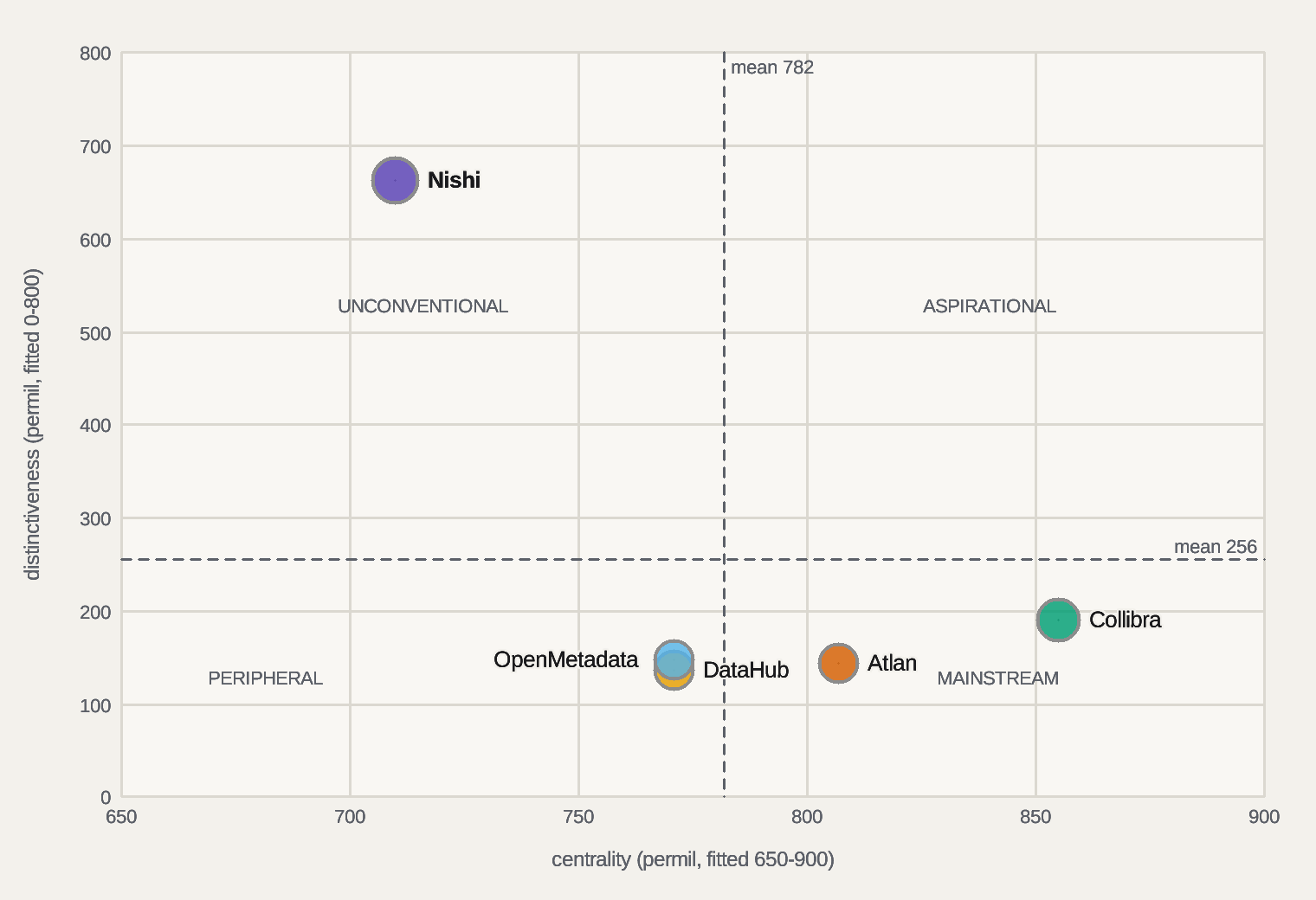
The four-quadrant map the field uses for brand strategy (Dawar and Bagga, HBR June 2015), re-derived from this matrix on every publish. Centrality is the share of the category's feature mass a player covers, each feature weighted by how many hold it; distinctiveness is the average lead over each rival on the rows the player holds; breadth is the depth-weighted share of the whole matrix (the bubble); depth is how deeply the rows held are held; momentum is the day-over-day move off the spine (green rising, red falling, grey until day two); the dashed path runs first day → previous day → today. Dividers are the category means. Axes are fitted to the field of play, so read the tick numerals, not the frame. Rival marks are documented presence, so a rival's position reads the record, never its quality. The picture grades its own readability below; the table beside it is the same data for a screen reader or a second method.
knowledge/compare/librarian.cdmap (cut|x|y, cube|x|y|z); absent = the HBR defaultsbubble area = breadth · ring = momentum (green rising, red falling, grey until day two) · dashed = category means · axes fitted to the field of play: centrality 650–900, distinctiveness 0–800 of 0–1000 permil (the full range put every player in one corner)
readability of the 2D cut, self-graded by the layout ruler: label overlaps 0 · labels over marks 0 · off-canvas 0 · unresolved labels 0 · mark overlaps 1 (a fact of the data: two players that close are that close) · data spread 619 permil of the plot · quadrant words unseated 0
text contrast, measured with wcag2-ratio (floors from contrast.conf), light theme: labels 16.24 (floor 4.50) · notes 16.24 (floor 4.50) · quadrant words 5.89 (floor 4.50) · tick numerals 5.89 (floor 4.50) · axis titles 5.59 (floor 4.50) · dark theme: labels 13.78 (floor 4.50) · quadrant words 5.55 (floor 4.50) · axis titles 5.97 (floor 4.50) · dark classes under their floor 0 (one figure serves both themes: a dark shortfall is a token to fix, never a class to hide) · classes refused under their floor 0 (a refused class is not drawn; the scale classes are measured, never hidden) · export: SVG PNG (receipt, rendered by the estate's own rasteriser from this page)

readability of the 3D cube, self-graded by the layout ruler: label overlaps 0 · labels over marks 0 · off-canvas 0 · unresolved labels 0 · mark overlaps 1 (a fact of the data: two players that close are that close) · data spread 429 permil of the plot
10 panels over 5 registered axes, every pair once (the lower axis on x, the higher on y) · each panel fitted to its own field of play, first and last tick numerals shown · no labels in a small cut, the legend names the colours; the grade below reports the mark terms only (MM summed over the panels, spread averaged)
readability of the small multiples, self-graded by the layout ruler: label overlaps 0 · labels over marks 0 · off-canvas 0 · unresolved labels 0 · mark overlaps 16 (a fact of the data: two players that close are that close) · data spread 498 permil of the plot
| Player | Quadrant | centrality | distinctiveness | breadth | depth | momentum | Rows held | Days on spine | First seen |
|---|---|---|---|---|---|---|---|---|---|
| Nishi | Unconventional | 710 | 663 | 677 | 884 | 0 since 2026-09-23 | 23 | 10 | 2026-09-15 |
| DataHub | Peripheral | 771 | 136 | 344 | 738 | 0 since 2026-09-23 | 14 | 10 | 2026-09-15 |
| OpenMetadata | Peripheral | 771 | 148 | 355 | 761 | 0 since 2026-09-23 | 14 | 10 | 2026-09-15 |
| Collibra | Mainstream | 855 | 191 | 400 | 705 | 0 since 2026-09-23 | 17 | 10 | 2026-09-15 |
| Atlan | Mainstream | 807 | 144 | 366 | 733 | 0 since 2026-09-23 | 15 | 10 | 2026-09-15 |
| Day | Matrix rows reviewed | Players recorded |
|---|---|---|
| 2026-09-15 | 30 | 5 |
| 2026-09-16 | 30 | 5 |
| 2026-09-17 | 30 | 5 |
| 2026-09-18 | 30 | 5 |
| 2026-09-19 | 30 | 5 |
| 2026-09-20 | 30 | 5 |
| 2026-09-21 | 30 | 5 |
| 2026-09-22 | 30 | 5 |
| 2026-09-23 | 30 | 5 |
| 2026-10-08 | 30 | 5 |
players 5|matrix rows 30|feature mass 83|centrality mean 782|distinctiveness mean 256|axes 5|spine days 10 (shown 10)|rows written today 0|readability defects 2D 0 cube 0|spine knowledge/status/cdmap/librarian.spine
Capability matrix — measured against source
◉ authored stronger claim; source present● present◐ partial○ absent? unassessed; excluded from relative comparison · click any capability for its evidence
Peer cell coverage: authored assessed 120, unassessed 0. Authored assessments are not verified outcomes.
No capabilities match this filter or search.
| Capability | Nishi | DataHub | OpenMetadata | Collibra | Atlan |
|---|---|---|---|---|---|
Content-addressed dataset identity (CID)Source present; authored stronger claim:cid_of in runtime/nx_canon_cid.nx, verified at emit. The datum IS its sha256 (nxc1-...) [multiformats-cid]; catalogs use mutable URNs pointing at external stores Adoption: LIB-WIRED importers=116 nonval=86 — fully adopted (top of its ladder).Pros Source symbol found; stronger capability claim is authored; ahead of DataHub, OpenMetadata, Collibra, Atlan; fully adopted on the estate ladderCons none on the measured axes (rival marks are documented presence, not depth) | ◉ | ○ | ○ | ○ | ○ |
Tamper-evident append-only storeSource present; authored stronger claim:ss_commit in runtime/nx_seg_store.nx, verified at emit. History is sacred, additive segs; catalogs are metadata over mutable warehouses Adoption: LIB-WIRED importers=498 nonval=372 — fully adopted (top of its ladder).Pros Source symbol found; stronger capability claim is authored; ahead of DataHub, OpenMetadata, Collibra, Atlan; fully adopted on the estate ladderCons none on the measured axes (rival marks are documented presence, not depth) | ◉ | ○ | ○ | ○ | ○ |
Dataset lineage graph (producer/consumer)Measured:ln_walk exists in runtime/_hdl_build/nx_store_lineage.nx, verified at emit. Live getdents walk of organ producer/consumer edges; the incumbents lead depth (parsed SQL, runtime capture) [openlineage-model] Adoption: BUILT-UNPROMOTED — PARTIAL: compiled, never promoted to the serving root: /api/promote it.Pros Implementing source symbol found; runtime acceptance separateCons behind DataHub (leads), OpenMetadata (leads), Collibra (leads), Atlan (leads); not adopted yet: compiled, never promoted to the serving root: /api/promote it | ● | ◉ | ◉ | ◉ | ◉ |
Trace-to-god silicon-up genesis lineageSource present; authored stronger claim:gl_validate in runtime/_hdl_build/nx_genesis_lineage.nx, verified at emit. Every artifact traces parent-by-parent to ORIGIN (hardware); no data catalog traces below the warehouse Adoption: BUILT-UNPROMOTED — PARTIAL: compiled, never promoted to the serving root: /api/promote it.Pros Source symbol found; stronger capability claim is authored; ahead of DataHub, OpenMetadata, Collibra, AtlanCons not adopted yet: compiled, never promoted to the serving root: /api/promote it | ◉ | ○ | ○ | ○ | ○ |
Cryptographically-signed provenance (C2PA-class)Source present; authored stronger claim:prov_make in runtime/nx_asset_provenance.nx, verified at emit. NXPC1 ed25519 credential binding CID+source+date; catalogs store mutable metadata, not signed credentials [c2pa-spec] Adoption: LIB-WIRED importers=5 nonval=2 — fully adopted (top of its ladder).Pros Source symbol found; stronger capability claim is authored; ahead of DataHub, OpenMetadata, Collibra, Atlan; fully adopted on the estate ladderCons none on the measured axes (rival marks are documented presence, not depth) | ◉ | ○ | ○ | ◐ | ○ |
Deny-by-default provenance verificationSource present; authored stronger claim:prov_verify in runtime/nx_asset_provenance.nx, verified at emit. Verify returns 1 ONLY if framing intact AND sig verifies AND entity==CID; tamper/rebind/wrong-key all reject (gate 9/9) Adoption: LIB-WIRED importers=5 nonval=2 — fully adopted (top of its ladder).Pros Source symbol found; stronger capability claim is authored; ahead of DataHub, OpenMetadata, Collibra, Atlan; fully adopted on the estate ladderCons none on the measured axes (rival marks are documented presence, not depth) | ◉ | ○ | ○ | ○ | ○ |
Content dedup and cross-topic flagsMeasured:rg_fp exists in runtime/_hdl_build/nx_research_grow.nx, verified at emit. Full-doc fingerprint dedup + two-topics-same-source flags rival marks uncited — the Yes, Best or Part codes on this row are an observation read with no reference mark behind them Adoption: BUILT-UNPROMOTED — PARTIAL: compiled, never promoted to the serving root: /api/promote it.Pros Implementing source symbol found; runtime acceptance separateCons not adopted yet: compiled, never promoted to the serving root: /api/promote it | ● | ● | ● | ● | ● |
Freshness / staleness reviewMeasured:rf_puts exists in runtime/_hdl_build/nx_research_freshness.nx, verified at emit. Moving/static/constant state machine; Collibra/Atlan have richer freshness SLAs [atlan-docs] Adoption: REGISTERED-DARK — PARTIAL: callable, authorised, completed MCP invocation not established by supplied journal window; lifetime history unknown (direct execution may be recorded elsewhere; this scan does not establish lifetime use); no execution surface runs it either (clock, cron, daemon, roster, actlog and surfaced forks checked).Pros Implementing source symbol found; runtime acceptance separate; ahead of DataHub, OpenMetadataCons not adopted yet: callable, authorised, completed MCP invocation not established by supplied journal window; lifetime history unknown (direct execution may be recorded elsewhere; this scan does not establish lifetime use); no execution surface runs it either (clock, cron, daemon, roster, actlog and surfaced forks checked) | ● | ◐ | ◐ | ● | ● |
No-new-TSV migration governance (live guard)Source present; authored stronger claim:sg_w in runtime/_hdl_build/nx_sov_guard.nx, verified at emit. Live RED on any unlisted new .tsv (10 violations now); catalogs assume clean data already lands in the warehouse rival marks uncited — the Yes, Best or Part codes on this row are an observation read with no reference mark behind them Adoption: BUILT-UNPROMOTED — PARTIAL: compiled, never promoted to the serving root: /api/promote it.Pros Source symbol found; stronger capability claim is authored; ahead of DataHub, OpenMetadata, Collibra, AtlanCons not adopted yet: compiled, never promoted to the serving root: /api/promote it | ◉ | ○ | ○ | ◐ | ◐ |
Schema drift detectionMeasured:nx_drift_kind_name exists in runtime/nx_schema_drift_detector.nx, verified at emit. Detects drift kinds; the incumbents enforce contracts and alert downstream owners [collibra-docs] Adoption: LIB-UNIMPORTED — PARTIAL: nothing imports it: wire it into a consumer or retire it.Pros Implementing source symbol found; runtime acceptance separateCons behind Collibra (leads), Atlan (leads); not adopted yet: nothing imports it: wire it into a consumer or retire it | ● | ● | ● | ◉ | ◉ |
Store compaction and retentionMeasured:ss_compact exists in runtime/nx_seg_store.nx, verified at emit. ss_compact reclaims superseded segs; enterprise catalogs have policy-driven lifecycle rival marks uncited — the Yes, Best or Part codes on this row are an observation read with no reference mark behind them Adoption: LIB-WIRED importers=498 nonval=372 — fully adopted (top of its ladder).Pros Implementing source symbol found; runtime acceptance separate; ahead of Collibra; fully adopted on the estate ladderCons none on the measured axes (rival marks are documented presence, not depth) | ● | ● | ● | ◐ | ● |
Ed25519 signatures on recordsMeasured:ed25519_parse_sig exists in runtime/nx_ed25519.nx, verified at emit. Sovereign signature primitive [rfc8032]; Collibra signs via enterprise PKI integrations [collibra-docs] Adoption: SOURCE-ONLY — PARTIAL: source exists, never compiled: /api/build it.Pros Implementing source symbol found; runtime acceptance separate; ahead of DataHub, OpenMetadata, AtlanCons not adopted yet: source exists, never compiled: /api/build it | ● | ○ | ○ | ● | ○ |
Library ingest and inverted indexMeasured:nx_inv_build_from_jsonl exists in runtime/nx_search_inverted.nx, verified at emit. BM25 over the library; incumbents have elastic-scale discovery search rival marks uncited — the Yes, Best or Part codes on this row are an observation read with no reference mark behind them Adoption: LIB-WIRED importers=38 nonval=32 — fully adopted (top of its ladder).Pros Implementing source symbol found; runtime acceptance separate; fully adopted on the estate ladderCons behind DataHub (leads), OpenMetadata (leads), Collibra (leads), Atlan (leads) | ● | ◉ | ◉ | ◉ | ◉ |
Format-sprawl audit instrumentSource present; authored stronger claim:la_scan_dir in runtime/nx_librarian_audit.nx, verified at emit. Mechanically classifies every file native-vs-legacy; catalogs profile schemas, not on-disk format sovereignty Adoption: LIB-GATE-ONLY importers=1 — PARTIAL: imported only by validation organs (gates, tests, benches): wire it into a shipping program.Pros Source symbol found; stronger capability claim is authored; ahead of DataHub, OpenMetadata, Collibra, AtlanCons not adopted yet: imported only by validation organs (gates, tests, benches): wire it into a shipping program | ◉ | ○ | ○ | ○ | ○ |
Applied subject classification of the whole libraryOpen — watchingruntime/nx_librarian_classify.nx : lbc_classify_doc, re-measured on every compare beat. Ship that symbol and this mark flips itself; the comparewatch- plane row flips with it. The Dewey-decimal for our data [dewey-oclc]: shelf/facet organs EXIST but the corpus is NOT classified/browsable; incumbents auto-classify + glossaryPros none measured yetCons behind DataHub (leads), OpenMetadata (leads), Collibra (leads), Atlan (leads); open contract; expected source declaration not established | ○ | ◉ | ◉ | ◉ | ◉ |
Running freshness management (scheduled review+re-mine)Open — watchingruntime/nx_librarian_freshness_run.nx : lfr_run_beat, re-measured on every compare beat. Ship that symbol and this mark flips itself; the comparewatch- plane row flips with it. nx_research_freshness+shelf_life exist but are NOT scheduled/running; incumbents have freshness SLAs + quality monitors rival marks uncited — the Yes, Best or Part codes on this row are an observation read with no reference mark behind themPros none measured yetCons behind DataHub (leads), OpenMetadata (leads), Collibra (leads), Atlan (leads); open contract; expected source declaration not established | ○ | ◉ | ◉ | ◉ | ◉ |
Librarian auto-reviews ingested material + RACI handoffMeasured:lr_run exists in runtime/nx_librarian_review.nx, verified at emit. ORCH-R1 gated: librarian reviewed 1326 docs, flagged 239 not-up-to-scruff, wrote R=librarian/C=researcher handoff to seg-store; remaining = auto-TRIGGER from the researcher bank + MCP API rival marks uncited — the Yes, Best or Part codes on this row are an observation read with no reference mark behind them Adoption: LIB-GATE-ONLY importers=1 — PARTIAL: imported only by validation organs (gates, tests, benches): wire it into a shipping program.Pros Implementing source symbol found; runtime acceptance separate; ahead of DataHub, CollibraCons not adopted yet: imported only by validation organs (gates, tests, benches): wire it into a shipping program | ● | ◐ | ● | ◐ | ● |
Cross-team RACI orchestration engine (call/resolve/dispatch)Source present; authored stronger claim:orch_engage in runtime/nx_orchestrate.nx, verified at emit. ORCH-R3 gated 13/13 + PROVEN LIVE: nx_orchestrate organize run -> resolved RACI from nishi_raci.tsv (A=librarian) -> dispatched -> librarian workstream RAN (1329 reviewed); denies unknown activities. No data catalog dispatches teams by RACI rival marks uncited — the Yes, Best or Part codes on this row are an observation read with no reference mark behind them Adoption: RUN-BY:cron — fully adopted (top of its ladder).Pros Source symbol found; stronger capability claim is authored; ahead of DataHub, OpenMetadata, Collibra, Atlan; fully adopted on the estate ladderCons none on the measured axes (rival marks are documented presence, not depth) | ◉ | ◐ | ● | ◐ | ◐ |
MCP orchestration APIs (call API -> team -> workstream)Open — watchingruntime/nx_orchestrate_api.nx : oapi_engage, re-measured on every compare beat. Ship that symbol and this mark flips itself; the comparewatch- plane row flips with it. The keystone for autonomy: no standard MCP API that engages a team to run a workstream; incumbents ship agentic active-metadata [atlan-docs]Pros none measured yetCons behind DataHub, OpenMetadata, Collibra, Atlan; open contract; expected source declaration not established | ○ | ● | ● | ◐ | ◐ |
Column/field-level lineageOpen — watchingruntime/nx_field_lineage.nx : fld_column_edge, re-measured on every compare beat. Ship that symbol and this mark flips itself; the comparewatch- plane row flips with it. Our top data-trust gap; DataHub/Collibra trace column-to-column [datahub-lineage]Pros none measured yetCons behind DataHub (leads), OpenMetadata (leads), Collibra (leads), Atlan (leads); open contract; expected source declaration not established | ○ | ◉ | ◉ | ◉ | ◉ |
Data-contract enforcement at ingestOpen — watchingruntime/nx_ingest_contract.nx : ic_enforce_contract, re-measured on every compare beat. Ship that symbol and this mark flips itself; the comparewatch- plane row flips with it. Detect exists (drift) but not enforce-at-the-door; contracts are the 2025/26 frontier rival marks uncited — the Yes, Best or Part codes on this row are an observation read with no reference mark behind themPros none measured yetCons behind DataHub, OpenMetadata, Collibra (leads), Atlan; open contract; expected source declaration not established | ○ | ● | ◐ | ◉ | ◐ |
Catalog discovery UI surfaceOpen — watchingruntime/nx_librarian_serve.nx : lbs_catalog_page, re-measured on every compare beat. Ship that symbol and this mark flips itself; the comparewatch- plane row flips with it. No live /librarian browse page yet; the incumbents ARE catalog UIs [openmetadata-docs]Pros none measured yetCons behind DataHub (leads), OpenMetadata (leads), Collibra (leads), Atlan (leads); open contract; expected source declaration not established | ○ | ◉ | ◉ | ◉ | ◉ |
Universal library foundationing (CID+sign+god-trace)Source present; authored stronger claim:lf_run in runtime/_hdl_build/nx_library_foundation.nx, verified at emit. Every library doc content-addressed + ed25519-signed + traced to god; 1314/1314 foundationed GREEN (resumable OOM-safe); no data catalog signs AND silicon-traces every ingested doc Adoption: REGISTERED-DARK — PARTIAL: callable, authorised, completed MCP invocation not established by supplied journal window; lifetime history unknown (direct execution may be recorded elsewhere; this scan does not establish lifetime use); no execution surface runs it either (clock, cron, daemon, roster, actlog and surfaced forks checked).Pros Source symbol found; stronger capability claim is authored; ahead of DataHub, OpenMetadata, Collibra, AtlanCons not adopted yet: callable, authorised, completed MCP invocation not established by supplied journal window; lifetime history unknown (direct execution may be recorded elsewhere; this scan does not establish lifetime use); no execution surface runs it either (clock, cron, daemon, roster, actlog and surfaced forks checked) | ◉ | ○ | ○ | ○ | ○ |
Licence-EVIDENCE class gating rights at ingest (declared vs read)Source present; authored stronger claim:aq_decide in runtime/nx_acquire_lib.nx, verified at emit. An UNREAD licence ABSTAINS and can never grant. Measured on the NAVER LABS Europe listing 2026-08-25: 2 of 26 releases carry any licence string (77 permil), both prose not a field, so a catalog that stores a licence STRING is storing an upstream assertion as if it were a fact. Gate 25/25 (now 40/40 with fixity), three bite-proven neg-controls, one compiling mutant killed. DRIVEN LIVE by runtime/nx_acquire.nx over the real NAVER LABS registry: rows=26 clear=1 review=25 refuse=0 malformed=0 sum=26 partition=RECONCILES, with naverlabs_anny carried the whole way -- listing page mirrored, licence URL derived, licence FETCHED and READ (Apache-2.0 confirmed by reading, not by the listing's assertion), pinned and SWHID'd -- and every other row honestly at REVIEW Adoption: LIB-WIRED importers=2 nonval=1 — fully adopted (top of its ladder).Pros Source symbol found; stronger capability claim is authored; ahead of DataHub, OpenMetadata, Collibra, Atlan; fully adopted on the estate ladderCons none on the measured axes (rival marks are documented presence, not depth) | ◉ | ○ | ○ | ○ | ○ |
Four independent verdicts per external work (mirror, redistribute, learn, attribute)Source present; authored stronger claim:aq_res in runtime/nx_acquire_lib.nx, verified at emit. They fail apart in practice: collapsing them is how a work gets mirrored for study then accidentally republished. Attribution is modelled as an OBLIGATION that takes the MAX and never abstains, so I-could-not-look can never lighten a duty; catalogs model licence as a tag, not as a duty with a direction Adoption: LIB-WIRED importers=2 nonval=1 — fully adopted (top of its ladder).Pros Source symbol found; stronger capability claim is authored; ahead of DataHub, OpenMetadata, Collibra, Atlan; fully adopted on the estate ladderCons none on the measured axes (rival marks are documented presence, not depth) | ◉ | ○ | ○ | ○ | ○ |
Rights refused unless the licence row is CONFIRMEDSource present; authored stronger claim:lg_eval in runtime/nx_licgate_lib.nx, verified at emit. verified was parsed into the table, printed by list, and never consulted by the verdict until 2026-08-25 -- sdxl-base-1.0 returned SHIP_OK exit=0 from a row the table itself marks UNCONFIRMED. Unverified rows now cap at CONDITIONAL, a strict tightening measured to move exactly one model and only toward REVIEW Adoption: LIB-WIRED importers=4 nonval=4 — fully adopted (top of its ladder).Pros Source symbol found; stronger capability claim is authored; ahead of DataHub, OpenMetadata, Collibra, Atlan; fully adopted on the estate ladderCons none on the measured axes (rival marks are documented presence, not depth) | ◉ | ○ | ○ | ○ | ○ |
Licence text acquired into our own mirror for the unread rowsDARK —runtime/nx_acquire_license.nx EXISTS but does not declare aq_license_fetch: something shipped at this path under another name, and this mark would read open forever. Repoint the contract to the real entry point (the plan rung AND this row) or rename the function; the flip follows on the next beat, and the comparewatch- plane row reads DARK until then. 24 of 26 acquire_sources.conf rows sit at evidence=NONE and their bytes are therefore unmirrorable by our own door; the remedy is to fetch each upstream LICENSE into the mirror and pin its digest, which is the only thing that can lift a row to READPros none measured yetCons open contract; expected source declaration not established | ○ | ○ | ○ | ○ | ○ |
Byte-length fixity beside every digest (the truncation a pin cannot see)Source present; authored stronger claim:aq_fixity in runtime/nx_acquire_lib.nx, verified at emit. A digest answers are-these-the-bytes-I-hashed. Only a LENGTH answers are-these-ALL-the-bytes. A body truncated in transit whose digest was then computed on what ARRIVED verifies CLEAN, and researched Aug-2026 neither in-toto DigestSet nor SPDX verifiedUsing carries a byte length anywhere, so both are structurally blind to it. Our provenance row already carried bytes beside sha256 and nothing read it. Gate 40/40 with the truncation case BITE-PROVEN, and three states so an unrecorded length can never read as MATCH Adoption: LIB-WIRED importers=2 nonval=1 — fully adopted (top of its ladder).Pros Source symbol found; stronger capability claim is authored; ahead of DataHub, OpenMetadata, Collibra, Atlan; fully adopted on the estate ladderCons none on the measured axes (rival marks are documented presence, not depth) | ◉ | ○ | ○ | ○ | ○ |
Digest shape DERIVED from its algorithm rather than assertedSource present; authored stronger claim:aq_digest_shape_ok in runtime/nx_acquire_lib.nx, verified at emit. The expected hex length comes from the algorithm that produced the digest, never a hand-picked constant. Measured in the field: the Croissant specification's own canonical FileObject examples put six values in a property named sha256, of which four are 32 hex characters (an MD5 length) and one is 40, so a validator that recomputes SHA-256 fails the specification's own examples. A field named for one hash routinely carries another, so the NAME is a claim and the LENGTH is the check Adoption: LIB-WIRED importers=2 nonval=1 — fully adopted (top of its ladder).Pros Source symbol found; stronger capability claim is authored; ahead of DataHub, OpenMetadata, Collibra, Atlan; fully adopted on the estate ladderCons none on the measured axes (rival marks are documented presence, not depth) | ◉ | ○ | ○ | ○ | ○ |
Forge-independent ISO-standard identity (SWHID)Source present; authored stronger claim:swhid_cnt in runtime/nx_swhid_lib.nx, verified at emit. ISO/IEC 18670:2025, spec V1.2. Computed from the file BYTES alone -- no filename, no path, no mtime -- so ANYONE can recompute it and confirm our copy is the same object Software Heritage holds, with no registry and no hosting forge in the loop. That is the anti-rot property: the pointer can die and the identity survives. SPDX 2.3 Annex F accepts swh as a Persistent-Id and DataCite 4.7 added it as a relatedIdentifierType, so one identifier reads in two ecosystems. Gate 18/18 against NINE differential vectors produced by git 2.49.0, an INDEPENDENT implementation rather than values we asserted; blob framing bite-proven; one compiling mutant killed. Carried BESIDE our sha256 and byte length and never instead of them: SHA-1 has chosen-prefix collisions since SHAttered 2017, so a SWHID is an interoperable NAME and never tamper evidence Adoption: LIB-WIRED importers=3 nonval=2 — fully adopted (top of its ladder).Pros Source symbol found; stronger capability claim is authored; ahead of DataHub, OpenMetadata, Collibra, Atlan; fully adopted on the estate ladderCons none on the measured axes (rival marks are documented presence, not depth) | ◉ | ○ | ○ | ○ | ○ |
| Class | Count | Note |
|---|---|---|
| rows with rival marks | 17 | rows carrying a Yes, Best or Part in a rival column |
| cited | 9 | a reference mark resolves to a pinned mirror |
| uncited | 8 | an observation read, badged until a reference lands |
| rows, summed | 17 | RECONCILED: the parts sum to the total 17 |
Delivery and evidence
Inspect risks, technical debt, rendered observations, experiments and references. Read scope and limitations alongside every result.
Risk register
| Risk | Likelihood x impact | Mitigation |
|---|---|---|
| A classifier that shelves by title fills the catalogue with confident wrong shelves | possible x medium | LI2 names unclassifiable docs and publishes precision on a labelled sample before the catalogue goes live. |
| Contract enforcement on live planes refuses a writer mid-flight | possible x high | LI4 derives contracts from the current planes first (zero refusals at birth) and tightens by declaration. |
Person · product · place — not yet measured for this domain
knowledge/compare/librarian.ppp (rows surface|nishi or c1..c4|label|url|connect naming OUR live surface and each rival's front door), run nx_ppp_probe domain librarian, and this section fills itself on the next beat: the same ruler on both sides — privacy and CX (third-party hosts, tracker classes, cookies, security headers), design and longevity (design hygiene, computed WCAG contrast, render-blocking resources, unsized media, script weight, theme and motion queries), findability (landmarks, skip link, on-site search, breadcrumb, headings, internal links).The field — discovered, not chosen
Rows written by nx_field_discover from librarian.seeds: the industry's own lists (Wikipedia wikitext, GitHub topics, awesome lists) read mechanically, every candidate counted across seeds. The matrix columns above are a SEAT'S pick; this band is the population they were picked from, and the stats line measures one against the other. A rival here is a lead, never a verdict — it earns a column when its capabilities are read and pinned.
| Class | Count | Note |
|---|---|---|
| seeds | 3 | |
| scanned | 3 | |
| fetched | 3 | |
| reused | 0 | |
| failed | 0 | |
| named | 3 | |
| candidates | 3 | |
| mentions | 3 | |
| capped | 0 |
| Rank | Rival | Seeds | Mentions | First seed | Kind | Link |
|---|---|---|---|---|---|---|
| 1 | DataHub | 1 | 1 | col0-datahub | named | https://docs.datahub.com/docs/features/feature-guides/lineage |
| 2 | Collibra | 1 | 1 | col2-collibra | named | https://productresources.collibra.com/docs/collibra/latest/Content/Home.htm |
| 3 | Atlan | 1 | 1 | col3-atlan | named | https://docs.atlan.com/ |
field candidates 3|shown 3 of 3|matrix columns in the field 3 of 4|discovered rivals with no column 0|malformed rows 0 (counted, never rendered)|read-capped 0
Exclusive and shared capabilities
This board grades 30 capabilities: 28 exclusive to it and 2 shared with other boards. Shared rows on this page: 2 = home here 1 + home elsewhere 0 + ambiguous 0 + undecided 1 + refused 0 (partition 2); undecided = unmapped 0 + unproven 1 + unevidenced 0; homonyms 0; since the previous census: new 0, resolved 0. Census FRESH age_s=6439.
| Capability | Organ | Boards grading it | Home | Rule | Evidence | Standing on this board |
|---|---|---|---|---|---|---|
| ss_commit | nx_seg_store.nx | authz, surveys, librarian, communitypulse, researchreach | — | none | unproven | undecided |
| cid_of | nx_canon_cid.nx | librarian*, researchreach | librarian | rung | plan | home here |
Gaps from the record — what the estate does that no board carries
The record census (nx_goalmap record) reads the invoked-tool population and every plan queue row and files each organ or directive that NO matrix, plan or gates row names. A row here is a callout the boards missed: adjudicate it onto a board or declare it infrastructure. Census state STALE (age 1395544 s), sources read 4 of 7 declared — a BLIND census is a FLOOR: unread sources can only add rows.
| kind | name | board | source | evidence |
|---|
rows shown 0|this board's directives 0|estate-wide un-boarded organs 452 (listed in full on /compare/ecosystem)|census rows 639|malformed 0 (counted, never rendered)
References
- [datahub-lineage] DataHub. About DataHub Lineage -- table-level and column-level lineage (column-level lineage tracks changes and movements for each specific data column, contrasted with table-level lineage). Vendor documentation. publisher · read in our library
knowledge/fetched/cmp_librarian_datahub_lineage.html· pinh6eaec6259b5bfcf0fca5dcfd04ffe4a988d934bd39c92337c65fba3ba86dddfa· accessed 2026-08-18 · vendor-docGrounds: The DataHub column: Best on "Dataset lineage graph (producer/consumer)" and "Column/field-level lineage" (our top data-trust gap, _ABSENT_ nx_field_lineage) -- the documented column-to-column lineage is exactly what the row note credits DataHub with tracing. - [openmetadata-docs] OpenMetadata. OpenMetadata Documentation -- unified platform for data discovery, lineage, and governance (open source). Vendor documentation. publisher · read in our library
knowledge/fetched/cmp_librarian_openmetadata.html· pinhd4e132ee502f657d8fd9c8ccc29c2e7ac9047d404beb9a5328e693826f4996f1· accessed 2026-08-18 · vendor-docGrounds: The OpenMetadata column codes (Best on lineage, discovery search, classification and catalog UI): the documentation front page names discovery, lineage and governance as the product's three pillars, which is the capability set those Best codes describe. - [collibra-docs] Collibra. Collibra Platform documentation home (Collibra Platform and Collibra Platform Self-Hosted). Vendor documentation. publisher · read in our library
knowledge/fetched/cmp_librarian_collibra.html· pinhee1af656d118ee5e145bfc1a2a17b3747b4738ee6a3914009cb27f951a55b882· accessed 2026-08-18 · vendor-docGrounds: The Collibra column: Best on "Schema drift detection" (contracts and downstream alerts), "Column/field-level lineage" and "Data-contract enforcement at ingest", Part on "Cryptographically-signed provenance" and "Ed25519 signatures on records" (enterprise PKI integrations) -- the enterprise governance platform the row notes name as the comparator. - [atlan-docs] Atlan. Atlan Documentation (active-metadata data catalog). Vendor documentation. publisher · read in our library
knowledge/fetched/cmp_librarian_atlan.html· pinh613240a821de378135163faad92ed2c709359c8edcf0c0b0e9dea98a7042aff9· accessed 2026-08-18 · vendor-docGrounds: The Atlan column: Best on "Freshness / staleness review" and "Schema drift detection", Part on "MCP orchestration APIs" (the note: incumbents ship agentic active-metadata) -- the documentation root is the vendor page those codes are graded against. - [c2pa-spec] Coalition for Content Provenance and Authenticity. C2PA Technical Specification 2.2 (Content Credentials): manifests, claims and signed assertions bound to an asset. publisher · read in our library
knowledge/fetched/cmp_librarian_c2pa.html· pinha1f401d240c28cae005e228ae80825b357856ea7d20c7e1118673bfdfc603e3e· accessed 2026-08-18 · published-standardGrounds: The "Cryptographically-signed provenance (C2PA-class)" exceed row: NXPC1 (nx_asset_provenance prov_make) is a signed credential binding CID plus source plus date, the same class of artefact this specification defines; the row grades our sovereign credential against the published one and codes the catalogs No because they store mutable metadata, not signed credentials. - [rfc8032] Josefsson, S., Liusvaara, I. RFC 8032: Edwards-Curve Digital Signature Algorithm (EdDSA). IETF, January 2017. publisher · read in our library
knowledge/fetched/cmp_librarian_rfc8032.html· pinh253cd2a103b528e92ee4bd5c8cbf472c7e4c4e16fdcfc2acb10201a8d72414aa· accessed 2026-08-18 · published-standardGrounds: The "Ed25519 signatures on records", "Deny-by-default provenance verification" and "Universal library foundationing (CID+sign+god-trace)" rows: nx_ed25519 implements this RFC's Ed25519 signature scheme sovereignly, and every foundationed library doc is signed under it (the estate's ed25519 extvec gate verifies against this RFC's vectors). - [multiformats-cid] Protocol Labs / multiformats. CID -- self-describing content-addressed identifiers for distributed systems (specification repository). publisher · read in our library
knowledge/fetched/cmp_librarian_multiformats_cid.html· pinh4be3cb5091d90726cde985a17695e491e0f30cb23ee4db1145bb1c6bbb0f3496· accessed 2026-08-18 · published-standardGrounds: The "Content-addressed dataset identity (CID)" exceed row: the datum IS its hash (nxc1-... from nx_canon_cid cid_of) -- the published CID scheme is the reference class for content addressing, against which the catalogs' mutable URNs pointing at external stores are graded No. - [openlineage-model] OpenLineage. Object Model -- Job, Run and Dataset entities extended through facets (schema, dataSource, version, dataQualityMetrics at dataset and column level). Open lineage standard. publisher · read in our library
knowledge/fetched/cmp_librarian_openlineage.html· pinhb4479ce9dc49f895028315ba05ecc51887a11bb5756ee24c210193ffc49eb118· accessed 2026-08-18 · published-standardGrounds: The "Dataset lineage graph (producer/consumer)" and "Column/field-level lineage" rows: the open lineage object model is what the incumbents' runtime lineage capture speaks (the row note: parsed SQL, runtime capture); our ln_walk is a getdents walk of organ producer/consumer edges, honestly Yes not Best. - [dewey-oclc] OCLC. Dewey Services -- the Dewey Decimal Classification, the library-world subject classification scheme. Vendor page. publisher · read in our library
knowledge/fetched/cmp_librarian_dewey.html· pinh6f69c442a8724865ba988e4e40dc6aa77bc943279022707031379428a9b586c7· accessed 2026-08-18 · vendor-docGrounds: The "Applied subject classification of the whole library" row (the note: the Dewey-decimal for our data; shelf/facet organs EXIST but the corpus is NOT classified/browsable): Dewey is the named model for the _ABSENT_ nx_librarian_classify watch, and the incumbents' auto-classify plus glossary is the Best code it is graded against.
generated by nx_swcompare_matrix (sovereign NishiLang organ) from knowledge/compare/librarian.matrix · source checks show implementation presence; runtime and user-outcome evidence are reported separately · JavaScript supports page controls