Nishi Family › Compare › Sovereign RISC-V Emulator, Bare-Metal Boot and Minimal OS
Nishi Compare · measured, not asserted
Sovereign RISC-V Emulator, Bare-Metal Boot and Minimal OS
Nishi vs the field — every Nishi cell is measured against real organ source at emit time; each gap names the watch contract that will close it.
Nishi rv64 sim + JIT + NXE verify-then-execute boot + the composed NishiOS kernel, against the system-emulation and firmware field
Overview
The purpose, declared position and evidence coverage of this domain. Source presence and completed acceptance are different measures.
Where we are. Re-measured 2026-08-21 against buildroot, not inherited from the /compare/nishios SOTA register. THE PRIVILEGED CORE IS DONE and the SOTA page understates it on two headline cells. nx_nishios_kernel_emit composes ONE boot image that falls through RESET (M-mode UART, mtvec+stvec+medeleg) to TRAP (ecall into a real dispatcher that decodes mcause and a7, then mret) to SCHED (two tasks, SYS_YIELD, round-robin mepc swap) to TIMER (CLINT mtimecmp armed, MTIP preempts a spin) to PAGING (mret to S-mode, Sv39 root PTEs, satp on, VA load) to USER (sret to U-mode on a U-bit gigapage, ecall delegated by medeleg, sret back, exit syscall) -- each phase leaving its own serial marker and its own distinct failure marker so the gate cannot pass vacuously. Sv39 itself is nx_sv39_walk in rv64im_min_mmu.nx with gigapage, megapage and 4K leaves, and six GREEN gates around it (_mmu_gate _paging_gate _perm_gate _ubit_gate _4kpage_gate _pagefault_gate). The RV64A atomics are likewise SHIPPED AND GATED (rv64im_min_sim.nx executes the AMO family; nx_rv64_amo_gate and nx_amo_payload exercise amoadd, amoswap, amoxor and amoand in .w and .d with sign-extension teeth) -- so the atomics prerequisite the SOTA page names for SMP is already MET. The emulator underneath reaches roughly 20 MIPS interpreted and roughly 8 GIPS on a JIT hot loop, with 0 divergences over 500 differential-fuzz vectors against QEMU and 25 of 25 encodings byte-identical against GNU-as. WHAT IS ACTUALLY OPEN is the developer and scale surface, and two of those absences are PROVEN rather than assumed: nharts returns matches=0 over 22,981 files with coverage_complete=1 and corpus_complete=1 (gdbstub was proven absent the same way on 2026-08-21 and SHIPPED 2026-08-23 as runtime/nx_gdbstub.nx -- NO1: stock gdb-multiarch 15.1 attached, broke, stepped, read registers and memory against a stub-free reference and detached with the guest completing its boot; nx_gdbstub_gate 13/13 on the laptop, SKIP-for-oracle on the NAS where no gdb is installed).
Where we need to go. Make the sovereign emulator something a person outside this estate can USE and CHECK, then make it scale, then take it off the emulator. Usable and checkable comes first because those are the only two axes an outsider can judge without trusting us: a stock debugger that attaches, and the field's own published architectural conformance suite. Scale (SMP, then the hypervisor extension, and the JIT maturity that makes device-heavy guests reach the measured hot-loop throughput) comes second. Real silicon comes last and stays behind the never-brick guarantee: every boot claim today is a claim about our own emulator or about third-party firmware used as an oracle, and putting unproven code on metal is the one move this estate does not make. Throughout, the sovereign EXCEEDs are shipping criteria no rung may trade away -- bit-exact determinism, verify-then-execute never-brick loading, own toolchain bits-up, zero third-party dependency.
Research bar. QEMU (the dynamic-translation and device bar) is measured on TCG block chaining, MMIO in translated code, gdbstub, snapshots, SMP, RISC-V H extension. Theirs: the emulator every rung here is measured against, and the oracle in our own 0-of-500 differential fuzz. Ours: NO1 NO2 NO4 NO5 NO6 all name a capability QEMU already has; NO1 and NO2 are the two an outsider notices first.
Research bar. Spike (the RISC-V golden reference) is measured on the reference the field checks a RISC-V behavioural emulator against, and the target the published architectural test suite is run on. Theirs: conformance is decided against Spike and the ratified ISA volumes, not against a vendor. Ours: NO3 converts our self-selected fuzz vectors into a third-party population measured on the field's own ruler.
Research bar. coreboot (the real-firmware bar) is measured on open-source firmware that owns real silicon from POST through payload handoff. Theirs: the only column in this domain that is not an emulator; it can also brick a board, which is the whole reason NO7 is last and guarded. Ours: NO7 is the guarded never-brick operator step, gated behind NO3 so nothing unproven reaches metal.
Research bar. Zircon (the capability object-kernel bar) is measured on kernel objects reached only through handles carrying rights, no ambient authority and no POSIX inside the kernel [@zircon]; components are the unit of software and their capabilities are routed by the framework [@fuchsiacomp]. Theirs: the kernel shape a spore needs: nothing runs with authority it was not handed. Ours: NO8 NO9.
Research bar. Genode (the component-framework bar on capability kernels) is measured on a recursive component tree where every component is sandboxed by its parent and drivers, file systems and the GUI server are unprivileged components [@genode]. Theirs: foreign software as a guest is a routing decision, never a trust decision. Ours: NO9 NO12.
Research bar. Redox (the everything-is-a-URL microkernel bar) is measured on schemes as the namespace primitive: a resource is a URL served by a userspace daemon [@redox]. Theirs: the namespace model under which swarm transport, codecs and model seats appear as paths. Ours: NO10 NO11.
Research bar. Theseus (the live-evolving OS, OSDI 2020) is measured on cells as the unit of code and state, bounds kept at runtime by the language, and live evolution of the running system without a reboot [@theseus]. Theirs: the seed-to-forest property: an OS that grows and replaces its organs in place. Ours: NO13.
Research bar. Unikraft (the specialised-unikernel bar) is measured on a library OS composed per application from only the components the workload needs [@unikraft]. Theirs: the spore: a minimal image that is exactly one workload and nothing else. Ours: NO8.
Research bar. WebAssembly component model (the portable sandboxed-guest bar) is measured on typed interfaces between sandboxed components with capabilities passed by import, no ambient authority [@wasmcomp]. Theirs: a guest ABI that carries no authority of its own and runs on any host. Ours: NO9.
Research bar. AIOS and MemGPT (the LLM-as-OS-tenant bar) is measured on AIOS schedules agents and their context as OS resources [@aios]; MemGPT pages context between memory tiers the way an OS pages memory [@memgpt]. Theirs: what an OS owes an LLM: scheduling, memory tiers and tool routing as kernel services. Ours: NO14.
Research bar. BitTorrent BEPs (the open transport standard) is measured on the BEP index: the protocol, the DHT, the extension protocol, uTP and magnet links, all published specifications [@bepindex]. Theirs: native swarm transport is standards work and license-clean by construction. Ours: NO10.
Research bar. AV1 and Opus (the royalty-free codec bar) is measured on the AV1 bitstream and decoding process [@av1spec] and the Opus codec definition in RFC 6716 [@opus6716]: both royalty-free, both specified in public with reference vectors. Theirs: native codecs as sovereign decoders of public formats, graded against the published process. Ours: NO11.
Research bar. Wayland (the compositor protocol bar) is measured on a display protocol where the compositor owns the scene and clients render into buffers it composes [@wayland]. Theirs: GUI as one service that can be absent: headless is the same OS without the compositor. Ours: NO12.
Research bar. seL4 (the verified capability-microkernel bar) is measured on a capability kernel whose isolation and functional correctness are machine-checked proofs, with untyped memory retyped into kernel objects by the holder of the capability [@sel4docs]. Theirs: the bar a spore kernel is graded against: isolation as a proof, never a promise. Ours: NO8 NO9.
Research bar. Plan 9 (the per-process namespace bar) is measured on every resource is a file served over one protocol and each process assembles its own namespace by mounting servers into it [@plan9]. Theirs: the model under which swarm transport, codecs and model seats mount as paths in a namespace a process owns. Ours: NO10 NO11.
Latest recorded release
2026-09-04 · NO15
September 2026 SOTA for the kernel, PCIe and firmware layers admitted as DATA: 4 refs pinned (nishios.refs 13270 to 14957 B, payload 5b62a6381ad237b3), a MEASUREMENT AND ITERATION TOOLING section of 4 rows carrying 4 watch contracts (nishios.matrix 13098 to 16115 B, 889d3df75eee8744), rungs NO15-NO18 under N5 ver 5.0 (nishios.plan 22190 to 23791 B, 36ceb4dcaddae77b); settled by the size ladder, single by row-unique count
Release entries describe recorded changes; they do not establish that every capability passed evaluation.
6 of 22 capabilities measured|1 of them measured exceeds|16 open|coverage 272/1000|adoption 5 full / 1 partial
Evidence profile — what the gaps on this board actually are
Measured by nx_swcompare_evidence, read back by nx_evprofile_lib. Every figure is a count with its denominator — there is deliberately no score, no grade and no percentage anywhere in this band, because a stored scalar is a field a seat can edit and a counted partition is not.
evidence|grounded 6/6|unsupported 0|gates green 6/6|proven able to fail 0/6|never bitten 6|green at 0/0 0|open gaps 16|of them unnamed 0|of them proof withheld 0|flips ready 1
proven able to fail counts the gates that have a RECORDED RED — nx_gate_bite mutated the gate subject, rebuilt it, watched the gate go red, and that record is inside the shared TTL. never bitten is its complement over the same denominator: those gates ran and were green, and nothing has ever shown them able to detect anything, so their green is a statement about this run and not about the gate. green at 0/0 is a separate and much weaker observation — the gate printed GREEN on a zero denominator, so its own tooth counter says it examined nothing. A gate can be green, non-zero, and still never bitten; that is the common case and it is now visible instead of implied.
partition: grounded + unsupported = 6 vs present 6 · named + unnamed + withheld = 16 vs open 16 · both reconcile
liar-kill conj=GPQN · all four conjuncts held
graded document: BUILDROOT tree, 16115 bytes · gates map: PRIMARY · stamped 1d 8h ago · source ../knowledge/status/evstamp_nishios.verdict
| Gap class | What it is, and the work it names |
|---|---|
| FLIP-READY | A watch contract symbol is now present in the organ it named: the cell can flip on a pure data edit with no new code. These are the cheapest closures on this board and they belong before any new work. |
nx_swcompare_evidence nishios itself and are not carried on the stamp, so this page names the classes and the producer names the rows. That split is stated rather than hidden: a count without a worklist is not actionable, and this band is honest about which half of that it is.Production map
Follow the dependencies, declared acceptance criteria and recorded priorities. Inspect source binding before treating a rank as executable work.
Ranking source binding: PLAN_MATRIX_BOUND_ONLY. Recorded priorities require current acceptance evidence and resource checks before execution.
Ranking matches the captured plan and matrix only. Latest execution outcome, research freshness, accepted delivery and investment return are unverified.
Recorded priority estimates
Order from nx_compare_rank (nx_dr_ocm: (deficit + cost-of-delay + option + enables) x sponsor x self-sufficiency x momentum / cost). FINISH rows are rungs whose symbol is present but whose organ is short of full adoption: listed before new work by this heuristic. Priority is not measured delivery cost or execution readiness. Stamp: # asof=1789563086 domain=nishios target_version=1.0 rungs=18 done=2 open=16 finish=1 ranker=nx_dr_ocm
| # | Stage | Rung | Priority | Derivation |
|---|---|---|---|---|
| F | FINISH | Architectural compliance suite (NO3) rvc_run_suite | REGISTERED-DARK | callable, authorised, completed MCP invocation not established by supplied journal window; lifetime history unknown (direct execution may be recorded elsewhere; this scan does not establish lifetime use); no execution surface runs it either (clock, cron, daemon, roster, actlog and surfaced forks checked) |
| #1 | 1.0 | Machine snapshot and restore (NO2) snap_save_state | 600 | v=3 m=2 c=10 |
| #2 | 1.0 | MMIO inside the JIT and cross-block trace chaining (NO4) jit_mmio_trace | 100 | v=2 m=1 c=20 |
| #3 | later | PK, KEK, db and dbx are inventoried with expiry dates and diffed against a baseline, writing nothing (NO17) nb_fwvar_inventory | 300 | v=3 m=1 c=10 |
| #4 | later | SMP multi-hart execution (NO5) smp_step_harts | 266 | v=8 m=1 c=30 |
| #5 | later | Spore image on a capability object kernel (NO8) nk_cap_handle | 233 | v=7 m=1 c=30 |
| #6 | later | LMS or SLH-DSA verification passes the published NIST vectors and refuses a forged one (NO18) nb_hbs_verify | 200 | v=3 m=1 c=15 |
| #7 | later | RISC-V hypervisor (H) extension (NO6) hyp_vs_enter | 166 | v=5 m=1 c=30 |
| #8 | later | Real-silicon POST and firmware handoff (NO7) rsp_post_handoff | 133 | v=2 m=2 c=30 |
| #9 | later | A named handler preserves, freezes and retrieves one resource class, and a failed freeze refuses the whole handover (NO15) nk_liveupdate_handler | 133 | v=2 m=1 c=15 |
| #10 | later | Native swarm transport as a namespace service (NO10) nk_swarm_scheme | 100 | v=2 m=1 c=20 |
| #11 | later | Foreign guests as routed components (NO9) nk_guest_route | 66 | v=2 m=1 c=30 |
| #12 | later | Live evolution: organs replaced in place (NO13) nk_cell_swap | 66 | v=2 m=1 c=30 |
| #13 | later | The bind path records device evidence and emits one of three named states, never refusing by default (NO16) nk_device_evidence | 66 | v=1 m=1 c=15 |
| #14 | later | Compositor or headless as one switch (NO12) nk_compositor | 50 | v=1 m=1 c=20 |
| #15 | later | Native royalty-free codecs as services (NO11) nk_codec_svc | 33 | v=1 m=1 c=30 |
| #16 | later | LLM tenancy: scheduling, memory tiers and tool routing as kernel services (NO14) nk_llm_tenant | 33 | v=1 m=1 c=30 |
Declared roadmap — contract, acceptance, executor, effort
| Rung | Closes with | Definition of done (pre-declared) | Executor | Est. |
|---|---|---|---|---|
| GDB remote-serial stub (NO1) | gdbstub_serve | ABSENCE PROVEN before filing (grep gdbstub over buildroot/runtime *.nx, matches=0, 22,980 files, coverage_complete=1 corpus_complete=1). Speak the GDB remote serial protocol over a socket: read and write the 32 registers and guest memory, set and clear breakpoints, single-step, continue. ACCEPT: a stock gdb attaches to a running guest, breaks at an address the disassembler independently resolved, steps, reads a register whose value a separate path derived, and detaches leaving the guest running -- plus a NEG-CONTROL that a breakpoint at an address never executed does NOT stop. The oracle is a third-party debugger, so this rung cannot be self-graded. | Organ | 1.5 u |
| Machine snapshot and restore (NO2) after NO1 | snap_save_state | Serialize the whole machine (registers, CSRs, guest RAM, device state, and the instruction count) and restore it exactly. Determinism already gives us the hard half: the state is reproducible, what is missing is writing it down. ACCEPT: snapshot at step N, run to step N+K recording the transcript, restore the snapshot, run K steps again, and the two transcripts are BYTE-IDENTICAL -- with a neg-control that a snapshot with one mutated byte restores to a DIFFERENT transcript rather than being silently accepted. | Organ | 1 u |
| Architectural compliance suite (NO3) | rvc_run_suite | Run the published RISC-V architectural test suite and publish our pass count PER TEST GROUP, never as one percentage. This is the rung that replaces a self-selected sample with a third-party population -- our 0-of-500 differential fuzz is grade-1 corroboration but the harness and the vectors are both ours. ACCEPT: per-group pass and total published on this domain page beside Spike as the reference target, AND a known-failing case must FAIL before any pass count is quoted (the vacuous-suite control). The suite is fetched and pinned before the first run so the corpus is a fixed, citable population. | Organ | 1.5 u |
| MMIO inside the JIT and cross-block trace chaining (NO4) | jit_mmio_trace | The JIT bails to the interpreter at every device access and re-dispatches at every basic-block edge, so device-heavy and call-heavy guests never reach the measured hot-loop throughput. Emit device accesses as calls into the MMIO path from translated code, and chain blocks so a taken branch jumps straight to the next translation. ACCEPT: a device-heavy workload measured BEFORE and AFTER shows the interpreter-bail count fall to zero on the traced path and the throughput move toward the hot-loop figure, AND the differential fuzz against QEMU stays at 0 divergences -- a JIT that is faster and wrong is a miscompile, so the equivalence result is the tooth, not the speed number. | Organ | 2 u |
| SMP multi-hart execution (NO5) | smp_step_harts | ABSENCE PROVEN before filing (grep nharts over buildroot/runtime *.nx, matches=0, 22,981 files, coverage_complete=1 corpus_complete=1). N harts stepping with per-hart CSRs and CLINT software interrupts, sharing one guest memory through the atomics that ALREADY SHIP -- correcting the SOTA page, which names atomics as the unmet prerequisite. ACCEPT: a two-hart guest that takes a spinlock built on the shipped AMO instructions completes a contended critical section with the invariant intact, and a NEG-CONTROL run with the atomic replaced by a plain load-store must CORRUPT the invariant. A test that passes without real contention has proven nothing. | Organ | 3 u |
| RISC-V hypervisor (H) extension (NO6) after NO5 | hyp_vs_enter | VS and HS modes with two-stage address translation, so a guest hypervisor can run inside ours and the field's nested-virtualization stress cases become reachable. ACCEPT: a guest in VS-mode faults through both translation stages to a physical page derived by an independent walk, and a neg-control with the second-stage PTE invalidated takes the correct guest-page fault rather than silently succeeding. | Organ | 3 u |
| Real-silicon POST and firmware handoff (NO7) after NO3 | rsp_post_handoff | The guarded never-brick operator step, and the only rung here that leaves the emulator. Today every boot claim is a claim about our own silicon model or about third-party firmware used as an oracle. ACCEPT: the image reaches userland on a real board with the never-brick genesis gate GREEN on every firmware-write node in the path, the write path proven reversible BEFORE the first write, and an operator present -- and the rung REFUSES to run if NO3 has not published a conformance pass count, because unproven code does not go on metal. Wrong-in-the-direction-of-doing-nothing by construction. | Organ | 3 u |
Milestones
| Milestone | Rungs | Cumulative |
|---|---|---|
| N0 · Checkable by an outsider (debugger + conformance) | NO1,NO3 | 3 u |
| N1 · Developer-complete emulator (snapshot + JIT maturity) | NO2,NO4 | 6 u |
| N2 · Scale (SMP + virtualization) | NO5,NO6 | 12 u |
| N3 · Off the emulator: real silicon | NO7 | 15 u |
| Rung | Closes with | Definition of done (pre-declared) | Executor | Est. |
|---|---|---|---|---|
| Spore image on a capability object kernel (NO8) | nk_cap_handle | The boot image nx_nishios_kernel_emit composes gains kernel objects reached only through handles with rights, so a task holds exactly the authority it was handed [zircon] and the image carries only the organs its workload needs [unikraft]. ACCEPT: a task without the handle to a device cannot reach it, and the NEG-CONTROL is an unhanded access that FAULTS with the object named rather than silently succeeding; the image byte count is published beside the workload it serves. | Organ | 3 u |
| Foreign guests as routed components (NO9) after NO8 | nk_guest_route | A foreign binary (a Linux-class guest or a WebAssembly component) runs as a child component whose every capability is routed by its parent, never ambient [fuchsiacomp] [genode] [wasmcomp]. ACCEPT: a guest that asks for a capability its parent did not route is REFUSED by name, and the NEG-CONTROL is the same guest with the route present, which succeeds; a Chrome-class application is the target guest and it never sees the sovereign surface. | Organ | 3 u |
| Native swarm transport as a namespace service (NO10) after NO8 | nk_swarm_scheme | BEP 3, the DHT and the extension protocol as an unprivileged service exposed as a path in the Redox scheme shape [redox] [bepindex], composed from the estate's existing torrent organs. ACCEPT: a torrent fetched through the path verifies every piece hash and REFUSES a corrupted piece with the piece index named (the neg-control), and the service runs headless and under the compositor alike. | Organ | 2 u |
| Native royalty-free codecs as services (NO11) after NO10 | nk_codec_svc | AV1 and Opus decode as sovereign services on the same namespace [av1spec] [opus6716], composed from the estate's video and audio organs. ACCEPT: a published conformance vector decodes bit-exact against the reference output, and the NEG-CONTROL is a corrupted bitstream refused with the frame named; no third-party decoder is linked, forked or shelled. | Organ | 3 u |
| Compositor or headless as one switch (NO12) after NO8 | nk_compositor | A Wayland-shaped compositor service that owns the scene while clients render into buffers [wayland], and headless is the same image without it [genode]. ACCEPT: the same boot image reaches userland with and without the compositor, a client that renders into a buffer is shown on the framebuffer under the compositor, and headless it is REFUSED by name rather than crashing. | Organ | 2 u |
| Live evolution: organs replaced in place (NO13) after NO8 | nk_cell_swap | Theseus-shaped cells: a running organ replaced by a new build with its state carried across, no reboot [theseus]. ACCEPT: a service swapped for a new build keeps serving and its transcript over a deterministic workload is BYTE-IDENTICAL before and after the swap, and the NEG-CONTROL is a swap with a mismatched state layout, which is REFUSED with the field named. | Organ | 3 u |
| LLM tenancy: scheduling, memory tiers and tool routing as kernel services (NO14) after NO9,NO13 | nk_llm_tenant | An LLM seat is a scheduled tenant whose context pages between memory tiers and whose tool calls route through the capability system [aios] [memgpt]; the no-float engine is the first tenant. ACCEPT: two seats share the engine under the scheduler with per-seat memory bounds enforced, and the NEG-CONTROL is a seat over its bound, which is PAGED to the next tier and never OOM-killed; every tool call a tenant makes is a routed capability visible in the ledger. | Organ | 3 u |
Milestones
| Milestone | Rungs | Cumulative |
|---|---|---|
| N4 · NishiOS above the emulator: spore to forest | NO8,NO9,NO10,NO11,NO12,NO13,NO14 | 34 u |
| Rung | Closes with | Definition of done (pre-declared) | Executor | Est. |
|---|---|---|---|---|
| A named handler preserves, freezes and retrieves one resource class, and a failed freeze refuses the whole handover (NO15) | nk_liveupdate_handler | DONE-RULE PRE-DECLARED 2026-09-04. One resource class round-trips through a fixed-format blob [linux-luo26]; a control handler whose freeze fails must cause the ENTIRE handover to be refused, and nothing is re-materialised. | Organ | 3 u |
| The bind path records device evidence and emits one of three named states, never refusing by default (NO16) after NO15 | nk_device_evidence | DONE-RULE PRE-DECLARED 2026-09-04. BOUND-ATTESTED, BOUND-UNATTESTED or REFUSED [pci-tsm26]; a device with no measurement must bind UNATTESTED, not be refused; a device whose measurement contradicts the reference must be REFUSED. | Organ | 3 u |
| PK, KEK, db and dbx are inventoried with expiry dates and diffed against a baseline, writing nothing (NO17) | nb_fwvar_inventory | DONE-RULE PRE-DECLARED 2026-09-04. Read-only by construction under never-brick [secureboot-expiry26]; the organ's syscall set is proven to contain no firmware write; a machine still on the 2011 certificates must be named in the diff. | Organ | 2 u |
| LMS or SLH-DSA verification passes the published NIST vectors and refuses a forged one (NO18) | nb_hbs_verify | DONE-RULE PRE-DECLARED 2026-09-04. Verification only, never signing [opentitan26]; every NIST known-answer vector verifies; a single flipped bit in a vector must be refused. | Organ | 3 u |
Milestones
| Milestone | Rungs | Cumulative |
|---|---|---|
| N5 · September 2026 SOTA: what a from-scratch OS must now do at the kernel, PCIe and firmware layers, admitted read-only under never-brick | NO15,NO16,NO17,NO18 | 11 u |
Inspect a rung and its prerequisites
Declared nodes 18. Rank input binding: PLAN_MATRIX_BOUND_ONLY. Dependency order is authored. Implementation, acceptance evidence, authority and resource readiness are unverified. No action is recommended or dispatched here.
Plan SHA-256 9fc616c42232433f3bd4e2c7870a3c86c015aeb6ab8f10ab4ffb282ec261896f. Target rows 0; role rows 0. Existing risks and release worklog retain their own scope; no node completion is inferred.
Use Enter or Space on a rung to inspect its contract. Prerequisite links locate another rung in this list; open its summary to inspect it. Estimates are authored effort, not forecasts.
NO1 — GDB remote-serial stub
Prerequisites: None declared; this does not establish execution eligibility.
Contract:
gdbstub_serveAcceptance: ABSENCE PROVEN before filing (grep gdbstub over buildroot/runtime *.nx, matches=0, 22,980 files, coverage_complete=1 corpus_complete=1). Speak the GDB remote serial protocol over a socket: read and write the 32 registers and guest memory, set and clear breakpoints, single-step, continue. ACCEPT: a stock gdb attaches to a running guest, breaks at an address the disassembler independently resolved, steps, reads a register whose value a separate path derived, and detaches leaving the guest running -- plus a NEG-CONTROL that a breakpoint at an address never executed does NOT stop. The oracle is a third-party debugger, so this rung cannot be self-graded.
Authored effort: 1.5. Executor kind: Organ. Responsible, accountable and verifier not established. Inspect retained worklog.
NO2 — Machine snapshot and restore
Prerequisites: NO1 (acceptance unverified)
Contract:
snap_save_stateAcceptance: Serialize the whole machine (registers, CSRs, guest RAM, device state, and the instruction count) and restore it exactly. Determinism already gives us the hard half: the state is reproducible, what is missing is writing it down. ACCEPT: snapshot at step N, run to step N+K recording the transcript, restore the snapshot, run K steps again, and the two transcripts are BYTE-IDENTICAL -- with a neg-control that a snapshot with one mutated byte restores to a DIFFERENT transcript rather than being silently accepted.
Authored effort: 1. Executor kind: Organ. Responsible, accountable and verifier not established. Inspect retained worklog.
NO3 — Architectural compliance suite
Prerequisites: None declared; this does not establish execution eligibility.
Contract:
rvc_run_suiteAcceptance: Run the published RISC-V architectural test suite and publish our pass count PER TEST GROUP, never as one percentage. This is the rung that replaces a self-selected sample with a third-party population -- our 0-of-500 differential fuzz is grade-1 corroboration but the harness and the vectors are both ours. ACCEPT: per-group pass and total published on this domain page beside Spike as the reference target, AND a known-failing case must FAIL before any pass count is quoted (the vacuous-suite control). The suite is fetched and pinned before the first run so the corpus is a fixed, citable population.
Authored effort: 1.5. Executor kind: Organ. Responsible, accountable and verifier not established. Inspect retained worklog.
NO4 — MMIO inside the JIT and cross-block trace chaining
Prerequisites: None declared; this does not establish execution eligibility.
Contract:
jit_mmio_traceAcceptance: The JIT bails to the interpreter at every device access and re-dispatches at every basic-block edge, so device-heavy and call-heavy guests never reach the measured hot-loop throughput. Emit device accesses as calls into the MMIO path from translated code, and chain blocks so a taken branch jumps straight to the next translation. ACCEPT: a device-heavy workload measured BEFORE and AFTER shows the interpreter-bail count fall to zero on the traced path and the throughput move toward the hot-loop figure, AND the differential fuzz against QEMU stays at 0 divergences -- a JIT that is faster and wrong is a miscompile, so the equivalence result is the tooth, not the speed number.
Authored effort: 2. Executor kind: Organ. Responsible, accountable and verifier not established. Inspect retained worklog.
NO5 — SMP multi-hart execution
Prerequisites: None declared; this does not establish execution eligibility.
Contract:
smp_step_hartsAcceptance: ABSENCE PROVEN before filing (grep nharts over buildroot/runtime *.nx, matches=0, 22,981 files, coverage_complete=1 corpus_complete=1). N harts stepping with per-hart CSRs and CLINT software interrupts, sharing one guest memory through the atomics that ALREADY SHIP -- correcting the SOTA page, which names atomics as the unmet prerequisite. ACCEPT: a two-hart guest that takes a spinlock built on the shipped AMO instructions completes a contended critical section with the invariant intact, and a NEG-CONTROL run with the atomic replaced by a plain load-store must CORRUPT the invariant. A test that passes without real contention has proven nothing.
Authored effort: 3. Executor kind: Organ. Responsible, accountable and verifier not established. Inspect retained worklog.
NO6 — RISC-V hypervisor (H) extension
Prerequisites: NO5 (acceptance unverified)
Contract:
hyp_vs_enterAcceptance: VS and HS modes with two-stage address translation, so a guest hypervisor can run inside ours and the field's nested-virtualization stress cases become reachable. ACCEPT: a guest in VS-mode faults through both translation stages to a physical page derived by an independent walk, and a neg-control with the second-stage PTE invalidated takes the correct guest-page fault rather than silently succeeding.
Authored effort: 3. Executor kind: Organ. Responsible, accountable and verifier not established. Inspect retained worklog.
NO7 — Real-silicon POST and firmware handoff
Prerequisites: NO3 (acceptance unverified)
Contract:
rsp_post_handoffAcceptance: The guarded never-brick operator step, and the only rung here that leaves the emulator. Today every boot claim is a claim about our own silicon model or about third-party firmware used as an oracle. ACCEPT: the image reaches userland on a real board with the never-brick genesis gate GREEN on every firmware-write node in the path, the write path proven reversible BEFORE the first write, and an operator present -- and the rung REFUSES to run if NO3 has not published a conformance pass count, because unproven code does not go on metal. Wrong-in-the-direction-of-doing-nothing by construction.
Authored effort: 3. Executor kind: Organ. Responsible, accountable and verifier not established. Inspect retained worklog.
NO8 — Spore image on a capability object kernel
Prerequisites: None declared; this does not establish execution eligibility.
Contract:
nk_cap_handleAcceptance: The boot image nx_nishios_kernel_emit composes gains kernel objects reached only through handles with rights, so a task holds exactly the authority it was handed [@zircon] and the image carries only the organs its workload needs [@unikraft]. ACCEPT: a task without the handle to a device cannot reach it, and the NEG-CONTROL is an unhanded access that FAULTS with the object named rather than silently succeeding; the image byte count is published beside the workload it serves.
Authored effort: 3. Executor kind: Organ. Responsible, accountable and verifier not established. Inspect retained worklog.
NO9 — Foreign guests as routed components
Prerequisites: NO8 (acceptance unverified)
Contract:
nk_guest_routeAcceptance: A foreign binary (a Linux-class guest or a WebAssembly component) runs as a child component whose every capability is routed by its parent, never ambient [@fuchsiacomp] [@genode] [@wasmcomp]. ACCEPT: a guest that asks for a capability its parent did not route is REFUSED by name, and the NEG-CONTROL is the same guest with the route present, which succeeds; a Chrome-class application is the target guest and it never sees the sovereign surface.
Authored effort: 3. Executor kind: Organ. Responsible, accountable and verifier not established. Inspect retained worklog.
NO10 — Native swarm transport as a namespace service
Prerequisites: NO8 (acceptance unverified)
Contract:
nk_swarm_schemeAcceptance: BEP 3, the DHT and the extension protocol as an unprivileged service exposed as a path in the Redox scheme shape [@redox] [@bepindex], composed from the estate's existing torrent organs. ACCEPT: a torrent fetched through the path verifies every piece hash and REFUSES a corrupted piece with the piece index named (the neg-control), and the service runs headless and under the compositor alike.
Authored effort: 2. Executor kind: Organ. Responsible, accountable and verifier not established. Inspect retained worklog.
NO11 — Native royalty-free codecs as services
Prerequisites: NO10 (acceptance unverified)
Contract:
nk_codec_svcAcceptance: AV1 and Opus decode as sovereign services on the same namespace [@av1spec] [@opus6716], composed from the estate's video and audio organs. ACCEPT: a published conformance vector decodes bit-exact against the reference output, and the NEG-CONTROL is a corrupted bitstream refused with the frame named; no third-party decoder is linked, forked or shelled.
Authored effort: 3. Executor kind: Organ. Responsible, accountable and verifier not established. Inspect retained worklog.
NO12 — Compositor or headless as one switch
Prerequisites: NO8 (acceptance unverified)
Contract:
nk_compositorAcceptance: A Wayland-shaped compositor service that owns the scene while clients render into buffers [@wayland], and headless is the same image without it [@genode]. ACCEPT: the same boot image reaches userland with and without the compositor, a client that renders into a buffer is shown on the framebuffer under the compositor, and headless it is REFUSED by name rather than crashing.
Authored effort: 2. Executor kind: Organ. Responsible, accountable and verifier not established. Inspect retained worklog.
NO13 — Live evolution: organs replaced in place
Prerequisites: NO8 (acceptance unverified)
Contract:
nk_cell_swapAcceptance: Theseus-shaped cells: a running organ replaced by a new build with its state carried across, no reboot [@theseus]. ACCEPT: a service swapped for a new build keeps serving and its transcript over a deterministic workload is BYTE-IDENTICAL before and after the swap, and the NEG-CONTROL is a swap with a mismatched state layout, which is REFUSED with the field named.
Authored effort: 3. Executor kind: Organ. Responsible, accountable and verifier not established. Inspect retained worklog.
NO14 — LLM tenancy: scheduling, memory tiers and tool routing as kernel services
Prerequisites: NO9 (acceptance unverified), NO13 (acceptance unverified)
Contract:
nk_llm_tenantAcceptance: An LLM seat is a scheduled tenant whose context pages between memory tiers and whose tool calls route through the capability system [@aios] [@memgpt]; the no-float engine is the first tenant. ACCEPT: two seats share the engine under the scheduler with per-seat memory bounds enforced, and the NEG-CONTROL is a seat over its bound, which is PAGED to the next tier and never OOM-killed; every tool call a tenant makes is a routed capability visible in the ledger.
Authored effort: 3. Executor kind: Organ. Responsible, accountable and verifier not established. Inspect retained worklog.
NO15 — A named handler preserves, freezes and retrieves one resource class, and a failed freeze refuses the whole handover
Prerequisites: None declared; this does not establish execution eligibility.
Contract:
nk_liveupdate_handlerAcceptance: DONE-RULE PRE-DECLARED 2026-09-04. One resource class round-trips through a fixed-format blob [@linux-luo26]; a control handler whose freeze fails must cause the ENTIRE handover to be refused, and nothing is re-materialised.
Authored effort: 3. Executor kind: Organ. Responsible, accountable and verifier not established. Inspect retained worklog.
NO16 — The bind path records device evidence and emits one of three named states, never refusing by default
Prerequisites: NO15 (acceptance unverified)
Contract:
nk_device_evidenceAcceptance: DONE-RULE PRE-DECLARED 2026-09-04. BOUND-ATTESTED, BOUND-UNATTESTED or REFUSED [@pci-tsm26]; a device with no measurement must bind UNATTESTED, not be refused; a device whose measurement contradicts the reference must be REFUSED.
Authored effort: 3. Executor kind: Organ. Responsible, accountable and verifier not established. Inspect retained worklog.
NO17 — PK, KEK, db and dbx are inventoried with expiry dates and diffed against a baseline, writing nothing
Prerequisites: None declared; this does not establish execution eligibility.
Contract:
nb_fwvar_inventoryAcceptance: DONE-RULE PRE-DECLARED 2026-09-04. Read-only by construction under never-brick [@secureboot-expiry26]; the organ's syscall set is proven to contain no firmware write; a machine still on the 2011 certificates must be named in the diff.
Authored effort: 2. Executor kind: Organ. Responsible, accountable and verifier not established. Inspect retained worklog.
NO18 — LMS or SLH-DSA verification passes the published NIST vectors and refuses a forged one
Prerequisites: None declared; this does not establish execution eligibility.
Contract:
nb_hbs_verifyAcceptance: DONE-RULE PRE-DECLARED 2026-09-04. Verification only, never signing [@opentitan26]; every NIST known-answer vector verifies; a single flipped bit in a vector must be refused.
Authored effort: 3. Executor kind: Organ. Responsible, accountable and verifier not established. Inspect retained worklog.
Learning and practice paths
No structured learning path is declared for this plan. Existing research, roadmap and worklog remain available above.
Capability comparisons
Compare the field, search individual capabilities and open their source and adoption evidence. Documented presence does not establish comparative quality.
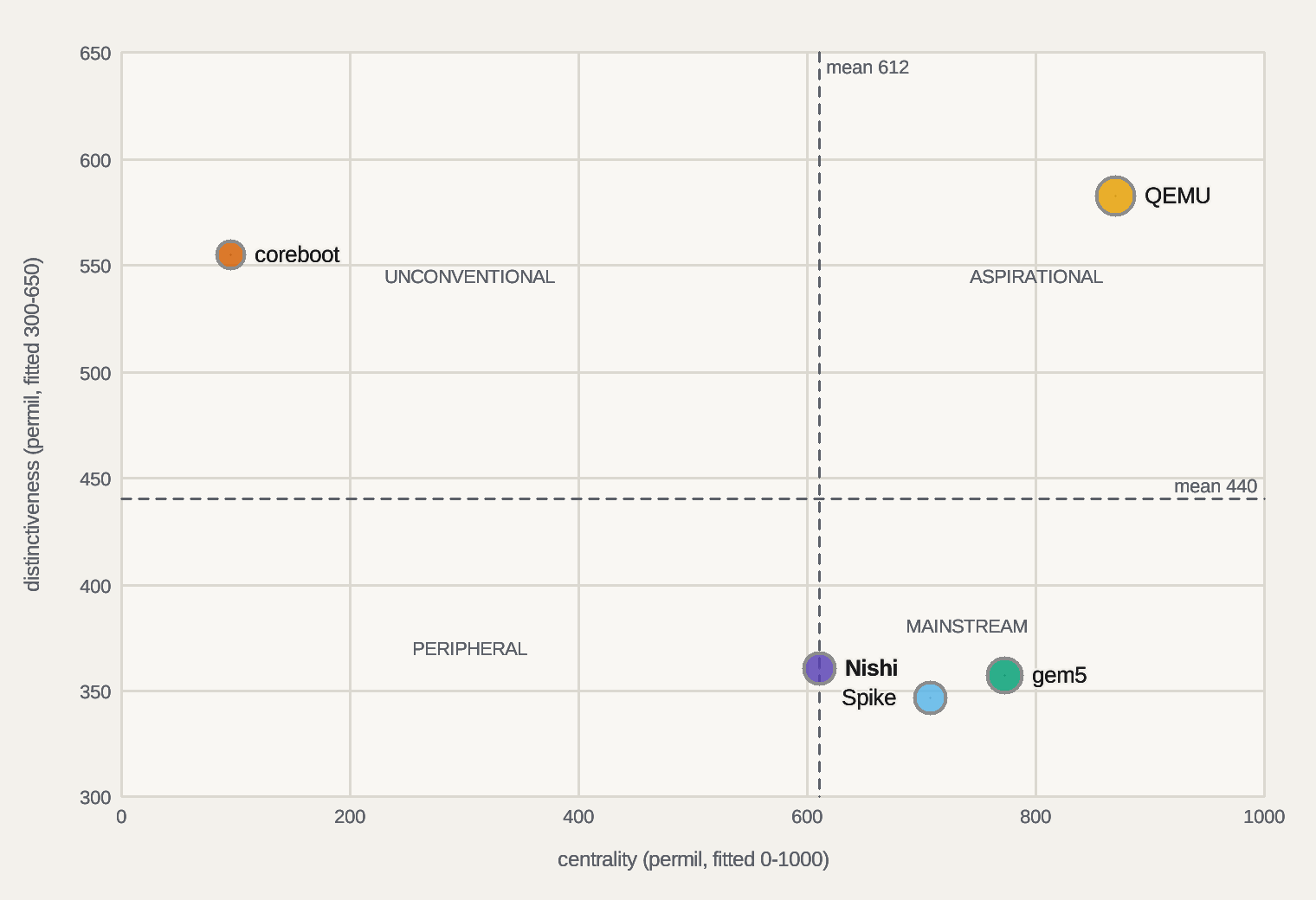
Position map — centrality and distinctiveness
The four-quadrant map the field uses for brand strategy (Dawar and Bagga, HBR June 2015), re-derived from this matrix on every publish. Centrality is the share of the category's feature mass a player covers, each feature weighted by how many hold it; distinctiveness is the average lead over each rival on the rows the player holds; breadth is the depth-weighted share of the whole matrix (the bubble); depth is how deeply the rows held are held; momentum is the day-over-day move off the spine (green rising, red falling, grey until day two); the dashed path runs first day → previous day → today. Dividers are the category means. Axes are fitted to the field of play, so read the tick numerals, not the frame. Rival marks are documented presence, so a rival's position reads the record, never its quality. The picture grades its own readability below; the table beside it is the same data for a screen reader or a second method.
knowledge/compare/nishios.cdmap (cut|x|y, cube|x|y|z); absent = the HBR defaultsbubble area = breadth · ring = momentum (green rising, red falling, grey until day two) · dashed = category means · axes fitted to the field of play: centrality 0–1000, distinctiveness 300–650 of 0–1000 permil (the full range put every player in one corner)
readability of the 2D cut, self-graded by the layout ruler: label overlaps 0 · labels over marks 0 · off-canvas 0 · unresolved labels 0 · mark overlaps 0 (a fact of the data: two players that close are that close) · data spread 724 permil of the plot · quadrant words unseated 0
text contrast, measured with wcag2-ratio (floors from contrast.conf), light theme: labels 16.24 (floor 4.50) · notes 16.24 (floor 4.50) · quadrant words 5.89 (floor 4.50) · tick numerals 5.89 (floor 4.50) · axis titles 5.59 (floor 4.50) · dark theme: labels 13.78 (floor 4.50) · quadrant words 5.55 (floor 4.50) · axis titles 5.97 (floor 4.50) · dark classes under their floor 0 (one figure serves both themes: a dark shortfall is a token to fix, never a class to hide) · classes refused under their floor 0 (a refused class is not drawn; the scale classes are measured, never hidden) · export: SVG PNG (receipt, rendered by the estate's own rasteriser from this page)

readability of the 3D cube, self-graded by the layout ruler: label overlaps 0 · labels over marks 0 · off-canvas 0 · unresolved labels 0 · mark overlaps 1 (a fact of the data: two players that close are that close) · data spread 387 permil of the plot
10 panels over 5 registered axes, every pair once (the lower axis on x, the higher on y) · each panel fitted to its own field of play, first and last tick numerals shown · no labels in a small cut, the legend names the colours; the grade below reports the mark terms only (MM summed over the panels, spread averaged)
readability of the small multiples, self-graded by the layout ruler: label overlaps 0 · labels over marks 0 · off-canvas 0 · unresolved labels 0 · mark overlaps 2 (a fact of the data: two players that close are that close) · data spread 579 permil of the plot
| Player | Quadrant | centrality | distinctiveness | breadth | depth | momentum | Rows held | Days on spine | First seen |
|---|---|---|---|---|---|---|---|---|---|
| Nishi | Mainstream | 612 | 361 | 196 | 722 | 0 since 2026-09-15 | 6 | 2 | 2026-09-15 |
| QEMU | Aspirational | 870 | 583 | 393 | 962 | 0 since 2026-09-15 | 9 | 2 | 2026-09-15 |
| Spike | Mainstream | 709 | 347 | 227 | 833 | 0 since 2026-09-15 | 6 | 2 | 2026-09-15 |
| gem5 | Mainstream | 774 | 357 | 257 | 809 | 0 since 2026-09-15 | 7 | 2 | 2026-09-15 |
| coreboot | Unconventional | 96 | 555 | 75 | 555 | 0 since 2026-09-15 | 3 | 2 | 2026-09-15 |
| Day | Matrix rows reviewed | Players recorded |
|---|---|---|
| 2026-09-15 | 22 | 5 |
| 2026-09-16 | 22 | 5 |
players 5|matrix rows 22|feature mass 31|centrality mean 612|distinctiveness mean 440|axes 5|spine days 2 (shown 2)|rows written today 0|readability defects 2D 0 cube 0|spine knowledge/status/cdmap/nishios.spine
comparewatch- plane row flips with it. A dark tag means the organ file EXISTS but does not declare the contracted symbol: something shipped there under another name, and until the contract is repointed to the real entry point (the plan rung and this row) or the function is renamed, that capability is invisible to this board — a build lost to darkness, named so it is not. The flip is necessary, not sufficient: it proves the symbol exists, never that the capability is good. The bar is the rung's pre-declared done-rule, proven by its gate — a symbol shipped without the behaviour behind it is a defect, and the flip is exactly what makes that defect visible instead of quiet. Competitor marks record documented capability presence — presence, not depth or scale. Adoption is measured too: every measured row carries where its organ stands on the estate's ladder (source → built → promoted → registered → invoked; libraries by importer reach minus validation importers; gates by the execution surfaces that run them). A row is fully adopted only at the top of its ladder; anything short is tagged partial with the exact remedy, so a build nobody promoted can no longer read as shipped. Census stamps: importers asof 1789497476, gate census asof 1789498715 (unix seconds; -1 = census absent).Capability matrix — measured against source
◉ leads / measured exceed● present◐ partial○ absent · click any capability for its evidence
| Capability | Nishi | QEMU | Spike | gem5 | coreboot |
|---|---|---|---|---|---|
| LIVE | |||||
Behavioral RV64IM system emulator (own silicon model)Measured:nx_rv64im_sim_run exists in runtime/_hdl_build/rv64im_min_sim.nx, verified at emit. The step interpreter every other row is measured on; QEMU-TCG and Spike are the throughput and golden-reference bars. Validated 0 divergences over 500 differential-fuzz vectors against QEMU rival marks uncited — the Yes, Best or Part codes on this row are an observation read with no reference mark behind them Adoption: LIB-WIRED importers=40 nonval=26 — fully adopted (top of its ladder).Pros Nishi has it, measured on disk; ahead of coreboot; fully adopted on the estate ladderCons behind QEMU (leads), Spike (leads) | ● | ◉ | ◉ | ● | ○ |
RV64 to x86-64 JIT (dynamic binary translation)Measured:jit_compile exists in runtime/_hdl_build/nx_rv64_jit.nx, verified at emit. Emits real x86-64 per instruction with a register-allocating variant (jit_compile_ra) and guest-memory bounds checks; QEMU-TCG is the only rival with dynamic translation in this column set. MMIO and cross-block chaining are the open half -- see the GAP row rival marks uncited — the Yes, Best or Part codes on this row are an observation read with no reference mark behind them Adoption: LIB-WIRED importers=17 nonval=4 — fully adopted (top of its ladder).Pros Nishi has it, measured on disk; ahead of Spike, gem5, coreboot; fully adopted on the estate ladderCons behind QEMU (leads) | ● | ◉ | ○ | ○ | ○ |
Sv39 paging with S and U privilege enforcementMeasured:nx_sv39_walk exists in runtime/_hdl_build/rv64im_min_mmu.nx, verified at emit. RE-MEASURED 2026-08-21 and the SOTA cell is STALE: three-level walk with gigapage, megapage and 4K leaves, U-bit and SUM enforcement, X-on-fetch and R-on-load permission faults, accessed and dirty bits, all with named neg-controls. Six gates GREEN. QEMU Spike and gem5 remain the completeness bar for the wider privileged spec rival marks uncited — the Yes, Best or Part codes on this row are an observation read with no reference mark behind them Adoption: LIB-WIRED importers=8 nonval=6 — fully adopted (top of its ladder).Pros Nishi has it, measured on disk; ahead of coreboot; fully adopted on the estate ladderCons behind QEMU (leads), Spike (leads), gem5 (leads) | ● | ◉ | ◉ | ◉ | ○ |
Verify-then-execute never-brick loaderMeasured exceed:nxe_load_exec in runtime/nx_nxe_lib.nx, verified at emit. EXCEED and alone in this column set: the NXE loader re-derives the payload integrity sum and checks the capability and never-brick bits BEFORE mapping anything executable, and refuses rather than jumping. Witnessed printing its own refusal on real TianoCore firmware Adoption: LIB-WIRED importers=4 nonval=4 — fully adopted (top of its ladder).Pros Nishi leads, a measured exceed; ahead of QEMU, Spike, gem5, coreboot; fully adopted on the estate ladderCons none on the measured axes (rival marks are documented presence, not depth) | ◉ | ○ | ○ | ○ | ○ |
| GAP | |||||
GDB remote-serial stub (breakpoints, step, registers)Measured:gdbstub_serve exists in runtime/nx_gdbstub.nx, verified at emit. SHIPPED 2026-08-23 as nx_gdbstub (gdbstub_serve) -- the organ path here is re-keyed from the 08-21 placeholder nx_rv64_gdbstub.nx to the file that shipped, so the measured contract can flip; the symbol is the one the contract named. GDB Remote Serial Protocol over rv64im_min_sim: target.xml served (riscv:rv64 x0-x31+pc), loopback port 0 read back via getsockname and announced in a ready file, m/M RAM-only through the sim's own Sv39 xlate, breakpoint bitmap over RAM (no cap), all sizes derived from the regfile constants. ORACLE WITNESSED (nx_gdbstub_gate 13/13 GREEN on the laptop with stock gdb-multiarch 15.1): gdb attached at the reset pc, broke at the decoder-resolved first executed store 0x8000003c, read x6=0x4e equal to a stub-free reference sim, stepped to 0x80000040, read memory equal to the image file bytes, detached and the guest completed the boot with transcript==golden; neg-controls: a breakpoint at a never-executed RAM address did NOT stop (guest exited under gdb), a bad-checksum frame was NAKed. Bite-proven: nx_gate_bite killed a compiling mutant; a breakpoint-blind mutant failed T3/T4 while T8 kept passing. On the NAS the gate runs the sovereign protocol teeth and reports the stock-gdb leg as a MISSING PRECONDITION (no gdb installed there) -- SKIP, never a pass. Laptop and NAS builds are byte-identical (142,030 B sha 361f6da6) rival marks uncited — the Yes, Best or Part codes on this row are an observation read with no reference mark behind them Adoption: RUN-BY:fork:nx_gdbstub_gate — fully adopted (top of its ladder).Pros Nishi has it, measured on disk; ahead of coreboot; fully adopted on the estate ladderCons behind QEMU (leads), gem5 (leads) | ● | ◉ | ● | ◉ | ○ |
Machine snapshot and restoreOpen — watchingruntime/_hdl_build/nx_rv64_gdbstub.nx : snap_save_state, re-measured on every compare beat. Ship that symbol and this mark flips itself; the comparewatch- plane row flips with it. No way to save and resume a machine, so a long boot must be re-run from reset every time and a failing state cannot be handed to anyone else. Deterministic replay already gives us the hard half -- the state is reproducible; what is missing is serializing it rival marks uncited — the Yes, Best or Part codes on this row are an observation read with no reference mark behind themPros none measured yetCons behind QEMU (leads), gem5; open contract, nothing on disk yet | ○ | ◉ | ○ | ● | ○ |
Architectural compliance suite (third-party conformance)Measured:rvc_run_suite exists in runtime/nx_rvc_run_suite.nx, verified at emit. The differential fuzz against QEMU is grade-1 external corroboration but it is OUR harness choosing OUR vectors. The published RISC-V architectural test suite is the field's own ruler and Spike is its reference target; running it converts a self-selected sample into a third-party population. LANDED 2026-08-23 (nx_rvc_run_suite on rv64im_min_sim, riscv-arch-test 2.7.4 pinned, Spike-generated references, gcc oracle-assembled): per-group PASS/total, never one percentage -- I 42/42, M 13/13, C 28/28, Zifencei 1/1, privilege 0/12 (SUITE 84 pass, 10 fail, 2 unsupported of 96; partition sums; witness bench/riscv-arch-test/nishios_NO3_local_witness.txt sha bd44f202, pin sha 971aeead). nx_rvc_gate GREEN 5/5 with a known-failing corrupt-signature control (an always-PASS comparator mutant reads RED 3/5). The first run read I 40/42 C 27/28 and found one REAL sim defect, FIXED the same day: RV64 SRAI immediate with shamt>=32 decoded as SRLI because alu_select tested funct7==0x20 while shamt[5] occupies funct7 bit 0 (srai-01 + c.srai-01 flipped to PASS; register sra-01 had always passed). The other first-run failure, jal-01, was the CORPUS BUILD not the sim: assembling the I group with rv64imac made the assembler emit 294,905 two-byte c.nops where the Spike references were generated from the suite Makefile march rv64i (4-byte nops), and jal-01 signs a label distance; rebuilt with the suite own per-group march and it PASSES. The privilege group is the honest residual: misaligned loads/stores/branches do not trap (got 0 where the handler should have written deadbeef) and ecall/ebreak do not complete under the test harness rival marks uncited — the Yes, Best or Part codes on this row are an observation read with no reference mark behind them Adoption: REGISTERED-DARK — PARTIAL: callable, authorised, completed MCP invocation not established by supplied journal window; lifetime history unknown (direct execution may be recorded elsewhere; this scan does not establish lifetime use); no execution surface runs it either (clock, cron, daemon, roster, actlog and surfaced forks checked).Pros Nishi has it, measured on disk; ahead of corebootCons behind Spike (leads); not adopted yet: callable, authorised, completed MCP invocation not established by supplied journal window; lifetime history unknown (direct execution may be recorded elsewhere; this scan does not establish lifetime use); no execution surface runs it either (clock, cron, daemon, roster, actlog and surfaced forks checked) | ● | ● | ◉ | ● | ○ |
MMIO inside the JIT and cross-block trace chainingOpen — watchingruntime/_hdl_build/nx_rv64_jit_mmio.nx : jit_mmio_trace, re-measured on every compare beat. Ship that symbol and this mark flips itself; the comparewatch- plane row flips with it. The JIT bails to the interpreter at any device access and re-dispatches at every basic-block edge, so device-heavy and call-heavy guests never reach the measured hot-loop throughput. QEMU-TCG chains blocks and handles MMIO in translated code; this is the named JIT-maturity bet on the SOTA page rival marks uncited — the Yes, Best or Part codes on this row are an observation read with no reference mark behind themPros none measured yetCons behind QEMU (leads); open contract, nothing on disk yet | ○ | ◉ | ○ | ○ | ○ |
SMP multi-hart executionOpen — watchingruntime/_hdl_build/nx_rv64_smp.nx : smp_step_harts, re-measured on every compare beat. Ship that symbol and this mark flips itself; the comparewatch- plane row flips with it. ABSENCE PROVEN: grep nharts over buildroot/runtime *.nx returned matches=0 across 22,981 files with coverage_complete=1 and corpus_complete=1. CORRECTION to the SOTA page: the atomics prerequisite it names is already MET (see the header), so SMP is blocked on nothing but itself rival marks uncited — the Yes, Best or Part codes on this row are an observation read with no reference mark behind themPros none measured yetCons behind QEMU (leads), Spike, gem5 (leads); open contract, nothing on disk yet | ○ | ◉ | ● | ◉ | ○ |
RISC-V hypervisor (H) extensionOpen — watchingruntime/_hdl_build/nx_rv64_hyp.nx : hyp_vs_enter, re-measured on every compare beat. Ship that symbol and this mark flips itself; the comparewatch- plane row flips with it. No VS or HS mode and no two-stage translation, so we cannot host a guest hypervisor or run the nested-virtualization workloads the field uses as a stress case. Needs SMP first to be worth having rival marks uncited — the Yes, Best or Part codes on this row are an observation read with no reference mark behind themPros none measured yetCons behind QEMU (leads), Spike, gem5; open contract, nothing on disk yet | ○ | ◉ | ● | ● | ○ |
Real-silicon POST and firmware handoffOpen — watchingruntime/_hdl_build/nx_boot_realsilicon.nx : rsp_post_handoff, re-measured on every compare beat. Ship that symbol and this mark flips itself; the comparewatch- plane row flips with it. The guarded never-brick operator step: every boot claim we make today is a claim about our own emulator or about someone else's firmware acting as an oracle. coreboot is the only column here that owns real silicon from POST. Gated by conformance -- do not put unproven code on metal rival marks uncited — the Yes, Best or Part codes on this row are an observation read with no reference mark behind themPros none measured yetCons behind coreboot (leads); open contract, nothing on disk yet | ○ | ○ | ○ | ○ | ◉ |
Spore image on a capability object kernelOpen — watchingruntime/nx_nishios_cap.nx : nk_cap_handle, re-measured on every compare beat. Ship that symbol and this mark flips itself; the comparewatch- plane row flips with it. Kernel objects reached only through handles with rights, no ambient authority [zircon], the image carrying only the organs its workload needs [unikraft]. Rival: Zircon and Unikraft, not the emulator columnsPros none measured yetCons open contract, nothing on disk yet | ○ | ○ | ○ | ○ | ○ |
Foreign guests as routed componentsOpen — watchingruntime/nx_nishios_guest.nx : nk_guest_route, re-measured on every compare beat. Ship that symbol and this mark flips itself; the comparewatch- plane row flips with it. A Linux-class guest or a WebAssembly component runs as a child whose every capability is routed by its parent [fuchsiacomp] [genode] [wasmcomp]; a Chrome-class application is the target guest. Rival: Fuchsia components, Genode, the component modelPros none measured yetCons open contract, nothing on disk yet | ○ | ○ | ○ | ○ | ○ |
Native swarm transport as a namespace serviceOpen — watchingruntime/nx_nishios_swarm.nx : nk_swarm_scheme, re-measured on every compare beat. Ship that symbol and this mark flips itself; the comparewatch- plane row flips with it. BEP 3, DHT and the extension protocol as an unprivileged service on a path [bepindex] [redox], composed from the estate torrent organs. Rival: Redox schemesPros none measured yetCons open contract, nothing on disk yet | ○ | ○ | ○ | ○ | ○ |
Native royalty-free codecs as servicesOpen — watchingruntime/nx_nishios_codec.nx : nk_codec_svc, re-measured on every compare beat. Ship that symbol and this mark flips itself; the comparewatch- plane row flips with it. AV1 and Opus decode as sovereign services graded against the published decoding process [av1spec] [opus6716]; no third-party decoder linked, forked or shelledPros none measured yetCons open contract, nothing on disk yet | ○ | ○ | ○ | ○ | ○ |
Compositor or headless as one switchOpen — watchingruntime/nx_nishios_compositor.nx : nk_compositor, re-measured on every compare beat. Ship that symbol and this mark flips itself; the comparewatch- plane row flips with it. A Wayland-shaped compositor that owns the scene [wayland]; headless is the same image without it. Rival: Wayland compositors, the Genode GUI serverPros none measured yetCons open contract, nothing on disk yet | ○ | ○ | ○ | ○ | ○ |
Live evolution: organs replaced in placeOpen — watchingruntime/nx_nishios_cell.nx : nk_cell_swap, re-measured on every compare beat. Ship that symbol and this mark flips itself; the comparewatch- plane row flips with it. Theseus-shaped cells replaced at runtime with state carried across [theseus]; transcript byte-identical before and after the swap. Rival: TheseusPros none measured yetCons open contract, nothing on disk yet | ○ | ○ | ○ | ○ | ○ |
LLM tenancy as kernel servicesOpen — watchingruntime/nx_nishios_tenant.nx : nk_llm_tenant, re-measured on every compare beat. Ship that symbol and this mark flips itself; the comparewatch- plane row flips with it. Scheduling, memory tiers and tool routing for an LLM seat as kernel services [aios] [memgpt]; the no-float engine is the first tenant. Rival: AIOS, MemGPTPros none measured yetCons open contract, nothing on disk yet | ○ | ○ | ○ | ○ | ○ |
Preserve, freeze and retrieve over one resource classDARK —runtime/_hdl_build/nx_nishios_kernel_emit.nx EXISTS but does not declare nk_liveupdate_handler: something shipped at this path under another name, and this mark would read open forever. Repoint the contract to the real entry point (the plan rung AND this row) or rename the function; the flip follows on the next beat, and the comparewatch- plane row reads DARK until then. WATCH nk_liveupdate_handler. The unit of hitless replacement moved from the process to the KERNEL: the Live Update Orchestrator merged for Linux 6.19, released 2026-02-08 [linux-luo26]. Done when an organ registers a named handler for ONE resource class, serialises its state to a fixed-format blob, refuses the whole handover if ANY handler's freeze fails, and re-materialises the resource by name in any order on the far side -- bite-proven with a control where one handler's freeze fails and the handover must be refused entire.Pros none measured yetCons open contract, nothing on disk yet | ○ | ○ | ○ | ○ | ○ |
Device evidence in the bind path with three named statesDARK —runtime/_hdl_build/nx_nishios_kernel_emit.nx EXISTS but does not declare nk_device_evidence: something shipped at this path under another name, and this mark would read open forever. Repoint the contract to the real entry point (the plan rung AND this row) or rename the function; the flip follows on the next beat, and the comparewatch- plane row reads DARK until then. WATCH nk_device_evidence. An OS must now authenticate and encrypt the link to its own PCIe devices: the PCI TSM core merged for 6.19 [pci-tsm26], confidence MEDIUM-HIGH. Done when, before binding, the driver path records device identity plus whatever measurement the device can produce, compares against a reference-value file, and emits BOUND-ATTESTED, BOUND-UNATTESTED or REFUSED as three named states -- and does NOT refuse by default, because this estate's own law is that a guard refusing a legitimate case is a false-positive generator.Pros none measured yetCons open contract, nothing on disk yet | ○ | ○ | ○ | ○ | ○ |
Firmware-variable inventory and diff, read-only by constructionDARK —runtime/_hdl_build/nx_neverbrick_genesis.nx EXISTS but does not declare nb_fwvar_inventory: something shipped at this path under another name, and this mark would read open forever. Repoint the contract to the real entry point (the plan rung AND this row) or rename the function; the flip follows on the next beat, and the comparewatch- plane row reads DARK until then. WATCH nb_fwvar_inventory. Every shipped machine's Secure Boot trust anchors expire in 2026 -- KEK CA 2011 on 2026-06-24 and UEFI CA 2011 on 2026-06-27 [secureboot-expiry26] -- and both dates are already PAST. Done when an organ READS PK, KEK, db and dbx and reports the certificates present with their expiry dates, writing nothing, and diffs against a banked baseline so a machine that has not taken the 2023 certificates is named. Read-only by construction is what satisfies never-brick; only after that census may any write path be discussed, and not by this row. Exceed claimed narrowly: a census that can run on every machine the estate boots and can brick none of them.Pros none measured yetCons behind coreboot; open contract, nothing on disk yet | ○ | ○ | ○ | ○ | ◐ |
Hash-based signature verifier for the boot chainDARK —runtime/_hdl_build/nx_neverbrick_genesis.nx EXISTS but does not declare nb_hbs_verify: something shipped at this path under another name, and this mark would read open forever. Repoint the contract to the real entry point (the plan rung AND this row) or rename the function; the flip follows on the next beat, and the comparewatch- plane row reads DARK until then. WATCH nb_hbs_verify. An auditable root of trust is now PURCHASABLE: OpenTitan shipping in production silicon, announced 2026-03-04 [opentitan26]. Done when LMS or SLH-DSA VERIFICATION -- never signing -- exists as a sovereign organ proven against published NIST test vectors. Verification-only is the right first unit: stateless, no key-management hazard, and it is the operation the boot path actually performs.Pros none measured yetCons behind coreboot; open contract, nothing on disk yet | ○ | ○ | ○ | ○ | ◐ |
Delivery and evidence
Inspect risks, technical debt, rendered observations, experiments and references. Read scope and limitations alongside every result.
Release history and work log
| When | Rung | Kind | Entry |
|---|---|---|---|
| 2026-09-02 | NO8 | land | seL4 documentation and the Plan 9 papers mirrored and pinned on retry through alternate hosts (docs.sel4.systems over TLS 1.3; doc.cat-v.org over the TLS 1.2 leg); the seL4 home page still fails the 1.2 client leg (t12-incomplete-flight) and is not cited; refs now 14 of 15 |
| 2026-09-02 | NO8 | queue | operator brief 2026-09-02 landed as data: bars Zircon, Genode, Redox, Theseus, Unikraft, WebAssembly components, AIOS and MemGPT, BitTorrent BEPs, AV1 and Opus, Wayland; rungs NO8 to NO14 under N4 (version 4.0); 12 of 15 references mirrored and pinned through nx_research_fetch; seL4 (About and the manual) and the Plan 9 paper failed on the sovereign TLS 1.2 client leg (t12-incomplete-flight, status 0) and wait on alternate mirrors |
| 2026-09-02 | NO8 | lesson | a bar is a mirror or it is nothing: three fetches returned status 0 and are NOT cited; a reference nobody fetched is a fabrication, so seL4 stays out of the refs until a mirror lands |
Risk register
| Risk | Likelihood x impact | Mitigation |
|---|---|---|
| A JIT or SMP change silently miscompiles the guest | possible x catastrophic | Every ISA-semantics rung re-runs the differential fuzz against QEMU and must hold 0 divergences; a speed result with a nonzero divergence count is a regression, not a win. |
| A conformance number gets read as marketing | likely x medium | Publish pass and total PER TEST GROUP with the known-failing control shown, never one percentage, and pin the suite corpus before the first run so the population cannot drift under the number. |
| Real-silicon work bricks a board | possible x catastrophic | NO7 is gated behind NO3, requires the never-brick genesis gate GREEN on every firmware-write node, requires the write path to be proven reversible before the first write, and requires an operator. It refuses rather than proceeding on any unmet precondition. |
| A watch contract flips on a stub carrying the right name | possible x high | The flip is the receipt, never the proof: each rung's accept rule above names an EXTERNAL oracle (a stock gdb, the published architectural suite, the QEMU differential) or a neg-control that a stub cannot satisfy. |
Release history continued
| When | Rung | Kind | Entry |
|---|---|---|---|
| 2026-09-03 | NO12 | queue | OPERATOR 2026-09-03 (carried on the gpu and gameengine goal rows): NishiOS and the Nishi browser are where the game stack is sovereign -- present and vsync owned by this compositor (gpu GP10 gpu_present_compositor is the same contract seen from the GPU board), no vendor UMD gating VRAM (gpu GP9), no store gating install (gameengine GE46). The third-party browser door is the final mile, measured the same day on /world/beach at WebGL2 default with WebGPU levered and cross-origin isolation paid but unconsumed; this rung is the door where those browser limits stop applying, and the same world bytes must open here without a store. |
| 2026-09-04 | NO15 | land | September 2026 SOTA for the kernel, PCIe and firmware layers admitted as DATA: 4 refs pinned (nishios.refs 13270 to 14957 B, payload 5b62a6381ad237b3), a MEASUREMENT AND ITERATION TOOLING section of 4 rows carrying 4 watch contracts (nishios.matrix 13098 to 16115 B, 889d3df75eee8744), rungs NO15-NO18 under N5 ver 5.0 (nishios.plan 22190 to 23791 B, 36ceb4dcaddae77b); settled by the size ladder, single by row-unique count |
| 2026-09-04 | NO15 | measure | referee nx_compare_refs_gate 24/24 GREEN fleet-wide after the append (job 1788557920): pins 1369 of 1369 matched, unresolved 0, uncited 0; all 4 keys cited inline |
| 2026-09-04 | NO17 | lesson | every firmware-touching row is READ-ONLY BY CONSTRUCTION under never-brick: NO17 inventories PK, KEK, db and dbx and writes nothing, and its done-rule includes proving the organ's syscall set contains no firmware write. The Secure Boot 2011 CA expiry dates (2026-06-24 and 2026-06-27) are already PAST, so the census is the urgent unit; any write path is a separate operator decision this board does not take |
| 2026-09-04 | NO15 | queue | build order by the board's columns: NO17 firmware inventory first (cheapest, the only row with an exceed), then NO18 HBS verification against the NIST vectors, then NO15 liveupdate handler, then NO16 device evidence which depends on it |
SOTA field — 8 peers, 30 axes, measured bindings
The Nishi sovereign rv64 emulator + never-brick NXE boot loader (nx_boot_run_sov) vs QEMU / Spike / gem5 / Bochs / Unicorn / Firecracker / Renode / coreboot
ISA and execution
nx_rv64im_sim + nxc RV64 backend, exhaustively verified on our own emu; QEMU/Spike/gem5 are the ISA bar [riscv-isa-ratified]
full mul/mulh/div/rem with exact RV64 semantics, fuzz-validated; present, not best-in-class
nx_rvc_expand decodes the C extension
no-float = the measured determinism exceed bet (doctrine); A-atomics = SMP prerequisite, filed F107h; QEMU/Spike/gem5 lead
Nishi models M-mode CSR + CLINT only (partial); full S/U paging is the QEMU/Spike bar
honest gap: RV64 only; QEMU/gem5/Unicorn are multi-ISA
Performance
behavioral step-interpreter measured by nx_emu_bench; QEMU-TCG leads by 1-2 orders [bellard2005]
QEMU ~500 (TCG)Spike ~100gem5 ~1-5Bochs ~50Unicorn ~100Firecracker nativeRenode ~10coreboot n/a
nx_rv64_jit emits real x86-64 (reg-alloc + intra-block control flow + guest memory); QEMU-TCG is the bar [bellard2005]
measured ~100x over our interpreter on a hot loop; native/QEMU-TCG class
QEMU ~2-10Spike n/agem5 n/aBochs n/aUnicorn ~1-5Firecracker nativeRenode n/acoreboot n/a
honest gap: single-core RV64IM (declared envelope); QEMU/gem5/Firecracker lead [lowepower2020]
honest gap: pure software sim, no host-CPU accel; QEMU-KVM/Firecracker lead [agache2020]
Devices
rv64im_min_virtio: real split-virtqueue blk/net/rng, drove real entropy end-to-end [virtio-oasis13]
16550 UART + SiFive CLINT + M-mode timer; Renode/QEMU are the device bar
honest partial: a focused device set (UART/virtio/nvme/gpu-model), not QEMU/Renode breadth [renode]
nx_hw_discover parses the real QEMU DTB (13 devices at real addresses), no hardcoded list
LANDED 2026-08-27, and this cell was published as No until 2026-08-28: gdbstub_serve (nx_gdbstub.nx:773) is a GDB remote-serial stub over the sovereign rv64 sim -- g/G/p/P registers, m/M memory, Z0 breakpoints, single-step, Ctrl-C interrupt and qXfer target.xml -- and its accept rule is an EXTERNAL ORACLE: stock gdb-multiarch 15.1 attaches and steps, nx_gdbstub_gate 13/13 GREEN. Graded Yes and not Best because SNAPSHOT is still absent and QEMU, gem5 and Renode still lead on watchpoints and multi-arch breadth.
honest gap: no VM snapshot or migration; QEMU/Firecracker lead
rv64im_min_gpu is a command-ring model, no real display output (partial)
Boot and firmware
boots POST to mount+replay to verify+execute /sbin/init on OUR silicon model; a genuine strength. EVIDENCE (this cell carried none until 2026-08-14): the loader half is WITNESSED ON REAL FIRMWARE, not modelled -- an ESP with no kernel file made real TianoCore/OVMF print our literal NXE! refusal and HOLD rather than jump blindly. A boot claim that has only ever run inside our own emulator is a claim about the emulator; this one has touched third-party firmware
EXCEED: NXE SHA-256 integrity gate refuses tampered code BEFORE it executes; no emulator does this
honest gap: guarded never-brick operator step, refused-by-construction in sim; coreboot is the real-firmware bar [coreboot-docs]
nx_boot_uefi models the memmap/handoff in-sim (partial); QEMU/coreboot boot real UEFI [uefi-spec]
Determinism and sovereignty
EXCEED: replayable bit-for-bit. EVIDENCE (MEASURED against an external reference): 0 divergences across 500 fuzz vectors versus QEMU. That number was already written in this cell and was still refused by the liar-kill, correctly -- it named no instrument and no date, so nothing told a reader whether it was measured or remembered. It is a differential result against a third-party emulator, which is grade-1 external corroboration rather than self-scoring, and integer-only execution is WHY it is reachable: there is no float nondeterminism to average away
our stack is validated AGAINST QEMU/GNU-as as oracles; they are the reference, we prove equivalence [spike-isa-sim]
QEMU referenceSpike referencegem5 selfBochs selfUnicorn selfFirecracker n/aRenode selfcoreboot n/a
deterministic replay BY CONSTRUCTION (no rr-style instrumentation needed); QEMU rr-class is opt-in. EVIDENCE (MEASURED 2026-08-14 note, same instrument as the determinism axis): replay is only meaningful if two runs actually agree, and that is the 0-divergence-in-500 differential against QEMU. By-construction is the mechanism -- integer-only execution with no float and no wall-clock in the state -- and the fuzz result is the evidence that the mechanism holds rather than merely being intended
EXCEED and alone: nxc to nxasm to RV64, zero external compiler in the whole chain. EVIDENCE (this cell carried none until 2026-08-14): the chain compiles ON THE NAS over the mgmt API with build-over-API GREEN since 2026-07-06, and the compiler SELF-HOSTS with nx_cc_equiv_gate running 10/10 plus a self-host stage before any toolchain promotion. Bits-up is checkable by rebuilding the compiler with itself, which is what that gate does
EXCEED and alone: own language, assembler, emulator, TLS, store; competitors lean on gcc/llvm/glibc/host libs. EVIDENCE (MEASURED 2026-08-13): a return-42 static ELF out of this toolchain is 188 bytes with --no-crash-guard and 5,105 bytes with the default crash guard. A binary that size cannot contain a libc -- which converts zero-third-party from a list of things we avoid into a number a reader can re-measure
Safety, scale and size
EXCEED: nx_neverbrick_genesis gate RED-flags any unguaranteed firmware-write node; coreboot (real firmware) can brick
dangerous guest code runs against virtual hardware; a bug crashes the sim, never the host (proven with hostile guests)
whole sovereign OS+emu core; about 1616x smaller than Puppy Linux
QEMU ~50000Spike ~2000gem5 ~100000Bochs ~10000Unicorn ~5000Firecracker ~5000Renode ~50000coreboot ~1000
Person · product · place — not yet measured for this domain
knowledge/compare/nishios.ppp (rows surface|nishi or c1..c4|label|url|connect naming OUR live surface and each rival's front door), run nx_ppp_probe domain nishios, and this section fills itself on the next beat: the same ruler on both sides — privacy and CX (third-party hosts, tracker classes, cookies, security headers), design and longevity (design hygiene, computed WCAG contrast, render-blocking resources, unsized media, script weight, theme and motion queries), findability (landmarks, skip link, on-site search, breadcrumb, headings, internal links).The field — discovered, not chosen
Rows written by nx_field_discover from nishios.seeds: the industry's own lists (Wikipedia wikitext, GitHub topics, awesome lists) read mechanically, every candidate counted across seeds. The matrix columns above are a SEAT'S pick; this band is the population they were picked from, and the stats line measures one against the other. A rival here is a lead, never a verdict — it earns a column when its capabilities are read and pinned.
field|seeds=1|scanned=1|fetched=1|reused=0|failed=0|named=1|candidates=1|mentions=1|capped=0
rival|coreboot|1|1|col3-coreboot|https://doc.coreboot.org/|named
| Rank | Rival | Seeds | Mentions | First seed | Kind | Link |
|---|---|---|---|---|---|---|
| 1 | coreboot | 1 | 1 | col3-coreboot | named | https://doc.coreboot.org/ |
field candidates 1|shown 1 of 1|matrix columns in the field 1 of 4|discovered rivals with no column 0|malformed rows 0 (counted, never rendered)|read-capped 0
Gaps from the record — what the estate does that no board carries
The record census (nx_goalmap record) reads the invoked-tool population and every plan queue row and files each organ or directive that NO matrix, plan or gates row names. A row here is a callout the boards missed: adjudicate it onto a board or declare it infrastructure. Census state BLIND (age 79826 s), sources read 4 of 7 declared — a BLIND census is a FLOOR: unread sources can only add rows.
| kind | name | board | source | evidence |
|---|
rows shown 0|this board's directives 0|estate-wide un-boarded organs 492 (listed in full on /compare/ecosystem)|census rows 611|malformed 0 (counted, never rendered)
References
- [bellard2005] Bellard, F. QEMU, a Fast and Portable Dynamic Translator. USENIX Annual Technical Conference, FREENIX Track, 2005. publisher · read in our library
knowledge/fetched/cmp_nishios_bellard2005.pdf· pinh991b59bf531b58bef88948367c78ce22d753b73d44c2b217a0d7abac67d31710· accessed 2026-08-18 · published-paperGrounds: The QEMU column and the JIT / dynamic binary translation and Interpreter throughput (MIPS) rows: QEMU-TCG dynamic translation is the bar nx_rv64_jit is graded against (~8 GIPS hot-loop vs the ~2-10 GIPS TCG class), and QEMU is the oracle in the Differential-fuzz validated vs reference row (0/500 divergences). - [riscv-isa-ratified] RISC-V International. Ratified RISC-V ISA Specifications: Unprivileged ISA and Privileged ISA volumes plus the ratified extension list (riscv.org/specifications/ratified). publisher · read in our library
knowledge/fetched/cmp_nishios_riscv-isa.html· pinh33461bf0413542c87c32a430032d8dacfb57f8a454f8c3c3aaa925e9b7e6d15a· accessed 2026-08-18 · published-standardGrounds: The ISA and execution category -- RV64I base integer, RV64M multiply and divide, RV64C compressed, RV64 A / F / D atomic and float, Privileged M / S / U modes: the extension letters and privilege modes are defined by these volumes, so the RV64IM+C envelope and the filed A/F/D and S/U gaps (F107h) are named against the standard, not against QEMU. - [virtio-oasis13] OASIS Open. Virtual I/O Device (VIRTIO) Version 1.3, OASIS Committee Specification (docs.oasis-open.org/virtio/virtio/v1.3). publisher · read in our library
knowledge/fetched/cmp_nishios_virtio13.html· pinh606cd751e50c5ccb59a9ccbfaf607c649c5b628dfd6aba7ba018147c9c54e6e9· accessed 2026-08-18 · published-standardGrounds: The virtio device models row: the split virtqueue layout and the blk / net / rng device types rv64im_min_virtio implements (nx_virtio_notify_dma) are this specification's normative definitions -- the row is a conformance claim against a public standard, which is why nx_virtio_spec_oracle_gate exists. - [uefi-spec] UEFI Forum. Unified Extensible Firmware Interface (UEFI) Specification, current release as listed on uefi.org/specifications (boot services, memory map, GPT and the EFI System Partition). publisher · read in our library
knowledge/fetched/cmp_nishios_uefispec.html· pinhc3d93ea9413a8c66128ff21f102365fb8ed04ed0baa8e84817a3a715e7e3ff15· accessed 2026-08-18 · published-standardGrounds: The UEFI boot support row (nx_boot_uefi models memmap and handoff in-sim, Part) and the Bare-metal boot evidence: the loader half is witnessed on real TianoCore/OVMF, and the boot services and ESP conventions it exercises are normative in this specification -- QEMU and coreboot boot real UEFI, we model it. - [agache2020] Agache, Brooker, Iordache, Liguori, Neugebauer, Piwonka, Popa. Firecracker: Lightweight Virtualization for Serverless Applications. USENIX NSDI 2020. publisher · read in our library
knowledge/fetched/cmp_nishios_agache2020.html· pinhc39745122622998e16b8e83f1ca8611ae760f320aeca413980c04f7d2d7ee15a· accessed 2026-08-18 · published-paperGrounds: The Firecracker column -- Hardware acceleration (KVM / HVF) and Snapshot / live migration rows where Firecracker leads: a KVM-backed microVM is the accel and snapshot bar our pure-software sim files as F107f and F107i, and its Sandbox-contained privileged code Best is the isolation posture we match by construction. - [lowepower2020] Lowe-Power, Ahmad, Akram, Alian, Amslinger et al. The gem5 Simulator: Version 20.0+. arXiv:2007.03152, 2020. publisher · read in our library
knowledge/fetched/cmp_nishios_gem5-2020.html· pinhe51185c80c7b5117bc957cc430a0932cb4d48a562d8b051d137a85a86a8a2c9d· accessed 2026-08-18 · published-paperGrounds: The gem5 column -- RV64I base integer, SMP / multicore and GDB / debug stub rows where gem5 is Best or Yes: the reference full-system architecture simulator our SMP (F107g) and gdb-stub (F107i) gaps are named against, and the ~1-5 MIPS interpreter figure in the Interpreter throughput row. - [spike-isa-sim] RISC-V Software Collaboration. Spike, the RISC-V ISA Simulator (riscv-isa-sim) -- project README and source repository. publisher · read in our library
knowledge/fetched/cmp_nishios_spike.html· pinh7ccacaa8a3e4be576122326a1edb03ed23e91c1040aff5995defbbad9e9747be· accessed 2026-08-18 · vendor-docGrounds: The Spike column: the golden-reference ISA simulator behind RV64I base integer B, the ~100 MIPS Interpreter throughput cell, and the reference cell in Differential-fuzz validated vs reference -- Spike is what a RISC-V behavioural emulator is checked against by the field. - [renode] Antmicro. Renode -- open source simulation framework for embedded and IoT systems (renode.io product page). publisher · read in our library
knowledge/fetched/cmp_nishios_renode.html· pinhda30466eb3b164ef41daecc959fc5ed9ada99f52fb656c46774befbb4b8b163a· accessed 2026-08-18 · vendor-docGrounds: The Renode column -- UART / CLINT / PLIC (B) and Full peripheral breadth (B) rows where Renode is the device bar, plus its Multi-ISA guests Y: our focused UART / virtio / nvme / gpu-model set is graded honest partial against this breadth. - [coreboot-docs] coreboot project. coreboot documentation (doc.coreboot.org): open-source firmware, payloads and the boot flow on real silicon. publisher · read in our library
knowledge/fetched/cmp_nishios_coreboot.html· pinh36ba5e576b8b82f716db5546872b5c39fcaf164baaee3f38b91db0400228c150· accessed 2026-08-18 · vendor-docGrounds: The coreboot column -- Real-silicon POST / firmware handoff (B) and the Never-brick by construction note that real firmware can brick: coreboot is the real-firmware bar the guarded never-brick operator step (F002 ULX3S / F103d) is measured against, and the Core size (KB) ~1000 comparison cell. - [zircon] Google Fuchsia project. Zircon kernel concepts: kernel objects, handles and rights, no ambient authority (fuchsia.dev concepts/kernel). publisher · read in our library
knowledge/fetched/cmp_nishios_zirconconcepts.html· pinh1c7caedb489ec53d5720c8b3d84138a3294cef646dd8322aae44227c92753655· accessed 2026-09-02 · vendor-docGrounds: The Zircon capability object-kernel bar and rung NO8: authority is a handle, never ambient. - [fuchsiacomp] Google Fuchsia project. Components v2 introduction: the component as the unit of software, capabilities routed by the framework (fuchsia.dev concepts/components/v2). publisher · read in our library
knowledge/fetched/cmp_nishios_fuchsiacomponents.html· pinheb762998eb01b4bf190716ca6502dc8c03758dc3ecac899cd038150b47565493· accessed 2026-09-02 · vendor-docGrounds: The Zircon bar and rung NO9: a foreign guest is a component whose capabilities are routed, not trusted. - [redox] Redox OS project. Redox: a Unix-like microkernel OS in Rust where resources are URLs served by schemes (redox-os.org). publisher · read in our library
knowledge/fetched/cmp_nishios_redox.html· pinh0c3f4e4506271497732ad8199e730c5b68f451f1138b2fe5db0352328d0308f8· accessed 2026-09-02 · vendor-docGrounds: The Redox namespace bar and rungs NO10 NO11: swarm transport and codecs appear as paths served by unprivileged services. - [theseus] Boos, K., Liyanage, N., Ijaz, R., Zhong, L. Theseus: an Experiment in Operating System Structure and State Management. USENIX OSDI 2020. publisher · read in our library
knowledge/fetched/cmp_nishios_theseus_osdi20.pdf· pinh4d15548486cea56a167e19d01e8183cc783a5321d4ba4dbb219459afb1f6102c· accessed 2026-09-02 · published-paperGrounds: The Theseus live-evolution bar and rung NO13: cells replaced at runtime with state carried across, the seed-to-forest property. - [genode] Genode Labs. Genode Foundations: a recursive component tree on capability kernels, every component sandboxed by its parent (genode.org documentation). publisher · read in our library
knowledge/fetched/cmp_nishios_genode.html· pinh2c42299a8ba591a8e74167990aae0d74e85e321f40384bb181f7283cbd241f15· accessed 2026-09-02 · vendor-docGrounds: The component-framework bar and rungs NO9 NO12: drivers, file systems and the compositor as unprivileged components. - [unikraft] Unikraft project. Unikraft concepts: a library OS specialised per application, only the components the workload needs (unikraft.org docs/concepts). publisher · read in our library
knowledge/fetched/cmp_nishios_unikraft.html· pinh10e0676f2a19b0ef899ee786c44f2a309d8399bea327d02559867af2a83b993c· accessed 2026-09-02 · vendor-docGrounds: The unikernel bar and rung NO8: the spore is a minimal image that is exactly one workload. - [wasmcomp] WebAssembly Community Group. The Component Model explainer: typed interfaces between sandboxed components, capabilities passed by import (component-model design/mvp/Explainer.md). publisher · read in our library
knowledge/fetched/cmp_nishios_wasm_component.html· pinh27edfceda9e35180e00952cedbaaeadfe670601f791495a7ca58fe78c7d4106f· accessed 2026-09-02 · published-standardGrounds: The portable sandboxed-guest bar and rung NO9: a guest ABI with no ambient authority that runs on any host. - [aios] Mei, K., Li, Z., Xu, S., Ye, R., Ge, Y., Zhang, Y. AIOS: LLM Agent Operating System. arXiv:2403.16971, 2024. publisher · read in our library
knowledge/fetched/cmp_nishios_aios.html· pinhabf717b8b51cf70591464a4d26f201157991a4185ed6786e3ad3fa4aa083cd71· accessed 2026-09-02 · published-paperGrounds: The LLM-as-OS-tenant bar and rung NO14: agents and their context scheduled as OS resources. - [memgpt] Packer, C., Wooders, S., Lin, K., Fang, V., Patil, S., Stoica, I., Gonzalez, J. MemGPT: Towards LLMs as Operating Systems. arXiv:2310.08560, 2023. publisher · read in our library
knowledge/fetched/cmp_nishios_memgpt.html· pinhfa7328c6c6b801fa1b9b6a5dd76fb1d2a8afddfc6e33bb2dd58978462bc6906f· accessed 2026-09-02 · published-paperGrounds: The LLM-as-OS-tenant bar and rung NO14: context paged between memory tiers the way an OS pages memory. - [bepindex] BitTorrent.org. Index of BitTorrent Enhancement Proposals (BEP 0): the protocol, DHT, extension protocol, uTP and magnet links as open specifications. publisher · read in our library
knowledge/fetched/cmp_nishios_bepindex.html· pinh77f2bb5b3a5cfa2f1381fa1c6fc1867492c7d831601909833fbd3607fc5afd9a· accessed 2026-09-02 · published-standardGrounds: The open transport bar and rung NO10: native swarm transport is standards work, license-clean by construction. - [av1spec] Alliance for Open Media. AV1 Bitstream and Decoding Process Specification (aomediacodec.github.io/av1-spec). publisher · read in our library
knowledge/fetched/cmp_nishios_av1spec.pdf· pinhec44e9fc42c4e5851faa879a1818dcb9014d834bbdd9420ccca7dcea05a3abe9· accessed 2026-09-02 · published-standardGrounds: The royalty-free codec bar and rung NO11: a sovereign AV1 decoder is graded against the published decoding process. - [opus6716] Valin, J.M., Vos, K., Terriberry, T. Definition of the Opus Audio Codec. IETF RFC 6716, 2012. publisher · read in our library
knowledge/fetched/cmp_nishios_opus_rfc6716.txt· pinh41caac5240a4a22661efd0031d5b7aee48f3c0bde3b2cdcee8165932e485f98c· accessed 2026-09-02 · published-standardGrounds: The royalty-free codec bar and rung NO11: Opus is the audio half, specified as an RFC with reference vectors. - [wayland] Wayland project. Wayland protocol documentation: the compositor owns the scene, clients render into buffers (wayland.freedesktop.org docs). publisher · read in our library
knowledge/fetched/cmp_nishios_wayland.html· pinh1a160d07c02ca3511147fdd6337479f5beea04517b755f005b87dec1f53b8c6a· accessed 2026-09-02 · vendor-docGrounds: The compositor protocol bar and rung NO12: GUI as one service that can be absent, headless is the same OS without it. - [sel4docs] seL4 Foundation. seL4 project documentation: the formally verified capability microkernel, its object types, capability derivation and the proofs (docs.sel4.systems/projects/sel4). publisher · read in our library
knowledge/fetched/cmp_nishios_sel4docs.html· pinha0ff21821033cfc7faacebbe548f30ef1b11f12dcf18a20e67fa1d38f90f67f0· accessed 2026-09-02 · vendor-docGrounds: The verified-microkernel bar and rung NO8: a capability kernel whose isolation is a proof, the bar a spore kernel is graded against. - [plan9] Pike, R., Presotto, D., Dorward, S., Flandrena, B., Thompson, K., Trickey, H., Winterbottom, P. Plan 9 from Bell Labs (the 4th edition papers, mirrored at doc.cat-v.org). publisher · read in our library
knowledge/fetched/cmp_nishios_plan9.html· pinh98ba3b3d52e0cbf752bd4a515f8c05b2c011c2f9e7ec8d8b56286be1a98bdc97· accessed 2026-09-02 · published-paperGrounds: The per-process namespace bar and rungs NO10 NO11: every resource is a file served over one protocol and each process assembles its own namespace, the model under which swarm transport and codecs mount as paths. - [linux-luo26] Linux kernel documentation: Live Update Orchestrator (core-api/liveupdate), merged for 6.19, released 2026-02-08. publisher · read in our library
knowledge/fetched/cmp_nishios_docsliveupdatehtml.html· pinh6b176dcc7b3982d61f4f6fa3c018e971936d26a941ae2abf390f0bcf4a4c5f4a· accessed 2026-09-04 · vendor-docGrounds: Preserve, freeze and retrieve over one resource class - [pci-tsm26] Linux kernel documentation: PCI TSM (driver-api/pci/tsm) -- device authentication and PCIe link encryption core, merged for 6.19. publisher · read in our library
knowledge/fetched/cmp_nishios_docstsmhtml.html· pinhafcbefa42220b1c046da6f2b0495b64373fe81eaaa699d5d1f674dbe4647e942· accessed 2026-09-04 · vendor-docGrounds: Device evidence in the bind path with three named states - [secureboot-expiry26] Microsoft Support: Windows Secure Boot certificate expiration and CA updates -- KEK CA 2011 expires 2026-06-24, UEFI CA 2011 2026-06-27. publisher · read in our library
knowledge/fetched/cmp_nishios_supportwindowssecureboo.html· pinha5718004fbceef621ec74df890dd47fd70142d7f4a9880fc1cf12831457fd895· accessed 2026-09-05 · vendor-docGrounds: Firmware-variable inventory and diff, read-only by construction - [opentitan26] Google Open Source Blog, 2026-03-04: OpenTitan shipping in production silicon -- an auditable root of trust is purchasable. publisher · read in our library
knowledge/fetched/cmp_nishios_opensourceopentitanshippin.html· pinhc68bbe7dbbf16fa20593874cf85611241c08bbfbe3319fbbb6e2d75f6c883a7b· accessed 2026-09-04 · vendor-docGrounds: Hash-based signature verifier for the boot chain
generated by nx_swcompare_matrix (sovereign NishiLang organ) from knowledge/compare/nishios.matrix · source checks show implementation presence; runtime and user-outcome evidence are reported separately · JavaScript supports page controls