Nishi Family › Compare › Code Genealogy and Provenance (Genealogist)
Nishi Compare · capabilities, evidence and delivery
Code Genealogy and Provenance (Genealogist)
Compare capabilities and delivery evidence. Source discovery, qualification, deployment and accepted outcomes are separate; an open contract names work still to verify.
Nishi vs Sourcegraph and CodeQL and jscpd and dependency-cruiser
Overview
The purpose, declared position and evidence coverage of this domain. Source presence and completed acceptance are different measures.
Where we are. The Genealogist is FamilySearch-for-code with a signature the field does not have: genesis lineage traced to the SEED, not the first commit (exceed), a relatedness graph, a sovereign whole-tree reference search with zero timeout on 89k files (exceed), duplicate and shadow-name detection with a prioritized resolution worklist, and the module dependency graph. It lacks the field's semantic depth: no language-server code graph, no dataflow query engine, no typed AST call-graph, no cross-language analysis, no coupling metrics, no token-level clone detection, no visual graph, no SBOM attestation, no churn and hotspot history, no IDE or CI surface. Lineage momentum 3121 is the hottest frontier signal on any radar.
Where we need to go. From textual reference to semantic truth: an AST-precise typed call-graph, a code-graph navigation door (go-to-def, find-refs) that the future LSP rides, a dataflow query engine over it, coupling metrics and a visual graph that the architecture ratchet can consume, token-level clones, SBOM attestation shared with the janitor and warden, and churn from our own sovereign history -- all NishiLang-first, cross-language by extension.
Research bar. Sourcegraph is measured on precise code intelligence, cross-repo navigation. Theirs: the code-graph bar. Ours: GN1 GN2 GN9 GN10 measured on this page.
Research bar. CodeQL is measured on code as a queryable database, dataflow and taint. Theirs: the query-engine bar. Ours: GN3.
Research bar. dependency-cruiser and jscpd is measured on rule-checked dependency graphs, SVG rendering; token-hash clone detection. Theirs: the graph and clone bars. Ours: GN5 GN6.
Research bar. SLSA and in-toto is measured on supply-chain provenance attestation. Theirs: the SBOM bar. Ours: GN7.
Latest recorded release
No valid dated release entry is recorded for this domain.
Release entries describe recorded changes; they do not establish that every capability passed evaluation.
8 of 18 capability source symbols found|2 of them authored stronger-claims|10 open|coverage 444/1000|adoption 7 full / 1 partial
Evidence profile — what the gaps on this board actually are
Measured by nx_swcompare_evidence, read back by nx_evprofile_lib. Every figure is a count with its denominator — there is deliberately no score, no grade and no percentage anywhere in this band, because a stored scalar is a field a seat can edit and a counted partition is not.
evidence|grounded 8/8|unsupported 0|gates green 1/1|proven able to fail 1/1|never bitten 0|green at 0/0 0|open gaps 10|of them unnamed 0|of them proof withheld 0|flips ready 0
proven able to fail counts the gates that have a RECORDED RED — nx_gate_bite mutated the gate subject, rebuilt it, watched the gate go red, and that record is inside the shared TTL. never bitten is its complement over the same denominator: those gates ran and were green, and nothing has ever shown them able to detect anything, so their green is a statement about this run and not about the gate. green at 0/0 is a separate and much weaker observation — the gate printed GREEN on a zero denominator, so its own tooth counter says it examined nothing. A gate can be green, non-zero, and still never bitten; that is the common case and it is now visible instead of implied.
partition: grounded + unsupported = 8 vs present 8 · named + unnamed + withheld = 10 vs open 10 · both reconcile
liar-kill conj=GPQN · all four conjuncts held
graded document: BUILDROOT tree, 6549 bytes · gates map: PRIMARY · stamped 3d 1h ago · source ../knowledge/status/evstamp_genealogy.verdict
| Gap class | What it is, and the work it names |
|---|---|
| NONE | No gap class fires on this board: every published claim is grounded, the declared gates ran and were green, no watch contract is unnamed or already landed, and the stamp is inside its TTL. That is a statement about evidence, not about depth, scale or polish. |
nx_swcompare_evidence genealogy itself and are not carried on the stamp, so this page names the classes and the producer names the rows. That split is stated rather than hidden: a count without a worklist is not actionable, and this band is honest about which half of that it is.Production map
Follow the dependencies, declared acceptance criteria and recorded priorities. Inspect source binding before treating a rank as executable work.
Ranking source binding: PLAN_MATRIX_BOUND_ONLY. Recorded priorities require current acceptance evidence and resource checks before execution.
Ranking matches the captured plan and matrix only. Latest execution outcome, research freshness, accepted delivery and investment return are unverified.
Recorded priority estimates
Order from nx_compare_rank (nx_dr_ocm: (deficit + cost-of-delay + option + enables) x sponsor x self-sufficiency x momentum / cost). FINISH rows are rungs whose symbol is present but whose organ is short of full adoption: listed before new work by this heuristic. Priority is not measured delivery cost or execution readiness. Stamp: # asof=1790081806 domain=genealogy target_version=0.1 rungs=13 done=3 open=10 finish=0 ranker=nx_dr_ocm
| # | Stage | Rung | Priority | Derivation |
|---|---|---|---|---|
| #1 | 0.1 | Typed AST call-graph (GN1) cga_typed_edges dossier | 2000 | v=20 m=2 c=20 |
| #2 | 0.1 | Visual dependency graph (GN6) dgs_render_svg dossier | 600 | v=3 m=2 c=10 |
| #3 | later | Token-level clone detection (GN5) cla_token_clones dossier | 1066 | v=8 m=2 c=15 |
| #4 | later | Code-graph navigation (GN2) cg_goto_def dossier | 1000 | v=15 m=1 c=15 |
| #5 | later | Coupling and cohesion metrics (GN4) cpl_coupling_score dossier | 1000 | v=15 m=1 c=15 |
| #6 | later | SBOM attestation (GN7) sba_emit_attest dossier | 200 | v=2 m=2 c=20 |
| #7 | later | Churn and hotspot history (GN8) ch_hotspot_rank dossier | 200 | v=3 m=1 c=15 |
| #8 | later | Cross-language parse (GN9) ml_parse_lang dossier | 200 | v=4 m=1 c=20 |
| #9 | later | IDE and CI bridge (GN10) gide_serve dossier | 200 | v=3 m=1 c=15 |
| #10 | later | Dataflow query engine (GN3) cq_dataflow_query dossier | 166 | v=5 m=1 c=30 |
Declared roadmap — contract, acceptance, executor, effort
| Rung | Closes with | Definition of done (pre-declared) | Executor | Est. |
|---|---|---|---|---|
| Organ ancestry graph (GG0) | gen_relatedness | Relatedness by shared ancestry, genesis lineage to the seed -- LANDED | Organ | 0 u |
| Whole-tree reference search (GG1) | oc_grep | No-timeout reference walk over 89k files -- LANDED | Organ | 0 u |
| Dependency graph of the tree (GG2) after GG0 | gen_obj_related | lineage_graph.tsv, the sovereign dep graph -- LANDED | Organ | 0 u |
| Typed AST call-graph (GN1) after GG1 | cga_typed_edges | Call edges resolved through the parser's own symbol table with types (no over-reporting by name); gate proves a fixture with two same-named functions in different files resolves each call to the right target where oc_grep reports both, and the edge count over the corpus is printed with its partition | Organ | 2 u |
| Code-graph navigation (GN2) after GN1 | cg_goto_def | Go-to-definition and find-references over GN1 as a door the future LSP rides (the lang lane's lsp_serve watch); gate proves goto-def on a fixture call returns the exact file:line and find-refs returns every precise caller | Organ | 1.5 u |
| Dataflow query engine (GN3) after GN1 | cq_dataflow_query | A query language over GN1 plus def-use chains: taint from a source to a sink across calls; gate proves a planted source-to-sink path through two organs is found and a sanitized path is not | Organ | 3 u |
| Coupling and cohesion metrics (GN4) after GN1 | cpl_coupling_score | Afferent and efferent coupling plus instability per organ from GN1 edges, published per organ and per directory; gate proves the estate-wide numbers reconcile with nx_eco_graph_arch's fan-in census on the base organ | Organ | 1.5 u |
| Token-level clone detection (GN5) after GG1 | cla_token_clones | Hash-windowed token clones across the corpus at a declared minimum length read as data, ranked by external-caller count like the dupname worklist; gate proves a planted 40-token clone pair is found and a renamed-identifier pair is found too (type-2 clones) | Organ | 1.5 u |
| Visual dependency graph (GN6) after GG2 | dgs_render_svg | SVG of any organ's neighbourhood from GG2 edges through the sovereign raster path; gate proves the node and edge counts in the SVG equal the TSV subset | Organ | 1 u |
| SBOM attestation (GN7) after GG2 | sba_emit_attest | An in-toto-style attestation over the janitor's SBOM (the sbom_emit contract on /compare/janitor) signed with the estate's ed25519 primitive, verifiable by prov_verify; gate proves a tampered SBOM fails verification | Organ | 2 u |
| Churn and hotspot history (GN8) after GN4 | ch_hotspot_rank | Change frequency per organ from the sovereign git and journals, ranked and joined to GN4 coupling to name hotspots; gate proves the most-changed organ in a fixture history ranks first and an organ with no history reads UNOBSERVED | Organ | 1.5 u |
| Cross-language parse (GN9) after GN1 | ml_parse_lang | Extension-level genealogy for non-NishiLang files upgraded to a real parse for at least one foreign language through a declared grammar table; gate proves imports in a fixture JS file become edges | Organ | 2 u |
| IDE and CI bridge (GN10) after GN2,GN5 | gide_serve | Expose GN2 and GN5 through the dev API daemon so an editor or the CI lane can ask; gate proves a request over the edge returns the same answer as the CLI | Organ | 1.5 u |
Milestones
| Milestone | Rungs | Cumulative |
|---|---|---|
| M1 · Precise call-graph and a picture of the tree | GN1,GN6 | 3 u |
| M2 · Navigate and query | GN2,GN3 | 7.5 u |
| M3 · Metrics, clones, attestation, history, surfaces | GN4,GN5,GN7,GN8,GN9,GN10 | 17.5 u |
| Class | Count | Note |
|---|---|---|
| bars | 0 | sotabar rows on the plan |
| fresh | 0 | the bar month is the current month |
| attested | 0 | an older bar with a this-month barscan reporting no newer entry |
| stale | 0 | a this-month scan saw a newer month the bar ignores |
| unattested | 0 | nobody looked this month |
| malformed | 0 | a sotabar row missing a field |
| duplicate | 0 | bar ids an earlier row already carries |
| bars, summed | 0 | RECONCILED: the parts sum to the total 0 |
| current month | 2026-10 | the month every bar is judged against |
Inspect a rung and its prerequisites
Declared nodes 13. Rank input binding: PLAN_MATRIX_BOUND_ONLY. Dependency order is authored. Implementation, acceptance evidence, authority and resource readiness are unverified. No action is recommended or dispatched here.
Plan SHA-256 1c5fb5155d06ab154da07a3db2d93d635e7c5a6e3ba1c044b0ec225b14147aa4. Target rows 0; role rows 0. Existing risks and release worklog retain their own scope; no node completion is inferred.
Runtime observation coverage: 0 of 13 rungs have current, identity-bound execution observations. Observation may report RED. Accepted completion remains unknown; source presence, qualification and deployment do not establish it.
Use Enter or Space on a rung to inspect its contract. Prerequisite links locate another rung in this list; open its summary to inspect it. Estimates are authored effort, not forecasts.
GG0 — Organ ancestry graph
Prerequisites: None declared; this does not establish execution eligibility.
Contract:
gen_relatednessAcceptance: Relatedness by shared ancestry, genesis lineage to the seed -- LANDED
Authored effort: 0. Executor kind: Organ. Responsible, accountable and verifier not established. Inspect retained worklog.
Runtime observation: UNKNOWN; outcome UNKNOWN; observed epoch -1. Declared owner: . Receipt
, SHA-256. Identity-bound observation is not accepted completion. Qualification and deployment remain unverified by this projection.GG1 — Whole-tree reference search
Prerequisites: None declared; this does not establish execution eligibility.
Contract:
oc_grepAcceptance: No-timeout reference walk over 89k files -- LANDED
Authored effort: 0. Executor kind: Organ. Responsible, accountable and verifier not established. Inspect retained worklog.
Runtime observation: UNKNOWN; outcome UNKNOWN; observed epoch -1. Declared owner: . Receipt
, SHA-256. Identity-bound observation is not accepted completion. Qualification and deployment remain unverified by this projection.GG2 — Dependency graph of the tree
Prerequisites: GG0 (acceptance unverified)
Contract:
gen_obj_relatedAcceptance: lineage_graph.tsv, the sovereign dep graph -- LANDED
Authored effort: 0. Executor kind: Organ. Responsible, accountable and verifier not established. Inspect retained worklog.
Runtime observation: UNKNOWN; outcome UNKNOWN; observed epoch -1. Declared owner: . Receipt
, SHA-256. Identity-bound observation is not accepted completion. Qualification and deployment remain unverified by this projection.GN1 — Typed AST call-graph
Prerequisites: GG1 (acceptance unverified)
Contract:
cga_typed_edgesAcceptance: Call edges resolved through the parser's own symbol table with types (no over-reporting by name); gate proves a fixture with two same-named functions in different files resolves each call to the right target where oc_grep reports both, and the edge count over the corpus is printed with its partition
Authored effort: 2. Executor kind: Organ. Responsible, accountable and verifier not established. Inspect retained worklog.
Runtime observation: UNKNOWN; outcome UNKNOWN; observed epoch -1. Declared owner: . Receipt
, SHA-256. Identity-bound observation is not accepted completion. Qualification and deployment remain unverified by this projection.GN2 — Code-graph navigation
Prerequisites: GN1 (acceptance unverified)
Contract:
cg_goto_defAcceptance: Go-to-definition and find-references over GN1 as a door the future LSP rides (the lang lane's lsp_serve watch); gate proves goto-def on a fixture call returns the exact file:line and find-refs returns every precise caller
Authored effort: 1.5. Executor kind: Organ. Responsible, accountable and verifier not established. Inspect retained worklog.
Runtime observation: UNKNOWN; outcome UNKNOWN; observed epoch -1. Declared owner: . Receipt
, SHA-256. Identity-bound observation is not accepted completion. Qualification and deployment remain unverified by this projection.GN3 — Dataflow query engine
Prerequisites: GN1 (acceptance unverified)
Contract:
cq_dataflow_queryAcceptance: A query language over GN1 plus def-use chains: taint from a source to a sink across calls; gate proves a planted source-to-sink path through two organs is found and a sanitized path is not
Authored effort: 3. Executor kind: Organ. Responsible, accountable and verifier not established. Inspect retained worklog.
Runtime observation: UNKNOWN; outcome UNKNOWN; observed epoch -1. Declared owner: . Receipt
, SHA-256. Identity-bound observation is not accepted completion. Qualification and deployment remain unverified by this projection.GN4 — Coupling and cohesion metrics
Prerequisites: GN1 (acceptance unverified)
Contract:
cpl_coupling_scoreAcceptance: Afferent and efferent coupling plus instability per organ from GN1 edges, published per organ and per directory; gate proves the estate-wide numbers reconcile with nx_eco_graph_arch's fan-in census on the base organ
Authored effort: 1.5. Executor kind: Organ. Responsible, accountable and verifier not established. Inspect retained worklog.
Runtime observation: UNKNOWN; outcome UNKNOWN; observed epoch -1. Declared owner: . Receipt
, SHA-256. Identity-bound observation is not accepted completion. Qualification and deployment remain unverified by this projection.GN5 — Token-level clone detection
Prerequisites: GG1 (acceptance unverified)
Contract:
cla_token_clonesAcceptance: Hash-windowed token clones across the corpus at a declared minimum length read as data, ranked by external-caller count like the dupname worklist; gate proves a planted 40-token clone pair is found and a renamed-identifier pair is found too (type-2 clones)
Authored effort: 1.5. Executor kind: Organ. Responsible, accountable and verifier not established. Inspect retained worklog.
Runtime observation: UNKNOWN; outcome UNKNOWN; observed epoch -1. Declared owner: . Receipt
, SHA-256. Identity-bound observation is not accepted completion. Qualification and deployment remain unverified by this projection.GN6 — Visual dependency graph
Prerequisites: GG2 (acceptance unverified)
Contract:
dgs_render_svgAcceptance: SVG of any organ's neighbourhood from GG2 edges through the sovereign raster path; gate proves the node and edge counts in the SVG equal the TSV subset
Authored effort: 1. Executor kind: Organ. Responsible, accountable and verifier not established. Inspect retained worklog.
Runtime observation: UNKNOWN; outcome UNKNOWN; observed epoch -1. Declared owner: . Receipt
, SHA-256. Identity-bound observation is not accepted completion. Qualification and deployment remain unverified by this projection.GN7 — SBOM attestation
Prerequisites: GG2 (acceptance unverified)
Contract:
sba_emit_attestAcceptance: An in-toto-style attestation over the janitor's SBOM (the sbom_emit contract on /compare/janitor) signed with the estate's ed25519 primitive, verifiable by prov_verify; gate proves a tampered SBOM fails verification
Authored effort: 2. Executor kind: Organ. Responsible, accountable and verifier not established. Inspect retained worklog.
Runtime observation: UNKNOWN; outcome UNKNOWN; observed epoch -1. Declared owner: . Receipt
, SHA-256. Identity-bound observation is not accepted completion. Qualification and deployment remain unverified by this projection.GN8 — Churn and hotspot history
Prerequisites: GN4 (acceptance unverified)
Contract:
ch_hotspot_rankAcceptance: Change frequency per organ from the sovereign git and journals, ranked and joined to GN4 coupling to name hotspots; gate proves the most-changed organ in a fixture history ranks first and an organ with no history reads UNOBSERVED
Authored effort: 1.5. Executor kind: Organ. Responsible, accountable and verifier not established. Inspect retained worklog.
Runtime observation: UNKNOWN; outcome UNKNOWN; observed epoch -1. Declared owner: . Receipt
, SHA-256. Identity-bound observation is not accepted completion. Qualification and deployment remain unverified by this projection.GN9 — Cross-language parse
Prerequisites: GN1 (acceptance unverified)
Contract:
ml_parse_langAcceptance: Extension-level genealogy for non-NishiLang files upgraded to a real parse for at least one foreign language through a declared grammar table; gate proves imports in a fixture JS file become edges
Authored effort: 2. Executor kind: Organ. Responsible, accountable and verifier not established. Inspect retained worklog.
Runtime observation: UNKNOWN; outcome UNKNOWN; observed epoch -1. Declared owner: . Receipt
, SHA-256. Identity-bound observation is not accepted completion. Qualification and deployment remain unverified by this projection.GN10 — IDE and CI bridge
Prerequisites: GN2 (acceptance unverified), GN5 (acceptance unverified)
Contract:
gide_serveAcceptance: Expose GN2 and GN5 through the dev API daemon so an editor or the CI lane can ask; gate proves a request over the edge returns the same answer as the CLI
Authored effort: 1.5. Executor kind: Organ. Responsible, accountable and verifier not established. Inspect retained worklog.
Runtime observation: UNKNOWN; outcome UNKNOWN; observed epoch -1. Declared owner: . Receipt
, SHA-256. Identity-bound observation is not accepted completion. Qualification and deployment remain unverified by this projection.
Learning and practice paths
No structured learning path is declared for this plan. Existing research, roadmap and worklog remain available above.
Rung dossiers — every record that bears on a rung, in one place
nx_swcompare_evidence genealogy writes it beside its stamp); every gate below reads UNRECORDED until it runs.knowledge/organ_gate.conf read from this working directory (1 rows) and from the estate root (196 rows); rows in both counted once: 0; declarations read: 197. Every declaration in either copy counts, so a stub beside the publisher can never hide the root.GG0 Organ ancestry graph · cell PRESENT · gate NO-GATE-DECLARED
| Contract | gen_relatedness · executor Organ · 0 u · stands on nothing |
|---|---|
| Definition of done | Relatedness by shared ancestry, genesis lineage to the seed -- LANDED |
| Matrix cell | Organ ancestry and relatedness graph · runtime/_hdl_build/nx_genealogist.nx · PRESENT decl |
| Gate | NO-GATE-DECLARED — knowledge/organ_gate.conf carries no row for nx_genealogist; declare nx_genealogist TAB <gate> and the ship loop proves it and the verdict lands here. |
| Work log | no log row names this rung yet |
GG1 Whole-tree reference search · cell PRESENT · gate NO-GATE-DECLARED
| Contract | oc_grep · executor Organ · 0 u · stands on nothing |
|---|---|
| Definition of done | No-timeout reference walk over 89k files -- LANDED |
| Matrix cell | Sovereign whole-tree reference search with zero timeout · runtime/_hdl_build/nx_organ_callers.nx · PRESENT decl |
| Gate | NO-GATE-DECLARED — knowledge/organ_gate.conf carries no row for nx_organ_callers; declare nx_organ_callers TAB <gate> and the ship loop proves it and the verdict lands here. |
| Work log | no log row names this rung yet |
GG2 Dependency graph of the tree · cell PRESENT · gate NO-GATE-DECLARED
| Contract | gen_obj_related · executor Organ · 0 u · stands on GG0 |
|---|---|
| Definition of done | lineage_graph.tsv, the sovereign dep graph -- LANDED |
| Matrix cell | Dependency graph of the module tree · runtime/_hdl_build/nx_genealogist.nx · PRESENT decl |
| Gate | NO-GATE-DECLARED — knowledge/organ_gate.conf carries no row for nx_genealogist; declare nx_genealogist TAB <gate> and the ship loop proves it and the verdict lands here. |
| Work log | no log row names this rung yet |
GN1 Typed AST call-graph · cell WATCHING · gate NO-GATE-DECLARED
| Contract | cga_typed_edges · executor Organ · 2 u · stands on GG1 |
|---|---|
| Definition of done | Call edges resolved through the parser's own symbol table with types (no over-reporting by name); gate proves a fixture with two same-named functions in different files resolves each call to the right target where oc_grep reports both, and the edge count over the corpus is printed with its partition |
| Matrix cell | Precise typed call-graph (AST + types) · runtime/nx_callgraph_ast.nx · WATCHING decl |
| Gate | NO-GATE-DECLARED — knowledge/organ_gate.conf carries no row for nx_callgraph_ast; declare nx_callgraph_ast TAB <gate> and the ship loop proves it and the verdict lands here. |
| Work log | no log row names this rung yet |
GN2 Code-graph navigation · cell WATCHING · gate NO-GATE-DECLARED
| Contract | cg_goto_def · executor Organ · 1.5 u · stands on GN1 |
|---|---|
| Definition of done | Go-to-definition and find-references over GN1 as a door the future LSP rides (the lang lane's lsp_serve watch); gate proves goto-def on a fixture call returns the exact file:line and find-refs returns every precise caller |
| Matrix cell | Semantic code-graph navigation (go-to-def / refs) · runtime/nx_code_graph.nx · WATCHING decl |
| Gate | NO-GATE-DECLARED — knowledge/organ_gate.conf carries no row for nx_code_graph; declare nx_code_graph TAB <gate> and the ship loop proves it and the verdict lands here. |
| Work log | no log row names this rung yet |
GN3 Dataflow query engine · cell WATCHING · gate NO-GATE-DECLARED
| Contract | cq_dataflow_query · executor Organ · 3 u · stands on GN1 |
|---|---|
| Definition of done | A query language over GN1 plus def-use chains: taint from a source to a sink across calls; gate proves a planted source-to-sink path through two organs is found and a sanitized path is not |
| Matrix cell | Semantic dataflow / dependency queries · runtime/nx_codeql_query.nx · WATCHING decl |
| Gate | NO-GATE-DECLARED — knowledge/organ_gate.conf carries no row for nx_codeql_query; declare nx_codeql_query TAB <gate> and the ship loop proves it and the verdict lands here. |
| Work log | no log row names this rung yet |
GN4 Coupling and cohesion metrics · cell WATCHING · gate NO-GATE-DECLARED
| Contract | cpl_coupling_score · executor Organ · 1.5 u · stands on GN1 |
|---|---|
| Definition of done | Afferent and efferent coupling plus instability per organ from GN1 edges, published per organ and per directory; gate proves the estate-wide numbers reconcile with nx_eco_graph_arch's fan-in census on the base organ |
| Matrix cell | Coupling and cohesion / architecture metrics · runtime/nx_coupling.nx · WATCHING decl |
| Gate | NO-GATE-DECLARED — knowledge/organ_gate.conf carries no row for nx_coupling; declare nx_coupling TAB <gate> and the ship loop proves it and the verdict lands here. |
| Work log | no log row names this rung yet |
GN5 Token-level clone detection · cell WATCHING · gate NO-GATE-DECLARED
| Contract | cla_token_clones · executor Organ · 1.5 u · stands on GG1 |
|---|---|
| Definition of done | Hash-windowed token clones across the corpus at a declared minimum length read as data, ranked by external-caller count like the dupname worklist; gate proves a planted 40-token clone pair is found and a renamed-identifier pair is found too (type-2 clones) |
| Matrix cell | Clone detection at token / AST granularity · runtime/nx_clone_ast.nx · WATCHING decl |
| Gate | NO-GATE-DECLARED — knowledge/organ_gate.conf carries no row for nx_clone_ast; declare nx_clone_ast TAB <gate> and the ship loop proves it and the verdict lands here. |
| Work log | no log row names this rung yet |
GN6 Visual dependency graph · cell WATCHING · gate NO-GATE-DECLARED
| Contract | dgs_render_svg · executor Organ · 1 u · stands on GG2 |
|---|---|
| Definition of done | SVG of any organ's neighbourhood from GG2 edges through the sovereign raster path; gate proves the node and edge counts in the SVG equal the TSV subset |
| Matrix cell | Visual dependency graph · runtime/nx_depgraph_svg.nx · WATCHING decl |
| Gate | NO-GATE-DECLARED — knowledge/organ_gate.conf carries no row for nx_depgraph_svg; declare nx_depgraph_svg TAB <gate> and the ship loop proves it and the verdict lands here. |
| Work log | no log row names this rung yet |
GN7 SBOM attestation · cell WATCHING · gate NO-GATE-DECLARED
| Contract | sba_emit_attest · executor Organ · 2 u · stands on GG2 |
|---|---|
| Definition of done | An in-toto-style attestation over the janitor's SBOM (the sbom_emit contract on /compare/janitor) signed with the estate's ed25519 primitive, verifiable by prov_verify; gate proves a tampered SBOM fails verification |
| Matrix cell | SBOM and supply-chain attestation · runtime/nx_sbom_attest.nx · WATCHING decl |
| Gate | NO-GATE-DECLARED — knowledge/organ_gate.conf carries no row for nx_sbom_attest; declare nx_sbom_attest TAB <gate> and the ship loop proves it and the verdict lands here. |
| Work log | no log row names this rung yet |
GN8 Churn and hotspot history · cell WATCHING · gate NO-GATE-DECLARED
| Contract | ch_hotspot_rank · executor Organ · 1.5 u · stands on GN4 |
|---|---|
| Definition of done | Change frequency per organ from the sovereign git and journals, ranked and joined to GN4 coupling to name hotspots; gate proves the most-changed organ in a fixture history ranks first and an organ with no history reads UNOBSERVED |
| Matrix cell | Historical churn and hotspot analysis · runtime/nx_churn.nx · WATCHING decl |
| Gate | NO-GATE-DECLARED — knowledge/organ_gate.conf carries no row for nx_churn; declare nx_churn TAB <gate> and the ship loop proves it and the verdict lands here. |
| Work log | no log row names this rung yet |
GN9 Cross-language parse · cell WATCHING · gate NO-GATE-DECLARED
| Contract | ml_parse_lang · executor Organ · 2 u · stands on GN1 |
|---|---|
| Definition of done | Extension-level genealogy for non-NishiLang files upgraded to a real parse for at least one foreign language through a declared grammar table; gate proves imports in a fixture JS file become edges |
| Matrix cell | Cross-language analysis · runtime/nx_multilang_graph.nx · WATCHING decl |
| Gate | NO-GATE-DECLARED — knowledge/organ_gate.conf carries no row for nx_multilang_graph; declare nx_multilang_graph TAB <gate> and the ship loop proves it and the verdict lands here. |
| Work log | no log row names this rung yet |
GN10 IDE and CI bridge · cell WATCHING · gate NO-GATE-DECLARED
| Contract | gide_serve · executor Organ · 1.5 u · stands on GN2, GN5 |
|---|---|
| Definition of done | Expose GN2 and GN5 through the dev API daemon so an editor or the CI lane can ask; gate proves a request over the edge returns the same answer as the CLI |
| Matrix cell | IDE / CI integration · runtime/nx_gen_ide.nx · WATCHING decl |
| Gate | NO-GATE-DECLARED — knowledge/organ_gate.conf carries no row for nx_gen_ide; declare nx_gen_ide TAB <gate> and the ship loop proves it and the verdict lands here. |
| Work log | no log row names this rung yet |
dossiers=13 cells_joined=13 no_matrix_row=0 (sum 13) gates_recorded=0 gates_unrecorded=0 no_gate_declared=13 (sum 13 of cells_joined) evgates=UNSTAMPED
Capability comparisons
Compare the field, search individual capabilities and open their source and adoption evidence. Documented presence does not establish comparative quality.
Position map — centrality and distinctiveness
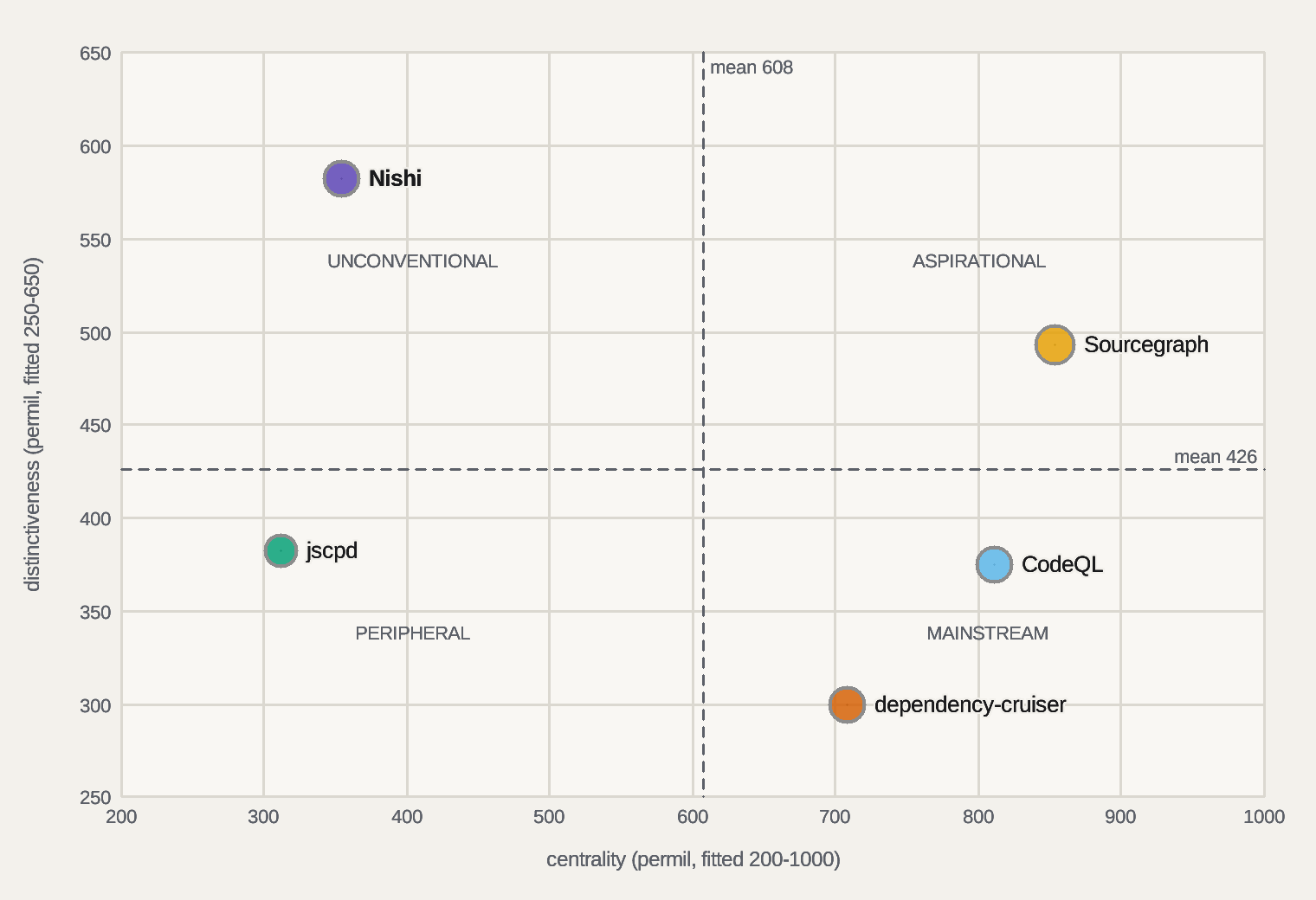
The four-quadrant map the field uses for brand strategy (Dawar and Bagga, HBR June 2015), re-derived from this matrix on every publish. Centrality is the share of the category's feature mass a player covers, each feature weighted by how many hold it; distinctiveness is the average lead over each rival on the rows the player holds; breadth is the depth-weighted share of the whole matrix (the bubble); depth is how deeply the rows held are held; momentum is the day-over-day move off the spine (green rising, red falling, grey until day two); the dashed path runs first day → previous day → today. Dividers are the category means. Axes are fitted to the field of play, so read the tick numerals, not the frame. Rival marks are documented presence, so a rival's position reads the record, never its quality. The picture grades its own readability below; the table beside it is the same data for a screen reader or a second method.
knowledge/compare/genealogy.cdmap (cut|x|y, cube|x|y|z); absent = the HBR defaultsbubble area = breadth · ring = momentum (green rising, red falling, grey until day two) · dashed = category means · axes fitted to the field of play: centrality 200–1000, distinctiveness 250–650 of 0–1000 permil (the full range put every player in one corner)
readability of the 2D cut, self-graded by the layout ruler: label overlaps 0 · labels over marks 0 · off-canvas 0 · unresolved labels 0 · mark overlaps 0 (a fact of the data: two players that close are that close) · data spread 691 permil of the plot · quadrant words unseated 0
text contrast, measured with wcag2-ratio (floors from contrast.conf), light theme: labels 16.24 (floor 4.50) · notes 16.24 (floor 4.50) · quadrant words 5.89 (floor 4.50) · tick numerals 5.89 (floor 4.50) · axis titles 5.59 (floor 4.50) · dark theme: labels 13.78 (floor 4.50) · quadrant words 5.55 (floor 4.50) · axis titles 5.97 (floor 4.50) · dark classes under their floor 0 (one figure serves both themes: a dark shortfall is a token to fix, never a class to hide) · classes refused under their floor 0 (a refused class is not drawn; the scale classes are measured, never hidden) · export: SVG PNG (receipt, rendered by the estate's own rasteriser from this page)

readability of the 3D cube, self-graded by the layout ruler: label overlaps 0 · labels over marks 0 · off-canvas 1 · unresolved labels 0 · mark overlaps 1 (a fact of the data: two players that close are that close) · data spread 338 permil of the plot
10 panels over 5 registered axes, every pair once (the lower axis on x, the higher on y) · each panel fitted to its own field of play, first and last tick numerals shown · no labels in a small cut, the legend names the colours; the grade below reports the mark terms only (MM summed over the panels, spread averaged)
readability of the small multiples, self-graded by the layout ruler: label overlaps 0 · labels over marks 0 · off-canvas 0 · unresolved labels 0 · mark overlaps 3 (a fact of the data: two players that close are that close) · data spread 541 permil of the plot
| Player | Quadrant | centrality | distinctiveness | breadth | depth | momentum | Rows held | Days on spine | First seen |
|---|---|---|---|---|---|---|---|---|---|
| Nishi | Unconventional | 354 | 583 | 333 | 750 | 0 since 2026-09-23 | 8 | 10 | 2026-09-15 |
| Sourcegraph | Aspirational | 854 | 493 | 574 | 794 | 0 since 2026-09-23 | 13 | 10 | 2026-09-15 |
| CodeQL | Mainstream | 812 | 375 | 444 | 666 | 0 since 2026-09-23 | 12 | 10 | 2026-09-15 |
| jscpd | Peripheral | 312 | 383 | 166 | 600 | 0 since 2026-09-23 | 5 | 10 | 2026-09-15 |
| dependency-cruiser | Mainstream | 708 | 300 | 333 | 600 | 0 since 2026-09-23 | 10 | 10 | 2026-09-15 |
| Day | Matrix rows reviewed | Players recorded |
|---|---|---|
| 2026-09-15 | 18 | 5 |
| 2026-09-16 | 18 | 5 |
| 2026-09-17 | 18 | 5 |
| 2026-09-18 | 18 | 5 |
| 2026-09-19 | 18 | 5 |
| 2026-09-20 | 18 | 5 |
| 2026-09-21 | 18 | 5 |
| 2026-09-22 | 18 | 5 |
| 2026-09-23 | 18 | 5 |
| 2026-10-08 | 18 | 5 |
players 5|matrix rows 18|feature mass 48|centrality mean 608|distinctiveness mean 426|axes 5|spine days 10 (shown 10)|rows written today 0|readability defects 2D 0 cube 1|spine knowledge/status/cdmap/genealogy.spine
Capability matrix — measured against source
◉ authored stronger claim; source present● present◐ partial○ absent? unassessed; excluded from relative comparison · click any capability for its evidence
Peer cell coverage: authored assessed 72, unassessed 0. Authored assessments are not verified outcomes.
No capabilities match this filter or search.
| Capability | Nishi | Sourcegraph | CodeQL | jscpd | dependency-cruiser |
|---|---|---|---|---|---|
Organ ancestry and relatedness graphMeasured:gen_relatedness exists in runtime/_hdl_build/nx_genealogist.nx, verified at emit. gen_register + gen_relatedness build the module family-tree (relatedness by shared ancestry); ancestry momentum measured 2673 on the 2026-07-10 radar = the hottest frontier signal; the field tracks references + git blame, not ancestry rival marks uncited — the Yes, Best or Part codes on this row are an observation read with no reference mark behind them Adoption: LIB-WIRED importers=4 nonval=1 — fully adopted (top of its ladder).Pros Implementing source symbol found; runtime acceptance separate; ahead of CodeQL, jscpd, dependency-cruiser; fully adopted on the estate ladderCons none on the measured axes (rival marks are documented presence, not depth) | ● | ● | ○ | ○ | ○ |
Genesis lineage traced to the seedMeasured:gen_register exists in runtime/_hdl_build/nx_genealogist.nx, verified at emit. genesis_lineage.tsv + idea_genealogy.tsv record where a capability CAME FROM (its genesis), not its first commit -- provenance to the root; no code-intel tool ships genesis lineage Adoption: LIB-WIRED importers=4 nonval=1 — fully adopted (top of its ladder).Pros Implementing source symbol found; runtime acceptance separate; ahead of Sourcegraph, CodeQL, jscpd, dependency-cruiser; fully adopted on the estate ladderCons none on the measured axes (rival marks are documented presence, not depth) | ● | ○ | ○ | ○ | ○ |
Caller and blast-radius analysisMeasured:oc_referenced exists in runtime/_hdl_build/nx_organ_callers.nx, verified at emit. Sovereign whole-tree reference search, no timeout on 89k files; powers the checked rename method (22 collisions to 14, zero loss, 2026-06-23); Sourcegraph precise refs lead cross-language rival marks uncited — the Yes, Best or Part codes on this row are an observation read with no reference mark behind them Adoption: LIB-WIRED importers=6 nonval=4 — fully adopted (top of its ladder).Pros Implementing source symbol found; runtime acceptance separate; ahead of CodeQL, jscpd, dependency-cruiser; fully adopted on the estate ladderCons behind Sourcegraph (leads) | ● | ◉ | ◐ | ○ | ◐ |
Duplicate and shadow-name detectionMeasured:jdn_scan exists in runtime/_hdl_build/nx_janitor_dupname.nx, verified at emit. Finds organs that run the WRONG code by name (name-shadowing); jscpd is the token-clone bar [jscpd]; shared with the janitor census Adoption: LIB-WIRED importers=12 nonval=6 — fully adopted (top of its ladder).Pros Implementing source symbol found; runtime acceptance separate; ahead of Sourcegraph, CodeQL, dependency-cruiser; fully adopted on the estate ladderCons behind jscpd (leads) | ● | ○ | ○ | ◉ | ○ |
Prioritized dedup / resolution worklistMeasured:wl_walk exists in runtime/_hdl_build/nx_dupname_worklist.nx, verified at emit. Ranks every collision by external-caller count so the safest are resolved first; the field reports clones, it does not rank the fix order rival marks uncited — the Yes, Best or Part codes on this row are an observation read with no reference mark behind them Adoption: LIB-GATE-ONLY importers=1 — PARTIAL: imported only by validation organs (gates, tests, benches): wire it into a shipping program.Pros Implementing source symbol found; runtime acceptance separate; ahead of Sourcegraph, CodeQL, dependency-cruiserCons not adopted yet: imported only by validation organs (gates, tests, benches): wire it into a shipping program | ● | ○ | ○ | ● | ○ |
Dependency graph of the module treeMeasured:gen_obj_related exists in runtime/_hdl_build/nx_genealogist.nx, verified at emit. lineage_graph.tsv is the sovereign dep graph; dependency-cruiser + Sourcegraph lead on precision + visualization [dependency-cruiser] Adoption: LIB-WIRED importers=4 nonval=1 — fully adopted (top of its ladder).Pros Implementing source symbol found; runtime acceptance separate; ahead of jscpd; fully adopted on the estate ladderCons behind dependency-cruiser (leads) | ● | ● | ● | ○ | ◉ |
Semantic code-graph navigation (go-to-def / refs)Open — watchingruntime/nx_code_graph.nx : cg_goto_def, re-measured on every compare beat. Ship that symbol and this mark flips itself; the comparewatch- plane row flips with it. Sourcegraph cross-repo code intelligence is the bar [sourcegraph-docs]; ours is textual reference search, not a language-server graphPros none measured yetCons behind Sourcegraph (leads), CodeQL, dependency-cruiser; open contract; expected source declaration not established | ○ | ◉ | ● | ○ | ● |
Semantic dataflow / dependency queriesOpen — watchingruntime/nx_codeql_query.nx : cq_dataflow_query, re-measured on every compare beat. Ship that symbol and this mark flips itself; the comparewatch- plane row flips with it. CodeQL treats code as a queryable database (dataflow, taint) [codeql-docs]; we have no query enginePros none measured yetCons behind Sourcegraph, CodeQL (leads), dependency-cruiser; open contract; expected source declaration not established | ○ | ● | ◉ | ○ | ● |
Precise typed call-graph (AST + types)Open — watchingruntime/nx_callgraph_ast.nx : cga_typed_edges, re-measured on every compare beat. Ship that symbol and this mark flips itself; the comparewatch- plane row flips with it. Reference search over-reports (safe but imprecise); a type-resolved call-graph is the named next rung [scip]Pros none measured yetCons behind Sourcegraph (leads), CodeQL (leads), dependency-cruiser; open contract; expected source declaration not established | ○ | ◉ | ◉ | ○ | ● |
Cross-language analysisOpen — watchingruntime/nx_multilang_graph.nx : ml_parse_lang, re-measured on every compare beat. Ship that symbol and this mark flips itself; the comparewatch- plane row flips with it. Sourcegraph/CodeQL span 20+ languages; our genealogy is NishiLang-shaped (extension-level for others) rival marks uncited — the Yes, Best or Part codes on this row are an observation read with no reference mark behind themPros none measured yetCons behind Sourcegraph (leads), CodeQL, jscpd, dependency-cruiser (leads); open contract; expected source declaration not established | ○ | ◉ | ◐ | ◐ | ◉ |
Coupling and cohesion / architecture metricsOpen — watchingruntime/nx_coupling.nx : cpl_coupling_score, re-measured on every compare beat. Ship that symbol and this mark flips itself; the comparewatch- plane row flips with it. NDepend-class coupling scoring; dependency-cruiser rules are partial; absent here rival marks uncited — the Yes, Best or Part codes on this row are an observation read with no reference mark behind themPros none measured yetCons behind Sourcegraph, CodeQL, dependency-cruiser; open contract; expected source declaration not established | ○ | ● | ● | ○ | ◐ |
Clone detection at token / AST granularityOpen — watchingruntime/nx_clone_ast.nx : cla_token_clones, re-measured on every compare beat. Ship that symbol and this mark flips itself; the comparewatch- plane row flips with it. jscpd token-hash clones are the bar; ours is name-shadow only, not body-similarity [roy-cordy2007]Pros none measured yetCons behind Sourcegraph, CodeQL, jscpd; open contract; expected source declaration not established | ○ | ● | ● | ◐ | ○ |
Visual dependency graphOpen — watchingruntime/nx_depgraph_svg.nx : dgs_render_svg, re-measured on every compare beat. Ship that symbol and this mark flips itself; the comparewatch- plane row flips with it. dependency-cruiser + madge render SVG graphs; ours is TSV data, no diagram rival marks uncited — the Yes, Best or Part codes on this row are an observation read with no reference mark behind themPros none measured yetCons behind Sourcegraph (leads), CodeQL, dependency-cruiser; open contract; expected source declaration not established | ○ | ◉ | ● | ○ | ◐ |
SBOM and supply-chain attestationOpen — watchingruntime/nx_sbom_attest.nx : sba_emit_attest, re-measured on every compare beat. Ship that symbol and this mark flips itself; the comparewatch- plane row flips with it. in-toto / SLSA provenance attestation [slsa-spec]; ties to the janitor SBOM gap (mom 1864) and the warden artifact-policy gap [in-toto-attestation]Pros none measured yetCons behind Sourcegraph, CodeQL, dependency-cruiser; open contract; expected source declaration not established | ○ | ● | ◐ | ○ | ● |
Historical churn and hotspot analysisOpen — watchingruntime/nx_churn.nx : ch_hotspot_rank, re-measured on every compare beat. Ship that symbol and this mark flips itself; the comparewatch- plane row flips with it. git-history churn/hotspot (CodeScene-class) [codescene-docs]; we have lineage but not time-series churnPros none measured yetCons behind Sourcegraph (leads), CodeQL; open contract; expected source declaration not established | ○ | ◉ | ● | ○ | ○ |
IDE / CI integrationOpen — watchingruntime/nx_gen_ide.nx : gide_serve, re-measured on every compare beat. Ship that symbol and this mark flips itself; the comparewatch- plane row flips with it. Sourcegraph editor extensions + CodeQL Actions are the bar; our genealogy is console + registry rival marks uncited — the Yes, Best or Part codes on this row are an observation read with no reference mark behind themPros none measured yetCons behind Sourcegraph, CodeQL (leads), jscpd, dependency-cruiser; open contract; expected source declaration not established | ○ | ◐ | ◉ | ● | ◐ |
Genesis provenance to the seed (ancestry to the root, not the first commit)Source present; authored stronger claim:gen_register in runtime/_hdl_build/nx_genealogist.nx, verified at emit. The spore/genesis lineage records a capability's true origin back to the seed idea; git-based tools start at the first commit -- we start at conception Adoption: LIB-WIRED importers=4 nonval=1 — fully adopted (top of its ladder).Pros Source symbol found; stronger capability claim is authored; ahead of Sourcegraph, CodeQL, jscpd, dependency-cruiser; fully adopted on the estate ladderCons none on the measured axes (rival marks are documented presence, not depth) | ◉ | ○ | ○ | ○ | ○ |
Sovereign whole-tree reference search with zero timeoutSource present; authored stronger claim:oc_grep in runtime/_hdl_build/nx_organ_callers.nx, verified at emit. oc_grep walks all 89k files with no external index, no timeout, no SaaS -- the caller/blast-radius engine that made the checked collision resolution possible; the field needs a hosted index Adoption: LIB-WIRED importers=6 nonval=4 — fully adopted (top of its ladder).Pros Source symbol found; stronger capability claim is authored; ahead of Sourcegraph, CodeQL, jscpd, dependency-cruiser; fully adopted on the estate ladderCons none on the measured axes (rival marks are documented presence, not depth) | ◉ | ○ | ○ | ○ | ○ |
| Class | Count | Note |
|---|---|---|
| rows with rival marks | 15 | rows carrying a Yes, Best or Part in a rival column |
| cited | 8 | a reference mark resolves to a pinned mirror |
| uncited | 7 | an observation read, badged until a reference lands |
| rows, summed | 15 | RECONCILED: the parts sum to the total 15 |
Delivery and evidence
Inspect risks, technical debt, rendered observations, experiments and references. Read scope and limitations alongside every result.
Risk register
| Risk | Likelihood x impact | Mitigation |
|---|---|---|
| A typed call-graph that is wrong is worse than the textual one that over-reports safely | possible x high | GN1 done-rule compares against oc_grep as the conservative superset: every precise edge must be in the textual set. |
| Clone detection with a tuned window fires on every boilerplate header | likely x medium | GN5 reads its minimum length as data and publishes precision on a labelled sample of the corpus before ranking. |
Person · product · place — not yet measured for this domain
knowledge/compare/genealogy.ppp (rows surface|nishi or c1..c4|label|url|connect naming OUR live surface and each rival's front door), run nx_ppp_probe domain genealogy, and this section fills itself on the next beat: the same ruler on both sides — privacy and CX (third-party hosts, tracker classes, cookies, security headers), design and longevity (design hygiene, computed WCAG contrast, render-blocking resources, unsized media, script weight, theme and motion queries), findability (landmarks, skip link, on-site search, breadcrumb, headings, internal links).The field — discovered, not chosen
Rows written by nx_field_discover from genealogy.seeds: the industry's own lists (Wikipedia wikitext, GitHub topics, awesome lists) read mechanically, every candidate counted across seeds. The matrix columns above are a SEAT'S pick; this band is the population they were picked from, and the stats line measures one against the other. A rival here is a lead, never a verdict — it earns a column when its capabilities are read and pinned.
| Class | Count | Note |
|---|---|---|
| seeds | 4 | |
| scanned | 4 | |
| fetched | 4 | |
| reused | 0 | |
| failed | 0 | |
| named | 4 | |
| candidates | 4 | |
| mentions | 4 | |
| capped | 0 |
| Rank | Rival | Seeds | Mentions | First seed | Kind | Link |
|---|---|---|---|---|---|---|
| 1 | Sourcegraph | 1 | 1 | col0-sourcegraph | named | https://sourcegraph.com/docs |
| 2 | CodeQL | 1 | 1 | col1-codeql | named | https://codeql.github.com/docs/ |
| 3 | jscpd | 1 | 1 | col2-jscpd | named | https://github.com/kucherenko/jscpd |
| 4 | dependency-cruiser | 1 | 1 | col3-dependency | named | https://github.com/sverweij/dependency-cruiser |
field candidates 4|shown 4 of 4|matrix columns in the field 4 of 4|discovered rivals with no column 0|malformed rows 0 (counted, never rendered)|read-capped 0
Exclusive and shared capabilities
This board grades 17 capabilities: 16 exclusive to it and 1 shared with other boards. Shared rows on this page: 1 = home here 0 + home elsewhere 0 + ambiguous 0 + undecided 1 + refused 0 (partition 1); undecided = unmapped 0 + unproven 1 + unevidenced 0; homonyms 0; since the previous census: new 0, resolved 0. Census FRESH age_s=6494.
| Capability | Organ | Boards grading it | Home | Rule | Evidence | Standing on this board |
|---|---|---|---|---|---|---|
| gen_register | nx_genealogist.nx | genealogy, team | — | none | unproven | undecided |
Gaps from the record — what the estate does that no board carries
The record census (nx_goalmap record) reads the invoked-tool population and every plan queue row and files each organ or directive that NO matrix, plan or gates row names. A row here is a callout the boards missed: adjudicate it onto a board or declare it infrastructure. Census state STALE (age 1395599 s), sources read 4 of 7 declared — a BLIND census is a FLOOR: unread sources can only add rows.
| kind | name | board | source | evidence |
|---|
rows shown 0|this board's directives 0|estate-wide un-boarded organs 452 (listed in full on /compare/ecosystem)|census rows 639|malformed 0 (counted, never rendered)
References
- [sourcegraph-docs] Sourcegraph. Sourcegraph documentation -- Code Search, precise code navigation (go-to-definition, find references), cross-repository code intelligence, editor extensions. Accessed August 2026. publisher · read in our library
knowledge/fetched/cmp_genealogy_sourcegraph-docs.html· pinha221aa6da30b94baab690458850b97a396b9af0912fc217369111aee4ffa05cc· accessed 2026-08-18 · vendor-docGrounds: The Sourcegraph column: Semantic code-graph navigation (go-to-def / refs) and Caller and blast-radius analysis are coded Best (precise refs lead cross-language), with Cross-language analysis, Visual dependency graph and IDE / CI integration -- the hosted-index bar the sovereign oc_grep whole-tree search is contrasted with. - [scip] Sourcegraph. SCIP Code Intelligence Protocol -- the language-agnostic protocol and index format for precise code navigation (successor to LSIF), repository README and protobuf schema. Accessed August 2026. publisher · read in our library
knowledge/fetched/cmp_genealogy_scip.html· pinhf2cb4921b42561b6ba331c068400a32a8d8e57ee6ce881d66bf3be5fb702ffd2· accessed 2026-08-18 · vendor-docGrounds: Semantic code-graph navigation (go-to-def / refs) and Precise typed call-graph (AST + types) -- the concrete artifact behind Sourcegraph's precise navigation: an indexer emits SCIP symbols and occurrences per language, which is the shape the named nx_callgraph_ast rung would have to emit to stop over-reporting from textual reference search. - [codeql-docs] GitHub. CodeQL documentation -- code as a queryable database, the QL language, dataflow and taint-tracking libraries, CodeQL CLI and Actions. Accessed August 2026. publisher · read in our library
knowledge/fetched/cmp_genealogy_codeql-docs.html· pinh2382aa728f3dc76e99dccda526ab166d21fff63c193362f5075512a95ecc3466· accessed 2026-08-18 · vendor-docGrounds: The CodeQL column: Semantic dataflow / dependency queries is coded Best (CodeQL treats code as a queryable database, dataflow and taint) and Precise typed call-graph Best; Nishi has no nx_codeql_query engine, and IDE / CI integration names CodeQL Actions as the bar. - [jscpd] Kucherenko, A. and contributors. jscpd -- copy/paste detector for programming source code (token-hash clone detection across 150+ formats), repository README, v5.x. Accessed August 2026. publisher · read in our library
knowledge/fetched/cmp_genealogy_jscpd.html· pinh778988ea93700d898022461fefc6114b5aa069e73f77303de16f40ddc30a740e· accessed 2026-08-18 · vendor-docGrounds: The jscpd column (bar v5.0.14, npm as-of 2026-08-04): Duplicate and shadow-name detection names jscpd as the token-clone bar and Clone detection at token / AST granularity is coded Part for jscpd and _ABSENT_ for Nishi (name-shadow only, not body similarity). - [dependency-cruiser] Verweij, S. and contributors. dependency-cruiser -- validate and visualise dependencies with rules (forbidden, allowed, orphans, cycles) and dot/SVG graph output for JavaScript, TypeScript and CoffeeScript, repository README, v18.x. Accessed August 2026. publisher · read in our library
knowledge/fetched/cmp_genealogy_dependency-cruiser.html· pinh558b2d7bf1b65ffb7f62c1094615e5aa10b0a3b1081235ba6fea3fd9ee9250e5· accessed 2026-08-18 · vendor-docGrounds: The dependency-cruiser column (bar v18.1.1, npm as-of 2026-08-04): Dependency graph of the module tree (dependency-cruiser + Sourcegraph lead on precision and visualization) and Visual dependency graph (dependency-cruiser + madge render SVG; ours is TSV, no diagram) plus its Part on Coupling and cohesion / architecture metrics via rules. - [slsa-spec] OpenSSF SLSA community. SLSA (Supply-chain Levels for Software Artifacts) specification v1.0 -- build provenance levels L1-L3 and the provenance predicate. Accessed August 2026. publisher · read in our library
knowledge/fetched/cmp_genealogy_slsa-spec.html· pinh94a6630c0ec4310ad583a35c0d4576a35100a027e1e6dbdd6ba0c9484e593247· accessed 2026-08-18 · published-standardGrounds: SBOM and supply-chain attestation -- the note names in-toto / SLSA provenance attestation as the bar; this is the SLSA level specification the _ABSENT_ nx_sbom_attest rung would target, shared with the janitor SBOM gap and the warden artifact-policy gap. - [in-toto-attestation] in-toto project (CNCF). in-toto Attestation Framework -- the Statement, Predicate and DSSE envelope specification for authenticated software supply-chain metadata (repository README and spec). Accessed August 2026. publisher · read in our library
knowledge/fetched/cmp_genealogy_in-toto-attestation.html· pinh69361fea3a6b2f0ea0cc20b74ad55cf6419dc6d4066fc07fd43586389fb27280· accessed 2026-08-18 · published-standardGrounds: SBOM and supply-chain attestation -- the attestation envelope SLSA provenance rides in; the estate already ships nx_coe_intoto and nx_coe_dsse organs, so this spec is the interoperability contract between them and the genealogist's provenance-to-the-seed claim. - [codescene-docs] CodeScene AB. CodeScene documentation -- behavioural code analysis: hotspots, code health, change coupling and knowledge maps from version-control history. Accessed August 2026. publisher · read in our library
knowledge/fetched/cmp_genealogy_codescene-docs.html· pinhfbfbc96aad40eb72cedda5a0449cd9139518171ecf27cf3dbc4f4a61839dbbe8· accessed 2026-08-18 · vendor-docGrounds: Historical churn and hotspot analysis -- the note names git-history churn/hotspot (CodeScene-class) as the bar and Nishi _ABSENT_ (lineage but no time-series churn); these docs define hotspots and change coupling as the measurements an nx_churn rung would reproduce. - [roy-cordy2007] Roy, C.K., Cordy, J.R. A Survey on Software Clone Detection Research. Queen's University School of Computing Technical Report 2007-541, Kingston, Ontario, 2007. Confirmed by search-index read; the queensu.ca host refused the sovereign TLS handshake, so no mirror is claimed. publisher · accessed 2026-08-18 · published-paperGrounds: Clone detection at token / AST granularity -- the survey that fixes the clone taxonomy (Type-1 to Type-4) and the text, token, tree and metrics detection families; jscpd's token-hash approach sits in that taxonomy and the _ABSENT_ nx_clone_ast row is named against it.
generated by nx_swcompare_matrix (sovereign NishiLang organ) from knowledge/compare/genealogy.matrix · source checks show implementation presence; runtime and user-outcome evidence are reported separately · JavaScript supports page controls