Nishi Family › Compare › Family Video Calls
Nishi Compare · capabilities, evidence and delivery
Family Video Calls
Compare capabilities and delivery evidence. Source discovery, qualification, deployment and accepted outcomes are separate; an open contract names work still to verify.
nishifamily.com/video (sovereign codec + relay + crypto, no WebRTC) vs Zoom and Google Meet and FaceTime and Jitsi Meet -- Aug-2026 field
Overview
The purpose, declared position and evidence coverage of this domain. Source presence and completed acceptance are different measures.
Where we are. MEASURED 2026-08-18 against the served client (build 861) and the sovereign organs: 640x480@30 or 480x384@60 adaptive send (MAX_W=640 memory layout), rich-banded K<=4 tile-parallel encode (build 848, disabled in E2EE rooms), SIMD SAD + adaptive motion search (843, 1.73x), rct9 LEAN+MVD (835, -12 to -21 percent bytes vs rct8), SFU with 2-layer simulcast + last-N + dominant speaker, receiver reports, room tokens, Reed-Solomon 8-of-10 FEC, ChaCha20 relay-blind E2EE with an MLS-class ratchet, chat + reactions + screen share, self-healing clients, MOS 4.21 good link / 3.53 congested. Transport is TCP/TLS through the relay (the sovereign QUIC stack is built and gated in isolation, not on the wire). Voice is lossless LPC over ScriptProcessor. No recording of live rooms, no captions, no blur. Codec efficiency +159 percent BD-rate vs x264 (see /compare/videocodec).
Where we need to go. THE OPERATOR'S ASK (2026-08-18): find out why nishifamily.com/video is not SOTA and best of breed, put the answer on /compare and in Nishi PM, and roadmap the climb. THE ANSWER, RANKED BY WHAT THE FAMILY SEES: (1) transport -- every major runs UDP-class media and we run TCP, so loss becomes freezes; (2) resolution ceiling -- the majors send 720p-1080p and we cap at 640x480 by a memory-layout constant while the codec and the band workers can already do 720p; (3) audio -- Opus at 16-32 kbps everywhere versus our ~600 kbps lossless LPC on the deprecated ScriptProcessor path; (4) codec efficiency -- one to two generations behind (H.264-class at +159 percent vs x264, field is AV1-first), closable with H.264-class RTC tools, and explicitly NOT closable by chasing AV2, VVC or neural codecs in 2026 (33x-slower reference, offline-only, GPU-only respectively). The exceed we keep: whole stack sovereign, bit-exact recon-hash conformance, LAN-local zero-middleman, self-healing.
Research bar. Microsoft Teams network planning (the documented major-vendor bar) is measured on 1080p at 30 fps camera video when unconstrained, HD in under 1.5 Mbps, 240p at a 150 kbps floor, audio prioritised over video, media over UDP. Theirs: Documented planning tiers, ms.date 2026-05-26 -- 'up to' figures, not lab-measured delivered resolution. Ours: V1 puts a 720p tier on the ladder gated on measured band budget; V2 moves media to UDP-class transport; V3 drops voice from ~600 kbps to Opus-class so the ladder has bits left for video [teamsnet].
Research bar. The same-instrument head-to-head bar (2026-09-02, 60 s, good link, one akiyo test card with a burned frame index, four referees) is measured on Jitsi Meet SELF-HOSTED on the same host (docker-jitsi-meet, the path-matched bar): 28.8-29.0 fps, 959-969 permil delivered, 0 stalls, 3-19 ms glass-to-glass, 37.0 dB PSNR, SSIM 0.961. LiveKit (livekit-server on the same host, VP8): 17.6-18.7 fps, 585-623 permil, 0 stalls, 46-48 ms, 41.4-41.7 dB, SSIM 0.972. Jitsi public (meet.ffmuc.net, WAN): 29.5-29.7 fps, 146-154 ms. Native WebRTC loopback: 30.0 fps, 999 permil, 20 ms, 43.1 dB. Theirs: The self-hosted Jitsi and LiveKit arms run beside the clients, so their latency is the floor a co-located SFU can reach; our relay is the family NAS reached over the home WAN, which adds the real path. Delivery and fidelity compare outright on every arm. Every referee ran on the same laptop with the same fake camera and the same 20 ms strip reader; the judge is nx_video_h2h and the receipt is video.bench. Ours: Ours on the same card (build 863): 9.9-18.2 fps, 331-607 permil, 39-81 ms, 34.0-35.1 dB, SSIM 0.939-0.947 -- delivery is the gap against Jitsi (10-18 vs 29 fps) and at parity with LiveKit on this host; latency 20-60 ms behind the co-located SFUs; fidelity 2 dB behind Jitsi and 6-7 dB behind LiveKit. The lever is encode throughput: 30-65 ms per frame single-thread with the band pool never arming under the budget rule (V1/V9/V12). EXTERNAL REFEREE on the SAME frame pairs (ffmpeg 7.0 + Netflix libvmaf, the engine MSU VQMT ships for VMAF): VMAF ours 75-83 (864: 75-78), Jitsi self-hosted 91, Jitsi public 73-90, LiveKit 97, WebRTC loopback 98; libvmaf PSNR agrees with the sovereign nx_quality_metric PSNR within 0.01 dB on all eleven arms once the integer-MSE floor was removed (qm_psnr_cdb_exact), and libvmaf SSIM (Gaussian window) sits within 0.011 of the sovereign 8x8-window SSIM -- the sovereign fidelity rulers are now independently validated; VMAF itself stays external until V11 lands [vqmtmetrics] [livekitsvc] [lehacvqad] [msucodecs].
Latest recorded release
2026-09-02 · V9
the abandoned S-class pipeline the operator named is un-dark: nx_sclass_scorecard (0f59a51c), nx_sclass_climb (78a53b61), nx_sclass_grade_report (7da14035) all PROMOTED+REGISTERED+AUTHORISED and INVOKED live -- grade_report prints the honest triangulated standing (boolean-min S-EXCEED-but-narrow, Karatsuba B-behind vs GMP, water-filling A-parity); nx_debt note verb was BUILT but the served binary was BEHIND (usage lacked note), now rebuilt 0af4f6f1 155828 B and PROMOTED so annotations reach the plane
Release entries describe recorded changes; they do not establish that every capability passed evaluation.
18 of 37 capability source symbols found|4 of them authored stronger-claims|19 open|coverage 486/1000|adoption 9 full / 9 partial
Evidence profile — what the gaps on this board actually are
Measured by nx_swcompare_evidence, read back by nx_evprofile_lib. Every figure is a count with its denominator — there is deliberately no score, no grade and no percentage anywhere in this band, because a stored scalar is a field a seat can edit and a counted partition is not.
evidence|grounded 18/23|unsupported 0|gates green 3/3|proven able to fail 2/3|never bitten 1|green at 0/0 0|open gaps 14|of them unnamed 1|of them proof withheld 0|flips ready 0
proven able to fail counts the gates that have a RECORDED RED — nx_gate_bite mutated the gate subject, rebuilt it, watched the gate go red, and that record is inside the shared TTL. never bitten is its complement over the same denominator: those gates ran and were green, and nothing has ever shown them able to detect anything, so their green is a statement about this run and not about the gate. green at 0/0 is a separate and much weaker observation — the gate printed GREEN on a zero denominator, so its own tooth counter says it examined nothing. A gate can be green, non-zero, and still never bitten; that is the common case and it is now visible instead of implied.
partition: grounded + unsupported = 18 vs present 23 · named + unnamed + withheld = 14 vs open 14 · LEAK — these do not sum, and an unexplained residual is a defect in this instrument, not in the board
liar-kill conj=GPQN · all four conjuncts held
graded document: BUILDROOT tree, 21730 bytes · gates map: PRIMARY · stamped 35d 23h ago · STALE against the shared TTL of 604800s — this is evidence about a build nobody can vouch for now · source ../knowledge/status/evstamp_video.verdict
| Gap class | What it is, and the work it names |
|---|---|
| UNNAMED-GAP | A gap row carries a bare _ABSENT_ with no symbol after it, so it names no build contract and no seat can pick it up. Give it an _ABSENT_:<symbol> and it becomes work somebody can do. |
| STALE | This profile is older than the shared TTL, or its clock ran backwards. It is reported as unusable rather than as fresh, because being wrong in the direction of refusing is the safe direction. |
nx_swcompare_evidence video itself and are not carried on the stamp, so this page names the classes and the producer names the rows. That split is stated rather than hidden: a count without a worklist is not actionable, and this band is honest about which half of that it is.Production map
Follow the dependencies, declared acceptance criteria and recorded priorities. Inspect source binding before treating a rank as executable work.
Ranking source binding: STALE_OR_INVALID_BINDING. Recorded priorities require current acceptance evidence and resource checks before execution.
Recorded ranking withheld
Retained ranking is not bound to the current plan and matrix: STALE_OR_INVALID_BINDING. Historical data remains retained. Refresh the ranking after resolving the input differences. Latest execution outcome is unverified.
Declared roadmap — contract, acceptance, executor, effort
| Rung | Closes with | Definition of done (pre-declared) | Executor | Est. |
|---|---|---|---|---|
| HD live tier (1152x640/1024x576 adaptive, derived layout) (V1) | vc_res_tier_hd | LANDED 2026-08-19 build 862, LIVE + gate-proven. Two HD rungs above 640x480 via a SEPARATE export vc_res_tier_hd (vc_res_tier byte-unchanged = drop-in); the whole codec-region layout DERIVES from the core's size exports (vc_slot_yuv/vc_ctx_bytes/... -- no magic hex, mount asserts JS==core), grown to exactly 108 MB, gated on all-peers-862 + deviceMemory>=4. THREE gates GREEN: codec bit-exact roundtrip at 1152x640/1024x576/640x480 (nx_video_client 25/25), the client layout math + roundtrip through its own offsets (7/7), the IIFE loadsmoke (no TDZ). Served wasm byte-identical to the gated build; deployed via nx_content_ship (self-mint + upload + promote + 4 edge verifies). The ceiling = the top BAND-DIVISIBLE tier: 1280x720 (45 MB-rows, no even K) is the next K=2 rung. Ceiling is a ONE-LINE core edit + gate now (VV_MAX_W/H), the potato layout is dead | Organ | 3 est, 1 actual u |
| Fast core-owned congestion control on the TCP/WSS lane (BWE default) (V2a) | vc_bwe_step | LANDED 2026-08-19 build 863, LIVE + gate-proven. AIMD congestion controller moved OUT of app.v2.js INTO the core (vc_bwe_step, beside vc_ladder_step): multiplicative decrease sized by log2 of the queue-overflow ratio (NO magic multiplier), additive-increase recovery counted in ticks (the JS version's 5-tick streak AND 1500ms timer were the same 1.5s twice -- now one signal), run every 300ms tick. DEFAULT ON, kill switch ?bwe=0, safe fallback to the slow ladder if an old cached core lacks the export. DETERMINISTIC gate nx_vc863_bwe 11/11: on a 2Mbps->500kbps drop it CONVERGES (queue drains + holds) with modeled freeze 0.9s vs the old +1-rung/9-tick ladder 6.3s which does NOT converge in the window (~7x shorter); neg-controls (clean link never down-steps, floored room holds at its floor) + derived severity/recovery unit checks all green. NEAR-TERM WSS palliative: it shortens the freeze, it cannot remove TCP head-of-line stalls -- V2 (UDP/QUIC) is the structural fix | Organ | 1 est, 1 actual u |
| QUIC / UDP datagram media leg LIVE (V2) | sig2_quic_dgram | nx_signaling_v2 carries media frames as QUIC DATAGRAMs on a UDP port by composing nx_quic_relay fan-out + nx_quic_fec + nx_quic_recovery; tab clients ride WebTransport, the Nishi browser and NishiOS ride native QUIC; TCP/TLS stays as the fallback lane. Done-rule = the intl_h2h harness (Minsk 150ms/2pct, Kyiv 160/5, Manila 200/3, intl-mobile 180/8) shows frozen-per-30s equal to the FEC arm (0) on the LIVE lane, and the vqoe congested MOS rises above the measured 3.53; a room with a 5 percent-loss member never stalls the others. V2a (build 863) already cut the WSS freeze DURATION ~7x on a modeled drop; V2's job is to remove the stall CLASS entirely, not just shorten it | Organ | 4 u |
| Opus-class lossy voice mode (V3) | nv1_lossy_encode | A sovereign integer perceptual voice mode beside the lossless LPC twin, 16-32 kbps, DTX + the DRED-class redundancy tail composed; judged by the estate's audio ruler against a pre-declared floor relative to the lossless path (no self-grading), bit-exact decode across devices, measured uplink under 40 kbps for voice. Lossless stays selectable for the archival and circles paths | Organ | 3 u |
| AudioWorklet capture and playout (V4) | AudioWorkletNode | Capture and playout move off ScriptProcessorNode onto AudioWorklet; mouth-to-ear measured at or below today's ~21 ms framing path with zero main-thread glitches under a 4-band encode load; the self-flipping comms debt closes on its own | Organ | 1 u |
| Sovereign noise suppression on the live voice path (V5) after V4 | ds_denoise_stream | Owned by comms C10: the spectral-subtraction substrate wired as a stream API with an SNR floor measured on real captured frames; this plan lists it so the audio milestone sums | Organ | 1 u |
| Server-side room recording (V6) | sig2_record_room | Consent-announced relay-side recording of a live room into the private family store, byte-identical replay through the sovereign player, retention conf-named; the circles path is the seed | Organ | 1.5 u |
| Live captions and transcription (V7) after V3 | asr_stream_decode | Sovereign streaming ASR on the NAS or on-device (nx_asr_frontend is the front end), WER on a pre-declared family test set below a declared floor, captions delivered over the relay wire; never a third-party speech API and E2EE content never leaves the trust boundary unencrypted | Local model | 4 u |
| Background blur and virtual background (V8) after V1 | pm_matte_stream | Integer portrait matte on the capture path before the encoder, measured cost under 20 percent of the encode budget at the shipped tier, quality judged by the estate's image referee against a declared floor | Organ | 2.5 u |
| Codec x264-parity arc (larger transforms + full-mode RDO) (V9) after V1 | vc_tx16_forward | Owned by the videocodec lane: 16x16/32x32 transforms and mode+partition RDO on the real range coder, measured on the MSU oracle (ffmpeg Y-PSNR, GOP48 zerolatency), the +159 percent gap vs x264 halved with encode fps above the tier floors; B-frames stay out of scope for RTC | Organ | 4 u |
| Live ops dashboard for sessions (V10) | vo_dashboard | An ops surface consuming the existing fps/bytes/mode/rr beacon and vqoe rows per session (Netflix Atlas class, small); the videoops row flips with it | Organ | 1 u |
| Sovereign VQMT metric parity (VMAF-class perceptual metric first, then NIQE, 3-SSIM, ST-SSIM, MSAD, Delta, VQM, Time shift, Blurring, Blocking, SI, TI) (V11) | qm_vmaf_milli | The sovereign quality oracle the operator designated: 4 of VQMT's 17 documented metrics exist today (PSNR, MSE, SSIM, MS-SSIM); the rung lands a model-free integer perceptual fusion (VIF, DLM, motion) judged against the published VMAF model on the MSU sequences, then the remaining twelve as data-driven metric organs behind nx_quality_metric, each KAT-checked against VQMT's own published reference values [vqmtmetrics] [vqmthelp141] | Organ | 6 u |
| Idle-lane liveness (transmit-only lanes are not zombies) (V12) | laneTxAlive | The client's lane watchdog reaps lanes that received nothing for 2.2 pings; lanes 1 and 2 never receive, so every family member reconnects both lanes every 15 s (measured 8 reconnects a minute per client). Done-rule = the same 60 s probe run shows zero 1006 closes on an idle lane and the relay pongs on every lane it accepts | Organ | 0.5 u |
| 3D and stereoscopic quality oracle (VQMT 3D class) and the stereo call path (V13) after V11 | qm_stereo_score | Beyond 2D: a sovereign stereo metric set (left-right mismatch, depth budget, vertical disparity, channel colour mismatch) mirroring MSU's Video Quality Measurement Tool 3D [vqmttoc], judged on the MSU stereo mismatch dataset, feeding a stereo capture and render path in the sovereign client; FaceTime spatial video is the only rival with a stereo call today | Organ | 6 u |
Milestones
| Milestone | Rungs | Cumulative |
|---|---|---|
| M5 · Quality oracle from 2D to 3D | V11,V13 | 12 u |
| M0 · Freeze-free WAN calls | V2 | 4 u |
| M1 · HD family calls | V1,V2 | 7 u |
| M2 · Audio parity | V3,V4,V5 | 12 u |
| M3 · Feature table-stakes | V6,V7,V8 | 20 u |
| M4 · Codec x264 parity with the exceeds intact | V9,V10 | 24 u |
| Rung | Closes with | Definition of done (pre-declared) | Executor | Est. |
|---|---|---|---|---|
| Reproducible codec and conversation evidence (V14) after V11 | nx_video_h2h | DEFINED 2026-09-12. Reuse quality metric, stage bench, h2h and bench receipt owners. Fix confirmed keyframe clock identifier shadow and NAS input resolution before timing claims. Record reference/capture/render frame IDs, alignment and missing pairs, exact codec/model/library hashes, pixel range/chroma/depth, preset, rate control, hardware and contention. Compare matched delay/bitrate/resource constraints with repeats, distributions and uncertainty; no BD-rate outside overlapping quality range. Add faces, hair, fabric, motion, low light and screen text. Cover audio quality, echo/double talk, AV sync, mouth-to-ear and capture-to-render delay; loss/bursts/jitter/reorder/handoff/resume, freezes and recovery. Unsupported telemetry is unknown. Grade quality and resource costs separately. External oracle parity and representative public outcome required, not symbol presence [rtcstats2026] [rtcquality2026] [visqol2026] | Workflow | Uncalibrated u |
| Research lineage from earliest traceable evidence to current frontier (V15) | nx_research_fetch | DEFINED 2026-09-12. Compose existing fetch, ingest, library, librarian, researcher and Compare owners rather than duplicate services. Retain canonical URL, series identifier, publication/revision/access dates separately, immutable content hash, rights/access limits and retrieval failure. Link cites, extends, corrects, supersedes and contradicts with claim-level evidence. Search publisher index, linked reports and relevant primary repositories for successors; latest means latest found within recorded coverage, never universal certainty. Diff methods, datasets, models, hardware, outcomes and uncertainty before deciding comparability. Preserve predecessors and unknown historical gaps; never invent an origin. Daily resource-aware change checks should schedule affected re-evaluations and emit stale/blocked/reviewed states; prove scheduler and replay before calling autonomous. Source series year 2025 includes an August 31 2026 neural report [msuneural2026] | Workflow | Uncalibrated u |
| Beyond Discord family communication workflows (V16) after V14 | nx_video_h2h | DEFINED 2026-09-12, benchmark requirement not parity. Baselines include Discord, Jitsi and relevant messaging/calling products with dated product versions, plan/region/device and primary claims separate from executed evidence. Test invitation and join friction, persistent text, delivery/order/duplicates, offline sync, edits, media transfer, search, notifications, screen share, accessibility and private controls alongside AV. Verify encryption by content type and membership/key changes; do not infer text encryption from AV encryption [discorddave2026]. Test actual Belarus and Miyazaki routes when endpoints exist; simulated conditions retain neutral network profile names. English/Japanese/Russian/Belarusian captions and translation require streaming delay, semantic errors, names/negation/code-switch and native-speaker review. Optional learning/conversation suggestions are identified as suggestions, not attributed speech. Human acceptance measures task completion, connection, enjoyment and learning, with privacy-preserving evidence. No observed Discord comparison run yet. | Workflow | Uncalibrated u |
| One-step communication qualification and supervised improvement (V17) after V14,V15,V16 | nx_swcompare_evidence | DEFINED 2026-09-12. Level 1 callable primitives expose capture, codec, transport, quality and evidence. Level 2 one-call workflows run declared scenarios with fixture/version pins and publish replayable receipts. Level 3 supervised agents select bounded work from evidence, propose isolated fixes, run independent gates and promote alpha to beta only after actual served review; production follows acceptance. Reuse existing catalogue and release surfaces, not per-change pages. Daily refresh records checked time, coverage, freshness policy, resource budget and next action; no unexercised autonomous pass. Show missing evidence and reviewer effort in ROI; never trade quality away silently. | Team | Uncalibrated u |
| YouTube transcripts fetched sovereignly and provenance-stamped (V18) after V15 | nx_yt_transcript | SHIPPED 2026-09-18. nx_yt_transcript composes the visionOS InnerTube client (nx_yt_captions_lib over the estate TLS-1.3 stack) to obtain a captionTracks baseUrl that serves without a proof-of-origin token, parses json3 and srv1 timedtext into startMs durMs text rows with HTML entities decoded, writes knowledge/fetched/yt_<id>.<lang>.transcript.txt and appends a prov row in the exact shape nx_research_fetch uses. Measured wall: the WEB timedtext baseUrl returns an empty 200 (pot token required) and the ANDROID_VR InnerTube client returns LOGIN_REQUIRED (bot check); the visionOS client (X-Youtube-Client-Name 101, captured from yt-dlp traffic) is the working route. Refereed against yt-dlp json3 at 1000 permil text agreement over 2057 of 2057 segments; nx_yt_transcript_gate 15 of 15 GREEN with a neg-control that an empty 200 body is REFUSED-EMPTY-BODY by name. Both pinned skull lectures on the aesthetictwin board are transcribed and cited. | Organ | 0 u |
| Class | Count | Note |
|---|---|---|
| bars | 0 | sotabar rows on the plan |
| fresh | 0 | the bar month is the current month |
| attested | 0 | an older bar with a this-month barscan reporting no newer entry |
| stale | 0 | a this-month scan saw a newer month the bar ignores |
| unattested | 0 | nobody looked this month |
| malformed | 0 | a sotabar row missing a field |
| duplicate | 0 | bar ids an earlier row already carries |
| bars, summed | 0 | RECONCILED: the parts sum to the total 0 |
| current month | 2026-10 | the month every bar is judged against |
Inspect a rung and its prerequisites
Declared nodes 19. Rank input binding: STALE_OR_INVALID_BINDING. Dependency order is authored. Implementation, acceptance evidence, authority and resource readiness are unverified. No action is recommended or dispatched here.
Plan SHA-256 45f32c0a3e567fd21c7ca3385368b23d485bf27a526f5d4926045ffa0a13cee6. Target rows 0; role rows 0. Existing risks and release worklog retain their own scope; no node completion is inferred.
Runtime observation coverage: 0 of 19 rungs have current, identity-bound execution observations. Observation may report RED. Accepted completion remains unknown; source presence, qualification and deployment do not establish it.
Use Enter or Space on a rung to inspect its contract. Prerequisite links locate another rung in this list; open its summary to inspect it. Estimates are authored effort, not forecasts.
V1 — HD live tier (1152x640/1024x576 adaptive, derived layout)
Prerequisites: None declared; this does not establish execution eligibility.
Contract:
vc_res_tier_hdAcceptance: LANDED 2026-08-19 build 862, LIVE + gate-proven. Two HD rungs above 640x480 via a SEPARATE export vc_res_tier_hd (vc_res_tier byte-unchanged = drop-in); the whole codec-region layout DERIVES from the core's size exports (vc_slot_yuv/vc_ctx_bytes/... -- no magic hex, mount asserts JS==core), grown to exactly 108 MB, gated on all-peers-862 + deviceMemory>=4. THREE gates GREEN: codec bit-exact roundtrip at 1152x640/1024x576/640x480 (nx_video_client 25/25), the client layout math + roundtrip through its own offsets (7/7), the IIFE loadsmoke (no TDZ). Served wasm byte-identical to the gated build; deployed via nx_content_ship (self-mint + upload + promote + 4 edge verifies). The ceiling = the top BAND-DIVISIBLE tier: 1280x720 (45 MB-rows, no even K) is the next K=2 rung. Ceiling is a ONE-LINE core edit + gate now (VV_MAX_W/H), the potato layout is dead
Authored effort: 3 est, 1 actual. Executor kind: Organ. Responsible, accountable and verifier not established. Inspect retained worklog.
Runtime observation: UNKNOWN; outcome UNKNOWN; observed epoch -1. Declared owner: . Receipt
, SHA-256. Identity-bound observation is not accepted completion. Qualification and deployment remain unverified by this projection.V2a — Fast core-owned congestion control on the TCP/WSS lane (BWE default)
Prerequisites: None declared; this does not establish execution eligibility.
Contract:
vc_bwe_stepAcceptance: LANDED 2026-08-19 build 863, LIVE + gate-proven. AIMD congestion controller moved OUT of app.v2.js INTO the core (vc_bwe_step, beside vc_ladder_step): multiplicative decrease sized by log2 of the queue-overflow ratio (NO magic multiplier), additive-increase recovery counted in ticks (the JS version's 5-tick streak AND 1500ms timer were the same 1.5s twice -- now one signal), run every 300ms tick. DEFAULT ON, kill switch ?bwe=0, safe fallback to the slow ladder if an old cached core lacks the export. DETERMINISTIC gate nx_vc863_bwe 11/11: on a 2Mbps->500kbps drop it CONVERGES (queue drains + holds) with modeled freeze 0.9s vs the old +1-rung/9-tick ladder 6.3s which does NOT converge in the window (~7x shorter); neg-controls (clean link never down-steps, floored room holds at its floor) + derived severity/recovery unit checks all green. NEAR-TERM WSS palliative: it shortens the freeze, it cannot remove TCP head-of-line stalls -- V2 (UDP/QUIC) is the structural fix
Authored effort: 1 est, 1 actual. Executor kind: Organ. Responsible, accountable and verifier not established. Inspect retained worklog.
Runtime observation: UNKNOWN; outcome UNKNOWN; observed epoch -1. Declared owner: . Receipt
, SHA-256. Identity-bound observation is not accepted completion. Qualification and deployment remain unverified by this projection.V2 — QUIC / UDP datagram media leg LIVE
Prerequisites: None declared; this does not establish execution eligibility.
Contract:
sig2_quic_dgramAcceptance: nx_signaling_v2 carries media frames as QUIC DATAGRAMs on a UDP port by composing nx_quic_relay fan-out + nx_quic_fec + nx_quic_recovery; tab clients ride WebTransport, the Nishi browser and NishiOS ride native QUIC; TCP/TLS stays as the fallback lane. Done-rule = the intl_h2h harness (Minsk 150ms/2pct, Kyiv 160/5, Manila 200/3, intl-mobile 180/8) shows frozen-per-30s equal to the FEC arm (0) on the LIVE lane, and the vqoe congested MOS rises above the measured 3.53; a room with a 5 percent-loss member never stalls the others. V2a (build 863) already cut the WSS freeze DURATION ~7x on a modeled drop; V2's job is to remove the stall CLASS entirely, not just shorten it
Authored effort: 4. Executor kind: Organ. Responsible, accountable and verifier not established. Inspect retained worklog.
Runtime observation: UNKNOWN; outcome UNKNOWN; observed epoch -1. Declared owner: . Receipt
, SHA-256. Identity-bound observation is not accepted completion. Qualification and deployment remain unverified by this projection.V3 — Opus-class lossy voice mode
Prerequisites: None declared; this does not establish execution eligibility.
Contract:
nv1_lossy_encodeAcceptance: A sovereign integer perceptual voice mode beside the lossless LPC twin, 16-32 kbps, DTX + the DRED-class redundancy tail composed; judged by the estate's audio ruler against a pre-declared floor relative to the lossless path (no self-grading), bit-exact decode across devices, measured uplink under 40 kbps for voice. Lossless stays selectable for the archival and circles paths
Authored effort: 3. Executor kind: Organ. Responsible, accountable and verifier not established. Inspect retained worklog.
Runtime observation: UNKNOWN; outcome UNKNOWN; observed epoch -1. Declared owner: . Receipt
, SHA-256. Identity-bound observation is not accepted completion. Qualification and deployment remain unverified by this projection.V4 — AudioWorklet capture and playout
Prerequisites: None declared; this does not establish execution eligibility.
Contract:
AudioWorkletNodeAcceptance: Capture and playout move off ScriptProcessorNode onto AudioWorklet; mouth-to-ear measured at or below today's ~21 ms framing path with zero main-thread glitches under a 4-band encode load; the self-flipping comms debt closes on its own
Authored effort: 1. Executor kind: Organ. Responsible, accountable and verifier not established. Inspect retained worklog.
Runtime observation: UNKNOWN; outcome UNKNOWN; observed epoch -1. Declared owner: . Receipt
, SHA-256. Identity-bound observation is not accepted completion. Qualification and deployment remain unverified by this projection.V5 — Sovereign noise suppression on the live voice path
Prerequisites: V4 (acceptance unverified)
Contract:
ds_denoise_streamAcceptance: Owned by comms C10: the spectral-subtraction substrate wired as a stream API with an SNR floor measured on real captured frames; this plan lists it so the audio milestone sums
Authored effort: 1. Executor kind: Organ. Responsible, accountable and verifier not established. Inspect retained worklog.
Runtime observation: UNKNOWN; outcome UNKNOWN; observed epoch -1. Declared owner: . Receipt
, SHA-256. Identity-bound observation is not accepted completion. Qualification and deployment remain unverified by this projection.V6 — Server-side room recording
Prerequisites: None declared; this does not establish execution eligibility.
Contract:
sig2_record_roomAcceptance: Consent-announced relay-side recording of a live room into the private family store, byte-identical replay through the sovereign player, retention conf-named; the circles path is the seed
Authored effort: 1.5. Executor kind: Organ. Responsible, accountable and verifier not established. Inspect retained worklog.
Runtime observation: UNKNOWN; outcome UNKNOWN; observed epoch -1. Declared owner: . Receipt
, SHA-256. Identity-bound observation is not accepted completion. Qualification and deployment remain unverified by this projection.V7 — Live captions and transcription
Prerequisites: V3 (acceptance unverified)
Contract:
asr_stream_decodeAcceptance: Sovereign streaming ASR on the NAS or on-device (nx_asr_frontend is the front end), WER on a pre-declared family test set below a declared floor, captions delivered over the relay wire; never a third-party speech API and E2EE content never leaves the trust boundary unencrypted
Authored effort: 4. Executor kind: Local model. Responsible, accountable and verifier not established. Inspect retained worklog.
Runtime observation: UNKNOWN; outcome UNKNOWN; observed epoch -1. Declared owner: . Receipt
, SHA-256. Identity-bound observation is not accepted completion. Qualification and deployment remain unverified by this projection.V8 — Background blur and virtual background
Prerequisites: V1 (acceptance unverified)
Contract:
pm_matte_streamAcceptance: Integer portrait matte on the capture path before the encoder, measured cost under 20 percent of the encode budget at the shipped tier, quality judged by the estate's image referee against a declared floor
Authored effort: 2.5. Executor kind: Organ. Responsible, accountable and verifier not established. Inspect retained worklog.
Runtime observation: UNKNOWN; outcome UNKNOWN; observed epoch -1. Declared owner: . Receipt
, SHA-256. Identity-bound observation is not accepted completion. Qualification and deployment remain unverified by this projection.V9 — Codec x264-parity arc (larger transforms + full-mode RDO)
Prerequisites: V1 (acceptance unverified)
Contract:
vc_tx16_forwardAcceptance: Owned by the videocodec lane: 16x16/32x32 transforms and mode+partition RDO on the real range coder, measured on the MSU oracle (ffmpeg Y-PSNR, GOP48 zerolatency), the +159 percent gap vs x264 halved with encode fps above the tier floors; B-frames stay out of scope for RTC
Authored effort: 4. Executor kind: Organ. Responsible, accountable and verifier not established. Inspect retained worklog.
Runtime observation: UNKNOWN; outcome UNKNOWN; observed epoch -1. Declared owner: . Receipt
, SHA-256. Identity-bound observation is not accepted completion. Qualification and deployment remain unverified by this projection.V10 — Live ops dashboard for sessions
Prerequisites: None declared; this does not establish execution eligibility.
Contract:
vo_dashboardAcceptance: An ops surface consuming the existing fps/bytes/mode/rr beacon and vqoe rows per session (Netflix Atlas class, small); the videoops row flips with it
Authored effort: 1. Executor kind: Organ. Responsible, accountable and verifier not established. Inspect retained worklog.
Runtime observation: UNKNOWN; outcome UNKNOWN; observed epoch -1. Declared owner: . Receipt
, SHA-256. Identity-bound observation is not accepted completion. Qualification and deployment remain unverified by this projection.V11 — Sovereign VQMT metric parity (VMAF-class perceptual metric first, then NIQE, 3-SSIM, ST-SSIM, MSAD, Delta, VQM, Time shift, Blurring, Blocking, SI, TI)
Prerequisites: None declared; this does not establish execution eligibility.
Contract:
qm_vmaf_milliAcceptance: The sovereign quality oracle the operator designated: 4 of VQMT's 17 documented metrics exist today (PSNR, MSE, SSIM, MS-SSIM); the rung lands a model-free integer perceptual fusion (VIF, DLM, motion) judged against the published VMAF model on the MSU sequences, then the remaining twelve as data-driven metric organs behind nx_quality_metric, each KAT-checked against VQMT's own published reference values [@vqmtmetrics] [@vqmthelp141]
Authored effort: 6. Executor kind: Organ. Responsible, accountable and verifier not established. Inspect retained worklog.
Runtime observation: UNKNOWN; outcome UNKNOWN; observed epoch -1. Declared owner: . Receipt
, SHA-256. Identity-bound observation is not accepted completion. Qualification and deployment remain unverified by this projection.V12 — Idle-lane liveness (transmit-only lanes are not zombies)
Prerequisites: None declared; this does not establish execution eligibility.
Contract:
laneTxAliveAcceptance: The client's lane watchdog reaps lanes that received nothing for 2.2 pings; lanes 1 and 2 never receive, so every family member reconnects both lanes every 15 s (measured 8 reconnects a minute per client). Done-rule = the same 60 s probe run shows zero 1006 closes on an idle lane and the relay pongs on every lane it accepts
Authored effort: 0.5. Executor kind: Organ. Responsible, accountable and verifier not established. Inspect retained worklog.
Runtime observation: UNKNOWN; outcome UNKNOWN; observed epoch -1. Declared owner: . Receipt
, SHA-256. Identity-bound observation is not accepted completion. Qualification and deployment remain unverified by this projection.V13 — 3D and stereoscopic quality oracle (VQMT 3D class) and the stereo call path
Prerequisites: V11 (acceptance unverified)
Contract:
qm_stereo_scoreAcceptance: Beyond 2D: a sovereign stereo metric set (left-right mismatch, depth budget, vertical disparity, channel colour mismatch) mirroring MSU's Video Quality Measurement Tool 3D [@vqmttoc], judged on the MSU stereo mismatch dataset, feeding a stereo capture and render path in the sovereign client; FaceTime spatial video is the only rival with a stereo call today
Authored effort: 6. Executor kind: Organ. Responsible, accountable and verifier not established. Inspect retained worklog.
Runtime observation: UNKNOWN; outcome UNKNOWN; observed epoch -1. Declared owner: . Receipt
, SHA-256. Identity-bound observation is not accepted completion. Qualification and deployment remain unverified by this projection.V14 — Reproducible codec and conversation evidence
Prerequisites: V11 (acceptance unverified)
Contract:
nx_video_h2hAcceptance: DEFINED 2026-09-12. Reuse quality metric, stage bench, h2h and bench receipt owners. Fix confirmed keyframe clock identifier shadow and NAS input resolution before timing claims. Record reference/capture/render frame IDs, alignment and missing pairs, exact codec/model/library hashes, pixel range/chroma/depth, preset, rate control, hardware and contention. Compare matched delay/bitrate/resource constraints with repeats, distributions and uncertainty; no BD-rate outside overlapping quality range. Add faces, hair, fabric, motion, low light and screen text. Cover audio quality, echo/double talk, AV sync, mouth-to-ear and capture-to-render delay; loss/bursts/jitter/reorder/handoff/resume, freezes and recovery. Unsupported telemetry is unknown. Grade quality and resource costs separately. External oracle parity and representative public outcome required, not symbol presence [@rtcstats2026] [@rtcquality2026] [@visqol2026]
Authored effort: Uncalibrated. Executor kind: Workflow. Responsible, accountable and verifier not established. Inspect retained worklog.
Runtime observation: UNKNOWN; outcome UNKNOWN; observed epoch -1. Declared owner: . Receipt
, SHA-256. Identity-bound observation is not accepted completion. Qualification and deployment remain unverified by this projection.V15 — Research lineage from earliest traceable evidence to current frontier
Prerequisites: None declared; this does not establish execution eligibility.
Contract:
nx_research_fetchAcceptance: DEFINED 2026-09-12. Compose existing fetch, ingest, library, librarian, researcher and Compare owners rather than duplicate services. Retain canonical URL, series identifier, publication/revision/access dates separately, immutable content hash, rights/access limits and retrieval failure. Link cites, extends, corrects, supersedes and contradicts with claim-level evidence. Search publisher index, linked reports and relevant primary repositories for successors; latest means latest found within recorded coverage, never universal certainty. Diff methods, datasets, models, hardware, outcomes and uncertainty before deciding comparability. Preserve predecessors and unknown historical gaps; never invent an origin. Daily resource-aware change checks should schedule affected re-evaluations and emit stale/blocked/reviewed states; prove scheduler and replay before calling autonomous. Source series year 2025 includes an August 31 2026 neural report [@msuneural2026]
Authored effort: Uncalibrated. Executor kind: Workflow. Responsible, accountable and verifier not established. Inspect retained worklog.
Runtime observation: UNKNOWN; outcome UNKNOWN; observed epoch -1. Declared owner: . Receipt
, SHA-256. Identity-bound observation is not accepted completion. Qualification and deployment remain unverified by this projection.V16 — Beyond Discord family communication workflows
Prerequisites: V14 (acceptance unverified)
Contract:
nx_video_h2hAcceptance: DEFINED 2026-09-12, benchmark requirement not parity. Baselines include Discord, Jitsi and relevant messaging/calling products with dated product versions, plan/region/device and primary claims separate from executed evidence. Test invitation and join friction, persistent text, delivery/order/duplicates, offline sync, edits, media transfer, search, notifications, screen share, accessibility and private controls alongside AV. Verify encryption by content type and membership/key changes; do not infer text encryption from AV encryption [@discorddave2026]. Test actual Belarus and Miyazaki routes when endpoints exist; simulated conditions retain neutral network profile names. English/Japanese/Russian/Belarusian captions and translation require streaming delay, semantic errors, names/negation/code-switch and native-speaker review. Optional learning/conversation suggestions are identified as suggestions, not attributed speech. Human acceptance measures task completion, connection, enjoyment and learning, with privacy-preserving evidence. No observed Discord comparison run yet.
Authored effort: Uncalibrated. Executor kind: Workflow. Responsible, accountable and verifier not established. Inspect retained worklog.
Runtime observation: UNKNOWN; outcome UNKNOWN; observed epoch -1. Declared owner: . Receipt
, SHA-256. Identity-bound observation is not accepted completion. Qualification and deployment remain unverified by this projection.V17 — One-step communication qualification and supervised improvement
Prerequisites: V14 (acceptance unverified), V15 (acceptance unverified), V16 (acceptance unverified)
Contract:
nx_swcompare_evidenceAcceptance: DEFINED 2026-09-12. Level 1 callable primitives expose capture, codec, transport, quality and evidence. Level 2 one-call workflows run declared scenarios with fixture/version pins and publish replayable receipts. Level 3 supervised agents select bounded work from evidence, propose isolated fixes, run independent gates and promote alpha to beta only after actual served review; production follows acceptance. Reuse existing catalogue and release surfaces, not per-change pages. Daily refresh records checked time, coverage, freshness policy, resource budget and next action; no unexercised autonomous pass. Show missing evidence and reviewer effort in ROI; never trade quality away silently.
Authored effort: Uncalibrated. Executor kind: Team. Responsible, accountable and verifier not established. Inspect retained worklog.
Runtime observation: UNKNOWN; outcome UNKNOWN; observed epoch -1. Declared owner: . Receipt
, SHA-256. Identity-bound observation is not accepted completion. Qualification and deployment remain unverified by this projection.V18 — YouTube transcripts fetched sovereignly and provenance-stamped
Prerequisites: V15 (acceptance unverified)
Contract:
nx_yt_transcriptAcceptance: SHIPPED 2026-09-18. nx_yt_transcript composes the visionOS InnerTube client (nx_yt_captions_lib over the estate TLS-1.3 stack) to obtain a captionTracks baseUrl that serves without a proof-of-origin token, parses json3 and srv1 timedtext into startMs durMs text rows with HTML entities decoded, writes knowledge/fetched/yt_<id>.<lang>.transcript.txt and appends a prov row in the exact shape nx_research_fetch uses. Measured wall: the WEB timedtext baseUrl returns an empty 200 (pot token required) and the ANDROID_VR InnerTube client returns LOGIN_REQUIRED (bot check); the visionOS client (X-Youtube-Client-Name 101, captured from yt-dlp traffic) is the working route. Refereed against yt-dlp json3 at 1000 permil text agreement over 2057 of 2057 segments; nx_yt_transcript_gate 15 of 15 GREEN with a neg-control that an empty 200 body is REFUSED-EMPTY-BODY by name. Both pinned skull lectures on the aesthetictwin board are transcribed and cited.
Authored effort: 0. Executor kind: Organ. Responsible, accountable and verifier not established. Inspect retained worklog.
Runtime observation: UNKNOWN; outcome UNKNOWN; observed epoch -1. Declared owner: . Receipt
, SHA-256. Identity-bound observation is not accepted completion. Qualification and deployment remain unverified by this projection.
Learning and practice paths
No structured learning path is declared for this plan. Existing research, roadmap and worklog remain available above.
Rung dossiers — every record that bears on a rung, in one place
nx_swcompare_evidence video writes it beside its stamp); every gate below reads UNRECORDED until it runs.knowledge/organ_gate.conf read from this working directory (1 rows) and from the estate root (196 rows); rows in both counted once: 0; declarations read: 197. Every declaration in either copy counts, so a stub beside the publisher can never hide the root.V1 HD live tier (1152x640/1024x576 adaptive, derived layout) · cell PRESENT · gate NO-GATE-DECLARED
| Contract | vc_res_tier_hd · executor Organ · 3 est, 1 actual u · stands on nothing |
|---|---|
| Definition of done | LANDED 2026-08-19 build 862, LIVE + gate-proven. Two HD rungs above 640x480 via a SEPARATE export vc_res_tier_hd (vc_res_tier byte-unchanged = drop-in); the whole codec-region layout DERIVES from the core's size exports (vc_slot_yuv/vc_ctx_bytes/... -- no magic hex, mount asserts JS==core), grown to exactly 108 MB, gated on all-peers-862 + deviceMemory>=4. THREE gates GREEN: codec bit-exact roundtrip at 1152x640/1024x576/640x480 (nx_video_client 25/25), the client layout math + roundtrip through its own offsets (7/7), the IIFE loadsmoke (no TDZ). Served wasm byte-identical to the gated build; deployed via nx_content_ship (self-mint + upload + promote + 4 edge verifies). The ceiling = the top BAND-DIVISIBLE tier: 1280x720 (45 MB-rows, no even K) is the next K=2 rung. Ceiling is a ONE-LINE core edit + gate now (VV_MAX_W/H), the potato layout is dead |
| Matrix cell | LIVE: Send resolution ceiling (HD adaptive) · runtime/nx_video_client_wasm.nx · PRESENT decl |
| Gate | NO-GATE-DECLARED — knowledge/organ_gate.conf carries no row for nx_video_client_wasm; declare nx_video_client_wasm TAB <gate> and the ship loop proves it and the verdict lands here. |
| Work log | no log row names this rung yet |
V2a Fast core-owned congestion control on the TCP/WSS lane (BWE default) · cell PRESENT · gate NO-GATE-DECLARED
| Contract | vc_bwe_step · executor Organ · 1 est, 1 actual u · stands on nothing |
|---|---|
| Definition of done | LANDED 2026-08-19 build 863, LIVE + gate-proven. AIMD congestion controller moved OUT of app.v2.js INTO the core (vc_bwe_step, beside vc_ladder_step): multiplicative decrease sized by log2 of the queue-overflow ratio (NO magic multiplier), additive-increase recovery counted in ticks (the JS version's 5-tick streak AND 1500ms timer were the same 1.5s twice -- now one signal), run every 300ms tick. DEFAULT ON, kill switch ?bwe=0, safe fallback to the slow ladder if an old cached core lacks the export. DETERMINISTIC gate nx_vc863_bwe 11/11: on a 2Mbps->500kbps drop it CONVERGES (queue drains + holds) with modeled freeze 0.9s vs the old +1-rung/9-tick ladder 6.3s which does NOT converge in the window (~7x shorter); neg-controls (clean link never down-steps, floored room holds at its floor) + derived severity/recovery unit checks all green. NEAR-TERM WSS palliative: it shortens the freeze, it cannot remove TCP head-of-line stalls -- V2 (UDP/QUIC) is the structural fix |
| Matrix cell | TRANSPORT: Congestion control (fast reaction to a narrowing pipe) · runtime/nx_video_client_wasm.nx · PRESENT decl |
| Gate | NO-GATE-DECLARED — knowledge/organ_gate.conf carries no row for nx_video_client_wasm; declare nx_video_client_wasm TAB <gate> and the ship loop proves it and the verdict lands here. |
| Work log | no log row names this rung yet |
V2 QUIC / UDP datagram media leg LIVE · cell WATCHING · gate NO-GATE-DECLARED
| Contract | sig2_quic_dgram · executor Organ · 4 u · stands on nothing |
|---|---|
| Definition of done | nx_signaling_v2 carries media frames as QUIC DATAGRAMs on a UDP port by composing nx_quic_relay fan-out + nx_quic_fec + nx_quic_recovery; tab clients ride WebTransport, the Nishi browser and NishiOS ride native QUIC; TCP/TLS stays as the fallback lane. Done-rule = the intl_h2h harness (Minsk 150ms/2pct, Kyiv 160/5, Manila 200/3, intl-mobile 180/8) shows frozen-per-30s equal to the FEC arm (0) on the LIVE lane, and the vqoe congested MOS rises above the measured 3.53; a room with a 5 percent-loss member never stalls the others. V2a (build 863) already cut the WSS freeze DURATION ~7x on a modeled drop; V2's job is to remove the stall CLASS entirely, not just shorten it |
| Matrix cell | TRANSPORT: UDP / QUIC datagram media leg (no head-of-line stall on loss) · runtime/_hdl_build/nx_signaling_v2.nx · WATCHING decl |
| Gate | NO-GATE-DECLARED — knowledge/organ_gate.conf carries no row for nx_signaling_v2; declare nx_signaling_v2 TAB <gate> and the ship loop proves it and the verdict lands here. |
| Work log | 2026-09-12 requirement OPERATOR REQUIREMENT 2026-09-12, NOT A MEASURED NETWORK RESULT: family acceptance includes the operator's sons calling their girlfriends in Belarus and Miyazaki. Prioritize private reliable calls, easy joining, usable audio and video, and recovery after interruption; then messaging, shared media and notifications so everyday family communication can move beyond Telegram and Instagram. Country and city names identify intended acceptance routes only: no route latency, access, privacy setting or delivered quality is claimed until witnessed on those routes. Reuse the existing Video, comms and product owners; retain codec and transport comparison requirements alongside these user journeys. |
V3 Opus-class lossy voice mode · cell WATCHING · gate NO-GATE-DECLARED
| Contract | nv1_lossy_encode · executor Organ · 3 u · stands on nothing |
|---|---|
| Definition of done | A sovereign integer perceptual voice mode beside the lossless LPC twin, 16-32 kbps, DTX + the DRED-class redundancy tail composed; judged by the estate's audio ruler against a pre-declared floor relative to the lossless path (no self-grading), bit-exact decode across devices, measured uplink under 40 kbps for voice. Lossless stays selectable for the archival and circles paths |
| Matrix cell | AUDIO: Opus-class low-bitrate voice (lossy perceptual, 16-32 kbps) · runtime/nx_nv1_lpc.nx · WATCHING decl |
| Gate | NO-GATE-DECLARED — knowledge/organ_gate.conf carries no row for nx_nv1_lpc; declare nx_nv1_lpc TAB <gate> and the ship loop proves it and the verdict lands here. |
| Work log | no log row names this rung yet |
V4 AudioWorklet capture and playout · cell WATCHING · gate NO-GATE-DECLARED
| Contract | AudioWorkletNode · executor Organ · 1 u · stands on nothing |
|---|---|
| Definition of done | Capture and playout move off ScriptProcessorNode onto AudioWorklet; mouth-to-ear measured at or below today's ~21 ms framing path with zero main-thread glitches under a 4-band encode load; the self-flipping comms debt closes on its own |
| Matrix cell | AUDIO: AudioWorklet capture and playout (low latency, off the main thread) · ../sites/nishifamily/video/app.v2.js · WATCHING jsdecl |
| Gate | NO-GATE-DECLARED — knowledge/organ_gate.conf carries no row for app.v2; declare app.v2 TAB <gate> and the ship loop proves it and the verdict lands here. |
| Work log | no log row names this rung yet |
V5 Sovereign noise suppression on the live voice path · cell WATCHING · gate NO-GATE-DECLARED
| Contract | ds_denoise_stream · executor Organ · 1 u · stands on V4 |
|---|---|
| Definition of done | Owned by comms C10: the spectral-subtraction substrate wired as a stream API with an SNR floor measured on real captured frames; this plan lists it so the audio milestone sums |
| Matrix cell | AUDIO: Sovereign noise suppression on the live voice path (comms C10, rung V5) · runtime/nx_denoise_spectral.nx · WATCHING decl |
| Gate | NO-GATE-DECLARED — knowledge/organ_gate.conf carries no row for nx_denoise_spectral; declare nx_denoise_spectral TAB <gate> and the ship loop proves it and the verdict lands here. |
| Work log | no log row names this rung yet |
V6 Server-side room recording · cell WATCHING · gate NO-GATE-DECLARED
| Contract | sig2_record_room · executor Organ · 1.5 u · stands on nothing |
|---|---|
| Definition of done | Consent-announced relay-side recording of a live room into the private family store, byte-identical replay through the sovereign player, retention conf-named; the circles path is the seed |
| Matrix cell | FEATURE: Call recording (server-side) · runtime/_hdl_build/nx_signaling_v2.nx · WATCHING decl |
| Gate | NO-GATE-DECLARED — knowledge/organ_gate.conf carries no row for nx_signaling_v2; declare nx_signaling_v2 TAB <gate> and the ship loop proves it and the verdict lands here. |
| Work log | no log row names this rung yet |
V7 Live captions and transcription · cell WATCHING · gate NO-GATE-DECLARED
| Contract | asr_stream_decode · executor Local model · 4 u · stands on V3 |
|---|---|
| Definition of done | Sovereign streaming ASR on the NAS or on-device (nx_asr_frontend is the front end), WER on a pre-declared family test set below a declared floor, captions delivered over the relay wire; never a third-party speech API and E2EE content never leaves the trust boundary unencrypted |
| Matrix cell | FEATURE: Live captions and transcription · runtime/nx_asr.nx · WATCHING decl |
| Gate | NO-GATE-DECLARED — knowledge/organ_gate.conf carries no row for nx_asr; declare nx_asr TAB <gate> and the ship loop proves it and the verdict lands here. |
| Work log | no log row names this rung yet |
V8 Background blur and virtual background · cell WATCHING · gate NO-GATE-DECLARED
| Contract | pm_matte_stream · executor Organ · 2.5 u · stands on V1 |
|---|---|
| Definition of done | Integer portrait matte on the capture path before the encoder, measured cost under 20 percent of the encode budget at the shipped tier, quality judged by the estate's image referee against a declared floor |
| Matrix cell | FEATURE: Background blur and virtual background · runtime/nx_portrait_matte.nx · WATCHING decl |
| Gate | NO-GATE-DECLARED — knowledge/organ_gate.conf carries no row for nx_portrait_matte; declare nx_portrait_matte TAB <gate> and the ship loop proves it and the verdict lands here. |
| Work log | no log row names this rung yet |
V9 Codec x264-parity arc (larger transforms + full-mode RDO) · cell WATCHING · gate NO-GATE-DECLARED
| Contract | vc_tx16_forward · executor Organ · 4 u · stands on V1 |
|---|---|
| Definition of done | Owned by the videocodec lane: 16x16/32x32 transforms and mode+partition RDO on the real range coder, measured on the MSU oracle (ffmpeg Y-PSNR, GOP48 zerolatency), the +159 percent gap vs x264 halved with encode fps above the tier floors; B-frames stay out of scope for RTC |
| Matrix cell | CODEC: Larger transforms and full-mode RDO (the x264-parity arc, rung V9) · runtime/nx_vcodec.nx · WATCHING decl |
| Gate | NO-GATE-DECLARED — knowledge/organ_gate.conf carries no row for nx_vcodec; declare nx_vcodec TAB <gate> and the ship loop proves it and the verdict lands here. |
| Work log | 2026-09-02 measure nx_vcodec_stage_bench (new sovereign stage-attribution bench, laptop-runnable, _ops/video_h2h/build_stage_bench.sh) on the h2h card at the live point qp24 thresh qp*30: whole encode 23.7 ms per CIF frame, integer search 30 percent, qpel refine 9 percent, the 16x4x4 transform-RDOQ-entropy coder 9 us per coded MB; the RD-skip band trial was 65 percent of encode because the lower band [thr/4, thr) held 291 of 396 MBs per frame (its floor sits below the recon quantisation-noise floor) 2026-09-02 land VC_EMODE_QQSKIP (emode bit14, quiet-quadrant early skip) in nx_vcodec.nx and composed in vv_seed_rctx; both trees identical (nx_vcodec.nx 151900 B sha c30ebc1b, nx_video_client_wasm.nx 52727 B sha bd6abbee); core rebuilt on the NAS with nx_compile_wat plus nx_wat_compiler (both registered today), 229064 B sha 6b4d4e67, live as nx_video_client.wasm with 864 banked as nx_video_client.wasm.bak-864-20260902 2026-09-02 measure BD-rate candidate vs live by nx_bd_calc over akiyo foreman bus mobile CIF (48 frames, q 8 to 44, live rct8 chain): +0.1 +0.9 -0.7 0.0 percent; encode per CIF frame at q24: 23.6 to 9.4 ms, 36.9 to 30.8, 89.8 to 86.3, 94.8 to 90.9 2026-09-02 measure same-instrument A/B on the live page, 60 s: 865 at 416x320 delivers 18.1 and 17.3 fps, 601 and 671 permil, glass-to-glass 48 and 52 ms, PSNR 34.9 dB against 864 at 320x256 and 256x192 with 17.3 and 12.4 fps, 577 and 413 permil, 59 and 60 ms, 34.0 and 33.8 dB; at 640x480 the same core gives 14.1 and 15.6 fps with +3.2 dB 2026-09-02 lesson a speedup upstream exposes every race and greedy policy downstream: the faster mount pinned both peers to main-thread decode for life (decW -1, no way back) and the tier ladder spent the headroom on 1152x640 over the TCP relay (16 s stalls); app.v2.js 865 adds pickDecWorker (first READY worker), late adoption of a worker at the next key, and RES_UPLIFT_CLS_CAP 7 (fps first) 2026-09-02 queue next bottleneck on moving content is about 55 us per CODED MB (integer search 18, a SCALAR bilinear quarter-pel refine 20 to 28 beside a SIMD integer SAD, coder 9); a delivered-fps governor (fps first, then resolution) is owed before the uplift cap is lifted; the one simultaneous stall per run on both receivers tracks NAS build load and is the V2 transport class 2026-09-02 measure hexagon motion search (VC_EMODE_HEXME, emode bit15, vm_search_hex: 6-point radius-2 hexagon then diamond, spatial predictor seed from the previous MB, exhaustive fallback above a trust bar derived from the incumbent VC_ME_EXTK far-ring trigger) measured by nx_vcodec_stage_bench bd against the exhaustive anchor over akiyo foreman bus mobile CIF, 48 frames, q 8 to 44: bare pattern +1.6 +10.4 +22.4 +1.7 percent BD; plus fallback at the trigger +1.2 +7.9 +2.2 +0.4; plus predictor seed +0.8 +3.5 0.0 +0.2 with encode per frame -21 to -29 percent on every sequence; bar halved (pattern must be twice as good) +0.3 +1.5 -0.6 0.0 but the time win is gone on bus and mobile because most moving blocks then pay for both searches 2026-09-02 lesson the pre-declared accept rule (BD within +1.0 percent on all four) decides: foreman fails at every setting, so bit15 stays OUT of the live emode and the code stays in the tree behind the bit at the /256 bar with the measured table beside the constant; halving a bar buys BD by doing both searches, which is a number not a mechanism -- the next mechanism is a second predictor (top neighbour, needs an MV row buffer) or one merged pattern-plus-ring scan that shares its SAD work; timing under NAS build load moved the anchor itself 30 to 46 ms per frame between runs while every BD number reproduced exactly, so BD is the ruler and the encode-time deltas are read within one run only 2026-09-02 queue source parity: NAS nx_vcodec.nx 151900 B sha c30ebc1b (QQSKIP, shipped in 865) versus laptop 152709 B carrying the dormant HEXME dispatch and the predictor handoff (the exhaustive anchor stays byte-identical on the wire with the handoff present, proven by identical anchor totals across four runs); nx_vcodec_stage_bench build queued behind admission (BQ row); nx_debt note verb source-landed, build queued (BQ-nx_debt) 2026-09-02 land admission cleared the I/O storm and the dark work shipped: source parity of the dormant hexagon (all 3 hunks) landed on the NAS twin byte-identical to laptop (nx_vcodec.nx b3b0780d 152709 B); nx_vcodec_stage_bench built fresh (934e63d1 139543 B) and PROMOTED+REGISTERED+AUTHORISED -- the estate-wide encoder stage-attribution bench is now a callable sovereign capability, not a laptop-only script; organ_kind.conf got 4 oneshot rows so /api/promote would accept them 2026-09-02 land the abandoned S-class pipeline the operator named is un-dark: nx_sclass_scorecard (0f59a51c), nx_sclass_climb (78a53b61), nx_sclass_grade_report (7da14035) all PROMOTED+REGISTERED+AUTHORISED and INVOKED live -- grade_report prints the honest triangulated standing (boolean-min S-EXCEED-but-narrow, Karatsuba B-behind vs GMP, water-filling A-parity); nx_debt note verb was BUILT but the served binary was BEHIND (usage lacked note), now rebuilt 0af4f6f1 155828 B and PROMOTED so annotations reach the plane 2026-09-02 lesson the mgmt API reads target from the POST BODY (form-encoded), NOT the query string -- query and JSON both 400 'missing target'; /api/build stages to _build only, so the stage slot needs a filecopy of _build/<t>.sov.elf to <t>.sov.elf.new before /api/promote; admin ops go through nx_mgmt_call POST <path> <form-body> which mints its own session (the raw curl route returns unauthorized on the tool cap); a 503 stage=read on a long build/promote is the edge window, the work continues server-side, read the job artifact not the receipt 2026-09-02 queue the stage bench defaults its card to a laptop WSL path so it reports UNMEASURED on the NAS -- shipping a test card into buildroot and defaulting to a NAS-relative path is the one refinement left before it is a first-class NAS-runnable bench; the S-class climb loop consuming .bench receipts is the generalisation (nx_stagebench_lib + a .bench class per domain) still owed 2026-09-12 qualify PRIVATE QUALIFICATION 2026-09-12, NOT A PRODUCT RELEASE: existing nx_vcodec_stage_bench default still names a laptop path and returns UNMEASURED on NAS (job1789236517). Private recovery candidate24580B sha db4869ff102fe304b3bf35c5f157061fbd3fc3c42966b67603772262f122eb4c resolves the same banked card from NAS root or buildroot while preserving explicit path override; comments distinguish historical2593, shipped865 mode18977, and experimental51745. Original120-frame card copied byte-identically, sha ff2a4a62e647bd0753b0058ca2171e9755bcfdfb829d6598521920445769db1a. Exact4-frame prefix smoke completed16cases in candidate and baseline, matching deterministic counts, bytes, PSNR and wire digests16/16 (jobs1789237687 and1789237484); explicit missing override refused exit3 UNMEASURED (job1789237726). Tested private artifact sha717599a932534d324df4f8d70dd7fa848b035d2a3baa257d061a90ae5523b29d,164408B (job1789237727). Full120-frame qualification remains incomplete:120s runs timed out after5cases,300s candidate after14of16. No speedup claimed. Separate pre-existing key_us defect is runtime-proven identifier reuse: inner k1 counter overwrites outer timestamp (job1789237521). Canonical source and served865 remain unchanged; root review precedes any promotion. This is benchmark-input evidence, not a call test on Belarus or Miyazaki routes. |
V10 Live ops dashboard for sessions · cell WATCHING · gate NO-GATE-DECLARED
| Contract | vo_dashboard · executor Organ · 1 u · stands on nothing |
|---|---|
| Definition of done | An ops surface consuming the existing fps/bytes/mode/rr beacon and vqoe rows per session (Netflix Atlas class, small); the videoops row flips with it |
| Matrix cell | OPS: Live ops dashboard for sessions (rung V10) · runtime/nx_videoops_dashboard.nx · WATCHING decl |
| Gate | NO-GATE-DECLARED — knowledge/organ_gate.conf carries no row for nx_videoops_dashboard; declare nx_videoops_dashboard TAB <gate> and the ship loop proves it and the verdict lands here. |
| Work log | no log row names this rung yet |
V11 Sovereign VQMT metric parity (VMAF-class perceptual metric first, then NIQE, 3-SSIM, ST-SSIM, MSAD, Delta, VQM, Time shift, Blurring, Blocking, SI, TI) · cell WATCHING · gate NO-GATE-DECLARED
| Contract | qm_vmaf_milli · executor Organ · 6 u · stands on nothing |
|---|---|
| Definition of done | The sovereign quality oracle the operator designated: 4 of VQMT's 17 documented metrics exist today (PSNR, MSE, SSIM, MS-SSIM); the rung lands a model-free integer perceptual fusion (VIF, DLM, motion) judged against the published VMAF model on the MSU sequences, then the remaining twelve as data-driven metric organs behind nx_quality_metric, each KAT-checked against VQMT's own published reference values [vqmtmetrics] [vqmthelp141] |
| Matrix cell | QUALITY ORACLE: Perceptual video quality metric (VMAF-class, sovereign, integer) · runtime/nx_quality_metric.nx · WATCHING decl |
| Gate | NO-GATE-DECLARED — knowledge/organ_gate.conf carries no row for nx_quality_metric; declare nx_quality_metric TAB <gate> and the ship loop proves it and the verdict lands here. |
| Work log | 2026-09-06 retract OPERATOR 2026-09-06: nishifamily.com/video is named beside the WebGPU lane as a heavy-investment climb that stalled short of SOTA (verbatim: same with nishifamily.com/video etc -- these projects with major investment that just stall out on their climb to sota are one of the key pillars this work should address based on september 2026 sota research and industry lessons and feedback etc). The board's own bar agrees: on the same test card ours delivers 10-18 fps at VMAF 75-83 against self-hosted Jitsi 29 fps at VMAF 91 and LiveKit at VMAF 97 (video.bench, 2026-09-02). Every LANDED rung above stays landed as PRESENCE; none reads complete until the head-to-head bar moves and the operator ACCEPTs (ecosystem EC40 reads this board's investment against its rank velocity so the stall is measured, never asserted) 2026-09-06 queue SOTA RE-BASELINE, September 2026: fetch and pin the current state of RTC video and audio (Opus and AV1-in-RTC practice, SFU practice, the VQMT metric set, WebTransport and QUIC datagram media) as refs with years on every bar; name every oracle this board already holds and did not consume before a rung read landed (video.bench h2h, libvmaf, MSU VQMT, nx_video_h2h); re-plan the climb as gated rungs each carrying an oracle receipt, a rung without a receipt never reads done; the bad-one-step law (engineshift ES27) applies: a landing without a measured outcome ranks below a longer rigorous one 2026-09-12 correction The earlier model-free integer fusion proposal is NOT VMAF parity. Retain it only as a separately named experimental metric. Qualify the exact Netflix model and implementation or call an independently pinned oracle via existing MCP/API. June 2026 VMAF v1 includes viewing-specific models; never compare unlike model scales as a trend. PSNR agreement does not prove VMAF equivalence. Historical September 2 call scores remain historical; relay placement differs between arms, so latency is not a controlled same-path comparison. Neural artifacts require subjective and robustness checks beyond a single objective score [vmafv12026] [msuneural2026]. |
V12 Idle-lane liveness (transmit-only lanes are not zombies) · cell WATCHING · gate NO-GATE-DECLARED
| Contract | laneTxAlive · executor Organ · 0.5 u · stands on nothing |
|---|---|
| Definition of done | The client's lane watchdog reaps lanes that received nothing for 2.2 pings; lanes 1 and 2 never receive, so every family member reconnects both lanes every 15 s (measured 8 reconnects a minute per client). Done-rule = the same 60 s probe run shows zero 1006 closes on an idle lane and the relay pongs on every lane it accepts |
| Matrix cell | TRANSPORT: Idle-lane liveness (transmit-only lanes must not be reaped) · ../sites/nishifamily/video/app.v2.js · WATCHING jsdecl |
| Gate | NO-GATE-DECLARED — knowledge/organ_gate.conf carries no row for app.v2; declare app.v2 TAB <gate> and the ship loop proves it and the verdict lands here. |
| Work log | no log row names this rung yet |
V13 3D and stereoscopic quality oracle (VQMT 3D class) and the stereo call path · cell WATCHING · gate NO-GATE-DECLARED
| Contract | qm_stereo_score · executor Organ · 6 u · stands on V11 |
|---|---|
| Definition of done | Beyond 2D: a sovereign stereo metric set (left-right mismatch, depth budget, vertical disparity, channel colour mismatch) mirroring MSU's Video Quality Measurement Tool 3D [vqmttoc], judged on the MSU stereo mismatch dataset, feeding a stereo capture and render path in the sovereign client; FaceTime spatial video is the only rival with a stereo call today |
| Matrix cell | QUALITY ORACLE: 3D and stereoscopic video quality (VQMT 3D class) · runtime/nx_quality_metric.nx · WATCHING decl |
| Gate | NO-GATE-DECLARED — knowledge/organ_gate.conf carries no row for nx_quality_metric; declare nx_quality_metric TAB <gate> and the ship loop proves it and the verdict lands here. |
| Work log | no log row names this rung yet |
V14 Reproducible codec and conversation evidence · cell NO-MATRIX-ROW · gate NO-MATRIX-ROW
| Contract | nx_video_h2h · executor Workflow · Uncalibrated u · stands on V11 |
|---|---|
| Definition of done | DEFINED 2026-09-12. Reuse quality metric, stage bench, h2h and bench receipt owners. Fix confirmed keyframe clock identifier shadow and NAS input resolution before timing claims. Record reference/capture/render frame IDs, alignment and missing pairs, exact codec/model/library hashes, pixel range/chroma/depth, preset, rate control, hardware and contention. Compare matched delay/bitrate/resource constraints with repeats, distributions and uncertainty; no BD-rate outside overlapping quality range. Add faces, hair, fabric, motion, low light and screen text. Cover audio quality, echo/double talk, AV sync, mouth-to-ear and capture-to-render delay; loss/bursts/jitter/reorder/handoff/resume, freezes and recovery. Unsupported telemetry is unknown. Grade quality and resource costs separately. External oracle parity and representative public outcome required, not symbol presence [rtcstats2026] [rtcquality2026] [visqol2026] |
| Matrix cell | NO-MATRIX-ROW — no matrix row carries nx_video_h2h; the ranker reads this rung as unmapped and no cell can flip for it. Add the row and the join completes on the next publish. |
| Gate | the gate join needs a matrix row: no organ is named for this rung |
| Work log | 2026-09-12 release 2026-09-12 research/requirements update only: primary-source references added; new oracle, lineage and chat workflow rungs defined. No codec, call delivery or autonomous researcher release is claimed. Private stage benchmark passes 16 bounded cases with matching outputs, but full suite remains incomplete and clock defect unresolved. Next acceptance is reliable measured inputs and matched public call evidence, followed by replayable user workflows. 2026-09-23 queue INTAKE 1790172869 routed by nx_intake_route (nishi-review-via-codex, epoch 1790172936) from operator-via-codex: Multimodal reality measurement composer for the Nishi estate. Build one owned, reusable, versioned evaluation workflow that accepts a qualified asset or scene plus a declared style and domain (photore -- sponsor intake-1790172869 plus2 |
V15 Research lineage from earliest traceable evidence to current frontier · cell NO-MATRIX-ROW · gate NO-MATRIX-ROW
| Contract | nx_research_fetch · executor Workflow · Uncalibrated u · stands on nothing |
|---|---|
| Definition of done | DEFINED 2026-09-12. Compose existing fetch, ingest, library, librarian, researcher and Compare owners rather than duplicate services. Retain canonical URL, series identifier, publication/revision/access dates separately, immutable content hash, rights/access limits and retrieval failure. Link cites, extends, corrects, supersedes and contradicts with claim-level evidence. Search publisher index, linked reports and relevant primary repositories for successors; latest means latest found within recorded coverage, never universal certainty. Diff methods, datasets, models, hardware, outcomes and uncertainty before deciding comparability. Preserve predecessors and unknown historical gaps; never invent an origin. Daily resource-aware change checks should schedule affected re-evaluations and emit stale/blocked/reviewed states; prove scheduler and replay before calling autonomous. Source series year 2025 includes an August 31 2026 neural report [msuneural2026] |
| Matrix cell | NO-MATRIX-ROW — no matrix row carries nx_research_fetch; the ranker reads this rung as unmapped and no cell can flip for it. Add the row and the join completes on the next publish. |
| Gate | the gate join needs a matrix row: no organ is named for this rung |
| Work log | 2026-09-23 queue INTAKE 1790173548 routed by nx_intake_route (nishi-review-via-codex, epoch 1790173579) from operator-via-codex: Build a sovereign legal-open-access research resolver, callable by MCP and API. Given DOI, title or URL, discover Unpaywall, author, institutional and publisher OA versions without bypassing controls; -- sponsor intake-1790173548 plus2 2026-09-23 queue INTAKE 1790173820 routed by nx_intake_route (nishi-review-via-codex, epoch 1790173910) from operator-via-codex: Create a Nishi sovereign research-publication and corpus pipeline. It must preserve original bytes and provenance, validate DOI or arXiv identity/title/authors/version/date/license, retain reading ord -- sponsor intake-1790173820 plus2 |
V16 Beyond Discord family communication workflows · cell NO-MATRIX-ROW · gate NO-MATRIX-ROW
| Contract | nx_video_h2h · executor Workflow · Uncalibrated u · stands on V14 |
|---|---|
| Definition of done | DEFINED 2026-09-12, benchmark requirement not parity. Baselines include Discord, Jitsi and relevant messaging/calling products with dated product versions, plan/region/device and primary claims separate from executed evidence. Test invitation and join friction, persistent text, delivery/order/duplicates, offline sync, edits, media transfer, search, notifications, screen share, accessibility and private controls alongside AV. Verify encryption by content type and membership/key changes; do not infer text encryption from AV encryption [discorddave2026]. Test actual Belarus and Miyazaki routes when endpoints exist; simulated conditions retain neutral network profile names. English/Japanese/Russian/Belarusian captions and translation require streaming delay, semantic errors, names/negation/code-switch and native-speaker review. Optional learning/conversation suggestions are identified as suggestions, not attributed speech. Human acceptance measures task completion, connection, enjoyment and learning, with privacy-preserving evidence. No observed Discord comparison run yet. |
| Matrix cell | NO-MATRIX-ROW — no matrix row carries nx_video_h2h; the ranker reads this rung as unmapped and no cell can flip for it. Add the row and the join completes on the next publish. |
| Gate | the gate join needs a matrix row: no organ is named for this rung |
| Work log | no log row names this rung yet |
V17 One-step communication qualification and supervised improvement · cell NO-MATRIX-ROW · gate NO-MATRIX-ROW
| Contract | nx_swcompare_evidence · executor Team · Uncalibrated u · stands on V14, V15, V16 |
|---|---|
| Definition of done | DEFINED 2026-09-12. Level 1 callable primitives expose capture, codec, transport, quality and evidence. Level 2 one-call workflows run declared scenarios with fixture/version pins and publish replayable receipts. Level 3 supervised agents select bounded work from evidence, propose isolated fixes, run independent gates and promote alpha to beta only after actual served review; production follows acceptance. Reuse existing catalogue and release surfaces, not per-change pages. Daily refresh records checked time, coverage, freshness policy, resource budget and next action; no unexercised autonomous pass. Show missing evidence and reviewer effort in ROI; never trade quality away silently. |
| Matrix cell | NO-MATRIX-ROW — no matrix row carries nx_swcompare_evidence; the ranker reads this rung as unmapped and no cell can flip for it. Add the row and the join completes on the next publish. |
| Gate | the gate join needs a matrix row: no organ is named for this rung |
| Work log | 2026-09-12 requirement 2026-09-12 cross-domain operator requirement: reusable MCP/API evaluators must improve Beach photorealism and detect uncanny motion/appearance. Separate codec fidelity from physical correctness, human likeness and perceptual acceptance. SMPL-X is a pose/shape/face/hand baseline, not medical or soft-tissue ground truth; its official site lists 2026 integrations while foundational publication is 2019 (https://smpl-x.is.tue.mpg.de/). Audio lossless qualification uses exact decoded sample equality to a retained source; spectral cutoff alone cannot prove source history. PEAQ is a perceptual standard with BS.1387-2 (05/2023) in force, not a lossless integrity oracle (https://www.itu.int/rec/R-REC-BS.1387/en). Candidate profiler/simulator list is research input, not installed capability or proof of flawless physics. Beach acceptance needs geometry/contact/rig/cloth/hair/material/lighting motion tests plus blinded human review under recorded conditions; retain contradictions and uncertainty. Shared primitive and evidence owners should serve both Beach and video, with domain-specific acceptance criteria. |
V18 YouTube transcripts fetched sovereignly and provenance-stamped · cell NO-MATRIX-ROW · gate NO-MATRIX-ROW
| Contract | nx_yt_transcript · executor Organ · 0 u · stands on V15 |
|---|---|
| Definition of done | SHIPPED 2026-09-18. nx_yt_transcript composes the visionOS InnerTube client (nx_yt_captions_lib over the estate TLS-1.3 stack) to obtain a captionTracks baseUrl that serves without a proof-of-origin token, parses json3 and srv1 timedtext into startMs durMs text rows with HTML entities decoded, writes knowledge/fetched/yt_<id>.<lang>.transcript.txt and appends a prov row in the exact shape nx_research_fetch uses. Measured wall: the WEB timedtext baseUrl returns an empty 200 (pot token required) and the ANDROID_VR InnerTube client returns LOGIN_REQUIRED (bot check); the visionOS client (X-Youtube-Client-Name 101, captured from yt-dlp traffic) is the working route. Refereed against yt-dlp json3 at 1000 permil text agreement over 2057 of 2057 segments; nx_yt_transcript_gate 15 of 15 GREEN with a neg-control that an empty 200 body is REFUSED-EMPTY-BODY by name. Both pinned skull lectures on the aesthetictwin board are transcribed and cited. |
| Matrix cell | NO-MATRIX-ROW — no matrix row carries nx_yt_transcript; the ranker reads this rung as unmapped and no cell can flip for it. Add the row and the join completes on the next publish. |
| Gate | the gate join needs a matrix row: no organ is named for this rung |
| Work log | no log row names this rung yet |
dossiers=19 cells_joined=14 no_matrix_row=5 (sum 19) gates_recorded=0 gates_unrecorded=0 no_gate_declared=14 (sum 14 of cells_joined) evgates=UNSTAMPED
Capability comparisons
Compare the field, search individual capabilities and open their source and adoption evidence. Documented presence does not establish comparative quality.
Position map — centrality and distinctiveness
The four-quadrant map the field uses for brand strategy (Dawar and Bagga, HBR June 2015), re-derived from this matrix on every publish. Centrality is the share of the category's feature mass a player covers, each feature weighted by how many hold it; distinctiveness is the average lead over each rival on the rows the player holds; breadth is the depth-weighted share of the whole matrix (the bubble); depth is how deeply the rows held are held; momentum is the day-over-day move off the spine (green rising, red falling, grey until day two); the dashed path runs first day → previous day → today. Dividers are the category means. Axes are fitted to the field of play, so read the tick numerals, not the frame. Rival marks are documented presence, so a rival's position reads the record, never its quality. The picture grades its own readability below; the table beside it is the same data for a screen reader or a second method.
knowledge/compare/video.cdmap (cut|x|y, cube|x|y|z); absent = the HBR defaultsbubble area = breadth · ring = momentum (green rising, red falling, grey until day two) · dashed = category means · axes fitted to the field of play: centrality 400–1000, distinctiveness 120–260 of 0–1000 permil (the full range put every player in one corner)
readability of the 2D cut, self-graded by the layout ruler: label overlaps 0 · labels over marks 0 · off-canvas 0 · unresolved labels 0 · mark overlaps 1 (a fact of the data: two players that close are that close) · data spread 628 permil of the plot · quadrant words unseated 0
text contrast, measured with wcag2-ratio (floors from contrast.conf), light theme: labels 16.24 (floor 4.50) · notes 16.24 (floor 4.50) · quadrant words 5.89 (floor 4.50) · tick numerals 5.89 (floor 4.50) · axis titles 5.59 (floor 4.50) · dark theme: labels 13.78 (floor 4.50) · quadrant words 5.55 (floor 4.50) · axis titles 5.97 (floor 4.50) · dark classes under their floor 0 (one figure serves both themes: a dark shortfall is a token to fix, never a class to hide) · classes refused under their floor 0 (a refused class is not drawn; the scale classes are measured, never hidden) · export: SVG PNG (receipt, rendered by the estate's own rasteriser from this page)

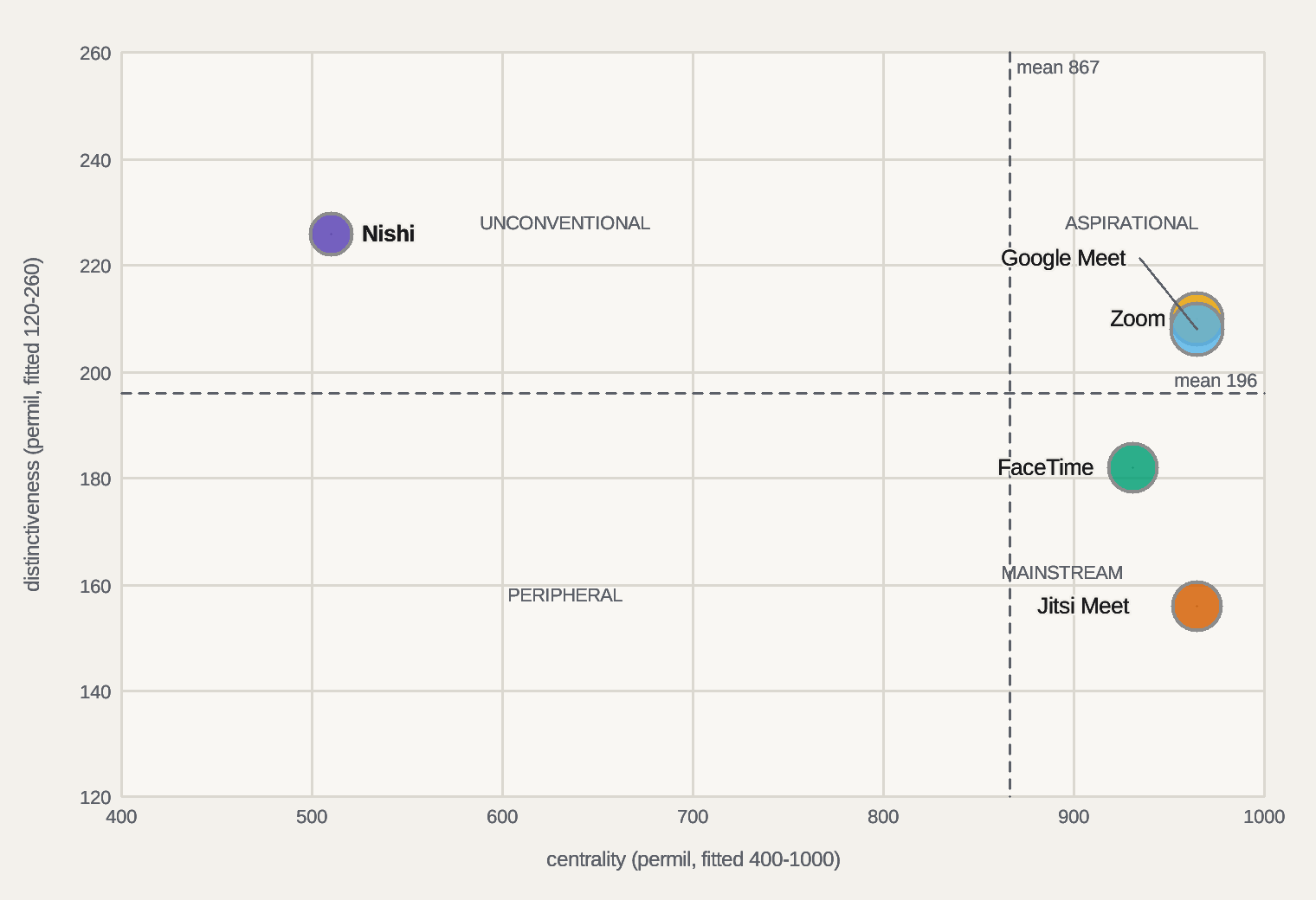
readability of the 3D cube, self-graded by the layout ruler: label overlaps 0 · labels over marks 0 · off-canvas 1 · unresolved labels 0 · mark overlaps 2 (a fact of the data: two players that close are that close) · data spread 428 permil of the plot
10 panels over 5 registered axes, every pair once (the lower axis on x, the higher on y) · each panel fitted to its own field of play, first and last tick numerals shown · no labels in a small cut, the legend names the colours; the grade below reports the mark terms only (MM summed over the panels, spread averaged)
readability of the small multiples, self-graded by the layout ruler: label overlaps 0 · labels over marks 0 · off-canvas 0 · unresolved labels 0 · mark overlaps 17 (a fact of the data: two players that close are that close) · data spread 536 permil of the plot
| Player | Quadrant | centrality | distinctiveness | breadth | depth | momentum | Rows held | Days on spine | First seen |
|---|---|---|---|---|---|---|---|---|---|
| Nishi | Unconventional | 510 | 226 | 360 | 740 | 0 since 2026-09-23 | 18 | 10 | 2026-09-15 |
| Zoom | Aspirational | 965 | 210 | 792 | 916 | 0 since 2026-09-23 | 32 | 10 | 2026-09-15 |
| Google Meet | Aspirational | 965 | 208 | 783 | 906 | 0 since 2026-09-23 | 32 | 10 | 2026-09-15 |
| FaceTime | Mainstream | 931 | 182 | 720 | 860 | 0 since 2026-09-23 | 31 | 10 | 2026-09-15 |
| Jitsi Meet | Mainstream | 965 | 156 | 711 | 822 | 0 since 2026-09-23 | 32 | 10 | 2026-09-15 |
| Day | Matrix rows reviewed | Players recorded |
|---|---|---|
| 2026-09-15 | 37 | 5 |
| 2026-09-16 | 37 | 5 |
| 2026-09-17 | 37 | 5 |
| 2026-09-18 | 37 | 5 |
| 2026-09-19 | 37 | 5 |
| 2026-09-20 | 37 | 5 |
| 2026-09-21 | 37 | 5 |
| 2026-09-22 | 37 | 5 |
| 2026-09-23 | 37 | 5 |
| 2026-10-08 | 37 | 5 |
players 5|matrix rows 37|feature mass 145|centrality mean 867|distinctiveness mean 196|axes 5|spine days 10 (shown 10)|rows written today 0|readability defects 2D 0 cube 1|spine knowledge/status/cdmap/video.spine
Capability matrix — measured against source
◉ authored stronger claim; source present● present◐ partial○ absent? unassessed; excluded from relative comparison · click any capability for its evidence
Peer cell coverage: authored assessed 148, unassessed 0. Authored assessments are not verified outcomes.
No capabilities match this filter or search.
| Capability | Nishi | Zoom | Google Meet | FaceTime | Jitsi Meet |
|---|---|---|---|---|---|
| LIVE | |||||
Send resolution ceiling (HD adaptive)Measured:vc_res_tier_hd exists in runtime/nx_video_client_wasm.nx, verified at emit. V1 LANDED build 862 (2026-08-19): two HD rungs ABOVE 640x480 -- 1152x640 (K=4 bands) and 1024x576 (K=3) -- reachable when every peer is 862-capable, the device has the memory (deviceMemory>=4) and the band pool put the sender at cls>=10; the whole codec-region layout is now DERIVED from the core's own size exports (no magic hex), grown to exactly 108 MB. PROVEN: codec bit-exact roundtrip at 1152x640/1024x576/640x480 (25/25 gate), the client layout math + a roundtrip through its own offsets (7/7 layout gate), and the IIFE loadsmoke (no TDZ abort); served wasm byte-identical to the gated build. Zoom, Meet and FaceTime still send 1080p and Teams documents 1080p30 in under 1.5 Mbps [teamsnet] -- 1280x720 (45 MB-rows) is the next K=2 rung, so the exceed is not yet parity on the top end, but the potato ceiling is gone Adoption: LIB-WIRED importers=9 nonval=2 — fully adopted (top of its ladder).Pros Implementing source symbol found; runtime acceptance separate; fully adopted on the estate ladderCons behind Zoom (leads), Google Meet (leads), FaceTime (leads), Jitsi Meet (leads) | ● | ◉ | ◉ | ◉ | ◉ |
Sovereign codec end to end (own H.264-class integer codec in tab, Nishi browser and native)Source present; authored stronger claim:vv_enc_rct8 in runtime/nx_video_codec_wasm.nx, verified at emit. Every rival rides WebRTC plus licensed or hardware codecs; ours is one integer bit-exact codec from the compiler up. Efficiency is graded honestly on /compare/videocodec: +159 percent BD-rate vs x264 RTC profile -- behind, and the field is AV1-first [jitsiav1] [chromeav1] Adoption: LIB-WIRED importers=65 nonval=19 — fully adopted (top of its ladder).Pros Source symbol found; stronger capability claim is authored; ahead of Zoom, Google Meet, FaceTime, Jitsi Meet; fully adopted on the estate ladderCons none on the measured axes (rival marks are documented presence, not depth) | ◉ | ○ | ○ | ○ | ○ |
Tile-parallel encode (multi-worker bands)Measured:vv_enc_rct8_band exists in runtime/nx_video_codec_wasm.nx, verified at emit. Rivals encode in hardware or multi-threaded native; ours fans up to 4 band workers with budget-derived arming (builds 848 and 854) but bands are DISABLED in E2EE rooms today (the e2eeAll interlock) -- lifting that interlock is the cheapest resolution lever rival marks uncited — the Yes, Best or Part codes on this row are an observation read with no reference mark behind them Adoption: LIB-WIRED importers=65 nonval=19 — fully adopted (top of its ladder).Pros Implementing source symbol found; runtime acceptance separate; fully adopted on the estate ladderCons none on the measured axes (rival marks are documented presence, not depth) | ● | ● | ● | ● | ● |
Hardware-accelerated encodeOpen — no implementing organ is measured for this axis yet. All majors use platform hardware encoders (H.264, HEVC, AV1) and Zoom gates even software AV1 to non-power-saving desktops [zoomcodecs]. Excluded here by doctrine (own codec, no third-party formats): the sovereign path is SIMD (build 843, 1.73x) plus bands plus a WebGPU motion-search legPros none measured yetCons behind Zoom (leads), Google Meet (leads), FaceTime (leads), Jitsi Meet; no implementing organ measured | ○ | ◉ | ◉ | ◉ | ● |
Adaptive bitrate / resolution ladder per linkMeasured:rungQ exists in ../sites/nishifamily/video/app.v2.js, verified at emit. Rivals run GCC or TWCC-class congestion control with simulcast or SVC and a 150 kbps floor [teamsnet]; ours walks qp, geometry and fps per link with rungQ, receiver reports and resPenalty (tier 4 = about 700 kbps) Adoption: ABSENT — PARTIAL: no source and no binary: this is a build contract, not a partial deploy.Pros Implementing source symbol found; runtime acceptance separateCons behind Zoom (leads), Google Meet (leads), FaceTime (leads); not adopted yet: no source and no binary: this is a build contract, not a partial deploy | ● | ◉ | ◉ | ◉ | ● |
SFU with simulcast, last-N and dominant speakerMeasured:sfu_set_lastn exists in runtime/nx_sfu_select.nx, verified at emit. Jitsi JVB and the Zoom SFU are the reference; LiveKit auto-enables L3T3_KEY SVC for VP9 and AV1 [livekitsvc]. Ours is sovereign selective forwarding with 2-layer simulcast, LNSET last-N and a zero-decode dominant-speaker announce (SFU-core census 1000 permil) Adoption: LIB-WIRED importers=2 nonval=1 — fully adopted (top of its ladder).Pros Implementing source symbol found; runtime acceptance separate; fully adopted on the estate ladderCons behind Zoom (leads), Google Meet (leads), Jitsi Meet (leads) | ● | ◉ | ◉ | ● | ◉ |
| TRANSPORT | |||||
UDP / QUIC datagram media leg (no head-of-line stall on loss)DARK —runtime/_hdl_build/nx_signaling_v2.nx EXISTS but does not declare sig2_quic_dgram: something shipped at this path under another name, and this mark would read open forever. Repoint the contract to the real entry point (the plan rung AND this row) or rename the function; the flip follows on the next beat, and the comparewatch- plane row reads DARK until then. Every major carries media over UDP with TCP only as fallback [imc21]; ours rides TCP/TLS through the relay, so a lost packet stalls every frame behind it -- the root cause of freezes on lossy WAN. The sovereign QUIC stack (nx_quic_udp, nx_quic_relay datagram fan-out, nx_quic_fec, nx_quic_recovery) is built and gated in isolation; the contract is the LIVE relay datagram leg plus a WebTransport client path (a browser tab has no raw UDP; the Nishi browser and native NishiOS do)Pros none measured yetCons behind Zoom (leads), Google Meet (leads), FaceTime (leads), Jitsi Meet (leads); open contract; expected source declaration not established | ○ | ◉ | ◉ | ◉ | ◉ |
Forward error correction on mediaOpen — no implementing organ is measured for this axis yet. Reed-Solomon 8-of-10 on frames, live; rivals use RED, FEC and NACK in the AVPF class [rfc4585]Pros none measured yetCons behind Zoom, Google Meet, FaceTime, Jitsi Meet; no implementing organ measured | ○ | ● | ● | ● | ● |
Congestion control (fast reaction to a narrowing pipe)Measured:vc_bwe_step exists in runtime/nx_video_client_wasm.nx, verified at emit. All majors run GCC/TWCC-class congestion control on UDP [imc21]; ours is a core-owned AIMD controller on the WSS send queue (vc_bwe_step, DEFAULT ON build 863, kill switch ?bwe=0) -- deterministic-gate-proven to CONVERGE and cut the modeled freeze ~7x vs the old +1-rung/9-tick ladder on a 2Mbps->500kbps drop. On TCP it can only SHORTEN a head-of-line stall, never remove it -- that is V2 (UDP/QUIC) Adoption: LIB-WIRED importers=9 nonval=2 — fully adopted (top of its ladder).Pros Implementing source symbol found; runtime acceptance separate; fully adopted on the estate ladderCons behind Zoom (leads), Google Meet (leads), FaceTime (leads), Jitsi Meet (leads) | ● | ◉ | ◉ | ◉ | ◉ |
Keyframe request on loss (PLI-class)Measured:function kreq exists in ../sites/nishifamily/video/app.v2.js, verified at emit. kreq recovers in about one RTT; RFC 4585 PLI is the standard behaviour [rfc4585] Adoption: ABSENT — PARTIAL: no source and no binary: this is a build contract, not a partial deploy.Pros Implementing source symbol found; runtime acceptance separateCons not adopted yet: no source and no binary: this is a build contract, not a partial deploy | ● | ● | ● | ● | ● |
| AUDIO | |||||
Opus-class low-bitrate voice (lossy perceptual, 16-32 kbps)Open — watchingruntime/nx_nv1_lpc.nx : nv1_lossy_encode, re-measured on every compare beat. Ship that symbol and this mark flips itself; the comparewatch- plane row flips with it. Every rival runs Opus (SILK plus CELT) [rfc6716] at 16-32 kbps with in-band FEC and DTX; ours sends LOSSLESS LPC voice -- bit-exact, but the measured lpc_speed ratio of about 790 permil means roughly 600 kbps at 48 kHz 16-bit, ten to twenty times Opus, which starves the video ladder on a mobile uplink. Contract = a lossy perceptual mode beside the lossless twin; the DRED-class redundancy scheduler already exists to ride itPros none measured yetCons behind Zoom (leads), Google Meet (leads), FaceTime (leads), Jitsi Meet (leads); open contract; expected source declaration not established | ○ | ◉ | ◉ | ◉ | ◉ |
AudioWorklet capture and playout (low latency, off the main thread)Open — watching../sites/nishifamily/video/app.v2.js : AudioWorkletNode, re-measured on every compare beat. Ship that symbol and this mark flips itself; the comparewatch- plane row flips with it. Rivals run audio natively or in AudioWorklet; ours still uses the deprecated ScriptProcessorNode (1024-frame, about 21 ms framing) -- a self-flipping debt since 2026-07-02 rival marks uncited — the Yes, Best or Part codes on this row are an observation read with no reference mark behind themPros none measured yetCons behind Zoom (leads), Google Meet (leads), FaceTime (leads), Jitsi Meet (leads); open contract; expected source declaration not established | ○ | ◉ | ◉ | ◉ | ◉ |
Echo cancellation and noise suppressionOpen — no implementing organ is measured for this axis yet. Ours enables the browser AEC and NS constraints only; Zoom, Meet and FaceTime run ML denoisers (Krisp-class). The sovereign spectral denoiser (nx_denoise_spectral) is in tree but not on the live voice path (comms rung C10 owns that contract) rival marks uncited — the Yes, Best or Part codes on this row are an observation read with no reference mark behind themPros none measured yetCons behind Zoom (leads), Google Meet (leads), FaceTime (leads), Jitsi Meet; no implementing organ measured | ○ | ◉ | ◉ | ◉ | ● |
Packet-loss concealment and deep redundancyMeasured:dred_gaps exists in runtime/nx_audio_dred.nx, verified at emit. Opus 1.5 DRED is the reference; ours has a classical DRED-class scheduler (coarse LPC envelope tails per packet) -- built and gated, wire-in to the live voice path pending; graded present because the organ exists, honest that it is not yet on the wire rival marks uncited — the Yes, Best or Part codes on this row are an observation read with no reference mark behind them Adoption: LIB-GATE-ONLY importers=1 — PARTIAL: imported only by validation organs (gates, tests, benches): wire it into a shipping program.Pros Implementing source symbol found; runtime acceptance separateCons behind Zoom (leads), Google Meet (leads); not adopted yet: imported only by validation organs (gates, tests, benches): wire it into a shipping program | ● | ◉ | ◉ | ● | ● |
| FEATURE | |||||
Screen shareOpen — no implementing organ is measured for this axis yet. Present (browser capture through the sovereign codec); rivals add annotation and multi-share rival marks uncited — the Yes, Best or Part codes on this row are an observation read with no reference mark behind themPros none measured yetCons behind Zoom (leads), Google Meet (leads), FaceTime (leads), Jitsi Meet (leads); no implementing organ measured | ○ | ◉ | ◉ | ◉ | ◉ |
In-call chat and reactionsMeasured:rxChat exists in ../sites/nishifamily/video/app.v2.js, verified at emit. Chat over the sovereign relay plus emoji reactions in the core wire (vc_react_pack); rivals add polls, raised hands and threads rival marks uncited — the Yes, Best or Part codes on this row are an observation read with no reference mark behind them Adoption: ABSENT — PARTIAL: no source and no binary: this is a build contract, not a partial deploy.Pros Implementing source symbol found; runtime acceptance separateCons behind Zoom (leads), Google Meet (leads), FaceTime (leads), Jitsi Meet (leads); not adopted yet: no source and no binary: this is a build contract, not a partial deploy | ● | ◉ | ◉ | ◉ | ◉ |
Call recording (server-side)DARK —runtime/_hdl_build/nx_signaling_v2.nx EXISTS but does not declare sig2_record_room: something shipped at this path under another name, and this mark would read open forever. Repoint the contract to the real entry point (the plan rung AND this row) or rename the function; the flip follows on the next beat, and the comparewatch- plane row reads DARK until then. Zoom cloud recording, Meet recording, Jitsi Jibri; FaceTime has none. Ours records CIRCLES (video messages via sd2_circle_upload) but not live rooms; contract = relay-side room recording into the private family store, consent-announced rival marks uncited — the Yes, Best or Part codes on this row are an observation read with no reference mark behind themPros none measured yetCons behind Zoom (leads), Google Meet (leads), Jitsi Meet (leads); open contract; expected source declaration not established | ○ | ◉ | ◉ | ○ | ◉ |
Live captions and transcriptionOpen — watchingruntime/nx_asr.nx : asr_stream_decode, re-measured on every compare beat. Ship that symbol and this mark flips itself; the comparewatch- plane row flips with it. Meet and Zoom ship live captions and summaries; Jitsi via Jigasi or Whisper; ours has an ASR front-end gate only. Must stay sovereign and on-NAS -- never a third-party speech API rival marks uncited — the Yes, Best or Part codes on this row are an observation read with no reference mark behind themPros none measured yetCons behind Zoom (leads), Google Meet (leads), FaceTime (leads), Jitsi Meet; open contract; expected source declaration not established | ○ | ◉ | ◉ | ◉ | ◐ |
Background blur and virtual backgroundOpen — watchingruntime/nx_portrait_matte.nx : pm_matte_stream, re-measured on every compare beat. Ship that symbol and this mark flips itself; the comparewatch- plane row flips with it. Table stakes on every rival (on-device segmentation); absent here -- an integer portrait matte on the capture path before the encoder rival marks uncited — the Yes, Best or Part codes on this row are an observation read with no reference mark behind themPros none measured yetCons behind Zoom (leads), Google Meet (leads), FaceTime (leads), Jitsi Meet (leads); open contract; expected source declaration not established | ○ | ◉ | ◉ | ◉ | ◉ |
Group size (gallery tiles, decode pool, last-N)Measured:wkDec exists in ../sites/nishifamily/video/app.v2.js, verified at emit. Zoom and Meet 100-plus, FaceTime 32, Jitsi 75-100 with last-N; ours is family scale with a device-sized decode worker pool and LNSET = 2 plus pool size rival marks uncited — the Yes, Best or Part codes on this row are an observation read with no reference mark behind them Adoption: ABSENT — PARTIAL: no source and no binary: this is a build contract, not a partial deploy.Pros Implementing source symbol found; runtime acceptance separateCons behind Zoom (leads), Google Meet (leads), Jitsi Meet (leads); not adopted yet: no source and no binary: this is a build contract, not a partial deploy | ● | ◉ | ◉ | ● | ◉ |
| CRYPTO | |||||
End-to-end encryption on callsMeasured:mcw_xform exists in runtime/nx_media_crypt_wasm.nx, verified at emit. FaceTime E2EE by default; Zoom E2EE optional; Meet client-side encryption for Workspace tiers only; Jitsi via insertable streams (forces VP8 [jitsiav1]). Ours: ChaCha20 relay-blind on video, audio and chat with an MLS-class ratchet (nx_mls_group) -- see /compare/comms for the crypto exceeds Adoption: LIB-UNIMPORTED — PARTIAL: nothing imports it: wire it into a consumer or retire it.Pros Implementing source symbol found; runtime acceptance separate; ahead of Google MeetCons behind FaceTime (leads); not adopted yet: nothing imports it: wire it into a consumer or retire it | ● | ● | ◐ | ◉ | ● |
Private keyed rooms (invite links)Measured:rk_token exists in runtime/nx_room_key.nx, verified at emit. sha256 token wall = private invite links; relay checks the token, the invite machine holds the E2EE secret rival marks uncited — the Yes, Best or Part codes on this row are an observation read with no reference mark behind them Adoption: LIB-WIRED importers=3 nonval=2 — fully adopted (top of its ladder).Pros Implementing source symbol found; runtime acceptance separate; fully adopted on the estate ladderCons none on the measured axes (rival marks are documented presence, not depth) | ● | ● | ● | ● | ● |
| OPS | |||||
Per-session QoE telemetry and MOS gateOpen — no implementing organ is measured for this axis yet. Beacon carries fps, bytes, mode and receiver reports; nx_vqoe_gate grades MOS from ITU-T G.1070-class models (measured 4.21 good link, 3.53 congested); rivals run planetary QoE (see /compare/videoops) rival marks uncited — the Yes, Best or Part codes on this row are an observation read with no reference mark behind themPros none measured yetCons behind Zoom (leads), Google Meet (leads), FaceTime, Jitsi Meet; no implementing organ measured | ○ | ◉ | ◉ | ● | ● |
Self-healing client (drift badges, auto-fallback, self-upgrade)Source present; authored stronger claim:driftCheck in ../sites/nishifamily/video/app.v2.js, verified at emit. The call diagnoses and heals itself: recon-hash drift verify, t8 auto-fallback, stale-client reload; rivals ship opaque failures Adoption: ABSENT — PARTIAL: no source and no binary: this is a build contract, not a partial deploy.Pros Source symbol found; stronger capability claim is authored; ahead of Zoom, Google Meet, FaceTime, Jitsi MeetCons not adopted yet: no source and no binary: this is a build contract, not a partial deploy | ◉ | ○ | ○ | ○ | ○ |
| MEASURED | |||||
Same-instrument head-to-head vs Jitsi Meet (self-hosted and public), LiveKit and native WebRTC (glass-truth delivery)Measured:vh_changes exists in runtime/nx_video_h2h.nx, verified at emit. MEASURED 2026-09-02 with ONE instrument on every stack [vqmtmetrics]: the same akiyo test card with a burned frame index through real headless Chromium clients, the same 20 ms strip reader on every receiver, judged by the sovereign nx_video_h2h and receipted in video.bench (rendered on this page), 60 s per arm on a good link. OURS build 863 (laptop to the NAS relay): effective 9.9 and 18.2 fps of a 30 fps source (delivered 331 and 607 permil), glass-to-glass median 81 and 39 ms, 0 and 10 stalls (worst 1.30 s), 416x320 and 320x256; build 864 (per-lane liveness, shipped the same day): 17.3 and 12.4 fps (577 and 413 permil), 59 and 60 ms, ZERO lane reconnects in 60 s where 863 had eight a minute per client; build 865 (2x faster core via the quiet-quadrant early skip, fps-first tier cap, decode-pool fixes -- shipped the same day, live probe): 17.7 and 17.3 fps (620 and 606 permil), 53 and 44 ms glass-to-glass, PSNR 34.9 dB at 416x320 on both clients. JITSI SELF-HOSTED on the same host (docker-jitsi-meet, the PATH-MATCHED referee): 28.8 and 29.0 fps (959 and 969 permil), 3 and 19 ms, 0 stalls, 352x288. JITSI PUBLIC (meet.ffmuc.net over the WAN): 29.5 and 29.7 fps, 146 and 154 ms, 1 stall each. LIVEKIT (livekit-server on the same host, VP8): 17.6 and 18.7 fps (585 and 623 permil), 46 and 48 ms, 0 stalls, 352x288. WEBRTC loopback: 30.0 fps, 999 permil, 20 ms. BY THE NUMBERS against the path-matched Jitsi: frame delivery BEHIND (10 to 18 vs 29 fps -- the 20 fps ladder cap and a single-thread encode of 30 to 65 ms per frame that the band pool never armed for), latency BEHIND (39 to 81 vs 3 to 19 ms), fidelity 2 dB BEHIND; against LiveKit on this host, delivery is at parity and latency comparable. Rival cells read 1 because they were MEASURED, not documented [livekitsvc] Adoption: REGISTERED-DARK — PARTIAL: callable, authorised, completed MCP invocation not established by supplied journal window; lifetime history unknown (direct execution may be recorded elsewhere; this scan does not establish lifetime use); no execution surface runs it either (clock, cron, daemon, roster, actlog and surfaced forks checked).Pros Implementing source symbol found; runtime acceptance separateCons not adopted yet: callable, authorised, completed MCP invocation not established by supplied journal window; lifetime history unknown (direct execution may be recorded elsewhere; this scan does not establish lifetime use); no execution surface runs it either (clock, cron, daemon, roster, actlog and surfaced forks checked) | ● | ● | ● | ● | ● |
Full-reference fidelity of the received picture (VQMT-class PSNR and SSIM, sovereign metric organ)Measured:qm_ssim_milli exists in runtime/nx_quality_metric.nx, verified at emit. The same runs: the received 352x288 luma against the sender's own preview of the same frame index, strip band excluded, computed by the sovereign nx_quality_metric (the seed of our VQMT) [vqmthelp141] AND, on the identical frame pairs, by the EXTERNAL referee ffmpeg 7.0 + Netflix libvmaf (the engine MSU VQMT ships for VMAF) [msucodecs]. Sovereign PSNR: OURS 35.0 and 33.9 dB (864: 34.0 and 33.8), JITSI self-hosted 36.9 and 36.9, JITSI public 36.4 and 32.7, LIVEKIT 41.3 and 41.0, WEBRTC loopback 42.4. libvmaf PSNR on the same pairs agrees WITHIN 0.01 dB on all eleven arms -- after this cross-check exposed that the sovereign ruler floored sum/n to an integer MSE and inflated high-quality frames by up to 0.9 dB (fixed as qm_psnr_cdb_exact the same day; the independent-method law earning its keep). SSIM: sovereign 8x8-window 0.936-0.976 vs libvmaf Gaussian 0.947-0.981, within 0.011. VMAF (external only until rung V11): OURS 75-83, JITSI self-hosted 91, JITSI public 73-90, LIVEKIT 97, WEBRTC 98 [lehacvqad]. Received-picture fidelity is 2 to 3 dB and about 13 VMAF points behind the path-matched Jitsi and 8 dB under the loopback ceiling; that ceiling is what the codec-efficiency rung (V9) buys back Adoption: LIB-WIRED importers=24 nonval=5 — fully adopted (top of its ladder).Pros Implementing source symbol found; runtime acceptance separate; fully adopted on the estate ladderCons none on the measured axes (rival marks are documented presence, not depth) | ● | ● | ● | ● | ● |
QUALITY ORACLE: Sovereign VQMT metric parity (17 documented metrics)Measured:nx_ms_ssim_image_q10 exists in runtime/nx_ms_ssim.nx, verified at emit. MSU VQMT documents 17 metrics in five groups [vqmtmetrics] [vqmttoc]: PSNR, VMAF, NIQE; SSIM, MS-SSIM, 3-SSIM, ST-SSIM; Delta, Identity, MSAD, MSE; VQM, MSU Time shift; MSU Blurring, MSU Blocking, SI, TI. Sovereign today: PSNR, MSE, SSIM (nx_quality_metric, nx_ssim) and MS-SSIM (nx_ms_ssim, a documented weighted-average approximation of the geometric mean) = 4 of 17. Absent: VMAF, NIQE, 3-SSIM, ST-SSIM, Delta, MSAD, VQM, Time shift, Blurring, Blocking, SI, TI (rung V11); VQMT 3D has no sovereign twin at all (rung V13). Rivals graded 2 because the reference tool itself is the bar on this row, not a call product Adoption: SOURCE-ONLY — PARTIAL: source exists, never compiled: /api/build it.Pros Implementing source symbol found; runtime acceptance separateCons behind Zoom (leads), Google Meet (leads), FaceTime (leads), Jitsi Meet (leads); not adopted yet: source exists, never compiled: /api/build it | ● | ◉ | ◉ | ◉ | ◉ |
QUALITY ORACLE: Perceptual video quality metric (VMAF-class, sovereign, integer)DARK —runtime/nx_quality_metric.nx EXISTS but does not declare qm_vmaf_milli: something shipped at this path under another name, and this mark would read open forever. Repoint the contract to the real entry point (the plan rung AND this row) or rename the function; the flip follows on the next beat, and the comparewatch- plane row reads DARK until then. VMAF is VQMT's headline perceptual metric and MSU's codec-comparison reference [vqmtmetrics]; the estate has no perceptual full-reference video metric, so every fidelity claim above is PSNR and SSIM only. Contract = a sovereign, model-free perceptual fusion (VIF, DLM and motion features) judged against the published VMAF model on the MSU sequencesPros none measured yetCons behind Zoom (leads), Google Meet (leads), FaceTime (leads), Jitsi Meet (leads); open contract; expected source declaration not established | ○ | ◉ | ◉ | ◉ | ◉ |
QUALITY ORACLE: 3D and stereoscopic video quality (VQMT 3D class)DARK —runtime/nx_quality_metric.nx EXISTS but does not declare qm_stereo_score: something shipped at this path under another name, and this mark would read open forever. Repoint the contract to the real entry point (the plan rung AND this row) or rename the function; the flip follows on the next beat, and the comparewatch- plane row reads DARK until then. MSU ships a separate Video Quality Measurement Tool 3D (stereo artifacts, depth and channel-mismatch metrics) [vqmttoc]; no rival call product measures 3D and the estate has no stereo metric: this is the beyond-2D axis. FaceTime spatial video is the one rival with a stereo call path, graded 1Pros none measured yetCons behind FaceTime; open contract; expected source declaration not established | ○ | ○ | ○ | ● | ○ |
| TRANSPORT | |||||
Idle-lane liveness (transmit-only lanes must not be reaped)Open — watching../sites/nishifamily/video/app.v2.js : laneTxAlive, re-measured on every compare beat. Ship that symbol and this mark flips itself; the comparewatch- plane row flips with it. Measured 2026-09-02 on both probe clients: lanes 1 and 2 are closed by the client's own zombie watchdog every 15 s (silent longer than 2.2 pings) and reopened 1.2 s later, 8 reconnects per client per minute, because only lane 0 ever receives; media rode lane 0 so no frames were lost, but that is 8 extra TLS handshakes a minute per family member and a latent frame-loss path the moment striping uses those lanes. Contract = liveness counts transmit activity, or the relay pongs on every lane rival marks uncited — the Yes, Best or Part codes on this row are an observation read with no reference mark behind themPros none measured yetCons behind Zoom, Google Meet, FaceTime, Jitsi Meet; open contract; expected source declaration not established | ○ | ● | ● | ● | ● |
MEASUREMENT LAB: Standardised RTC session telemetry (W3C WebRTC-stats getStats schema)Open — no implementing organ is measured for this axis yet. The field reports per-session quality through the W3C WebRTC-stats getStats() schema -- RTCInboundRtpStreamStats framesPerSecond, freezeCount, totalFreezesDuration, jitterBufferDelay [webrtcstats]; ours emits a sovereign beacon carrying the same fields (fps, bytes, mode, receiver reports) graded by nx_vqoe_gate. Parity contract = emit the beacon in the WebRTC-stats shape so any standard analyzer reads a Nishi call. FaceTime exposes no page-level stats (0)Pros none measured yetCons behind Zoom (leads), Google Meet (leads), Jitsi Meet (leads); no implementing organ measured | ○ | ◉ | ◉ | ○ | ◉ |
MEASUREMENT LAB: Impaired-link test harness (tc-netem-class loss, latency, jitter, reorder shaping)DARK —runtime/nx_video_h2h.nx EXISTS but does not declare vh_netem_arm: something shipped at this path under another name, and this mark would read open forever. Repoint the contract to the real entry point (the plan rung AND this row) or rename the function; the flip follows on the next beat, and the comparewatch- plane row reads DARK until then. The field validates congestion control and FEC by shaping the link with Linux tc-netem -- packet loss, added latency, jitter, reorder [tcnetem] -- and re-measuring delivery; the same-instrument head-to-head measured clean-link arms only. Contract vh_netem_arm = the sovereign harness runs each stack behind a declared loss and latency profile so the V2 transport done-rule (frozen-per-30s equal to the FEC arm) is MEASURED, not modeled. Every RTC vendor tests under netem-class shaping (Best)Pros none measured yetCons behind Zoom (leads), Google Meet (leads), FaceTime (leads), Jitsi Meet (leads); open contract; expected source declaration not established | ○ | ◉ | ◉ | ◉ | ◉ |
| CODEC | |||||
Larger transforms and full-mode RDO (the x264-parity arc, rung V9)DARK —runtime/nx_vcodec.nx EXISTS but does not declare vc_tx16_forward: something shipped at this path under another name, and this mark would read open forever. Repoint the contract to the real entry point (the plan rung AND this row) or rename the function; the flip follows on the next beat, and the comparewatch- plane row reads DARK until then. WATCH vc_tx16_forward: 16x16/32x32 transforms and mode+partition RDO on the real range coder, measured on the MSU oracle (rung V9). Until 2026-09-02 this rung had NO matrix row, so nx_compare_rank priced it at ZERO while the board's own verdict named codec throughput and efficiency as measured gaps -- the ranker reads columns, not prose. Encode-side progress the same day: the quiet-quadrant early skip (2.1x on talking heads, live in 865) and a hexagon motion search measured at 21-29 percent per frame on moving content, held behind emode bit15 until its BD-rate on foreman clears +1.0 percent [msucodecs]Pros none measured yetCons behind Zoom (leads), Google Meet (leads), FaceTime (leads), Jitsi Meet (leads); open contract; expected source declaration not established | ○ | ◉ | ◉ | ◉ | ◉ |
| AUDIO | |||||
Sovereign noise suppression on the live voice path (comms C10, rung V5)DARK —runtime/nx_denoise_spectral.nx EXISTS but does not declare ds_denoise_stream: something shipped at this path under another name, and this mark would read open forever. Repoint the contract to the real entry point (the plan rung AND this row) or rename the function; the flip follows on the next beat, and the comparewatch- plane row reads DARK until then. WATCH ds_denoise_stream: the spectral-subtraction substrate wired as a stream API on the live voice path with an SNR floor measured on real captured frames; owned by comms C10, listed here so the audio milestone is priced by the ranker (it was unmapped -- priced at zero -- until 2026-09-02) rival marks uncited — the Yes, Best or Part codes on this row are an observation read with no reference mark behind themPros none measured yetCons behind Zoom (leads), Google Meet (leads), FaceTime (leads), Jitsi Meet; open contract; expected source declaration not established | ○ | ◉ | ◉ | ◉ | ● |
| OPS | |||||
Live ops dashboard for sessions (rung V10)Open — watchingruntime/nx_videoops_dashboard.nx : vo_dashboard, re-measured on every compare beat. Ship that symbol and this mark flips itself; the comparewatch- plane row flips with it. WATCH vo_dashboard: an ops surface consuming the existing fps/bytes/mode/rr beacon and vqoe rows per session (Netflix Atlas class, small); the videoops row flips with it. Unmapped on this board until 2026-09-02 rival marks uncited — the Yes, Best or Part codes on this row are an observation read with no reference mark behind themPros none measured yetCons behind Zoom (leads), Google Meet (leads), FaceTime, Jitsi Meet; open contract; expected source declaration not established | ○ | ◉ | ◉ | ● | ● |
| SOVEREIGN | |||||
Self-hosted on family hardware -- zero middleman, no WebRTC, no OpenSSLSource present; authored stronger claim:SIG2_DG_CASCADE in runtime/_hdl_build/nx_signaling_v2.nx, verified at emit. Every rival routes media through their cloud; ours runs on the family NAS with its own TLS, relay, codec and crypto, so a LAN call never leaves the LAN Adoption: RUN-BY:daemon — fully adopted (top of its ladder).Pros Source symbol found; stronger capability claim is authored; ahead of Zoom, Google Meet, FaceTime, Jitsi Meet; fully adopted on the estate ladderCons none on the measured axes (rival marks are documented presence, not depth) | ◉ | ○ | ○ | ○ | ○ |
Integer bit-exact media plus recon-hash conformanceSource present; authored stronger claim:vc_recon_hash in runtime/nx_video_codec_wasm.nx, verified at emit. Per-frame decode-truth verification on every device; impossible on the float pipelines every rival ships Adoption: LIB-WIRED importers=65 nonval=19 — fully adopted (top of its ladder).Pros Source symbol found; stronger capability claim is authored; ahead of Zoom, Google Meet, FaceTime, Jitsi Meet; fully adopted on the estate ladderCons none on the measured axes (rival marks are documented presence, not depth) | ◉ | ○ | ○ | ○ | ○ |
| Class | Count | Note |
|---|---|---|
| rows with rival marks | 33 | rows carrying a Yes, Best or Part in a rival column |
| cited | 18 | a reference mark resolves to a pinned mirror |
| uncited | 15 | an observation read, badged until a reference lands |
| rows, summed | 33 | RECONCILED: the parts sum to the total 33 |
Delivery and evidence
Inspect risks, technical debt, rendered observations, experiments and references. Read scope and limitations alongside every result.
Release history and work log
| When | Rung | Kind | Entry |
|---|---|---|---|
| 2026-09-06 | V11 | retract | OPERATOR 2026-09-06: nishifamily.com/video is named beside the WebGPU lane as a heavy-investment climb that stalled short of SOTA (verbatim: same with nishifamily.com/video etc -- these projects with major investment that just stall out on their climb to sota are one of the key pillars this work should address based on september 2026 sota research and industry lessons and feedback etc). The board's own bar agrees: on the same test card ours delivers 10-18 fps at VMAF 75-83 against self-hosted Jitsi 29 fps at VMAF 91 and LiveKit at VMAF 97 (video.bench, 2026-09-02). Every LANDED rung above stays landed as PRESENCE; none reads complete until the head-to-head bar moves and the operator ACCEPTs (ecosystem EC40 reads this board's investment against its rank velocity so the stall is measured, never asserted) |
| 2026-09-06 | V11 | queue | SOTA RE-BASELINE, September 2026: fetch and pin the current state of RTC video and audio (Opus and AV1-in-RTC practice, SFU practice, the VQMT metric set, WebTransport and QUIC datagram media) as refs with years on every bar; name every oracle this board already holds and did not consume before a rung read landed (video.bench h2h, libvmaf, MSU VQMT, nx_video_h2h); re-plan the climb as gated rungs each carrying an oracle receipt, a rung without a receipt never reads done; the bad-one-step law (engineshift ES27) applies: a landing without a measured outcome ranks below a longer rigorous one |
| 2026-09-02 | V9 | measure | nx_vcodec_stage_bench (new sovereign stage-attribution bench, laptop-runnable, _ops/video_h2h/build_stage_bench.sh) on the h2h card at the live point qp24 thresh qp*30: whole encode 23.7 ms per CIF frame, integer search 30 percent, qpel refine 9 percent, the 16x4x4 transform-RDOQ-entropy coder 9 us per coded MB; the RD-skip band trial was 65 percent of encode because the lower band [thr/4, thr) held 291 of 396 MBs per frame (its floor sits below the recon quantisation-noise floor) |
| 2026-09-02 | V9 | land | VC_EMODE_QQSKIP (emode bit14, quiet-quadrant early skip) in nx_vcodec.nx and composed in vv_seed_rctx; both trees identical (nx_vcodec.nx 151900 B sha c30ebc1b, nx_video_client_wasm.nx 52727 B sha bd6abbee); core rebuilt on the NAS with nx_compile_wat plus nx_wat_compiler (both registered today), 229064 B sha 6b4d4e67, live as nx_video_client.wasm with 864 banked as nx_video_client.wasm.bak-864-20260902 |
| 2026-09-02 | V9 | measure | BD-rate candidate vs live by nx_bd_calc over akiyo foreman bus mobile CIF (48 frames, q 8 to 44, live rct8 chain): +0.1 +0.9 -0.7 0.0 percent; encode per CIF frame at q24: 23.6 to 9.4 ms, 36.9 to 30.8, 89.8 to 86.3, 94.8 to 90.9 |
| 2026-09-02 | V9 | measure | same-instrument A/B on the live page, 60 s: 865 at 416x320 delivers 18.1 and 17.3 fps, 601 and 671 permil, glass-to-glass 48 and 52 ms, PSNR 34.9 dB against 864 at 320x256 and 256x192 with 17.3 and 12.4 fps, 577 and 413 permil, 59 and 60 ms, 34.0 and 33.8 dB; at 640x480 the same core gives 14.1 and 15.6 fps with +3.2 dB |
| 2026-09-02 | V9 | lesson | a speedup upstream exposes every race and greedy policy downstream: the faster mount pinned both peers to main-thread decode for life (decW -1, no way back) and the tier ladder spent the headroom on 1152x640 over the TCP relay (16 s stalls); app.v2.js 865 adds pickDecWorker (first READY worker), late adoption of a worker at the next key, and RES_UPLIFT_CLS_CAP 7 (fps first) |
| 2026-09-02 | V9 | queue | next bottleneck on moving content is about 55 us per CODED MB (integer search 18, a SCALAR bilinear quarter-pel refine 20 to 28 beside a SIMD integer SAD, coder 9); a delivered-fps governor (fps first, then resolution) is owed before the uplift cap is lifted; the one simultaneous stall per run on both receivers tracks NAS build load and is the V2 transport class |
| 2026-09-02 | V9 | measure | hexagon motion search (VC_EMODE_HEXME, emode bit15, vm_search_hex: 6-point radius-2 hexagon then diamond, spatial predictor seed from the previous MB, exhaustive fallback above a trust bar derived from the incumbent VC_ME_EXTK far-ring trigger) measured by nx_vcodec_stage_bench bd against the exhaustive anchor over akiyo foreman bus mobile CIF, 48 frames, q 8 to 44: bare pattern +1.6 +10.4 +22.4 +1.7 percent BD; plus fallback at the trigger +1.2 +7.9 +2.2 +0.4; plus predictor seed +0.8 +3.5 0.0 +0.2 with encode per frame -21 to -29 percent on every sequence; bar halved (pattern must be twice as good) +0.3 +1.5 -0.6 0.0 but the time win is gone on bus and mobile because most moving blocks then pay for both searches |
| 2026-09-02 | V9 | lesson | the pre-declared accept rule (BD within +1.0 percent on all four) decides: foreman fails at every setting, so bit15 stays OUT of the live emode and the code stays in the tree behind the bit at the /256 bar with the measured table beside the constant; halving a bar buys BD by doing both searches, which is a number not a mechanism -- the next mechanism is a second predictor (top neighbour, needs an MV row buffer) or one merged pattern-plus-ring scan that shares its SAD work; timing under NAS build load moved the anchor itself 30 to 46 ms per frame between runs while every BD number reproduced exactly, so BD is the ruler and the encode-time deltas are read within one run only |
| 2026-09-02 | V9 | queue | source parity: NAS nx_vcodec.nx 151900 B sha c30ebc1b (QQSKIP, shipped in 865) versus laptop 152709 B carrying the dormant HEXME dispatch and the predictor handoff (the exhaustive anchor stays byte-identical on the wire with the handoff present, proven by identical anchor totals across four runs); nx_vcodec_stage_bench build queued behind admission (BQ row); nx_debt note verb source-landed, build queued (BQ-nx_debt) |
| 2026-09-02 | V9 | land | admission cleared the I/O storm and the dark work shipped: source parity of the dormant hexagon (all 3 hunks) landed on the NAS twin byte-identical to laptop (nx_vcodec.nx b3b0780d 152709 B); nx_vcodec_stage_bench built fresh (934e63d1 139543 B) and PROMOTED+REGISTERED+AUTHORISED -- the estate-wide encoder stage-attribution bench is now a callable sovereign capability, not a laptop-only script; organ_kind.conf got 4 oneshot rows so /api/promote would accept them |
| 2026-09-02 | V9 | land | the abandoned S-class pipeline the operator named is un-dark: nx_sclass_scorecard (0f59a51c), nx_sclass_climb (78a53b61), nx_sclass_grade_report (7da14035) all PROMOTED+REGISTERED+AUTHORISED and INVOKED live -- grade_report prints the honest triangulated standing (boolean-min S-EXCEED-but-narrow, Karatsuba B-behind vs GMP, water-filling A-parity); nx_debt note verb was BUILT but the served binary was BEHIND (usage lacked note), now rebuilt 0af4f6f1 155828 B and PROMOTED so annotations reach the plane |
| 2026-09-02 | V9 | lesson | the mgmt API reads target from the POST BODY (form-encoded), NOT the query string -- query and JSON both 400 'missing target'; /api/build stages to _build only, so the stage slot needs a filecopy of _build/<t>.sov.elf to <t>.sov.elf.new before /api/promote; admin ops go through nx_mgmt_call POST <path> <form-body> which mints its own session (the raw curl route returns unauthorized on the tool cap); a 503 stage=read on a long build/promote is the edge window, the work continues server-side, read the job artifact not the receipt |
| 2026-09-02 | V9 | queue | the stage bench defaults its card to a laptop WSL path so it reports UNMEASURED on the NAS -- shipping a test card into buildroot and defaulting to a NAS-relative path is the one refinement left before it is a first-class NAS-runnable bench; the S-class climb loop consuming .bench receipts is the generalisation (nx_stagebench_lib + a .bench class per domain) still owed |
Debt register
| Id | Sev | What it is | Unblock |
|---|---|---|---|
| videoops-path-defectnot in this scope | 4 | DISCHARGED 2026-08-18: 9 videoops rows (and 1 familyatlas row) pointed at sites/... which the emitter (CWD=buildroot) cannot read, publishing 8 false OPEN cells and a 444 permil coverage; repointed to ../sites/... (the comms convention), every symbol re-verified in the served build 861. | Done; the regen re-measures. Law: a measured-symbol row is only as true as the PATH the ruler can reach -- verify path AND symbol the way the emitter does. |
| video-radar-corpusnot in this scope | 3 | DISCHARGED 2026-08-18: /compare/video/frontier api.json was emitted with corpus_bytes=0 (video.q and its 5 OpenAlex banks lived only outside buildroot) while the hand-published HTML showed a July corpus; banks re-fetched sovereign (2.60 MB) into buildroot/knowledge/library and video moved from radar.list to regen.list so the frontier door regenerates HTML and JSON from the same axes on every beat. | Done; the axes were also re-aligned to videocodec.matrix (range coder live, B-frames absent, tile-parallel present). |
| e2ee-band-interlocknot in this scope | 4 | Bands (the resolution lever) are disabled in E2EE rooms (bandArmedNow requires !e2eeAll), so an encrypted family call is capped BELOW an unencrypted one -- privacy costs resolution today. | V1 lifts it: encrypt after band concat on the sender, decrypt before band split on the receiver; gate proves bit-exact under E2EE with K=4. |
| lpc-voice-bitratenot in this scope | 5 | Lossless LPC voice at ~790 permil ratio is roughly 600 kbps at 48 kHz 16-bit -- ten to twenty times Opus -- and it competes with video for the same uplink; on mobile it is the first thing that starves the ladder. | V3 is the fix; until it lands this row stays open and the page says so. |
| tcp-hol-transportnot in this scope | 6 | Media over TCP/TLS: one lost segment stalls every frame behind it; the FEC helps relay-dropped frames but cannot help TCP-level loss. The measured cause of the good-link 4.21 vs congested 3.53 MOS gap. | V2 is the fix. The QUIC stack exists; the wire-in is the rung. |
Risk register
| Risk | Likelihood x impact | Mitigation |
|---|---|---|
| A watch contract flips on symbol existence, so a stub reads green | possible x high | The done-rule proven by a gate is the bar; the flip is the receipt. Every rung above names its measured proof. |
| 720p arrives with an fps collapse on phones (the 816 lesson) | possible x high | Tier arms only on MEASURED band budget per device; no tier ships below its fps floor; old peers fail safe to today's tiers. |
| A UDP leg opens the relay to amplification or spoofed senders | possible x high | Datagram leg rides the QUIC handshake (authenticated), room-token gated, rate-limited per connection; TCP fallback stays. |
| Chasing AV2/VVC/neural instead of the ranked gaps | possible x medium | The refs on this page carry the numbers: AV2 33x slower reference, VVenC faster preset -13 percent offline-only, DCVC-RT GPU-only -- the ranker's inputs, not opinions. |
Release history continued
| When | Rung | Kind | Entry |
|---|---|---|---|
| 2026-09-12 | V2 | requirement | OPERATOR REQUIREMENT 2026-09-12, NOT A MEASURED NETWORK RESULT: family acceptance includes the operator's sons calling their girlfriends in Belarus and Miyazaki. Prioritize private reliable calls, easy joining, usable audio and video, and recovery after interruption; then messaging, shared media and notifications so everyday family communication can move beyond Telegram and Instagram. Country and city names identify intended acceptance routes only: no route latency, access, privacy setting or delivered quality is claimed until witnessed on those routes. Reuse the existing Video, comms and product owners; retain codec and transport comparison requirements alongside these user journeys. |
| 2026-09-12 | V9 | qualify | PRIVATE QUALIFICATION 2026-09-12, NOT A PRODUCT RELEASE: existing nx_vcodec_stage_bench default still names a laptop path and returns UNMEASURED on NAS (job1789236517). Private recovery candidate24580B sha db4869ff102fe304b3bf35c5f157061fbd3fc3c42966b67603772262f122eb4c resolves the same banked card from NAS root or buildroot while preserving explicit path override; comments distinguish historical2593, shipped865 mode18977, and experimental51745. Original120-frame card copied byte-identically, sha ff2a4a62e647bd0753b0058ca2171e9755bcfdfb829d6598521920445769db1a. Exact4-frame prefix smoke completed16cases in candidate and baseline, matching deterministic counts, bytes, PSNR and wire digests16/16 (jobs1789237687 and1789237484); explicit missing override refused exit3 UNMEASURED (job1789237726). Tested private artifact sha717599a932534d324df4f8d70dd7fa848b035d2a3baa257d061a90ae5523b29d,164408B (job1789237727). Full120-frame qualification remains incomplete:120s runs timed out after5cases,300s candidate after14of16. No speedup claimed. Separate pre-existing key_us defect is runtime-proven identifier reuse: inner k1 counter overwrites outer timestamp (job1789237521). Canonical source and served865 remain unchanged; root review precedes any promotion. This is benchmark-input evidence, not a call test on Belarus or Miyazaki routes. |
| 2026-09-12 | V11 | correction | The earlier model-free integer fusion proposal is NOT VMAF parity. Retain it only as a separately named experimental metric. Qualify the exact Netflix model and implementation or call an independently pinned oracle via existing MCP/API. June 2026 VMAF v1 includes viewing-specific models; never compare unlike model scales as a trend. PSNR agreement does not prove VMAF equivalence. Historical September 2 call scores remain historical; relay placement differs between arms, so latency is not a controlled same-path comparison. Neural artifacts require subjective and robustness checks beyond a single objective score [vmafv12026] [msuneural2026]. |
| 2026-09-12 | V14 | release | 2026-09-12 research/requirements update only: primary-source references added; new oracle, lineage and chat workflow rungs defined. No codec, call delivery or autonomous researcher release is claimed. Private stage benchmark passes 16 bounded cases with matching outputs, but full suite remains incomplete and clock defect unresolved. Next acceptance is reliable measured inputs and matched public call evidence, followed by replayable user workflows. |
| 2026-09-12 | V17 | requirement | 2026-09-12 cross-domain operator requirement: reusable MCP/API evaluators must improve Beach photorealism and detect uncanny motion/appearance. Separate codec fidelity from physical correctness, human likeness and perceptual acceptance. SMPL-X is a pose/shape/face/hand baseline, not medical or soft-tissue ground truth; its official site lists 2026 integrations while foundational publication is 2019 (https://smpl-x.is.tue.mpg.de/). Audio lossless qualification uses exact decoded sample equality to a retained source; spectral cutoff alone cannot prove source history. PEAQ is a perceptual standard with BS.1387-2 (05/2023) in force, not a lossless integrity oracle (https://www.itu.int/rec/R-REC-BS.1387/en). Candidate profiler/simulator list is research input, not installed capability or proof of flawless physics. Beach acceptance needs geometry/contact/rig/cloth/hair/material/lighting motion tests plus blinded human review under recorded conditions; retain contradictions and uncertainty. Shared primitive and evidence owners should serve both Beach and video, with domain-specific acceptance criteria. |
| 2026-09-23 | V14 | queue | INTAKE 1790172869 routed by nx_intake_route (nishi-review-via-codex, epoch 1790172936) from operator-via-codex: Multimodal reality measurement composer for the Nishi estate. Build one owned, reusable, versioned evaluation workflow that accepts a qualified asset or scene plus a declared style and domain (photore -- sponsor intake-1790172869 plus2 |
| 2026-09-23 | V15 | queue | INTAKE 1790173548 routed by nx_intake_route (nishi-review-via-codex, epoch 1790173579) from operator-via-codex: Build a sovereign legal-open-access research resolver, callable by MCP and API. Given DOI, title or URL, discover Unpaywall, author, institutional and publisher OA versions without bypassing controls; -- sponsor intake-1790173548 plus2 |
| 2026-09-23 | V15 | queue | INTAKE 1790173820 routed by nx_intake_route (nishi-review-via-codex, epoch 1790173910) from operator-via-codex: Create a Nishi sovereign research-publication and corpus pipeline. It must preserve original bytes and provenance, validate DOI or arXiv identity/title/authors/version/date/license, retain reading ord -- sponsor intake-1790173820 plus2 |
Measured head-to-head — a receipt, not a claim
west-laptop|Intel64_Family_6_Model_198_Stepping_2,_GenuineIntel|Windows-10-10.0.26200-SP0|nproc=20
on 2026-09-02 (unix 1788352589), 60 runs per arm, reference arm webrtc-A = 1.00x. Every arm had to print the same checksum or its row is VOID and never ranked; an arm whose toolchain is not declared on the host is UNMEASURABLE, an absence rather than a loss. Written by nx_video_h2h, re-derived here by nx_bench_receipt_lib: reader verdict VALID, writer wrote VALID (writer and reader agree).| Arm | Toolchain | Version | Median µs | Min µs | vs reference | Checksum | Status | Runs | Source sha256 | Binary |
|---|---|---|---|---|---|---|---|---|---|---|
| webrtc-A | Chromium native WebRTC loopback (VP8/VP9 + jitter buffer + GCC): the delivery primitive every rival runs on | browser A | 20000 | 0 | 1.00x | 208572097806675822 | VALID | 1793 | 2e4ff37c7d32 | - 0 B |
| ours-A | nishifamily.com/video: sovereign integer codec + relay over WSS + ChaCha20 E2EE, no WebRTC (the product under test) | browser A | 81000 | 41000 | 4.05x | 208572097806675822 | VALID | 607 | 2e4ff37c7d32 | - 0 B |
| ours-B | nishifamily.com/video: sovereign integer codec + relay over WSS + ChaCha20 E2EE, no WebRTC (the product under test) | browser B | 39000 | 36000 | 1.95x | 208572097806675822 | VALID | 1113 | 2e4ff37c7d32 | - 0 B |
| ours864-A | nishifamily.com/video: sovereign integer codec + relay over WSS + ChaCha20 E2EE, no WebRTC (the product under test) | browser A | 59000 | 19000 | 2.95x | 208572097806675822 | VALID | 631 | 2e4ff37c7d32 | - 0 B |
| ours864-B | nishifamily.com/video: sovereign integer codec + relay over WSS + ChaCha20 E2EE, no WebRTC (the product under test) | browser B | 60000 | 19000 | 3.00x | 208572097806675822 | VALID | 453 | 2e4ff37c7d32 | - 0 B |
| ours865live-A | nishifamily.com/video: sovereign integer codec + relay over WSS + ChaCha20 E2EE, no WebRTC (the product under test) | browser A | 53000 | 11000 | 2.65x | 208572097806675822 | VALID | 717 | 2e4ff37c7d32 | - 0 B |
| ours865live-B | nishifamily.com/video: sovereign integer codec + relay over WSS + ChaCha20 E2EE, no WebRTC (the product under test) | browser B | 44000 | 13000 | 2.20x | 208572097806675822 | VALID | 701 | 2e4ff37c7d32 | - 0 B |
| jitsiself-A | Jitsi Meet through its JVB SFU, SELF-HOSTED beside the clients (docker-jitsi-meet on the same host: the path-matched referee) | browser A | 3000 | 0 | 0.15x | 208572097806675822 | VALID | 2253 | 2e4ff37c7d32 | - 0 B |
| jitsiself-B | Jitsi Meet through its JVB SFU, SELF-HOSTED beside the clients (docker-jitsi-meet on the same host: the path-matched referee) | browser B | 19000 | 0 | 0.95x | 208572097806675822 | VALID | 2175 | 2e4ff37c7d32 | - 0 B |
| jitsipublic-A | Jitsi Meet through its JVB SFU (public instance over the WAN; the referee, never the direction) | browser A | 146000 | 105000 | 7.30x | 208572097806675822 | VALID | 1728 | 2e4ff37c7d32 | - 0 B |
| jitsipublic-B | Jitsi Meet through its JVB SFU (public instance over the WAN; the referee, never the direction) | browser B | 154000 | 132000 | 7.70x | 208572097806675822 | VALID | 1742 | 2e4ff37c7d32 | - 0 B |
| livekit-A | LiveKit SFU (livekit-server dev mode on the same host, livekit-client VP8, dynacast and adaptive stream off): the modern open SFU referee | browser A | 46000 | 0 | 2.30x | 208572097806675822 | VALID | 1117 | 2e4ff37c7d32 | - 0 B |
| livekit-B | LiveKit SFU (livekit-server dev mode on the same host, livekit-client VP8, dynacast and adaptive stream off): the modern open SFU referee | browser B | 48000 | 7000 | 2.40x | 208572097806675822 | VALID | 1223 | 2e4ff37c7d32 | - 0 B |
bench arms=13 valid=13 void=0 unmeasurable=0 build_fail=0 run_fail=0 unknown=0 (partition sums) verdict=VALID
reproduce:
receipt: knowledge/compare/video.bench · a rerun on the same host that changes the ranking is a finding, not noise; a rerun on a different host is a different receipt and says so in its host line.
Person · product · place — not yet measured for this domain
knowledge/compare/video.ppp (rows surface|nishi or c1..c4|label|url|connect naming OUR live surface and each rival's front door), run nx_ppp_probe domain video, and this section fills itself on the next beat: the same ruler on both sides — privacy and CX (third-party hosts, tracker classes, cookies, security headers), design and longevity (design hygiene, computed WCAG contrast, render-blocking resources, unsized media, script weight, theme and motion queries), findability (landmarks, skip link, on-site search, breadcrumb, headings, internal links).The field — discovered, not chosen
Rows written by nx_field_discover from video.seeds: the industry's own lists (Wikipedia wikitext, GitHub topics, awesome lists) read mechanically, every candidate counted across seeds. The matrix columns above are a SEAT'S pick; this band is the population they were picked from, and the stats line measures one against the other. A rival here is a lead, never a verdict — it earns a column when its capabilities are read and pinned.
| Class | Count | Note |
|---|---|---|
| seeds | 3 | |
| scanned | 3 | |
| fetched | 3 | |
| reused | 0 | |
| failed | 0 | |
| named | 3 | |
| candidates | 3 | |
| mentions | 3 | |
| capped | 0 |
| Rank | Rival | Seeds | Mentions | First seed | Kind | Link |
|---|---|---|---|---|---|---|
| 1 | Zoom | 1 | 1 | col0-zoom | named | https://library.zoom.com/admin-corner/network-management/quality-of-service-and-network-best-practices-explainer/how-zoom-audio-and-video-codecs-affect-bandwid |
| 2 | Google Meet | 1 | 1 | col1-google | named | https://jitsi.org/blog/av1-and-more-how-does-jitsi-meet-pick-video-codecs/ |
| 3 | Jitsi Meet | 1 | 1 | col3-jitsi | named | https://jitsi.org/blog/av1-and-more-how-does-jitsi-meet-pick-video-codecs/ |
field candidates 3|shown 3 of 3|matrix columns in the field 3 of 4|discovered rivals with no column 0|malformed rows 0 (counted, never rendered)|read-capped 0
Exclusive and shared capabilities
This board grades 35 capabilities: 21 exclusive to it and 14 shared with other boards. Shared rows on this page: 14 = home here 0 + home elsewhere 0 + ambiguous 1 + undecided 13 + refused 0 (partition 14); undecided = unmapped 0 + unproven 13 + unevidenced 0; homonyms 1; since the previous census: new 0, resolved 0. Census FRESH age_s=6659.
| Capability | Organ | Boards grading it | Home | Rule | Evidence | Standing on this board |
|---|---|---|---|---|---|---|
| vv_enc_rct8 | nx_video_codec_wasm.nx | comms, videocodec, video | — | none | unproven | undecided |
| getDisplayMedia | app.v2.js | comms, video | — | none | unproven | undecided |
| sfu_set_lastn | nx_sfu_select.nx | comms, video | — | none | unproven | undecided |
| SIG2_DG_CASCADE | nx_signaling_v2.nx | comms, video | — | none | unproven | undecided |
| vc_fecs_pack | app.v2.js | comms, video | — | none | unproven | undecided |
| ds_denoise_stream | nx_denoise_spectral.nx | comms*, video* | — | ambiguous | plan | ambiguous |
| rxChat | app.v2.js | comms, video | — | none | unproven | undecided |
| mcw_xform | nx_media_crypt_wasm.nx | comms, video | — | none | unproven | undecided |
| rk_token | nx_room_key.nx | comms, video, synthroom | — | none | unproven | undecided |
| vc_recon_hash | nx_video_codec_wasm.nx | comms, video | — | none | unproven | undecided |
| driftCheck | app.v2.js | comms, video | — | none | unproven | undecided |
| fpsTx | app.v2.js | videoops, video | — | none | unproven | undecided |
| vo_dashboard | - | videoops:runtime/nx_video_ops.nx, video:runtime/nx_videoops_dashboard.nx | — | homonym | - | homonym |
| rungQ | app.v2.js | videoops, video | — | none | unproven | undecided |
| function kreq | app.v2.js | videoops, video | — | none | unproven | undecided |
Gaps from the record — what the estate does that no board carries
The record census (nx_goalmap record) reads the invoked-tool population and every plan queue row and files each organ or directive that NO matrix, plan or gates row names. A row here is a callout the boards missed: adjudicate it onto a board or declare it infrastructure. Census state STALE (age 1395764 s), sources read 4 of 7 declared — a BLIND census is a FLOOR: unread sources can only add rows.
| kind | name | board | source | evidence |
|---|---|---|---|---|
| directive | nx_stagebench_lib | video | plan-queue | rung=V9 |
rows shown 1|this board's directives 1|estate-wide un-boarded organs 452 (listed in full on /compare/ecosystem)|census rows 639|malformed 0 (counted, never rendered)
References
- [jitsiav1] Jitsi. AV1 and more: how does Jitsi Meet pick video codecs? Jitsi blog, 17 December 2024 -- AV1 is the preferred desktop codec on meet.jit.si and the Docker default from stable-9909, with adaptive fallback AV1 to VP9 to VP8 on CPU limitation, then fewer streams (last-N), then lower resolutions. publisher · read in our library
knowledge/fetched/cmp_video_jitsiav1.html· pinhe2373b0b05f97b244d35c435359b32f9b796ead29750ebc748539ae937304d90· accessed 2026-08-18 · vendor-docGrounds: The Jitsi column on the codec generation and adaptive-ladder rows: AV1-first desktop, VP8 forced under E2EE, mobile decodes AV1 but encodes a lighter codec -- the same class of budget-derived fallback our band arming and resPenalty implement one generation behind. - [zoomcodecs] Zoom. How Zoom audio and video codecs affect bandwidth usage. Zoom Admin Corner Technical Library, page updated 23 July 2026 -- AV1 encode is software-only, activated only when hardware encoding is off and the device is not power-saving, and falls back to H.264 AVC under high CPU load. publisher · read in our library
knowledge/fetched/cmp_video_zoomcodecs.html· pinhad912d2fc2e4ef7dc4fb9c07d279a50431211b19a60ffed85b86c54c55ab5312· accessed 2026-08-18 · vendor-docGrounds: The Zoom column on the codec generation and hardware-encode rows: even Zoom gates software AV1 to non-power-saving desktops with H.264 fallback, which is why the sovereign roadmap targets H.264-class RTC tools plus parallelism rather than AV1-class tools. - [teamsnet] Microsoft. Prepare your organization's network for Microsoft Teams (bandwidth requirements). Microsoft Learn, ms.date 26 May 2026 -- up to 1080p at 30 fps camera video, HD in under 1.5 Mbps, per-endpoint ladder from 150 kbps (240p) to 4 Mbps, audio prioritised over video under constraint. publisher · read in our library
knowledge/fetched/cmp_video_teamsnet.html· pinha0a54ebbc20956a59fcfb649cc09f01c5dfbdd096a081a24dea592fc29161ba5· accessed 2026-08-18 · vendor-docGrounds: The resolution-ceiling and adaptive-ladder rows: the documented major-vendor bar is 1080p30 in under 1.5 Mbps at the recommended tier and 240p at a 150 kbps floor; our 640x480 ceiling and 700 kbps tier-4 rung are graded beside it. - [imc21] Chang, Varvello, Hao, Mukherjee (Nokia Bell Labs). Can you see me now? A measurement study of Zoom, Webex, and Meet. ACM IMC 2021, arXiv 2109.13113 -- 700-plus sessions: all three majors carry multi-party media over UDP (Zoom UDP 8801, Webex UDP 9000, Meet UDP 19305) with TCP only as fallback; streaming lag 20-70 ms US; per-client bitrate 0.4-2.0 Mbps. publisher · read in our library
knowledge/fetched/cmp_video_imc21.html· pinhf3cfa2ecea3ebda9e7c46177238a2c31ab0f7ebd98ccd99e1b3d964916c2a0b7· accessed 2026-08-18 · published-paperGrounds: The TRANSPORT: UDP / QUIC datagram media leg row -- every major runs UDP-class media where our relay rides TCP/TLS; this measured fact is what makes transport the number-one gate on the roadmap. Numbers are 2021 and pre-AV1, corroborated by current vendor port documentation. - [livekitsvc] LiveKit. Media -- advanced: codecs, simulcast and SVC. LiveKit docs (main branch, 2026) -- H.264, VP8, VP9 and AV1 in real time; VP9/AV1 auto-enable SVC with scalabilityMode L3T3_KEY (3 spatial x 3 temporal layers, one encoder), simulcast disabled for SVC codecs, screen share forced to L1T3, browser-gated on Firefox and Safari. publisher · read in our library
knowledge/fetched/cmp_video_livekitsvc.html· pinhca5f64594ca93f56b193df7658584541d17b7f70701988a330c2cc1bd5b08b4d· accessed 2026-08-18 · vendor-docGrounds: The SFU / simulcast row: the open-source reference is L3T3_KEY SVC against our 2-layer simulcast; a moderate gap, not the leading one. - [av2ctc26] AOMedia-affiliated authors. AV2 (AVM v13.0) coding performance under AV2 CTC v8.0 versus a libaom AV1 research anchor. arXiv 2605.15800, 15 May 2026 -- Random Access -29.81 percent PSNR-YUV BD-rate, Low-Delay -26.05 percent, All-Intra -22.32 percent; encoding 33x slower and decoding 3.86x slower than the AV1 anchor; spec 1.0.0 frozen 28 May 2026; no real-time AV2 encoder exists. publisher · read in our library
knowledge/fetched/cmp_video_av2ctc26.html· pinh230019baa29066373caac30186da1f1e9bd915e3b2a7fdad4024eabcfd149860· accessed 2026-08-18 · published-paperGrounds: The verdict's NOT-A-GATE list: AV2 is a moat for a native decoder (no browser decodes it) but not a real-time encode target for a family call product in 2026 -- its reference encoder is 33x slower than an already-offline AV1 anchor. - [dcvcrt25] Jia, Li, Li, Lu, Lu (Microsoft Research). Towards Practical Real-Time Neural Video Compression (DCVC-RT). CVPR 2025, arXiv 2502.20762 -- 1080p 125.2 encode / 112.8 decode fps on an A100 (fp16), about 40/34 fps on a 2080Ti, about 21 percent bitrate saving vs H.266/VTM low-delay; deterministic int16 mode much slower; about 385 GMAC per 1080p frame. publisher · read in our library
knowledge/fetched/cmp_video_dcvcrt25.html· pinh098b9884b79c0d3d5c6ca883c46e7730b6fa9fe59f90c5d0f7f43c465d774e96· accessed 2026-08-18 · published-paperGrounds: The verdict's NOT-A-GATE list and the videocodec neural rows: the best real-time neural codec is GPU-bound at hundreds of GMAC per frame, seconds per frame on single-thread CPU or WASM, so neural coding is a research lane, not a call-quality lever this year. - [vvencperf] Fraunhofer HHI. VVenC encoder performance (wiki, edited 30 March 2026; VVenC v1.14.0 released 21 January 2026) -- vs HEVC HM-17.0 on JVET RA CTC: faster -13.3 percent BD-rate (380x faster than HM), fast -25.8, medium -35.1, slow -39.1, slower -42.1 percent; all published numbers are offline random-access, no low-delay or RTC configuration and no fps. publisher · read in our library
knowledge/fetched/cmp_video_vvencperf.html· pinha9d9fd9ef163ebbce4ac189de62236f43148066162ba53c11315b05f69a7db13· accessed 2026-08-18 · vendor-docGrounds: The verdict's NOT-A-GATE list: VVC's 40 percent gain over HEVC is an offline operating point; its fastest preset buys 13 percent, so VVC-class tools are not the family-call lever either. - [chromeav1] Baliga, Paniconi, Wang (Google). Real-time AV1 in Chrome for WebRTC (libaom Speed 10, Chrome 113). Chrome for Developers blog, 2 May 2023 -- for camera video the RTC AV1 preset delivers 12 percent better quality at the same bitrate than VP9 speed 7 while encoding 25 percent faster on desktops (vendor self-measurement, corroborated in direction by an independent 2020 study). publisher · read in our library
knowledge/fetched/cmp_video_chromeav1.html· pinh0ea0cb9fdee041e6c2692167ede05eae451a5aa5e70e930605789ec5d1228968· accessed 2026-08-18 · vendor-docGrounds: The codec-generation row: the browser-side AV1 RTC preset is only about 12 percent past VP9-rt, i.e. the majors' real-time efficiency edge over x264-class is one to two generations, not an order of magnitude -- the gap a sovereign H.264-class codec can close with RTC tools rather than a new standard. - [rfc6716] Valin, Vos, Terriberry. Definition of the Opus Audio Codec. IETF RFC 6716, September 2012. publisher · read in our library
knowledge/fetched/cmp_comms_rfc6716.html· pinhc82a8f3977bf8320ed47c2f3b6376d32ba2b85600054d090c6f3e683f25ee245· accessed 2026-08-18 · published-standardGrounds: The AUDIO: Opus-class low-bitrate voice row: every rival column embeds Opus (SILK plus CELT, lossy, 16-32 kbps voice) where our live path is lossless LPC at roughly ten to twenty times the bitrate -- the audio gate on mobile uplinks. - [rfc4585] Ott, Wenger, Sato, Burmeister, Rey. Extended RTP Profile for RTCP-Based Feedback (RTP/AVPF). IETF RFC 4585, July 2006 -- Picture Loss Indication and FIR-class feedback. publisher · read in our library
knowledge/fetched/cmp_videoops_rfc4585.html· pinh8bb0556e71f1747219389c2ebbe9f3e5ce5f755f2a4cae0613b9d6b66cae4cb3· accessed 2026-08-18 · published-standardGrounds: The TRANSPORT: keyframe request on loss and FEC rows: kreq is our PLI analogue and Reed-Solomon 8-of-10 is our FEC; the AVPF profile is the standard behaviour every rival implements. - [vqmttoc] MSU Graphics and Media Lab Video Group. MSU Video Quality Measurement Tool: Documentation TOC (VQMT 14.1, page generated 24 June 2022) -- the documentation root: command-line help, usage of metrics in CLI, picture types, configuration format. publisher · read in our library
knowledge/fetched/cmp_video_vqmttoc.html· pinhce5d0478ef950c0aa752dca96927552d4d331b889c3850ad87c60873120518c4· accessed 2026-09-02 · vendor-docGrounds: The QUALITY ORACLE rows: the operator-designated measurement authority whose documented method the sovereign judge (nx_video_h2h) and metric organs are graded against. - [vqmtmetrics] MSU Video Group. MSU Quality Measurement Tool: Metrics information (metrics reference, 27 December 2021) -- the VQMT metric set in five groups: PSNR, VMAF, NIQE; SSIM, MS-SSIM, 3-SSIM, ST-SSIM; Delta, Identity, MSAD, MSE; VQM, MSU Time shift; MSU Blurring, MSU Blocking, SI, TI. publisher · read in our library
knowledge/fetched/cmp_video_vqmtmetrics.html· pinh43243690a170f3c990f5c7584b0e23559fb6494dfdb95a356a921f05edf3bab4· accessed 2026-09-02 · vendor-docGrounds: The VQMT metric-parity rows: 17 metrics in 5 groups, each graded present or absent in the sovereign metric organs (nx_quality_metric, nx_ssim, nx_ms_ssim). - [vqmthelp141] MSU Video Group. MSU VQMT 14.1 online help: usage of VQMT metrics in CLI -- per-metric parameters, colour-plane handling (Y, U, V, YUV, R, G, B, L), read modes and averaging. publisher · read in our library
knowledge/fetched/cmp_video_vqmthelp141.html· pinhb25a87997c189a80846f60a84d1b4cf51a8265009761702162ad4922ba621dca· accessed 2026-09-02 · vendor-docGrounds: The measured-fidelity row: the judge compares the Y plane only with the index strip band excluded, the per-plane convention VQMT documents; colour-plane and averaging modes are the declared gap. - [vqmtbasic] MSU Video Group. MSU Video Quality Measurement Tool: basic information -- the tool's metric families, supported inputs, GUI and command-line editions (Free, Pro, Premium) and the visualisation of per-frame metric curves. publisher · read in our library
knowledge/fetched/cmp_video_vqmtbasic.html· pinhbc2e6ced0000137fb15d59c2c915201d619b9c5d0f33275f6f68de5b9fef1421· accessed 2026-09-02 · vendor-docGrounds: The QUALITY ORACLE rows: what the reference analyzer does that the sovereign one must reproduce before it can be called its equal -- batch metric runs, per-frame curves, multiple colour planes. - [vqmt3d] MSU Video Group. Video Quality Measurement Tool 3D (stereo quality): stereo artifact metrics (channel colour and sharpness mismatch, vertical disparity, depth budget, temporal shift), correction tools and the published stereo-quality reports. publisher · read in our library
knowledge/fetched/cmp_video_vqmt3d.html· pinh82cb889e1403c8c92bb1def6167ebc2cf406fe19cdef9800da7f520903b8b595· accessed 2026-09-02 · vendor-docGrounds: The 3D and stereoscopic quality row and rung V13: the metric set the beyond-2D oracle must carry, none of which exists sovereign today. - [msucodecs] MSU Video Group. Codecs comparisons and optimization: the annual MSU video codec comparisons (AVC, HEVC, VVC, AV1, image and lossless codecs), their methodology (BD-rate over YUV-PSNR, SSIM and VMAF, subjective Bradley-Terry) and all reports. publisher · read in our library
knowledge/fetched/cmp_video_msucodecs.html· pinhe7bced3e56b25c15000447beb5912faa46cc2e6e3dfa2e1e71321a8ee73495df· accessed 2026-09-02 · vendor-docGrounds: The codec-efficiency row and rung V9: the comparison methodology the sovereign codec is graded by on /compare/videocodec, and the VMAF-plus-PSNR pairing this board now reports for delivered pictures. - [msuother] MSU Video Group. Other projects: shot-by-shot movie comparison, frame-rate conversion, video data filtering and compression research. publisher · read in our library
knowledge/fetched/cmp_video_msuother.html· pinh27288afff5034785090b607bf3f768bd70f50254947f22deccaf39a537521fe7· accessed 2026-09-02 · vendor-docGrounds: Context for the frame-rate and temporal rows: MSU's frame-rate conversion and temporal-shift work is the reference vocabulary for the judge's effective-fps and stall measures. - [lehacvqad] MSU Video Group. LEHA-CVQAD video quality metrics benchmark: full-reference and no-reference metrics ranked by correlation with subjective scores on a compressed-video dataset -- the leaderboard that says which metric is currently best of breed. publisher · read in our library
knowledge/fetched/cmp_video_lehacvqad.html· pinhfed2c32d0f60f01acee8067dc7bee4750ee9ed8a6faf7b046af0125e81bd3b37· accessed 2026-09-02 · vendor-docGrounds: Rung V11's target selection: the sovereign perceptual metric is aimed at whatever full-reference metric leads this benchmark and is reproducible, not at VMAF by habit; VMAF is the interim external referee because MSU's own comparisons report it. - [webrtcstats] W3C. Identifiers for WebRTC's Statistics API (webrtc-stats), W3C Candidate Recommendation -- the getStats() dictionaries RTCInboundRtpStreamStats and RTCOutboundRtpStreamStats defining framesPerSecond, freezeCount, totalFreezesDuration, jitterBufferDelay and the per-session telemetry every WebRTC application reports. publisher · read in our library
knowledge/fetched/cmp_video_webrtcstats.html· pinhb899c5df0aabf3431027bafcbaae29cb6474dbd9c1f089377c69d0a4db8d67c8· accessed 2026-09-02 · published-standardGrounds: The MEASUREMENT LAB telemetry row: the standard schema the sovereign QoE beacon is graded against; freezeCount and totalFreezesDuration are the fields the head-to-head stall rule reproduces. - [tcnetem] Linux man-pages project. tc-netem(8): Network Emulator -- the Linux traffic-control qdisc that adds packet delay, loss, duplication, corruption, reordering and rate limiting to an interface. publisher · read in our library
knowledge/fetched/cmp_video_tcnetem.html· pinh775a11b364d5b77ee198c7e8893509657718e7b8d2575daf290ff9d486c49895· accessed 2026-09-02 · vendor-docGrounds: The MEASUREMENT LAB impaired-link row and the V2 transport done-rule: the field's standard link-shaping oracle for proving congestion control and FEC under loss and latency, the profile the sovereign harness must run each arm behind. - [vmafv12026] Netflix VMAF v1 model documentation, June 2026 release; display-specific models and HFR limitations publisher · accessed 2026-09-12 · primary-source-reviewed-unmirroredGrounds: Pin model and library hashes, viewing assumptions and pixel pipeline; custom fusion is not model parity.
- [msuneural2026] MSU neural evaluation in 2025 comparison series; publisher news dates release 2026-08-31 publisher · accessed 2026-09-12 · primary-source-reviewed-unmirroredGrounds: Series year differs from publication date; retain subjective evaluation and artifact limitations.
- [rtcstats2026] W3C WebRTC Statistics API, accessed 2026-09-12 publisher · accessed 2026-09-12 · primary-source-reviewed-unmirroredGrounds: Use documented freeze, jitter buffer, loss and timing semantics; unsupported fields remain unknown.
- [discorddave2026] Discord official voice and video E2EE announcement, accessed 2026-09-12 publisher · accessed 2026-09-12 · primary-source-reviewed-unmirroredGrounds: Documented AV encryption excludes Stage channels; this is not proof of text encryption or measured Nishi parity.
- [rtcquality2026] WebRTC end-to-end default video quality analyzer publisher · accessed 2026-09-12 · primary-source-reviewed-unmirroredGrounds: Frame lifecycle and delivery measurements complement picture metrics.
- [visqol2026] Google ViSQOL official repository publisher · accessed 2026-09-12 · primary-source-reviewed-unmirroredGrounds: Full-reference speech/audio oracle; mode and model must be pinned; predicted quality is not conversational success.
generated by nx_swcompare_matrix (sovereign NishiLang organ) from knowledge/compare/video.matrix · source checks show implementation presence; runtime and user-outcome evidence are reported separately · JavaScript supports page controls