Nishi Family › Compare › Video Codec Engine
Nishi Compare · capabilities, evidence and delivery
Video Codec Engine
Compare capabilities and delivery evidence. Source discovery, qualification, deployment and accepted outcomes are separate; an open contract names work still to verify.
How the Nishi compression engine measures up -- Nishi vs x264 and x265 and SVT-AV1 and DCVC-FM (neural)
Overview
The purpose, declared position and evidence coverage of this domain. Source presence and completed acceptance are different measures.
Where we are. Measured 2026-08-19. A real H.264-class sovereign codec is live in two measured profiles with range coding, quarter-pel motion, RD-selected partitions, in-loop deblock, real-bit RDO over skip and transform, and structural exceeds (integer-deterministic bit-exact everywhere, one codec on three surfaces). The gap to the majors is second-generation architecture (modes and partitions RDO, larger transforms, B-pyramid) and the learned loop (a post-filter that fires, hyperprior, an end-to-end neural codec, perceptual coding). The live resolution ceiling is tracked on /compare/video.
Where we need to go. Close the second-generation architecture gap with every rung measured on the MSU set against the 822 baseline and never negative on any sequence, then the learned loop in integer inference, then the neural frontier -- keeping bit-exact determinism as the exceed the float codecs cannot match.
Latest recorded release
No valid dated release entry is recorded for this domain.
Release entries describe recorded changes; they do not establish that every capability passed evaluation.
15 of 22 capability source symbols found|3 of them authored stronger-claims|7 open|coverage 681/1000|adoption 8 full / 7 partial
Evidence profile — what the gaps on this board actually are
Measured by nx_swcompare_evidence, read back by nx_evprofile_lib. Every figure is a count with its denominator — there is deliberately no score, no grade and no percentage anywhere in this band, because a stored scalar is a field a seat can edit and a counted partition is not.
evidence|grounded 15/15|unsupported 0|gates green 4/5|proven able to fail 3/5|never bitten 2|green at 0/0 0|open gaps 7|of them unnamed 0|of them proof withheld 0|flips ready 0
proven able to fail counts the gates that have a RECORDED RED — nx_gate_bite mutated the gate subject, rebuilt it, watched the gate go red, and that record is inside the shared TTL. never bitten is its complement over the same denominator: those gates ran and were green, and nothing has ever shown them able to detect anything, so their green is a statement about this run and not about the gate. green at 0/0 is a separate and much weaker observation — the gate printed GREEN on a zero denominator, so its own tooth counter says it examined nothing. A gate can be green, non-zero, and still never bitten; that is the common case and it is now visible instead of implied.
partition: grounded + unsupported = 15 vs present 15 · named + unnamed + withheld = 7 vs open 7 · both reconcile
liar-kill conj=GPqN · first failing conjunct: quorum
graded document: BUILDROOT tree, 11619 bytes · gates map: PRIMARY · stamped 0d 16h ago · source ../knowledge/status/evstamp_videocodec.verdict
| Gap class | What it is, and the work it names |
|---|---|
| GATE-FAILING | A declared gate ran and was not GREEN. The remedy is to FIX the gate it names. This is deliberately NOT merged with CLAIM-ONLY: one needs a gate written and the other needs a gate repaired, and a single merged number sends a seat at the wrong work. |
nx_swcompare_evidence videocodec itself and are not carried on the stamp, so this page names the classes and the producer names the rows. That split is stated rather than hidden: a count without a worklist is not actionable, and this band is honest about which half of that it is.Production map
Follow the dependencies, declared acceptance criteria and recorded priorities. Inspect source binding before treating a rank as executable work.
Ranking source binding: STALE_OR_INVALID_BINDING. Recorded priorities require current acceptance evidence and resource checks before execution.
Recorded ranking withheld
Retained ranking is not bound to the current plan and matrix: STALE_OR_INVALID_BINDING. Historical data remains retained. Refresh the ranking after resolving the input differences. Latest execution outcome is unverified.
Declared roadmap — contract, acceptance, executor, effort
| Rung | Closes with | Definition of done (pre-declared) | Executor | Est. |
|---|---|---|---|---|
| Full-mode RDO (R0) | vc_rdo_modes | Intra modes and inter partitions trial-coded through the real range-coder cost like skip and transform already are; BD-rate on the MSU four-sequence set vs the 822 baseline never negative on any sequence; encode fps above the RTC tier floor | Organ | 1.5 u |
| Larger transforms (R1) | vt_dct16 | 16x16 and 32x32 integer transforms with RD selection beside 4x4 and 8x8; bit-exact decode; BD-rate measured on flat content where the gain lives | Organ | 2 u |
| B-frames and hierarchical GOP (R2) after R0 | vb_encode | Bi-prediction with a B-pyramid under the existing reference model; decoder bit-exact; BD-rate gain measured per sequence; latency profile kept out of the RTC default by data | Organ | 3 u |
| Post-filter trained to fire (R3) | vc_nf_train | A training run over banked frames produces a table that measurably fires; BD-rate improves on the set; a table that changes nothing is refused, not shipped | Local model | 1.5 u |
| Learned entropy hyperprior (R4) after R3 | ne_model | A trained model over learned features (not DCT coefficients, which the measurement already showed near-optimal) with integer inference; bits per pixel vs the hand context coder published | Local model | 2.5 u |
| End-to-end neural codec (R5) after R4 | nc_codec | A DCVC-class learned codec in integer inference running on the wasm path; BD-rate vs our classical codec and vs x265 on the set; speed axis published beside it | Local model | 4 u |
| Perceptual and generative coding (R6) after R5 | pc_gen | Generative reconstruction at very low rate judged by the no-reference critic and a full-reference metric; a recon that hallucinates content fails the faithfulness tooth | Local model | 4 u |
Milestones
| Milestone | Rungs | Cumulative |
|---|---|---|
| M0 · Second-generation architecture | R0,R1,R2 | 6.5 u |
| M1 · Learned loop | R3,R4 | 10.5 u |
| M2 · Neural frontier | R5,R6 | 18.5 u |
| Class | Count | Note |
|---|---|---|
| bars | 0 | sotabar rows on the plan |
| fresh | 0 | the bar month is the current month |
| attested | 0 | an older bar with a this-month barscan reporting no newer entry |
| stale | 0 | a this-month scan saw a newer month the bar ignores |
| unattested | 0 | nobody looked this month |
| malformed | 0 | a sotabar row missing a field |
| duplicate | 0 | bar ids an earlier row already carries |
| bars, summed | 0 | RECONCILED: the parts sum to the total 0 |
| current month | 2026-10 | the month every bar is judged against |
Inspect a rung and its prerequisites
Declared nodes 7. Rank input binding: STALE_OR_INVALID_BINDING. Dependency order is authored. Implementation, acceptance evidence, authority and resource readiness are unverified. No action is recommended or dispatched here.
Plan SHA-256 a8295e451c3297120db0218295609003661740b15845d7ba1e93a46b312823aa. Target rows 0; role rows 0. Existing risks and release worklog retain their own scope; no node completion is inferred.
Runtime observation coverage: 0 of 7 rungs have current, identity-bound execution observations. Observation may report RED. Accepted completion remains unknown; source presence, qualification and deployment do not establish it.
Use Enter or Space on a rung to inspect its contract. Prerequisite links locate another rung in this list; open its summary to inspect it. Estimates are authored effort, not forecasts.
R0 — Full-mode RDO
Prerequisites: None declared; this does not establish execution eligibility.
Contract:
vc_rdo_modesAcceptance: Intra modes and inter partitions trial-coded through the real range-coder cost like skip and transform already are; BD-rate on the MSU four-sequence set vs the 822 baseline never negative on any sequence; encode fps above the RTC tier floor
Authored effort: 1.5. Executor kind: Organ. Responsible, accountable and verifier not established. Inspect retained worklog.
Runtime observation: UNKNOWN; outcome UNKNOWN; observed epoch -1. Declared owner: . Receipt
, SHA-256. Identity-bound observation is not accepted completion. Qualification and deployment remain unverified by this projection.R1 — Larger transforms
Prerequisites: None declared; this does not establish execution eligibility.
Contract:
vt_dct16Acceptance: 16x16 and 32x32 integer transforms with RD selection beside 4x4 and 8x8; bit-exact decode; BD-rate measured on flat content where the gain lives
Authored effort: 2. Executor kind: Organ. Responsible, accountable and verifier not established. Inspect retained worklog.
Runtime observation: UNKNOWN; outcome UNKNOWN; observed epoch -1. Declared owner: . Receipt
, SHA-256. Identity-bound observation is not accepted completion. Qualification and deployment remain unverified by this projection.R2 — B-frames and hierarchical GOP
Prerequisites: R0 (acceptance unverified)
Contract:
vb_encodeAcceptance: Bi-prediction with a B-pyramid under the existing reference model; decoder bit-exact; BD-rate gain measured per sequence; latency profile kept out of the RTC default by data
Authored effort: 3. Executor kind: Organ. Responsible, accountable and verifier not established. Inspect retained worklog.
Runtime observation: UNKNOWN; outcome UNKNOWN; observed epoch -1. Declared owner: . Receipt
, SHA-256. Identity-bound observation is not accepted completion. Qualification and deployment remain unverified by this projection.R3 — Post-filter trained to fire
Prerequisites: None declared; this does not establish execution eligibility.
Contract:
vc_nf_trainAcceptance: A training run over banked frames produces a table that measurably fires; BD-rate improves on the set; a table that changes nothing is refused, not shipped
Authored effort: 1.5. Executor kind: Local model. Responsible, accountable and verifier not established. Inspect retained worklog.
Runtime observation: UNKNOWN; outcome UNKNOWN; observed epoch -1. Declared owner: . Receipt
, SHA-256. Identity-bound observation is not accepted completion. Qualification and deployment remain unverified by this projection.R4 — Learned entropy hyperprior
Prerequisites: R3 (acceptance unverified)
Contract:
ne_modelAcceptance: A trained model over learned features (not DCT coefficients, which the measurement already showed near-optimal) with integer inference; bits per pixel vs the hand context coder published
Authored effort: 2.5. Executor kind: Local model. Responsible, accountable and verifier not established. Inspect retained worklog.
Runtime observation: UNKNOWN; outcome UNKNOWN; observed epoch -1. Declared owner: . Receipt
, SHA-256. Identity-bound observation is not accepted completion. Qualification and deployment remain unverified by this projection.R5 — End-to-end neural codec
Prerequisites: R4 (acceptance unverified)
Contract:
nc_codecAcceptance: A DCVC-class learned codec in integer inference running on the wasm path; BD-rate vs our classical codec and vs x265 on the set; speed axis published beside it
Authored effort: 4. Executor kind: Local model. Responsible, accountable and verifier not established. Inspect retained worklog.
Runtime observation: UNKNOWN; outcome UNKNOWN; observed epoch -1. Declared owner: . Receipt
, SHA-256. Identity-bound observation is not accepted completion. Qualification and deployment remain unverified by this projection.R6 — Perceptual and generative coding
Prerequisites: R5 (acceptance unverified)
Contract:
pc_genAcceptance: Generative reconstruction at very low rate judged by the no-reference critic and a full-reference metric; a recon that hallucinates content fails the faithfulness tooth
Authored effort: 4. Executor kind: Local model. Responsible, accountable and verifier not established. Inspect retained worklog.
Runtime observation: UNKNOWN; outcome UNKNOWN; observed epoch -1. Declared owner: . Receipt
, SHA-256. Identity-bound observation is not accepted completion. Qualification and deployment remain unverified by this projection.
Learning and practice paths
No structured learning path is declared for this plan. Existing research, roadmap and worklog remain available above.
Rung dossiers — every record that bears on a rung, in one place
nx_swcompare_evidence videocodec writes it beside its stamp); every gate below reads UNRECORDED until it runs.knowledge/organ_gate.conf read from this working directory (1 rows) and from the estate root (196 rows); rows in both counted once: 0; declarations read: 197. Every declaration in either copy counts, so a stub beside the publisher can never hide the root.R0 Full-mode RDO · cell WATCHING · gate NO-GATE-DECLARED
| Contract | vc_rdo_modes · executor Organ · 1.5 u · stands on nothing |
|---|---|
| Definition of done | Intra modes and inter partitions trial-coded through the real range-coder cost like skip and transform already are; BD-rate on the MSU four-sequence set vs the 822 baseline never negative on any sequence; encode fps above the RTC tier floor |
| Matrix cell | Full-mode RDO over intra modes and partitions · runtime/nx_vcodec.nx · WATCHING decl |
| Gate | NO-GATE-DECLARED — knowledge/organ_gate.conf carries no row for nx_vcodec; declare nx_vcodec TAB <gate> and the ship loop proves it and the verdict lands here. |
| Work log | no log row names this rung yet |
R1 Larger transforms · cell WATCHING · gate NO-GATE-DECLARED
| Contract | vt_dct16 · executor Organ · 2 u · stands on nothing |
|---|---|
| Definition of done | 16x16 and 32x32 integer transforms with RD selection beside 4x4 and 8x8; bit-exact decode; BD-rate measured on flat content where the gain lives |
| Matrix cell | Larger transforms (16/32/64) · runtime/nx_vcodec_bigtx.nx · WATCHING decl |
| Gate | NO-GATE-DECLARED — knowledge/organ_gate.conf carries no row for nx_vcodec_bigtx; declare nx_vcodec_bigtx TAB <gate> and the ship loop proves it and the verdict lands here. |
| Work log | no log row names this rung yet |
R2 B-frames and hierarchical GOP · cell WATCHING · gate NO-GATE-DECLARED
| Contract | vb_encode · executor Organ · 3 u · stands on R0 |
|---|---|
| Definition of done | Bi-prediction with a B-pyramid under the existing reference model; decoder bit-exact; BD-rate gain measured per sequence; latency profile kept out of the RTC default by data |
| Matrix cell | B-frames / hierarchical GOP · runtime/nx_vcodec_bframe.nx · WATCHING decl |
| Gate | NO-GATE-DECLARED — knowledge/organ_gate.conf carries no row for nx_vcodec_bframe; declare nx_vcodec_bframe TAB <gate> and the ship loop proves it and the verdict lands here. |
| Work log | no log row names this rung yet |
R3 Post-filter trained to fire · cell WATCHING · gate NO-GATE-DECLARED
| Contract | vc_nf_train · executor Local model · 1.5 u · stands on nothing |
|---|---|
| Definition of done | A training run over banked frames produces a table that measurably fires; BD-rate improves on the set; a table that changes nothing is refused, not shipped |
| Matrix cell | Restoration post-filter trained to fire · runtime/nx_vcodec_nf.nx · WATCHING decl |
| Gate | NO-GATE-DECLARED — knowledge/organ_gate.conf carries no row for nx_vcodec_nf; declare nx_vcodec_nf TAB <gate> and the ship loop proves it and the verdict lands here. |
| Work log | no log row names this rung yet |
R4 Learned entropy hyperprior · cell WATCHING · gate NO-GATE-DECLARED
| Contract | ne_model · executor Local model · 2.5 u · stands on R3 |
|---|---|
| Definition of done | A trained model over learned features (not DCT coefficients, which the measurement already showed near-optimal) with integer inference; bits per pixel vs the hand context coder published |
| Matrix cell | Learned entropy model (hyperprior) · runtime/nx_neural_entropy.nx · WATCHING decl |
| Gate | NO-GATE-DECLARED — knowledge/organ_gate.conf carries no row for nx_neural_entropy; declare nx_neural_entropy TAB <gate> and the ship loop proves it and the verdict lands here. |
| Work log | no log row names this rung yet |
R5 End-to-end neural codec · cell WATCHING · gate NO-GATE-DECLARED
| Contract | nc_codec · executor Local model · 4 u · stands on R4 |
|---|---|
| Definition of done | A DCVC-class learned codec in integer inference running on the wasm path; BD-rate vs our classical codec and vs x265 on the set; speed axis published beside it |
| Matrix cell | End-to-end neural codec · runtime/nx_neural_codec.nx · WATCHING decl |
| Gate | NO-GATE-DECLARED — knowledge/organ_gate.conf carries no row for nx_neural_codec; declare nx_neural_codec TAB <gate> and the ship loop proves it and the verdict lands here. |
| Work log | no log row names this rung yet |
R6 Perceptual and generative coding · cell WATCHING · gate NO-GATE-DECLARED
| Contract | pc_gen · executor Local model · 4 u · stands on R5 |
|---|---|
| Definition of done | Generative reconstruction at very low rate judged by the no-reference critic and a full-reference metric; a recon that hallucinates content fails the faithfulness tooth |
| Matrix cell | Perceptual / generative coding · runtime/nx_perceptual_codec.nx · WATCHING decl |
| Gate | NO-GATE-DECLARED — knowledge/organ_gate.conf carries no row for nx_perceptual_codec; declare nx_perceptual_codec TAB <gate> and the ship loop proves it and the verdict lands here. |
| Work log | no log row names this rung yet |
dossiers=7 cells_joined=7 no_matrix_row=0 (sum 7) gates_recorded=0 gates_unrecorded=0 no_gate_declared=7 (sum 7 of cells_joined) evgates=UNSTAMPED
Capability comparisons
Compare the field, search individual capabilities and open their source and adoption evidence. Documented presence does not establish comparative quality.
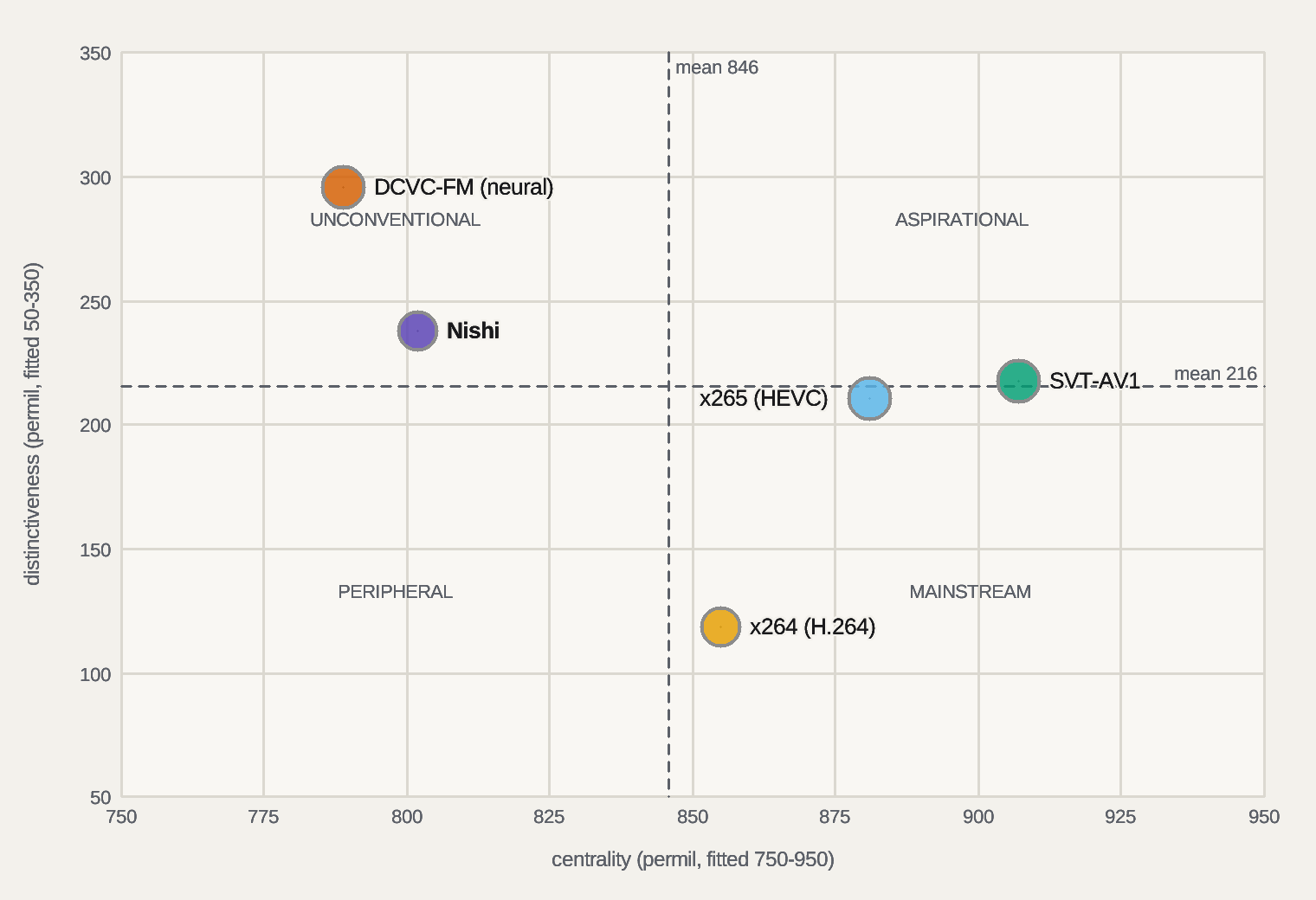
Position map — centrality and distinctiveness
The four-quadrant map the field uses for brand strategy (Dawar and Bagga, HBR June 2015), re-derived from this matrix on every publish. Centrality is the share of the category's feature mass a player covers, each feature weighted by how many hold it; distinctiveness is the average lead over each rival on the rows the player holds; breadth is the depth-weighted share of the whole matrix (the bubble); depth is how deeply the rows held are held; momentum is the day-over-day move off the spine (green rising, red falling, grey until day two); the dashed path runs first day → previous day → today. Dividers are the category means. Axes are fitted to the field of play, so read the tick numerals, not the frame. Rival marks are documented presence, so a rival's position reads the record, never its quality. The picture grades its own readability below; the table beside it is the same data for a screen reader or a second method.
knowledge/compare/videocodec.cdmap (cut|x|y, cube|x|y|z); absent = the HBR defaultsbubble area = breadth · ring = momentum (green rising, red falling, grey until day two) · dashed = category means · axes fitted to the field of play: centrality 750–950, distinctiveness 50–350 of 0–1000 permil (the full range put every player in one corner)
readability of the 2D cut, self-graded by the layout ruler: label overlaps 0 · labels over marks 0 · off-canvas 0 · unresolved labels 0 · mark overlaps 0 (a fact of the data: two players that close are that close) · data spread 590 permil of the plot · quadrant words unseated 0
text contrast, measured with wcag2-ratio (floors from contrast.conf), light theme: labels 16.24 (floor 4.50) · notes 16.24 (floor 4.50) · quadrant words 5.89 (floor 4.50) · tick numerals 5.89 (floor 4.50) · axis titles 5.59 (floor 4.50) · dark theme: labels 13.78 (floor 4.50) · quadrant words 5.55 (floor 4.50) · axis titles 5.97 (floor 4.50) · dark classes under their floor 0 (one figure serves both themes: a dark shortfall is a token to fix, never a class to hide) · classes refused under their floor 0 (a refused class is not drawn; the scale classes are measured, never hidden) · export: SVG PNG (receipt, rendered by the estate's own rasteriser from this page)

readability of the 3D cube, self-graded by the layout ruler: label overlaps 0 · labels over marks 0 · off-canvas 1 · unresolved labels 0 · mark overlaps 1 (a fact of the data: two players that close are that close) · data spread 344 permil of the plot
10 panels over 5 registered axes, every pair once (the lower axis on x, the higher on y) · each panel fitted to its own field of play, first and last tick numerals shown · no labels in a small cut, the legend names the colours; the grade below reports the mark terms only (MM summed over the panels, spread averaged)
readability of the small multiples, self-graded by the layout ruler: label overlaps 0 · labels over marks 0 · off-canvas 0 · unresolved labels 0 · mark overlaps 2 (a fact of the data: two players that close are that close) · data spread 497 permil of the plot
| Player | Quadrant | centrality | distinctiveness | breadth | depth | momentum | Rows held | Days on spine | First seen |
|---|---|---|---|---|---|---|---|---|---|
| Nishi | Unconventional | 802 | 238 | 500 | 733 | 0 since 2026-09-23 | 15 | 10 | 2026-09-15 |
| x264 (H.264) | Mainstream | 855 | 119 | 515 | 809 | 0 since 2026-09-23 | 14 | 10 | 2026-09-15 |
| x265 (HEVC) | Mainstream | 881 | 211 | 606 | 888 | 0 since 2026-09-23 | 15 | 10 | 2026-09-15 |
| SVT-AV1 | Aspirational | 907 | 218 | 621 | 854 | 0 since 2026-09-23 | 16 | 10 | 2026-09-15 |
| DCVC-FM (neural) | Unconventional | 789 | 296 | 590 | 812 | 0 since 2026-09-23 | 16 | 10 | 2026-09-15 |
| Day | Matrix rows reviewed | Players recorded |
|---|---|---|
| 2026-09-15 | 22 | 5 |
| 2026-09-16 | 22 | 5 |
| 2026-09-17 | 22 | 5 |
| 2026-09-18 | 22 | 5 |
| 2026-09-19 | 22 | 5 |
| 2026-09-20 | 22 | 5 |
| 2026-09-21 | 22 | 5 |
| 2026-09-22 | 22 | 5 |
| 2026-09-23 | 22 | 5 |
| 2026-10-08 | 22 | 5 |
players 5|matrix rows 22|feature mass 76|centrality mean 846|distinctiveness mean 216|axes 5|spine days 10 (shown 10)|rows written today 0|readability defects 2D 0 cube 1|spine knowledge/status/cdmap/videocodec.spine
Capability matrix — measured against source
◉ authored stronger claim; source present● present◐ partial○ absent? unassessed; excluded from relative comparison · click any capability for its evidence
Peer cell coverage: authored assessed 88, unassessed 0. Authored assessments are not verified outcomes.
No capabilities match this filter or search.
| Capability | Nishi | x264 (H.264) | x265 (HEVC) | SVT-AV1 | DCVC-FM (neural) |
|---|---|---|---|---|---|
Block transform -- integer DCTMeasured:nx_dct8_forward_1d exists in runtime/nx_dct8.nx, verified at emit. Nishi 4x4 + 8x8 [h264]; HEVC to 32x32, AV1 to 64x64 (big win on flat content) Adoption: LIB-WIRED importers=27 nonval=14 — fully adopted (top of its ladder).Pros Implementing source symbol found; runtime acceptance separate; fully adopted on the estate ladderCons none on the measured axes (rival marks are documented presence, not depth) | ● | ● | ● | ● | ● |
Context/arithmetic entropy coderMeasured:rc_block_encode exists in runtime/nx_rangecoder.nx, verified at emit. Nishi binary range coder saves 33pct vs its own CAVLC (MEASURED); CABAC [x264] + learned entropy are deeper Adoption: LIB-WIRED importers=4 nonval=2 — fully adopted (top of its ladder).Pros Implementing source symbol found; runtime acceptance separate; fully adopted on the estate ladderCons behind x264 (H.264) (leads), x265 (HEVC) (leads), SVT-AV1 (leads), DCVC-FM (neural) (leads) | ● | ◉ | ◉ | ◉ | ◉ |
Quarter-pel motion compensationMeasured:qp_pixel exists in runtime/nx_vsubpel.nx, verified at emit. Nishi 1/4-pel translational; AV1 adds 1/8-pel, affine, OBMC [av1spec] Adoption: LIB-WIRED importers=5 nonval=3 — fully adopted (top of its ladder).Pros Implementing source symbol found; runtime acceptance separate; fully adopted on the estate ladderCons behind SVT-AV1 (leads) | ● | ● | ● | ◉ | ● |
Variable block-size motion partitionsMeasured:vc_enc_mb_part8_inter exists in runtime/nx_vcodec.nx, verified at emit. Nishi P_8x8 = 4 independent 8x8 MVs per MB, RD-selected vs 16x16, differential MV -- LIVE vcv-7 (BUILD 810). MEASURED +2-4pct bit-exact on MSU akiyo/foreman/bus/mobile at qp8/20/32. The first partition rung; x264 splits to 4x4, HEVC uses a CTU quadtree, AV1 to 4x4-plus. Cuts the dominant P-frame residual (measured 87-97pct of P bits) rival marks uncited — the Yes, Best or Part codes on this row are an observation read with no reference mark behind them Adoption: BUILT-UNPROMOTED — PARTIAL: compiled, never promoted to the serving root: /api/promote it.Pros Implementing source symbol found; runtime acceptance separateCons behind x265 (HEVC) (leads), SVT-AV1 (leads); not adopted yet: compiled, never promoted to the serving root: /api/promote it | ● | ● | ◉ | ◉ | ● |
Rich intra predictionMeasured:vc_pred_rich exists in runtime/nx_vcodec.nx, verified at emit. Nishi 9 modes + MPM; HEVC 35, AV1 56-plus directional rival marks uncited — the Yes, Best or Part codes on this row are an observation read with no reference mark behind them Adoption: BUILT-UNPROMOTED — PARTIAL: compiled, never promoted to the serving root: /api/promote it.Pros Implementing source symbol found; runtime acceptance separateCons behind x265 (HEVC) (leads), SVT-AV1 (leads); not adopted yet: compiled, never promoted to the serving root: /api/promote it | ● | ● | ◉ | ◉ | ● |
In-loop filteringMeasured:vv_deblock exists in runtime/nx_video_codec_wasm.nx, verified at emit. Nishi deblock, gentle-tuned vcv-8 (c1 qp*1.5+2 -> qp/2+2 was the FIFTH mis-tuned constant: over-smoothing the in-loop reference cost 24-47 BD-rate pts, MEASURED + shipped BUILD 815); HEVC adds SAO, AV1 adds CDEF + loop restoration rival marks uncited — the Yes, Best or Part codes on this row are an observation read with no reference mark behind them Adoption: LIB-WIRED importers=65 nonval=19 — fully adopted (top of its ladder).Pros Implementing source symbol found; runtime acceptance separate; fully adopted on the estate ladderCons behind x265 (HEVC) (leads), SVT-AV1 (leads) | ● | ● | ◉ | ◉ | ● |
Rate-distortion mode decision (real-bit RDO)Measured:vc_enc_block_packed_e exists in runtime/nx_vcodec.nx, verified at emit. Nishi RDO now covers THREE decisions: (1) RD-SKIP (BUILD 816, archival profile): every P-MB trial-coded skip-vs-code through the LIVE range coder (est/probs snapshot+restore), argmin J=32*SSE+qp^2*bits -- MEASURED -7..-44 BD-rate pts; (2) per-MB HEAT-AQ skip policy (BUILD 819, live): past-streak-modulated thresholds, -1.72pct avg; (3) per-MB 4x4-vs-8x8 TRANSFORM trial (BUILD 820, live): the 803 machinery awakened -- both transforms trial-quantized per coded MB, argmin J commits, t8 bit explicit on the wire (stock decode) -- MEASURED -0.52pct avg incremental (never negative, +9.3pct encode at 120fps). Its bit cost is still the CAVLC table (the true stream is range-coded) -- replacing it with real-rc-bit trial costing is the remaining P3 rung. x264/x265 apply full-RDO to every mode+partition+transform (the 20-year integration edge); ours now covers skip+transform -- modes/partitions remain rival marks uncited — the Yes, Best or Part codes on this row are an observation read with no reference mark behind them Adoption: BUILT-UNPROMOTED — PARTIAL: compiled, never promoted to the serving root: /api/promote it.Pros Implementing source symbol found; runtime acceptance separateCons behind x264 (H.264) (leads), x265 (HEVC) (leads), SVT-AV1 (leads), DCVC-FM (neural) (leads); not adopted yet: compiled, never promoted to the serving root: /api/promote it | ● | ◉ | ◉ | ◉ | ◉ |
B-frames / hierarchical GOPOpen — watchingruntime/nx_vcodec_bframe.nx : vb_encode, re-measured on every compare beat. Ship that symbol and this mark flips itself; the comparewatch- plane row flips with it. Nishi is I+P only; hierarchical-B is 15-30pct of the majors efficiency rival marks uncited — the Yes, Best or Part codes on this row are an observation read with no reference mark behind themPros none measured yetCons behind x264 (H.264) (leads), x265 (HEVC) (leads), SVT-AV1 (leads), DCVC-FM (neural); open contract; expected source declaration not established | ○ | ◉ | ◉ | ◉ | ● |
Larger transforms (16/32/64)Open — watchingruntime/nx_vcodec_bigtx.nx : vt_dct16, re-measured on every compare beat. Ship that symbol and this mark flips itself; the comparewatch- plane row flips with it. Nishi 8x8 max; HEVC 32x32 [h265] [x265], AV1 64x64Pros none measured yetCons behind x265 (HEVC) (leads), SVT-AV1 (leads); open contract; expected source declaration not established | ○ | ○ | ◉ | ◉ | ○ |
Trained restoration post-filterMeasured:vc_nf_apply exists in runtime/nx_vcodec_nf.nx, verified at emit. Nishi has a trained integer post-filter but the table is mostly-identity today (barely fires); neural codecs learn the whole loop rival marks uncited — the Yes, Best or Part codes on this row are an observation read with no reference mark behind them Adoption: LIB-WIRED importers=2 nonval=2 — fully adopted (top of its ladder).Pros Implementing source symbol found; runtime acceptance separate; ahead of x264 (H.264), x265 (HEVC), SVT-AV1; fully adopted on the estate ladderCons none on the measured axes (rival marks are documented presence, not depth) | ● | ○ | ○ | ○ | ● |
Learned entropy model (hyperprior)Open — watchingruntime/nx_neural_entropy.nx : ne_model, re-measured on every compare beat. Ship that symbol and this mark flips itself; the comparewatch- plane row flips with it. MEASURED: our hand-context coder is already 0.088 bits/sig-flag (near-optimal) -- a trained model on DCT coeffs is marginal; the DCVC win is a JOINTLY-TRAINED model over LEARNED features, not DCT [dcvcfm24]Pros none measured yetCons behind DCVC-FM (neural) (leads); open contract; expected source declaration not established | ○ | ○ | ○ | ○ | ◉ |
End-to-end neural codecOpen — watchingruntime/nx_neural_codec.nx : nc_codec, re-measured on every compare beat. Ship that symbol and this mark flips itself; the comparewatch- plane row flips with it. DCVC-FM beats VVC by 20-40pct [dcvcfm24]; Nishi is classical block-based onlyPros none measured yetCons behind DCVC-FM (neural) (leads); open contract; expected source declaration not established | ○ | ○ | ○ | ○ | ◉ |
Perceptual / generative codingOpen — watchingruntime/nx_perceptual_codec.nx : pc_gen, re-measured on every compare beat. Ship that symbol and this mark flips itself; the comparewatch- plane row flips with it. The number-one frontier (momentum 108); GAN/diffusion codecs -- Nishi absent rival marks uncited — the Yes, Best or Part codes on this row are an observation read with no reference mark behind themPros none measured yetCons behind SVT-AV1, DCVC-FM (neural) (leads); open contract; expected source declaration not established | ○ | ○ | ○ | ◐ | ◉ |
Compression efficiency (external BD-rate, ffmpeg oracle)Measured:vc_enc_frame_packed_rc exists in runtime/nx_vcodec.nx, verified at emit. MEASURED on 4 standard CIF seqs vs x264/x265/AV1 (ffmpeg Y-PSNR, GOP48 zerolatency RTC) [svtav1] [bjontegaard01] [msu-codec-comparison]. TWO PROFILES (a codec is a rate/quality/SPEED triangle -- BD-rate alone is a partial grade): (1) RTC/live (BUILD 822, the shipped /video default): THREE gen-2 rungs shipped 2026-07-12 -- P2 HEAT-AQ (819: protect long-static MBs from drift, per-MB skip-thresh /2 on a 4-skip streak; -1.72pct avg) + t8 RD-auto (820: per-MB 4x4-vs-8x8 transform trial; -0.52pct) + P3 REAL-BIT RDO (822: the trial made byte-faithful to the emit paths -- RDOQ levels in BOTH arms + each arm costed by a read-only walk of the coder's OWN adaptive sig-map bins (rc_sig_cost_q8/rc_bits_q8) instead of CAVLC tables; -2.58pct avg incremental, biggest on motion content bus -3.16) = COMBINED MEASURED **-4.82pct avg BD-rate vs the 817 baseline** (akiyo -6.86 / foreman -6.00 / bus -4.05 / mobile -2.38), never negative on any seq, same-scorer x264 gap cut **+176pct -> +159pct in one day**, encode 119 fps (measured, far above every tier floor; the real-bit cost walk is FREE vs the tables); the CHURN direction (cheapening active MBs) measured +6.4pct = REFUTED, never do it. (2) ARCHIVAL/offline (RD-skip emode bit11, ~10 fps, for stored-media transcode): avg +140pct vs x264 (old-scorer scale) -- RD-skip's J=32D+q^2R trial coding buys -7..-44 BD-pts but costs 9-19x encode, so it is NOT the live default. Lineage 811-815 fixed five mis-tuned constants (foreman 21x -> 2.4x, 8.7x bitrate cut from the original +703..+1987pct). INTRA-only +41..+66pct. Gen-1 levers measured out: subpel/partition/ME/MV-pred ~0, multi-ref 1.5pct, intra-in-P wash, SATD 0.1-0.5pct, I16-pred/16x16-TX/CDEF/QP-cascade REFUTED. Remaining vs x264 = 2nd-gen architecture (32x32 CTU, hier-refs, B-pyramid) + compound RDO Adoption: BUILT-UNPROMOTED — PARTIAL: compiled, never promoted to the serving root: /api/promote it.Pros Implementing source symbol found; runtime acceptance separateCons behind x264 (H.264) (leads), x265 (HEVC) (leads), SVT-AV1 (leads), DCVC-FM (neural) (leads); not adopted yet: compiled, never promoted to the serving root: /api/promote it | ● | ◉ | ◉ | ◉ | ◉ |
Real-time encode throughput (fps budget)Measured:vv_enc_rct8 exists in runtime/nx_video_codec_wasm.nx, verified at emit. MEASURED (vc_fps_bench, wasm VM, 320x256 P-frame, talking-head): Nishi RTC profile ~89 fps single-thread (browser-viable for live calls); ARCHIVAL/RD-skip profile 4.6-9.7 fps (offline only). x264 zerolatency = the RTC gold standard (1080p realtime on a desktop core) [x264]; x265/AV1 need fast presets or HW; DCVC-neural = GPU-only. ★A codec claim is INCOMPLETE without this axis -- BUILD 816 shipped an RD-skip that collapsed live encode 89->4.6 fps because the census had NO speed axis; 817 split the profiles + added this row Adoption: LIB-WIRED importers=65 nonval=19 — fully adopted (top of its ladder).Pros Implementing source symbol found; runtime acceptance separate; ahead of DCVC-FM (neural); fully adopted on the estate ladderCons behind x264 (H.264) (leads), x265 (HEVC) (leads) | ● | ◉ | ◉ | ● | ○ |
Encoder stage attribution -- where the encode time goes, per macroblock (sovereign stage bench)Measured:sb_run exists in runtime/nx_vcodec_stage_bench.nx, verified at emit. MEASURED 2026-09-02 by nx_vcodec_stage_bench (new, sovereign, laptop-runnable: the PRODUCTION rct8 RTC encoder, emode 2593, over the real head-to-head test card, timing the whole encode, the integer search, the quarter-pel refine and the 16x4x4 transform-RDOQ-entropy coder per macroblock, with band populations, PSNR and a wire digest per run). At the LIVE point (qp 24, skip threshold qp*30) a 352x288 frame cost 23.7 ms: integer search 30 percent, qpel 9 percent, the whole 4x4 coder only 9 us per coded MB -- and the RD-skip band trial was 65 percent of the frame, because the lower trial band [thr/4, thr) held 291 of 396 MBs (its floor sits BELOW the recon quantisation-noise floor of a static block, so 88 percent of the frame paid a 55 us code-arm trial and re-skipped; 1746 vs 1749 bytes). FIX (build 865, encoder-only bit14 VC_EMODE_QQSKIP): trial a lower-band MB only when an 8x8 quadrant moves -- 23.7 to 11.0 ms per frame, wire digests of every unchanged mode byte-identical, BD-rate by nx_bd_calc on akiyo/foreman/bus/mobile +0.1/+0.9/-0.7/0.0 percent, live single-thread encode 93 to 21 ms at 416x320. NEXT named bottleneck: about 55 us per CODED MB on moving content (search 18, a SCALAR bilinear qpel refine 20-28 beside a SIMD integer SAD, coder 9). x264, x265 and SVT-AV1 ship per-stage timing and stat reports (1); neural codecs do not expose one (0). [x264] [svtav1] Adoption: REGISTERED-DARK — PARTIAL: callable, authorised, completed MCP invocation not established by supplied journal window; lifetime history unknown (direct execution may be recorded elsewhere; this scan does not establish lifetime use); no execution surface runs it either (clock, cron, daemon, roster, actlog and surfaced forks checked).Pros Implementing source symbol found; runtime acceptance separate; ahead of DCVC-FM (neural)Cons not adopted yet: callable, authorised, completed MCP invocation not established by supplied journal window; lifetime history unknown (direct execution may be recorded elsewhere; this scan does not establish lifetime use); no execution surface runs it either (clock, cron, daemon, roster, actlog and surfaced forks checked) | ● | ● | ● | ● | ○ |
Live resolution ceiling + per-device adaptive sendMeasured:vv_enc_rct8 exists in runtime/nx_video_codec_wasm.nx, verified at emit. MEASURED (vc_res_bench/vc_hd_bench, wasm VM): the codec itself is RESOLUTION-AGNOSTIC (bit-exact GREEN proven at 640x480/960x544/1280x720); the LIVE ceiling is the client memory layout + single-thread fps. BUILD 818 (2026-07-12) raised the shipped ceiling 320x256 -> 640x480 with Jitsi-class per-device adaptive tiers (measured: 640x480=38.6fps / 480x384=58 / 416x320=70 single-thread; tier picked by mount-time measured encoder class; LO 128x96 simulcast for weak receivers; old-peer rooms fail safe to 320x256) + adaptive tile rendering (the old client DOWNSCALED every received frame onto a 320x256 canvas -- resolution was capped at DISPLAY too). Majors do 720p-1080p live (x264 1080p realtime single-core; Zoom/Meet/Jitsi default 720p) -- Nishi is BEHIND on ceiling until the tile-parallel HD arc lands: 720p single-thread = 8.8 fps MEASURED, needs ~4-band parallel encode with the rich codec in the band path (band path is legacy-entropy today; legacy band at 1280x704 = 251ms/band REFUTED). ★This axis was MISSING from the census while users saw potato -- presence of a speed row did not catch a resolution cap; grade what users SEE. UPDATE 2026-08-19: V1 SHIPPED (build 862) -- the CLIENT ceiling was RAISED from 640x480 to HD 1152x640/1024x576 adaptive via vc_res_tier_hd + a fully DERIVED region layout (no magic hex, grown to 108 MB, gated on all-peers-862 + deviceMemory>=4); codec bit-exact roundtrip at 1152x640/1024x576/640x480 gate-proven (25/25) and served byte-identical to the gated build. 1280x720 (45 MB-rows, no even band split) is the next K=2 rung; see V1 on /compare/video rival marks uncited — the Yes, Best or Part codes on this row are an observation read with no reference mark behind them Adoption: LIB-WIRED importers=65 nonval=19 — fully adopted (top of its ladder).Pros Implementing source symbol found; runtime acceptance separate; fully adopted on the estate ladderCons behind x264 (H.264) (leads), x265 (HEVC) (leads), SVT-AV1 (leads) | ● | ◉ | ◉ | ◉ | ● |
Sovereign own-stack (zero third-party)Source present; authored stronger claim:vc_t8_init in runtime/nx_vcodec.nx, verified at emit. Own language, compiler, wasm -- x264/x265/AV1 are C/C++, DCVC is Python/CUDA Adoption: BUILT-UNPROMOTED — PARTIAL: compiled, never promoted to the serving root: /api/promote it.Pros Source symbol found; stronger capability claim is authored; ahead of x264 (H.264), x265 (HEVC), SVT-AV1, DCVC-FM (neural)Cons not adopted yet: compiled, never promoted to the serving root: /api/promote it | ◉ | ○ | ○ | ○ | ○ |
Integer-deterministic bit-exact everywhereSource present; authored stronger claim:vc_mb_t8_ok in runtime/nx_vcodec.nx, verified at emit. No-float pipeline reproduces bit-exact on ANY device, which is what makes recon-hash conformance possible; float codecs cannot Adoption: BUILT-UNPROMOTED — PARTIAL: compiled, never promoted to the serving root: /api/promote it.Pros Source symbol found; stronger capability claim is authored; ahead of x264 (H.264), x265 (HEVC), SVT-AV1, DCVC-FM (neural)Cons not adopted yet: compiled, never promoted to the serving root: /api/promote it | ◉ | ○ | ○ | ○ | ○ |
| One codec | |||||
browser tab + Nishi browser + native NishiOSSource present; authored stronger claim:vv_enc_rct8 in runtime/nx_video_codec_wasm.nx, verified at emit. The same sovereign codec runs in a tab, the Nishi browser, and native NishiOS; others need hardware or wasm ports rival marks uncited — the Yes, Best or Part codes on this row are an observation read with no reference mark behind them Adoption: LIB-WIRED importers=65 nonval=19 — fully adopted (top of its ladder).Pros Source symbol found; stronger capability claim is authored; ahead of x264 (H.264), x265 (HEVC), SVT-AV1, DCVC-FM (neural); fully adopted on the estate ladderCons none on the measured axes (rival marks are documented presence, not depth) | ◉ | ◐ | ◐ | ◐ | ○ |
Full-mode RDO over intra modes and partitionsDARK —runtime/nx_vcodec.nx EXISTS but does not declare vc_rdo_modes: something shipped at this path under another name, and this mark would read open forever. Repoint the contract to the real entry point (the plan rung AND this row) or rename the function; the flip follows on the next beat, and the comparewatch- plane row reads DARK until then. The RDO row's own remainder: skip and transform are RD-decided, modes and partitions are not rival marks uncited — the Yes, Best or Part codes on this row are an observation read with no reference mark behind themPros none measured yetCons behind x264 (H.264) (leads), x265 (HEVC) (leads), SVT-AV1 (leads), DCVC-FM (neural) (leads); open contract; expected source declaration not established | ○ | ◉ | ◉ | ◉ | ◉ |
Restoration post-filter trained to fireDARK —runtime/nx_vcodec_nf.nx EXISTS but does not declare vc_nf_train: something shipped at this path under another name, and this mark would read open forever. Repoint the contract to the real entry point (the plan rung AND this row) or rename the function; the flip follows on the next beat, and the comparewatch- plane row reads DARK until then. The trained table is mostly identity today; a training run that measurably fires, BD-rate proven rival marks uncited — the Yes, Best or Part codes on this row are an observation read with no reference mark behind themPros none measured yetCons behind DCVC-FM (neural); open contract; expected source declaration not established | ○ | ○ | ○ | ○ | ● |
| Class | Count | Note |
|---|---|---|
| rows with rival marks | 20 | rows carrying a Yes, Best or Part in a rival column |
| cited | 9 | a reference mark resolves to a pinned mirror |
| uncited | 11 | an observation read, badged until a reference lands |
| rows, summed | 20 | RECONCILED: the parts sum to the total 20 |
Delivery and evidence
Inspect risks, technical debt, rendered observations, experiments and references. Read scope and limitations alongside every result.
Person · product · place — not yet measured for this domain
knowledge/compare/videocodec.ppp (rows surface|nishi or c1..c4|label|url|connect naming OUR live surface and each rival's front door), run nx_ppp_probe domain videocodec, and this section fills itself on the next beat: the same ruler on both sides — privacy and CX (third-party hosts, tracker classes, cookies, security headers), design and longevity (design hygiene, computed WCAG contrast, render-blocking resources, unsized media, script weight, theme and motion queries), findability (landmarks, skip link, on-site search, breadcrumb, headings, internal links).The field — discovered, not chosen
Rows written by nx_field_discover from videocodec.seeds: the industry's own lists (Wikipedia wikitext, GitHub topics, awesome lists) read mechanically, every candidate counted across seeds. The matrix columns above are a SEAT'S pick; this band is the population they were picked from, and the stats line measures one against the other. A rival here is a lead, never a verdict — it earns a column when its capabilities are read and pinned.
| Class | Count | Note |
|---|---|---|
| seeds | 4 | |
| scanned | 4 | |
| fetched | 4 | |
| reused | 0 | |
| failed | 0 | |
| named | 4 | |
| candidates | 4 | |
| mentions | 4 | |
| capped | 0 |
| Rank | Rival | Seeds | Mentions | First seed | Kind | Link |
|---|---|---|---|---|---|---|
| 1 | x264 (H.264) | 1 | 1 | col0-x264 | named | https://www.videolan.org/developers/x264.html |
| 2 | x265 (HEVC) | 1 | 1 | col1-x265 | named | https://www.videolan.org/developers/x265.html |
| 3 | SVT-AV1 | 1 | 1 | col2-svt | named | https://gitlab.com/AOMediaCodec/SVT-AV1 |
| 4 | DCVC-FM (neural) | 1 | 1 | col3-dcvc | named | https://arxiv.org/abs/2402.17414 |
field candidates 4|shown 4 of 4|matrix columns in the field 4 of 4|discovered rivals with no column 0|malformed rows 0 (counted, never rendered)|read-capped 0
Exclusive and shared capabilities
This board grades 20 capabilities: 17 exclusive to it and 3 shared with other boards. Shared rows on this page: 3 = home here 0 + home elsewhere 0 + ambiguous 0 + undecided 3 + refused 0 (partition 3); undecided = unmapped 0 + unproven 3 + unevidenced 0; homonyms 1; since the previous census: new 0, resolved 0. Census FRESH age_s=6463.
| Capability | Organ | Boards grading it | Home | Rule | Evidence | Standing on this board |
|---|---|---|---|---|---|---|
| vv_enc_rct8 | nx_video_codec_wasm.nx | comms, videocodec, video | — | none | unproven | undecided |
| sb_run | - | videocodec:runtime/nx_vcodec_stage_bench.nx, referee:runtime/nx_std_bench.nx | — | homonym | - | homonym |
| vc_t8_init | nx_vcodec.nx | videocodec, videoops | — | none | unproven | undecided |
| vc_mb_t8_ok | nx_vcodec.nx | videocodec, videoops | — | none | unproven | undecided |
Gaps from the record — what the estate does that no board carries
The record census (nx_goalmap record) reads the invoked-tool population and every plan queue row and files each organ or directive that NO matrix, plan or gates row names. A row here is a callout the boards missed: adjudicate it onto a board or declare it infrastructure. Census state STALE (age 1395568 s), sources read 4 of 7 declared — a BLIND census is a FLOOR: unread sources can only add rows.
| kind | name | board | source | evidence |
|---|
rows shown 0|this board's directives 0|estate-wide un-boarded organs 452 (listed in full on /compare/ecosystem)|census rows 639|malformed 0 (counted, never rendered)
References
- [x264] VideoLAN. x264, the best H.264/AVC encoder: CAVLC/CABAC entropy coding, adaptive B-frame placement and B-frames as references, psy-RD and psy-trellis, multipass ABR/VBV ratecontrol, 4 or more 1080p streams in realtime on a consumer machine. publisher · read in our library
knowledge/fetched/cmp_videocodec_x264.html· pinh8ac7051331232bc3423f7c294ee026b062290eb8459679751e822e5f44894a79· accessed 2026-08-18 · vendor-docGrounds: The x264 column: "Context/arithmetic entropy coder" (CABAC), "B-frames / hierarchical GOP" (adaptive B placement, B-refs), "Rate-distortion mode decision (real-bit RDO)" (psy-RD/trellis over every mode) and "Real-time encode throughput (fps budget)" -- the page's 1080p-realtime claim is the RTC gold standard the row grades our 89 fps 320x256 against. - [x265] VideoLAN and MulticoreWare. x265, free H.265/HEVC encoder: quad-tree prediction, adaptive B-frame placement, CABAC, multiple reference frames, frame-level and wavefront parallelism; GPL with commercial licence. publisher · read in our library
knowledge/fetched/cmp_videocodec_x265.html· pinhb0c55e0005ad2b44ece4b190fc6151f17f37eb96afe8f81089bd77537f176fac· accessed 2026-08-18 · vendor-docGrounds: The x265 column: "Larger transforms (16/32/64)" and "Variable block-size motion partitions" ride the HEVC CTU quadtree the page names; "Real-time encode throughput" code 2 with fast presets or parallelism, as the page describes. - [svtav1] Alliance for Open Media. SVT-AV1 -- the AOM-maintained AV1 software encoder (Clear BSD; official GitLab repository with README, CHANGELOG and releases). publisher · read in our library
knowledge/fetched/cmp_videocodec_svtav1.html· pinh29f5ebda4e8ba42867599b0979acccdc377d006f15d12c732b3cc90e4712a7e5· accessed 2026-08-18 · vendor-docGrounds: The SVT-AV1 column: the AV1 encoder our ffmpeg oracle runs for the "Compression efficiency (external BD-rate, ffmpeg oracle)" row and whose fast presets ground the "Real-time encode throughput" code 1. - [av1spec] Alliance for Open Media. AV1 Bitstream and Decoding Process Specification (v1.0.0 with errata), the normative decoder definition: 1/8-pel and warped/affine motion, OBMC, directional intra modes, CDEF and loop restoration, transforms to 64x64. publisher · read in our library
knowledge/fetched/cmp_videocodec_av1spec.html· pinhacf58a3fdb82a85e25aa7fe19b8fe2a5ccc02884d0e852f2fc9b05ba7aa49609· accessed 2026-08-18 · published-standardGrounds: The AV1 feature reads across "Quarter-pel motion compensation" (AV1 adds 1/8-pel, affine, OBMC), "Rich intra prediction" (directional modes), "In-loop filtering" (CDEF + loop restoration) and "Larger transforms (16/32/64)" (AV1 64x64) are read from this normative text, not from marketing. - [h264] ITU-T. Recommendation H.264: Advanced video coding for generic audiovisual services (first edition 05/2003; in-force editions through 2024) -- ITU-T publication page listing every edition. publisher · read in our library
knowledge/fetched/cmp_videocodec_h264.html· pinhce4404ca022f3b50d0ba54439285cac85dcbc09d0a6ec6a6059642f833b1ba84· accessed 2026-08-18 · published-standardGrounds: The @verdict claim "a REAL H.264-class sovereign codec": CAVLC/CABAC, quarter-pel MC, 4x4/8x8 integer transform, 9 intra 4x4 modes and in-loop deblocking are H.264 toolset elements, so "Block transform -- integer DCT", "Rich intra prediction" (Nishi 9 modes + MPM) and "In-loop filtering" (deblock) are graded against this standard's toolset. - [h265] ITU-T. Recommendation H.265: High efficiency video coding (first edition 04/2013; in-force editions through 2024) -- ITU-T publication page listing every edition. publisher · read in our library
knowledge/fetched/cmp_videocodec_h265.html· pinh0f621ca591bf5c68bdb52451098015cb033d6aba38178de88422da585eec886b· accessed 2026-08-18 · published-standardGrounds: The HEVC feature reads: "Larger transforms (16/32/64)" (HEVC 32x32), "Rich intra prediction" (HEVC 35 modes), "In-loop filtering" (HEVC adds SAO) and the CTU quadtree behind "Variable block-size motion partitions" are HEVC toolset facts this standard defines. - [dcvcfm24] Li, Li, Lu. Neural Video Compression with Feature Modulation (DCVC-FM). CVPR 2024, arXiv:2402.17414 -- abstract headline: 29.7 percent bitrate saving over the previous SOTA neural video codec under the single-intra-frame setting with 16 percent fewer MACs. publisher · read in our library
knowledge/fetched/cmp_videocodec_dcvcfm24.html· pinha127e0bee1abebea0a55a8339570014a261eff241357000780bdb40d3fe3cf02· accessed 2026-08-18 · published-paperGrounds: The DCVC-FM (neural) column: "End-to-end neural codec" and "Learned entropy model (hyperprior)" code 2 are this paper's architecture (jointly trained model over learned features, which the entropy row's note names as the real win). The row note's "beats VVC by 20-40pct" is a read of the paper's VTM comparison tables, not of the abstract, whose stated number is the 29.7 percent above. - [bjontegaard01] Bjontegaard, G. Calculation of average PSNR differences between RD-curves. ITU-T SG16 Q.6 VCEG document VCEG-M33, Austin TX, April 2001 (the BD-PSNR / BD-rate definition). publisher · read in our library
knowledge/fetched/cmp_videocodec_bjontegaard01.doc· pinh37cfd46e88a3e8b880c95bc92753027c8fed5fde39947b0a50b17efc0e336014· accessed 2026-08-18 · published-standardGrounds: "Compression efficiency (external BD-rate, ffmpeg oracle)": every +/- pct on this page (+159pct RTC, +140pct archival, -4.82pct avg vs the 817 baseline) is a Bjontegaard delta-rate over four rate points as this document defines; the mirror is the original ITU-hosted Word document. - [msu-codec-comparison] Moscow State University Graphics and Media Lab. MSU Video Codecs Comparison (annual reports 2003-2025): objective Y-PSNR/SSIM/VMAF and subjective methodology over standard sequences at CIF through 4K, the reference public codec benchmark. publisher · read in our library
knowledge/fetched/cmp_videocodec_msu.html· pinhf38da4818d416b566c54ccf26e07b3f66240dc00b81ec7a0d3b56b32052dbbc1· accessed 2026-08-18 · published-paperGrounds: The @verdict claim "Every number on this page is MSU-methodology measured (ffmpeg Y-PSNR oracles)" and the akiyo/foreman/bus/mobile CIF sequence set used by nx_vcodec_rd_bench: this is the methodology page those measurements follow.
generated by nx_swcompare_matrix (sovereign NishiLang organ) from knowledge/compare/videocodec.matrix · source checks show implementation presence; runtime and user-outcome evidence are reported separately · JavaScript supports page controls