Nishi Family › Compare › GPU Worker Mesh and Distributed Inference
Nishi Compare · capabilities, evidence and delivery
GPU Worker Mesh and Distributed Inference
Compare capabilities and delivery evidence. Source discovery, qualification, deployment and accepted outcomes are separate; an open contract names work still to verify.
A NAS orchestrator dispatching capability-scoped jobs to GPU workers (laptop 5080 images, west 3090 video, cloud) and pushing results to the gallery -- Nishi vs NVIDIA Triton and Ray Serve and Modal and KServe
Overview
The purpose, declared position and evidence coverage of this domain. Source presence and completed acceptance are different measures.
Where we are. Measured 2026-08-19. Every row of the mesh is present and proven: ocap dispatch, cross-host routing, sovereign actuation, daemonless governance, a content-addressed registry, batching scheduler, load balancing, autoscale to zero, streaming, admission, multi-model residency -- with three exceeds on sovereignty and capability scoping. The matrix carries no symbol gaps; this plan admits four watch contracts on the rows where Triton, Ray and Modal lead: circuit-breaker failover, on-demand model load, fused batched execution and a live remote replica.
Where we need to go. Make the mesh robust and fast -- breakers, on-demand residency, fused batches -- then prove the cluster with a remote replica serving live, keeping zero per-call cost and the ocap grant as the exceed.
Latest recorded release
No valid dated release entry is recorded for this domain.
Release entries describe recorded changes; they do not establish that every capability passed evaluation.
17 of 21 capability source symbols found|3 of them authored stronger-claims|4 open|coverage 809/1000|adoption 9 full / 8 partial
Evidence profile — what the gaps on this board actually are
Measured by nx_swcompare_evidence, read back by nx_evprofile_lib. Every figure is a count with its denominator — there is deliberately no score, no grade and no percentage anywhere in this band, because a stored scalar is a field a seat can edit and a counted partition is not.
evidence|grounded 17/17|unsupported 0|gates green 7/7|proven able to fail 7/7|never bitten 0|green at 0/0 7|open gaps 4|of them unnamed 0|of them proof withheld 0|flips ready 0
proven able to fail counts the gates that have a RECORDED RED — nx_gate_bite mutated the gate subject, rebuilt it, watched the gate go red, and that record is inside the shared TTL. never bitten is its complement over the same denominator: those gates ran and were green, and nothing has ever shown them able to detect anything, so their green is a statement about this run and not about the gate. green at 0/0 is a separate and much weaker observation — the gate printed GREEN on a zero denominator, so its own tooth counter says it examined nothing. A gate can be green, non-zero, and still never bitten; that is the common case and it is now visible instead of implied.
partition: grounded + unsupported = 17 vs present 17 · named + unnamed + withheld = 4 vs open 4 · both reconcile
liar-kill conj=GPQN · all four conjuncts held
graded document: BUILDROOT tree, 7451 bytes · gates map: PRIMARY · stamped 3d 13h ago · source ../knowledge/status/evstamp_workermesh.verdict
| Gap class | What it is, and the work it names |
|---|---|
| VACUOUS-GATE | A gate reported GREEN on a ZERO denominator. A gate with real teeth and a broken counter, and a gate with no teeth at all, are indistinguishable from outside; that indistinguishability is the finding, so it is reported here and never convicted. |
nx_swcompare_evidence workermesh itself and are not carried on the stamp, so this page names the classes and the producer names the rows. That split is stated rather than hidden: a count without a worklist is not actionable, and this band is honest about which half of that it is.Production map
Follow the dependencies, declared acceptance criteria and recorded priorities. Inspect source binding before treating a rank as executable work.
Ranking source binding: PLAN_MATRIX_BOUND_ONLY. Recorded priorities require current acceptance evidence and resource checks before execution.
Ranking matches the captured plan and matrix only. Latest execution outcome, research freshness, accepted delivery and investment return are unverified.
Recorded priority estimates
Order from nx_compare_rank (nx_dr_ocm: (deficit + cost-of-delay + option + enables) x sponsor x self-sufficiency x momentum / cost). FINISH rows are rungs whose symbol is present but whose organ is short of full adoption: listed before new work by this heuristic. Priority is not measured delivery cost or execution readiness. Stamp: # asof=1790081762 domain=workermesh target_version=0.1 rungs=4 done=0 open=4 finish=0 ranker=nx_dr_ocm
| # | Stage | Rung | Priority | Derivation |
|---|---|---|---|---|
| #1 | 0.1 | Circuit breaker (R0) wd_circuit dossier | 1700 | v=17 m=1 c=10 |
| #2 | 0.1 | On-demand load and unload (R1) mx_load_on_demand dossier | 800 | v=12 m=1 c=15 |
| #3 | later | Remote replica live (R3) lb_remote_replica dossier | 600 | v=12 m=1 c=20 |
| #4 | later | Fused batched execution (R2) mb_fused_exec dossier | 240 | v=6 m=1 c=25 |
Declared roadmap — contract, acceptance, executor, effort
| Rung | Closes with | Definition of done (pre-declared) | Executor | Est. |
|---|---|---|---|---|
| Circuit breaker (R0) | wd_circuit | Per-worker failure history opens a breaker after N failures, half-opens on a schedule and closes on success; N and the schedule are conf rows; a flapping fixture is shed, a healthy one is routed | Organ | 1 u |
| On-demand load and unload (R1) | mx_load_on_demand | A request for a non-resident model triggers load under the VRAM budget with LRU eviction and the request completes; idle models unload on the autoscale schedule; VRAM before and after printed | Organ | 1.5 u |
| Fused batched execution (R2) | mb_fused_exec | A batching-capable backend executes n greater than 1 as one forward pass; measured seconds per image at batch 4 below sequential by a PRE-DECLARED margin on the 5080 | Organ | 2.5 u |
| Remote replica live (R3) after R0 | lb_remote_replica | The 3090 box or a cloud replica joins as an endpoint row, serves live traffic through the balancer and is skipped when it drops; the routing log names the replica per request | Organ | 2 u |
Milestones
| Milestone | Rungs | Cumulative |
|---|---|---|
| M0 · Robust | R0,R1 | 2.5 u |
| M1 · Throughput | R2 | 5 u |
| M2 · Cluster | R3 | 7 u |
| Class | Count | Note |
|---|---|---|
| bars | 0 | sotabar rows on the plan |
| fresh | 0 | the bar month is the current month |
| attested | 0 | an older bar with a this-month barscan reporting no newer entry |
| stale | 0 | a this-month scan saw a newer month the bar ignores |
| unattested | 0 | nobody looked this month |
| malformed | 0 | a sotabar row missing a field |
| duplicate | 0 | bar ids an earlier row already carries |
| bars, summed | 0 | RECONCILED: the parts sum to the total 0 |
| current month | 2026-10 | the month every bar is judged against |
Inspect a rung and its prerequisites
Declared nodes 4. Rank input binding: PLAN_MATRIX_BOUND_ONLY. Dependency order is authored. Implementation, acceptance evidence, authority and resource readiness are unverified. No action is recommended or dispatched here.
Plan SHA-256 ea85661e611666fb7c1a62c7593528de810ec14f04fbba192673cc0d210d1683. Target rows 0; role rows 0. Existing risks and release worklog retain their own scope; no node completion is inferred.
Runtime observation coverage: 0 of 4 rungs have current, identity-bound execution observations. Observation may report RED. Accepted completion remains unknown; source presence, qualification and deployment do not establish it.
Use Enter or Space on a rung to inspect its contract. Prerequisite links locate another rung in this list; open its summary to inspect it. Estimates are authored effort, not forecasts.
R0 — Circuit breaker
Prerequisites: None declared; this does not establish execution eligibility.
Contract:
wd_circuitAcceptance: Per-worker failure history opens a breaker after N failures, half-opens on a schedule and closes on success; N and the schedule are conf rows; a flapping fixture is shed, a healthy one is routed
Authored effort: 1. Executor kind: Organ. Responsible, accountable and verifier not established. Inspect retained worklog.
Runtime observation: UNKNOWN; outcome UNKNOWN; observed epoch -1. Declared owner: . Receipt
, SHA-256. Identity-bound observation is not accepted completion. Qualification and deployment remain unverified by this projection.R1 — On-demand load and unload
Prerequisites: None declared; this does not establish execution eligibility.
Contract:
mx_load_on_demandAcceptance: A request for a non-resident model triggers load under the VRAM budget with LRU eviction and the request completes; idle models unload on the autoscale schedule; VRAM before and after printed
Authored effort: 1.5. Executor kind: Organ. Responsible, accountable and verifier not established. Inspect retained worklog.
Runtime observation: UNKNOWN; outcome UNKNOWN; observed epoch -1. Declared owner: . Receipt
, SHA-256. Identity-bound observation is not accepted completion. Qualification and deployment remain unverified by this projection.R2 — Fused batched execution
Prerequisites: None declared; this does not establish execution eligibility.
Contract:
mb_fused_execAcceptance: A batching-capable backend executes n greater than 1 as one forward pass; measured seconds per image at batch 4 below sequential by a PRE-DECLARED margin on the 5080
Authored effort: 2.5. Executor kind: Organ. Responsible, accountable and verifier not established. Inspect retained worklog.
Runtime observation: UNKNOWN; outcome UNKNOWN; observed epoch -1. Declared owner: . Receipt
, SHA-256. Identity-bound observation is not accepted completion. Qualification and deployment remain unverified by this projection.R3 — Remote replica live
Prerequisites: R0 (acceptance unverified)
Contract:
lb_remote_replicaAcceptance: The 3090 box or a cloud replica joins as an endpoint row, serves live traffic through the balancer and is skipped when it drops; the routing log names the replica per request
Authored effort: 2. Executor kind: Organ. Responsible, accountable and verifier not established. Inspect retained worklog.
Runtime observation: UNKNOWN; outcome UNKNOWN; observed epoch -1. Declared owner: . Receipt
, SHA-256. Identity-bound observation is not accepted completion. Qualification and deployment remain unverified by this projection.
Learning and practice paths
No structured learning path is declared for this plan. Existing research, roadmap and worklog remain available above.
Rung dossiers — every record that bears on a rung, in one place
nx_swcompare_evidence workermesh writes it beside its stamp); every gate below reads UNRECORDED until it runs.knowledge/organ_gate.conf read from this working directory (1 rows) and from the estate root (196 rows); rows in both counted once: 0; declarations read: 197. Every declaration in either copy counts, so a stub beside the publisher can never hide the root.R0 Circuit breaker · cell WATCHING · gate NO-GATE-DECLARED
| Contract | wd_circuit · executor Organ · 1 u · stands on nothing |
|---|---|
| Definition of done | Per-worker failure history opens a breaker after N failures, half-opens on a schedule and closes on success; N and the schedule are conf rows; a flapping fixture is shed, a healthy one is routed |
| Matrix cell | Failover with health history and circuit breaker · runtime/nx_worker_dispatch.nx · WATCHING decl |
| Gate | NO-GATE-DECLARED — knowledge/organ_gate.conf carries no row for nx_worker_dispatch; declare nx_worker_dispatch TAB <gate> and the ship loop proves it and the verdict lands here. |
| Work log | no log row names this rung yet |
R1 On-demand load and unload · cell WATCHING · gate NO-GATE-DECLARED
| Contract | mx_load_on_demand · executor Organ · 1.5 u · stands on nothing |
|---|---|
| Definition of done | A request for a non-resident model triggers load under the VRAM budget with LRU eviction and the request completes; idle models unload on the autoscale schedule; VRAM before and after printed |
| Matrix cell | On-demand model load and unload · runtime/nx_mesh_mux.nx · WATCHING decl |
| Gate | NO-GATE-DECLARED — knowledge/organ_gate.conf carries no row for nx_mesh_mux; declare nx_mesh_mux TAB <gate> and the ship loop proves it and the verdict lands here. |
| Work log | no log row names this rung yet |
R2 Fused batched execution · cell WATCHING · gate NO-GATE-DECLARED
| Contract | mb_fused_exec · executor Organ · 2.5 u · stands on nothing |
|---|---|
| Definition of done | A batching-capable backend executes n greater than 1 as one forward pass; measured seconds per image at batch 4 below sequential by a PRE-DECLARED margin on the 5080 |
| Matrix cell | Fused batched forward on the worker · runtime/nx_mesh_batch.nx · WATCHING decl |
| Gate | NO-GATE-DECLARED — knowledge/organ_gate.conf carries no row for nx_mesh_batch; declare nx_mesh_batch TAB <gate> and the ship loop proves it and the verdict lands here. |
| Work log | no log row names this rung yet |
R3 Remote replica live · cell WATCHING · gate NO-GATE-DECLARED
| Contract | lb_remote_replica · executor Organ · 2 u · stands on R0 |
|---|---|
| Definition of done | The 3090 box or a cloud replica joins as an endpoint row, serves live traffic through the balancer and is skipped when it drops; the routing log names the replica per request |
| Matrix cell | Remote replica live across hosts · runtime/nx_mesh_lb.nx · WATCHING decl |
| Gate | NO-GATE-DECLARED — knowledge/organ_gate.conf carries no row for nx_mesh_lb; declare nx_mesh_lb TAB <gate> and the ship loop proves it and the verdict lands here. |
| Work log | no log row names this rung yet |
dossiers=4 cells_joined=4 no_matrix_row=0 (sum 4) gates_recorded=0 gates_unrecorded=0 no_gate_declared=4 (sum 4 of cells_joined) evgates=UNSTAMPED
Capability comparisons
Compare the field, search individual capabilities and open their source and adoption evidence. Documented presence does not establish comparative quality.
Position map — centrality and distinctiveness
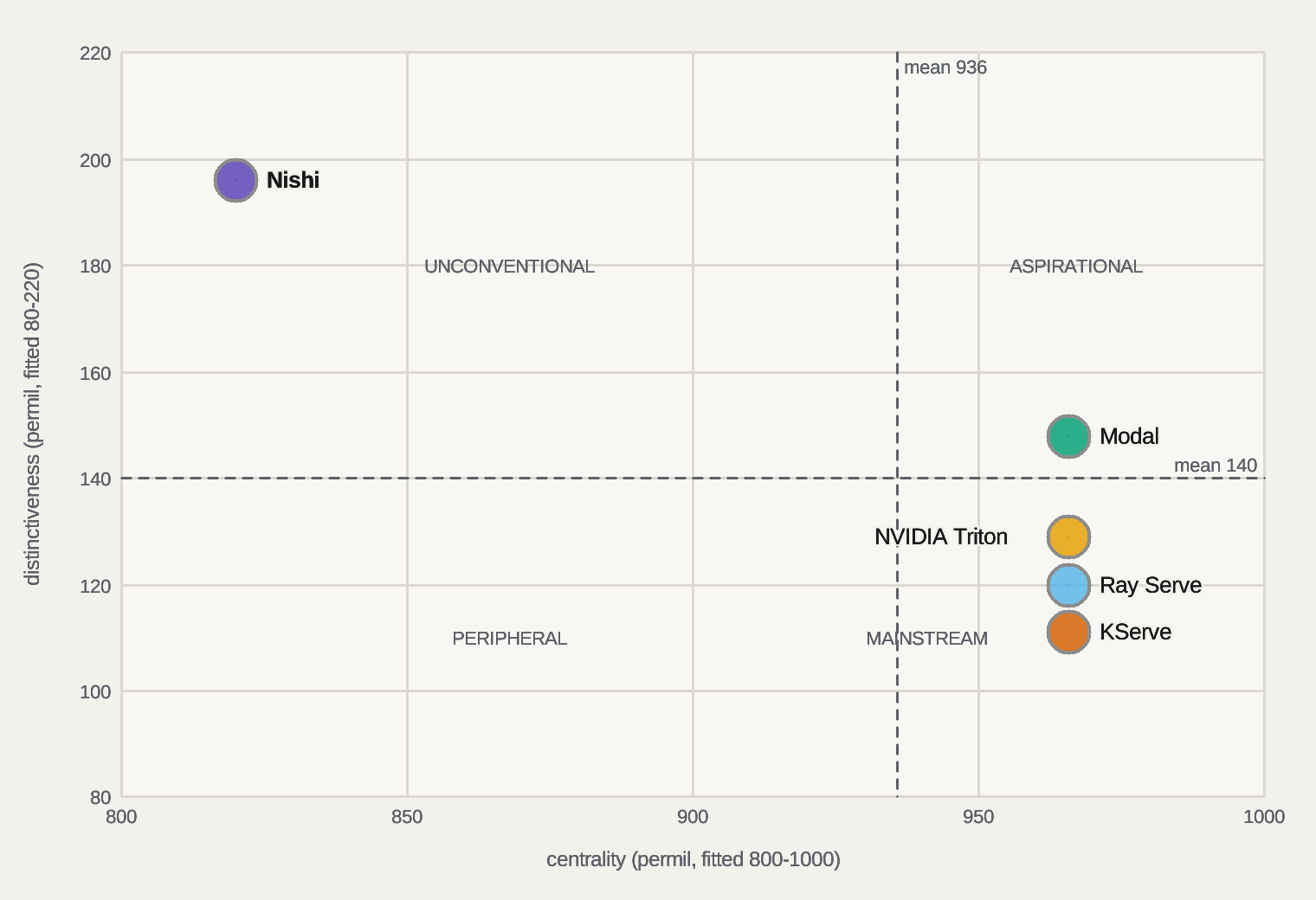
The four-quadrant map the field uses for brand strategy (Dawar and Bagga, HBR June 2015), re-derived from this matrix on every publish. Centrality is the share of the category's feature mass a player covers, each feature weighted by how many hold it; distinctiveness is the average lead over each rival on the rows the player holds; breadth is the depth-weighted share of the whole matrix (the bubble); depth is how deeply the rows held are held; momentum is the day-over-day move off the spine (green rising, red falling, grey until day two); the dashed path runs first day → previous day → today. Dividers are the category means. Axes are fitted to the field of play, so read the tick numerals, not the frame. Rival marks are documented presence, so a rival's position reads the record, never its quality. The picture grades its own readability below; the table beside it is the same data for a screen reader or a second method.
knowledge/compare/workermesh.cdmap (cut|x|y, cube|x|y|z); absent = the HBR defaultsbubble area = breadth · ring = momentum (green rising, red falling, grey until day two) · dashed = category means · axes fitted to the field of play: centrality 800–1000, distinctiveness 80–220 of 0–1000 permil (the full range put every player in one corner)
readability of the 2D cut, self-graded by the layout ruler: label overlaps 0 · labels over marks 0 · off-canvas 0 · unresolved labels 0 · mark overlaps 0 (a fact of the data: two players that close are that close) · data spread 667 permil of the plot · quadrant words unseated 0
text contrast, measured with wcag2-ratio (floors from contrast.conf), light theme: labels 16.24 (floor 4.50) · notes 16.24 (floor 4.50) · quadrant words 5.89 (floor 4.50) · tick numerals 5.89 (floor 4.50) · axis titles 5.59 (floor 4.50) · dark theme: labels 13.78 (floor 4.50) · quadrant words 5.55 (floor 4.50) · axis titles 5.97 (floor 4.50) · dark classes under their floor 0 (one figure serves both themes: a dark shortfall is a token to fix, never a class to hide) · classes refused under their floor 0 (a refused class is not drawn; the scale classes are measured, never hidden) · export: SVG PNG (receipt, rendered by the estate's own rasteriser from this page)

readability of the 3D cube, self-graded by the layout ruler: label overlaps 0 · labels over marks 0 · off-canvas 0 · unresolved labels 0 · mark overlaps 2 (a fact of the data: two players that close are that close) · data spread 459 permil of the plot
10 panels over 5 registered axes, every pair once (the lower axis on x, the higher on y) · each panel fitted to its own field of play, first and last tick numerals shown · no labels in a small cut, the legend names the colours; the grade below reports the mark terms only (MM summed over the panels, spread averaged)
readability of the small multiples, self-graded by the layout ruler: label overlaps 0 · labels over marks 0 · off-canvas 0 · unresolved labels 0 · mark overlaps 23 (a fact of the data: two players that close are that close) · data spread 534 permil of the plot
| Player | Quadrant | centrality | distinctiveness | breadth | depth | momentum | Rows held | Days on spine | First seen |
|---|---|---|---|---|---|---|---|---|---|
| Nishi | Unconventional | 820 | 196 | 587 | 725 | 0 since 2026-09-23 | 17 | 10 | 2026-09-15 |
| NVIDIA Triton | Mainstream | 966 | 129 | 714 | 833 | 0 since 2026-09-23 | 18 | 10 | 2026-09-15 |
| Ray Serve | Mainstream | 966 | 120 | 714 | 833 | 0 since 2026-09-23 | 18 | 10 | 2026-09-15 |
| Modal | Aspirational | 966 | 148 | 761 | 888 | 0 since 2026-09-23 | 18 | 10 | 2026-09-15 |
| KServe | Mainstream | 966 | 111 | 714 | 833 | 0 since 2026-09-23 | 18 | 10 | 2026-09-15 |
| Day | Matrix rows reviewed | Players recorded |
|---|---|---|
| 2026-09-15 | 21 | 5 |
| 2026-09-16 | 21 | 5 |
| 2026-09-17 | 21 | 5 |
| 2026-09-18 | 21 | 5 |
| 2026-09-19 | 21 | 5 |
| 2026-09-20 | 21 | 5 |
| 2026-09-21 | 21 | 5 |
| 2026-09-22 | 21 | 5 |
| 2026-09-23 | 21 | 5 |
| 2026-10-08 | 21 | 5 |
players 5|matrix rows 21|feature mass 89|centrality mean 936|distinctiveness mean 140|axes 5|spine days 10 (shown 10)|rows written today 0|readability defects 2D 0 cube 0|spine knowledge/status/cdmap/workermesh.spine
Capability matrix — measured against source
◉ authored stronger claim; source present● present◐ partial○ absent? unassessed; excluded from relative comparison · click any capability for its evidence
Peer cell coverage: authored assessed 84, unassessed 0. Authored assessments are not verified outcomes.
No capabilities match this filter or search.
| Capability | Nishi | NVIDIA Triton | Ray Serve | Modal | KServe |
|---|---|---|---|---|---|
Capability-scoped job dispatchMeasured:WORKERDISPATCHGATE exists in runtime/nx_worker_dispatch.nx, verified at emit. Ray and Modal are Best at programmatic dispatch [ray-serve] [modal-scale]; Nishi routes by job type to the right worker class and enforces the grant deny-by-default Adoption: RUN-BY:fork:nx_mesh_run — fully adopted (top of its ladder).Pros Implementing source symbol found; runtime acceptance separate; fully adopted on the estate ladderCons behind Ray Serve (leads), Modal (leads) | ● | ● | ◉ | ◉ | ● |
Cross-host GPU worker routingMeasured:wd_route exists in runtime/nx_worker_dispatch.nx, verified at emit. Ray and K8s-native KServe route across a cluster as Best [moritz2018] [kserve-kpa]; Nishi routes image to the 5080 and video to the 3090 and other to cloud Adoption: RUN-BY:fork:nx_mesh_run — fully adopted (top of its ladder).Pros Implementing source symbol found; runtime acceptance separate; fully adopted on the estate ladderCons behind Ray Serve (leads), Modal (leads), KServe (leads) | ● | ● | ◉ | ◉ | ◉ |
Sovereign end-to-end actuationMeasured:MESHGENGATE exists in runtime/nx_mesh_gen.nx, verified at emit. All frameworks serve inference; Nishi proved a single organ POST-decode-publish loop over its own TCP with zero shell rival marks uncited — the Yes, Best or Part codes on this row are an observation read with no reference mark behind them Adoption: RUN-BY:fork:nx_mesh_run — fully adopted (top of its ladder).Pros Implementing source symbol found; runtime acceptance separate; fully adopted on the estate ladderCons none on the measured axes (rival marks are documented presence, not depth) | ● | ● | ● | ● | ● |
Native GPU container governance daemonlessMeasured:nx_pe_emit_container exists in runtime/nx_pe_container_win.nx, verified at emit. Triton and Ray need a server daemon and Modal is cloud and KServe needs Kubernetes; Nishi governs the worker natively via Job Objects no daemon no VM. SYMBOL REPOINTED 2026-09-01: the row cited CreateJobObjectW, which is a WINDOWS API NAME and not a sovereign function, so the one-symbol ruler correctly refused it and the OLD substring ruler had been grounding the row against a COMMENT. THE SAME ROW APPEARS IN THREE BOARDS (containers, swarm, workermesh) AND WAS THE ENTIRE RED FOR ALL THREE -- one cause, three domains, which is why collapsing to causes before sizing a campaign matters. The defining sovereign function in that organ is nx_pe_emit_container. A ROW THAT CITES A FOREIGN OS API HAS NO SOVEREIGN DEFINITION TO GROUND AGAINST -- name the wrapper, never the syscall it wraps rival marks uncited — the Yes, Best or Part codes on this row are an observation read with no reference mark behind them Adoption: SOURCE-ONLY — PARTIAL: source exists, never compiled: /api/build it.Pros Implementing source symbol found; runtime acceptance separate; ahead of NVIDIA Triton, Ray Serve, Modal, KServeCons not adopted yet: source exists, never compiled: /api/build it | ● | ◐ | ◐ | ◐ | ◐ |
Content-addressed model and artifact registryMeasured:CONTAINERREGISTRYGATE exists in runtime/nx_container_registry.nx, verified at emit. Triton model repository is the reference; Nishi has a SHA-256 content-addressed registry with integrity-verified pull rival marks uncited — the Yes, Best or Part codes on this row are an observation read with no reference mark behind them Adoption: BUILT-UNPROMOTED — PARTIAL: compiled, never promoted to the serving root: /api/promote it.Pros Implementing source symbol found; runtime acceptance separateCons behind NVIDIA Triton (leads), Modal (leads), KServe (leads); not adopted yet: compiled, never promoted to the serving root: /api/promote it | ● | ◉ | ● | ◉ | ◉ |
Push results to consumable storageMeasured:mg_gen exists in runtime/nx_mesh_gen.nx, verified at emit. All can write outputs; Nishi decodes the worker response and publishes to the gallery in the same sovereign organ rival marks uncited — the Yes, Best or Part codes on this row are an observation read with no reference mark behind them Adoption: RUN-BY:fork:nx_mesh_run — fully adopted (top of its ladder).Pros Implementing source symbol found; runtime acceptance separate; fully adopted on the estate ladderCons none on the measured axes (rival marks are documented presence, not depth) | ● | ● | ● | ● | ● |
Model load and unloadMeasured:sd-server exists in runtime/nx_pe_container_sdserver.nx, verified at emit. Triton and Modal do dynamic model load and unload as Best; Nishi loads and unloads the worker (VRAM 0 to 10.9GB to 0) but manually not yet on demand rival marks uncited — the Yes, Best or Part codes on this row are an observation read with no reference mark behind them Adoption: SOURCE-ONLY — PARTIAL: source exists, never compiled: /api/build it.Pros Implementing source symbol found; runtime acceptance separateCons behind NVIDIA Triton (leads), Modal (leads), KServe (leads); not adopted yet: source exists, never compiled: /api/build it | ● | ◉ | ● | ◉ | ◉ |
Worker health probe and livenessMeasured:wd_probe exists in runtime/nx_worker_dispatch.nx, verified at emit. Mature frameworks have rich health and failover as Best; Nishi has a basic reachability probe rival marks uncited — the Yes, Best or Part codes on this row are an observation read with no reference mark behind them Adoption: RUN-BY:fork:nx_mesh_run — fully adopted (top of its ladder).Pros Implementing source symbol found; runtime acceptance separate; fully adopted on the estate ladderCons behind NVIDIA Triton (leads), Ray Serve (leads), Modal (leads), KServe (leads) | ● | ◉ | ◉ | ◉ | ◉ |
Dynamic request batchingMeasured:MESHBATCHGATE exists in runtime/nx_mesh_batch.nx, verified at emit. Triton fuses requests into one GPU forward pass [triton-modelconfig] [crankshaw2017]; Nishi has a sovereign batch SCHEDULER (coalesce by preferred-size OR max-delay, sim 32 into 4 batches of 8) AND live n=K batched EXECUTION (proven: genbatch 3 = 3 images in ONE round-trip on the 5080); MEASURED-HONEST -- the current sd.cpp engine runs n greater than 1 SEQUENTIALLY (20.3s per image batched vs 19.3s sequential) so today the win is fewer dispatches and connections not fewer forward passes; true fused throughput needs a batching-capable backend -- Nishi now HAS the compute primitive (nx_batch_infer, a sovereign fused batched-GEMM, bit-exact vs sequential via weight-stationary reuse); the CPU reuse win is modest (compute-bound), the large win is GPU kernel-launch amortization Adoption: REGISTERED-UNAUTHORISED — PARTIAL: registered, no cap ever minted; no execution surface runs it either (clock, cron, daemon, roster, actlog and surfaced forks checked).Pros Implementing source symbol found; runtime acceptance separateCons behind NVIDIA Triton (leads); not adopted yet: registered, no cap ever minted; no execution surface runs it either (clock, cron, daemon, roster, actlog and surfaced forks checked) | ● | ◉ | ● | ● | ● |
Multi-worker load balancing across replicasMeasured:MESHLBGATE exists in runtime/nx_mesh_lb.nx, verified at emit. Balancing across replicas is Best in every framework; Nishi now health-probes each replica (bounded 1s non-blocking) and round-robins among the healthy ones skipping the down -- PROVEN live routing to the laptop 5080 and skipping the offline west 3090; west or a cloud replica joins as one endpoint row rival marks uncited — the Yes, Best or Part codes on this row are an observation read with no reference mark behind them Adoption: RUN-BY:fork:nx_mesh_run — fully adopted (top of its ladder).Pros Implementing source symbol found; runtime acceptance separate; fully adopted on the estate ladderCons behind NVIDIA Triton (leads), Ray Serve (leads), Modal (leads), KServe (leads) | ● | ◉ | ◉ | ◉ | ◉ |
Autoscaling scale-to-zero on demandMeasured:MESHAUTOSCALEGATE exists in runtime/nx_mesh_autoscale.nx, verified at emit. Modal and KServe scale-to-zero are Best [modal-scale] [knative-autoscaling]; Nishi has a proven policy controller AND now a HANDS-OFF host-agent (nx_mesh_hostagent) that autonomously forks the worker on demand and reaps it on idle -- PROVEN with a real process (probe 0 to 1 to 0, native fork and kill lifecycle); Nishi idle is a TRUE 0 MB 0 procs so scale-to-zero costs almost nothing Adoption: REGISTERED-UNAUTHORISED — PARTIAL: registered, no cap ever minted; no execution surface runs it either (clock, cron, daemon, roster, actlog and surfaced forks checked).Pros Implementing source symbol found; runtime acceptance separateCons behind Ray Serve (leads), Modal (leads), KServe (leads); not adopted yet: registered, no cap ever minted; no execution surface runs it either (clock, cron, daemon, roster, actlog and surfaced forks checked) | ● | ● | ◉ | ◉ | ◉ |
Streaming responsesMeasured:MESHSTREAMGATE exists in runtime/nx_mesh_stream.nx, verified at emit. Token and chunk streaming is standard; Nishi now emits a valid Server-Sent-Events stream -- accepted then one progress event per step (step total pct) then a terminal result with the artifact URL, consumable by a browser EventSource and the same shape as our live /api/events [whatwg-sse]; the natural frame-delivery channel for video on the west 3090 Adoption: REGISTERED-DARK — PARTIAL: callable, authorised, completed MCP invocation not established by supplied journal window; lifetime history unknown (direct execution may be recorded elsewhere; this scan does not establish lifetime use); no execution surface runs it either (clock, cron, daemon, roster, actlog and surfaced forks checked).Pros Implementing source symbol found; runtime acceptance separateCons behind Ray Serve (leads), Modal (leads); not adopted yet: callable, authorised, completed MCP invocation not established by supplied journal window; lifetime history unknown (direct execution may be recorded elsewhere; this scan does not establish lifetime use); no execution surface runs it either (clock, cron, daemon, roster, actlog and surfaced forks checked) | ● | ● | ◉ | ◉ | ● |
Request queue and admission controlMeasured:MESHBATCHGATE exists in runtime/nx_mesh_batch.nx, verified at emit. Queueing and backpressure protect the GPU under load; Nishi now has a bounded queue with admission control -- sim proved 100 requests at cap 64 admits 64 and sheds 36 with backpressure, never over-cap, and no request starves rival marks uncited — the Yes, Best or Part codes on this row are an observation read with no reference mark behind them Adoption: REGISTERED-UNAUTHORISED — PARTIAL: registered, no cap ever minted; no execution surface runs it either (clock, cron, daemon, roster, actlog and surfaced forks checked).Pros Implementing source symbol found; runtime acceptance separateCons behind NVIDIA Triton (leads), Ray Serve (leads), Modal (leads); not adopted yet: registered, no cap ever minted; no execution surface runs it either (clock, cron, daemon, roster, actlog and surfaced forks checked) | ● | ◉ | ◉ | ◉ | ● |
Multi-model multiplexing on one GPUMeasured:MESHMUXGATE exists in runtime/nx_mesh_mux.nx, verified at emit. Serving many models on shared GPU memory is Best in the frameworks; Nishi now has a VRAM-budgeted LRU model residency -- route by model-id, keep the hot models loaded, evict the least-recently-used to fit a new one, refuse an oversized model; composes with autoscale load-unload and the content-addressed model registry rival marks uncited — the Yes, Best or Part codes on this row are an observation read with no reference mark behind them Adoption: REGISTERED-DARK — PARTIAL: callable, authorised, completed MCP invocation not established by supplied journal window; lifetime history unknown (direct execution may be recorded elsewhere; this scan does not establish lifetime use); no execution surface runs it either (clock, cron, daemon, roster, actlog and surfaced forks checked).Pros Implementing source symbol found; runtime acceptance separateCons behind NVIDIA Triton (leads), Ray Serve (leads), Modal (leads), KServe (leads); not adopted yet: callable, authorised, completed MCP invocation not established by supplied journal window; lifetime history unknown (direct execution may be recorded elsewhere; this scan does not establish lifetime use); no execution surface runs it either (clock, cron, daemon, roster, actlog and surfaced forks checked) | ● | ◉ | ◉ | ◉ | ◉ |
EXCEED sovereign: own-stack no serving frameworkSource present; authored stronger claim:MESHGENGATE in runtime/nx_mesh_gen.nx, verified at emit. The whole mesh is our own TCP client plus base64 plus container governance plus dispatch -- no Triton no Ray no CUDA serving runtime no cloud dependency Adoption: RUN-BY:fork:nx_mesh_run — fully adopted (top of its ladder).Pros Source symbol found; stronger capability claim is authored; ahead of NVIDIA Triton, Ray Serve, Modal, KServe; fully adopted on the estate ladderCons none on the measured axes (rival marks are documented presence, not depth) | ◉ | ○ | ○ | ○ | ○ |
| EXCEED unique | |||||
capability-scoped resource accessSource present; authored stronger claim:wd_authorize in runtime/nx_worker_dispatch.nx, verified at emit. A job may only call the worker and storage its capability grants -- deny-by-default MCP-style trusted-to-do-work enforcement none of the frameworks have this model [miller2006] Adoption: RUN-BY:fork:nx_mesh_run — fully adopted (top of its ladder).Pros Source symbol found; stronger capability claim is authored; ahead of NVIDIA Triton, Ray Serve, Modal, KServe; fully adopted on the estate ladderCons none on the measured axes (rival marks are documented presence, not depth) | ◉ | ○ | ○ | ○ | ○ |
EXCEED sovereign: zero-cost on your hardware auditableSource present; authored stronger claim:mg_gen in runtime/nx_mesh_gen.nx, verified at emit. Runs on your own GPUs at no per-call cost with the whole loop readable bits-up; the managed frameworks are cloud-metered or heavyweight infra Adoption: RUN-BY:fork:nx_mesh_run — fully adopted (top of its ladder).Pros Source symbol found; stronger capability claim is authored; ahead of NVIDIA Triton, Ray Serve, Modal, KServe; fully adopted on the estate ladderCons none on the measured axes (rival marks are documented presence, not depth) | ◉ | ○ | ○ | ○ | ○ |
Failover with health history and circuit breakerDARK —runtime/nx_worker_dispatch.nx EXISTS but does not declare wd_circuit: something shipped at this path under another name, and this mark would read open forever. Repoint the contract to the real entry point (the plan rung AND this row) or rename the function; the flip follows on the next beat, and the comparewatch- plane row reads DARK until then. The reachability probe exists; a breaker that opens on repeated failure and half-opens on a schedule is the mature-framework bar rival marks uncited — the Yes, Best or Part codes on this row are an observation read with no reference mark behind themPros none measured yetCons behind NVIDIA Triton (leads), Ray Serve (leads), Modal (leads), KServe (leads); open contract; expected source declaration not established | ○ | ◉ | ◉ | ◉ | ◉ |
On-demand model load and unloadDARK —runtime/nx_mesh_mux.nx EXISTS but does not declare mx_load_on_demand: something shipped at this path under another name, and this mark would read open forever. Repoint the contract to the real entry point (the plan rung AND this row) or rename the function; the flip follows on the next beat, and the comparewatch- plane row reads DARK until then. Load and unload exist manually; on-demand by request with the LRU residency already shipped closes the row rival marks uncited — the Yes, Best or Part codes on this row are an observation read with no reference mark behind themPros none measured yetCons behind NVIDIA Triton (leads), Ray Serve, Modal (leads), KServe (leads); open contract; expected source declaration not established | ○ | ◉ | ● | ◉ | ◉ |
Fused batched forward on the workerDARK —runtime/nx_mesh_batch.nx EXISTS but does not declare mb_fused_exec: something shipped at this path under another name, and this mark would read open forever. Repoint the contract to the real entry point (the plan rung AND this row) or rename the function; the flip follows on the next beat, and the comparewatch- plane row reads DARK until then. The scheduler batches and the backend runs sequentially; a batching-capable backend turns fewer dispatches into fewer forward passes rival marks uncited — the Yes, Best or Part codes on this row are an observation read with no reference mark behind themPros none measured yetCons behind NVIDIA Triton (leads), Ray Serve, Modal, KServe; open contract; expected source declaration not established | ○ | ◉ | ● | ● | ● |
Remote replica live across hostsDARK —runtime/nx_mesh_lb.nx EXISTS but does not declare lb_remote_replica: something shipped at this path under another name, and this mark would read open forever. Repoint the contract to the real entry point (the plan rung AND this row) or rename the function; the flip follows on the next beat, and the comparewatch- plane row reads DARK until then. Round-robin over healthy replicas is proven on the LAN; a remote replica (west 3090, cloud) serving live is the cluster proof rival marks uncited — the Yes, Best or Part codes on this row are an observation read with no reference mark behind themPros none measured yetCons behind NVIDIA Triton, Ray Serve (leads), Modal (leads), KServe (leads); open contract; expected source declaration not established | ○ | ● | ◉ | ◉ | ◉ |
| Class | Count | Note |
|---|---|---|
| rows with rival marks | 18 | rows carrying a Yes, Best or Part in a rival column |
| cited | 5 | a reference mark resolves to a pinned mirror |
| uncited | 13 | an observation read, badged until a reference lands |
| rows, summed | 18 | RECONCILED: the parts sum to the total 18 |
Delivery and evidence
Inspect risks, technical debt, rendered observations, experiments and references. Read scope and limitations alongside every result.
Person · product · place — not yet measured for this domain
knowledge/compare/workermesh.ppp (rows surface|nishi or c1..c4|label|url|connect naming OUR live surface and each rival's front door), run nx_ppp_probe domain workermesh, and this section fills itself on the next beat: the same ruler on both sides — privacy and CX (third-party hosts, tracker classes, cookies, security headers), design and longevity (design hygiene, computed WCAG contrast, render-blocking resources, unsized media, script weight, theme and motion queries), findability (landmarks, skip link, on-site search, breadcrumb, headings, internal links).The field — discovered, not chosen
Rows written by nx_field_discover from workermesh.seeds: the industry's own lists (Wikipedia wikitext, GitHub topics, awesome lists) read mechanically, every candidate counted across seeds. The matrix columns above are a SEAT'S pick; this band is the population they were picked from, and the stats line measures one against the other. A rival here is a lead, never a verdict — it earns a column when its capabilities are read and pinned.
| Class | Count | Note |
|---|---|---|
| seeds | 4 | |
| scanned | 4 | |
| fetched | 4 | |
| reused | 0 | |
| failed | 0 | |
| named | 4 | |
| candidates | 4 | |
| mentions | 4 | |
| capped | 0 |
| Rank | Rival | Seeds | Mentions | First seed | Kind | Link |
|---|---|---|---|---|---|---|
| 1 | NVIDIA Triton | 1 | 1 | col0-nvidia | named | https://docs.nvidia.com/deeplearning/triton-inference-server/user-guide/docs/user_guide/model_configuration.html |
| 2 | Ray Serve | 1 | 1 | col1-ray | named | https://docs.ray.io/en/latest/serve/index.html |
| 3 | Modal | 1 | 1 | col2-modal | named | https://modal.com/docs/guide/scale |
| 4 | KServe | 1 | 1 | col3-kserve | named | https://kserve.github.io/website/docs/model-serving/predictive-inference/autoscaling/kpa-autoscaler |
field candidates 4|shown 4 of 4|matrix columns in the field 4 of 4|discovered rivals with no column 0|malformed rows 0 (counted, never rendered)|read-capped 0
Exclusive and shared capabilities
This board grades 18 capabilities: 12 exclusive to it and 6 shared with other boards. Shared rows on this page: 6 = home here 0 + home elsewhere 1 + ambiguous 1 + undecided 4 + refused 0 (partition 6); undecided = unmapped 0 + unproven 4 + unevidenced 0; homonyms 0; since the previous census: new 0, resolved 0. Census FRESH age_s=6389.
| Capability | Organ | Boards grading it | Home | Rule | Evidence | Standing on this board |
|---|---|---|---|---|---|---|
| WORKERDISPATCHGATE | nx_worker_dispatch.nx | swarm, workermesh | — | none | unproven | undecided |
| MESHAUTOSCALEGATE | nx_mesh_autoscale.nx | swarm, workermesh | — | none | unproven | undecided |
| nx_pe_emit_container | nx_pe_container_win.nx | swarm, workermesh, containers | — | none | unproven | undecided |
| CONTAINERREGISTRYGATE | nx_container_registry.nx | swarm, workermesh, containers* | containers | rung | plan | home elsewhere adopt: @xrow containers|CONTAINERREGISTRYGATE|home by rung (fleet duplicate census) |
| sd-server | nx_pe_container_sdserver.nx | workermesh, containers | — | none | unproven | undecided |
| lb_remote_replica | nx_mesh_lb.nx | workermesh*, engineshift* | — | ambiguous | plan | ambiguous |
Gaps from the record — what the estate does that no board carries
The record census (nx_goalmap record) reads the invoked-tool population and every plan queue row and files each organ or directive that NO matrix, plan or gates row names. A row here is a callout the boards missed: adjudicate it onto a board or declare it infrastructure. Census state STALE (age 1395494 s), sources read 4 of 7 declared — a BLIND census is a FLOOR: unread sources can only add rows.
| kind | name | board | source | evidence |
|---|
rows shown 0|this board's directives 0|estate-wide un-boarded organs 452 (listed in full on /compare/ecosystem)|census rows 639|malformed 0 (counted, never rendered)
References
- [triton-modelconfig] NVIDIA. Triton Inference Server -- Model Configuration (user guide): model repository layout, instance groups, dynamic_batching (preferred batch sizes, max queue delay), sequence batching and model warmup. publisher · read in our library
knowledge/fetched/cmp_workermesh_triton-modelconfig.html· pinh531bec727c4e04515c0d9657db12bd5cb71532af826e22864f6e15c29ec95b2d· accessed 2026-08-18 · vendor-docGrounds: The NVIDIA Triton column: Dynamic request batching (Triton fuses requests into one GPU forward pass -- the preferred-size OR max-delay policy nx_mesh_batch mirrors), Content-addressed model and artifact registry (the model repository is the reference), Model load and unload (Best) and Multi-model multiplexing on one GPU. - [ray-serve] Anyscale / Ray project. Ray Serve: Scalable and Programmable Serving (docs.ray.io/en/latest/serve): deployments, replicas, autoscaling, request batching, model composition and streaming responses on a Ray cluster. publisher · read in our library
knowledge/fetched/cmp_workermesh_ray-serve.html· pinh4d68895f641dfbfb10eadc8fe24ef29c9655836f7a5b5a14e0d58dacde8331d6· accessed 2026-08-18 · vendor-docGrounds: The Ray Serve column: Capability-scoped job dispatch and Cross-host GPU worker routing (Best at programmatic dispatch across a cluster), Multi-worker load balancing across replicas, Streaming responses and Autoscaling scale-to-zero (Best) -- the serving layer our sovereign mesh_gen loop is graded against. - [moritz2018] Moritz, Nishihara, Wang, Tumanov, Liaw, Liang, Elibol, Yang, Paul, Jordan, Stoica. Ray: A Distributed Framework for Emerging AI Applications. USENIX OSDI 2018. publisher · read in our library
knowledge/fetched/cmp_workermesh_moritz2018.html· pinh78f4b1e52b0a2fdb2e1853f519f36ee1b9b4dec27b0b3f6afb6423ff8941eca0· accessed 2026-08-18 · published-paperGrounds: The distributed substrate under the Ray Serve column: the dynamic task graph, distributed scheduler and object store that make Cross-host GPU worker routing and Multi-worker load balancing across replicas Best in Ray -- the published architecture our single-organ TCP dispatch is contrasted with. - [modal-scale] Modal Labs. Scaling out (modal.com/docs/guide/scale): every Function is an autoscaling pool of containers, scale to zero by default when idle, min_containers and max_containers, and concurrent inputs. publisher · read in our library
knowledge/fetched/cmp_workermesh_modal-scale.html· pinhf7099caee48204296a4bceed81e37633dba524236a09c1d1a818c3f1906b2d37· accessed 2026-08-18 · vendor-docGrounds: The Modal column: Autoscaling scale-to-zero on demand (Best -- the bar the nx_mesh_hostagent fork-on-demand reap-on-idle proof is measured against), Capability-scoped job dispatch (Best programmatic dispatch), Model load and unload and the cloud-metered contrast in EXCEED sovereign: zero-cost on your hardware auditable. - [kserve-kpa] KServe Authors. Autoscaling with Knative Pod Autoscaler (kserve.github.io/website/docs/model-serving/predictive-inference/autoscaling/kpa-autoscaler): concurrency-based autoscaling of InferenceServices, scale to zero via minReplicas 0 in Knative serverless mode. publisher · read in our library
knowledge/fetched/cmp_workermesh_kserve-kpa.html· pinh87aee1efb0ca25cdd3c53a55700281cd3cb3e9f657597b2f5585bed6413c63ac· accessed 2026-08-18 · vendor-docGrounds: The KServe column: Autoscaling scale-to-zero on demand (Best) and Cross-host GPU worker routing (K8s-native routing across a cluster as Best), plus the needs Kubernetes note in Native GPU container governance daemonless. - [crankshaw2017] Crankshaw, Wang, Zhou, Franklin, Gonzalez, Stoica. Clipper: A Low-Latency Online Prediction Serving System. USENIX NSDI 2017. publisher · read in our library
knowledge/fetched/cmp_workermesh_crankshaw2017.html· pinh13f076342574c8cc9773645ca3421a5247c599c8b777af81524d6321192e0373· accessed 2026-08-18 · published-paperGrounds: The Dynamic request batching and Request queue and admission control rows: adaptive batching that trades queueing delay for GPU throughput under a latency objective is this paper's contribution -- the published bar for the coalesce-by-preferred-size-OR-max-delay scheduler and the bounded queue with backpressure (100 at cap 64 admits 64 sheds 36). - [whatwg-sse] WHATWG. HTML Living Standard, section 9.2 Server-sent events: the EventSource interface and the text/event-stream wire format. publisher · read in our library
knowledge/fetched/cmp_probe_whatwg_sse.html· pinh56e4bbeb7c54f2f55a01cdfd9cbc68ec25bb03849caa18814690b3049573761b· accessed 2026-08-18 · published-standardGrounds: The Streaming responses row: nx_mesh_stream emits a valid Server-Sent-Events stream (accepted, per-step progress, terminal result with the artifact URL) consumable by a browser EventSource -- the wire format is normative here and is the same shape as our live /api/events. Not mirrored: the sovereign fetcher could not complete the TLS 1.2 body transfer from html.spec.whatwg.org (verified live via a second reader). - [miller2006] Miller, M. S. Robust Composition: Towards a Unified Approach to Access Control and Concurrency Control. PhD dissertation, Johns Hopkins University, 2006 (JScholarship record; author copy at erights.org). publisher · read in our library
knowledge/fetched/cmp_workermesh_miller2006-jhu.html· pinh3bb2fcee5cba1d79f76b834d676e96b8005f68f978d4713248b3103f4abbc170· accessed 2026-08-18 · published-paperGrounds: The EXCEED unique: capability-scoped resource access row and Capability-scoped job dispatch: a job may only call the worker and storage its capability grants, deny-by-default -- the object-capability discipline this dissertation formalises, which none of the four frameworks model. - [knative-autoscaling] Knative Authors. Knative Serving -- Autoscaling (knative.dev/docs/serving/autoscaling): the Knative Pod Autoscaler, concurrency and RPS targets, scale-to-zero and scale bounds. publisher · read in our library
knowledge/fetched/cmp_workermesh_knative-autoscaling.html· pinh4af390da890a19b69db70d699695d1d8f30cbcbacfd951314c8bbc603344d312· accessed 2026-08-18 · vendor-docGrounds: The Autoscaling scale-to-zero on demand row: KServe's scale-to-zero is Knative's KPA, so the Knative autoscaler is the mechanism behind the KServe Best cell -- and the class the swarm register names as KubeEdge/Knative-class scale-to-zero.
generated by nx_swcompare_matrix (sovereign NishiLang organ) from knowledge/compare/workermesh.matrix · source checks show implementation presence; runtime and user-outcome evidence are reported separately · JavaScript supports page controls