Nishi Family › World › Graphics Evidence
Sovereign Graphics — Evidence Chain
→ BEYOND-METAHUMAN PROGRAM (live): /world/metahuman — procedural humans past MetaHuman: the capability ruler, the honest distance, and the face built inside-out one measured unit at a time.
OUR OWN stack — language → compiler → IR → rasterizer → shader-VM → OS → browser → driver, zero third-party (no WebGPU, no WebGL, no three.js, no canvas) — to state of the art on Windows and Linux. Every claim below is backed by a rendered artifact and a gate; nothing is asserted. Measured 2026-07-18/19/20, never claimed.
⚠ Honest distance to SOTA — we are clay, not MetaHuman
The 804 above measures breadth of graphics primitives present (a BRDF exists, a rasterizer exists, a z-buffer exists). It is not photoreal-human parity, and reading it as SOTA would be self-flattery. On output reality, our best human render is CLAY (~406–421/1000) against a real-photo corpus mean of 776 — an organ-measured gap of ~370, tracked by the realism loop. Photoreal-human fidelity therefore sits near 200/1000, not 804 — rungs 1–2 of the climb (SSS skin, eye shader) are shipped, each gate-proven and eyeballed.
North star, stated plainly: MetaHumans (Epic’s photoreal external digital humans) set the external bar — and our own benchmark is higher still: an IRL anatomically-correct being, inside and out (MetaHumans don’t render internals). We are far below both today. The gold GGX sphere further down is a necessary primitive, nowhere near sufficient: a MetaHuman needs subsurface-scattering skin, strand-based hair, cornea/iris eye shaders, scanned material maps, and facial micro-geometry layered on top.
| photoreal-human axis (MetaHuman / inside-and-out being parity) | verdict |
|---|---|
| skin subsurface scattering (BSSRDF) | PARTIAL — SSS shading proven (wrap+reddening); scan-accurate profile + texture remain |
| strand-based hair + groom | GAP |
| eye shader (cornea refraction, iris, sclera) | PARTIAL — cornea/iris/sclera shader proven vs doll-eye on 5 measured cues; lids/lashes/tear-film/vessels remain |
| teeth + gums | GAP |
| facial micro-geometry (pores, wrinkle maps) | GAP |
| scanned material maps (photogrammetry) | GAP |
| internal anatomy render (bones, organs, muscle) | PARTIAL — mesh exists, clay render |
| muscle / tendon deformation | PARTIAL — skinning, no muscle sim |
Scores DROP when audited — that is the system working (the clay-audit standing rule: output reality ≥ capability presence). The realism loop and nx_photoreal_critic are the hard judges; we climb against their score, not the eyeball. The benchmark subject itself: the anatomically-correct being.
First rung of the climb — subsurface-scattering skin
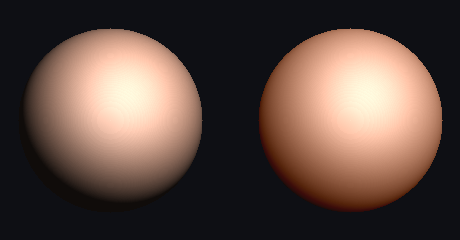
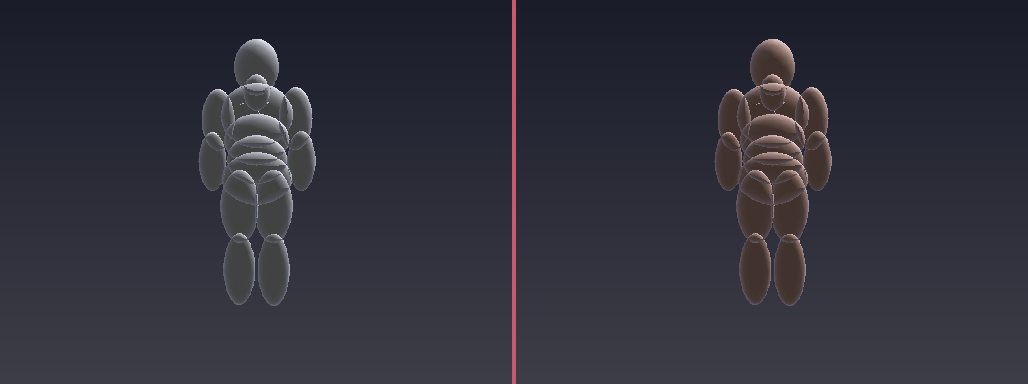
nx_gx_sss_skin_gate (GREEN 4/4 + eyeballed). Left = clay (hard Lambert — the terminator snaps to grey, plastic). Right = subsurface scattering: light wraps past the terminator and reddens there, because red penetrates skin deepest and scatters back out. Measured: the SSS sphere lights 26,244 px vs 23,021 (wrap) and carries 55% more warmth (ΣR−B 2,004,452 vs 1,297,533). This is the #1 clay→flesh lever. Honest: it is the SSS shading model, not photoreal — a single untextured sphere still has no pores, texture, or hair, so a detail-scoring critic rightly ranks it below a real photo. Shading rung done; texture + pores + hair remain.Second rung of the climb — the eye (cornea · iris · sclera)

nx_gx_eye_gate (GREEN 7/7 + eyeballed, 2026-07-20). Left = doll eye (broad bloom, flat pale iris, no limbal ring). Right = the eye shader, measurably better on 5 cues: sharp specular catchlight (111 px top-band vs 10,368 broad), dark limbal ring (boundary luminance 40 vs iris 149 / sclera 175), radial iris fibers (angular delta 23 vs 0), corneal refraction magnifying the iris (4,984 px vs 2,417 at the same geometric radius), and warm sclera (ΣR−B 3,209 vs 0). Honest residual: lids, lashes, tear-film meniscus, scleral vessels — in isolation the eye still reads CG; this is the shader rung, proven.The trunk, re-proven — from the first byte up
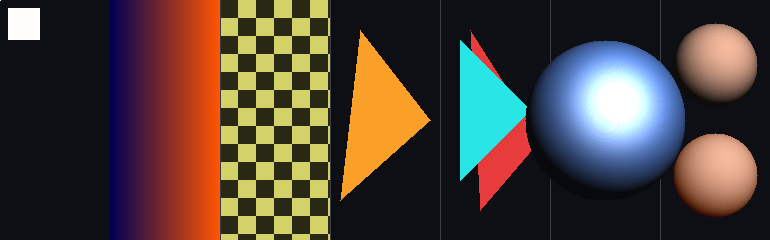
nx_gx_firstbyte_gate (GREEN 9/9, 2026-07-20): the whole sovereign chain proven bottom-up in ONE artifact — T1 byte 0 written and held → T2 per-byte RGB addressing → T3 linear scanline gradient (mid=128) → T4 framebuffer checksum exact (8,172,450) → T5 triangle raster within 0.3% of analytic area (6,866 px vs 6,850) → T6 z-buffer rejects 3,001 far fragments (near cyan wins though far drawn last) → T7 lit-sphere hotspot 255 / terminator 12 → T8 SSS wraps past clay (+680 lit px) → T9 the shipped PNG’s own first byte = 137 (PNG magic), read back from disk. Every deeper gate (GGX, browser compositing, the eye) stands on this trunk.The game substrate — Gx-1c: <canvas> + the per-frame loop
The Nishi-Browser now has a first-class <canvas> element — a sourceless render surface a fetched page simply declares. The layout engine gives it a real CSS-sized box in flow; each frame the game loop updates world state, renders it through the real nx_swgpu mesh pipeline (no inline rasterizer — the DRY fold), and the browser repaints the whole page. Gate nx_gx1c_canvas_gate GREEN 7/7 + eyeballed, with a neg-control (a canvas-less page finds no surface) and the engine regression suite (Gx-1b) re-run GREEN on the edited engine. Measured: 143 ms/frame — envelope: 512×384 swgpu mesh render + full 1000×1000 browser repaint + PNG encode per frame (interactive play would skip the PNG encode; this is the substrate proof, not a real-time claim). Below: frame 0 and frame 3 of the same page — the world state (yaw) advanced and the surface repainted in place.
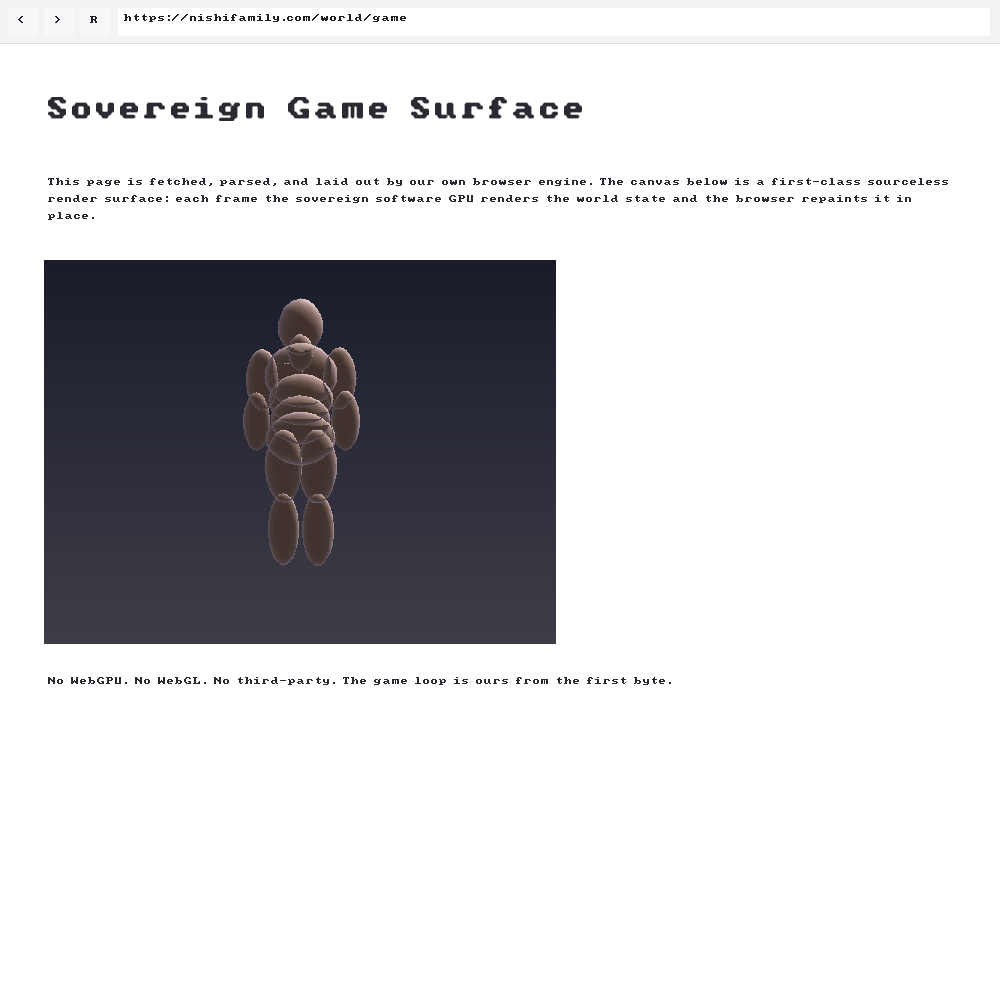
<canvas>; the browser lays it out in flow (box idx 9 at 44,216, paragraph correctly below) and blits the swgpu render (humanoid facing camera, per-pixel lit) through its own image pass.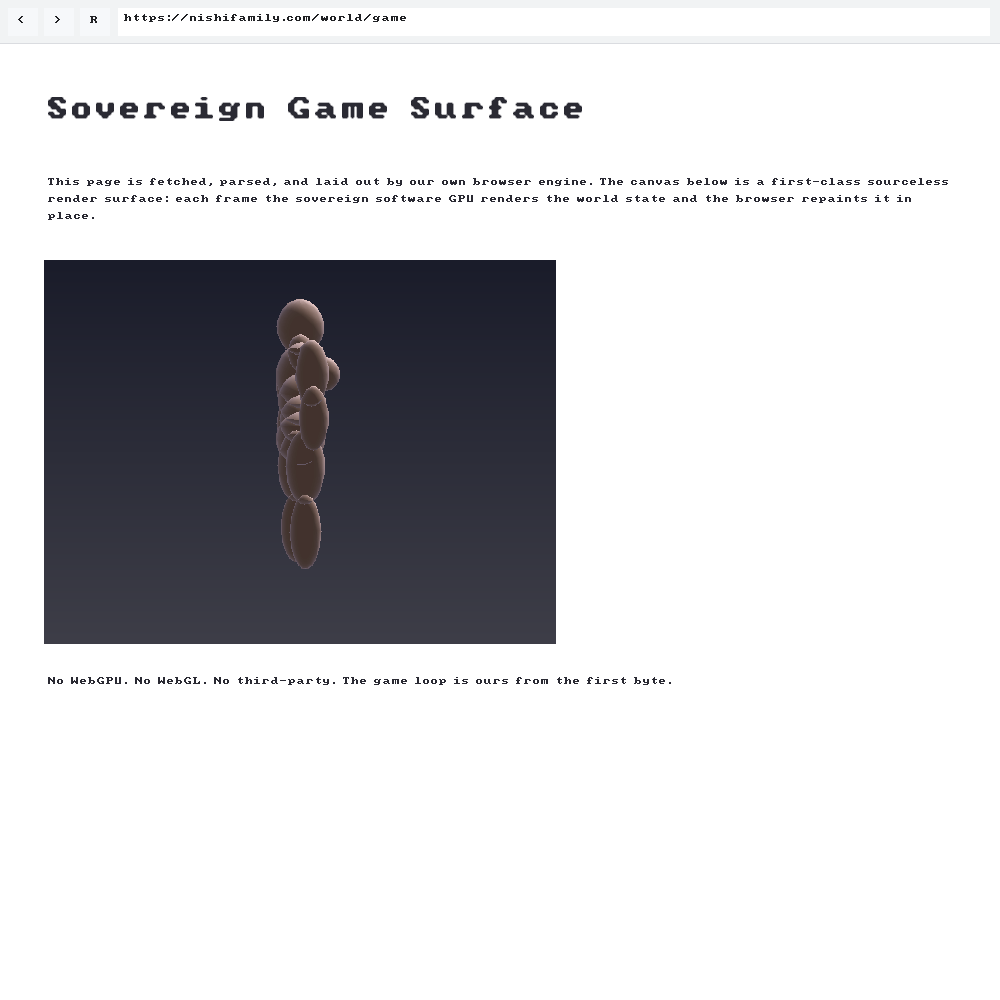
The first playable — Gx-4: walking through a sovereign world
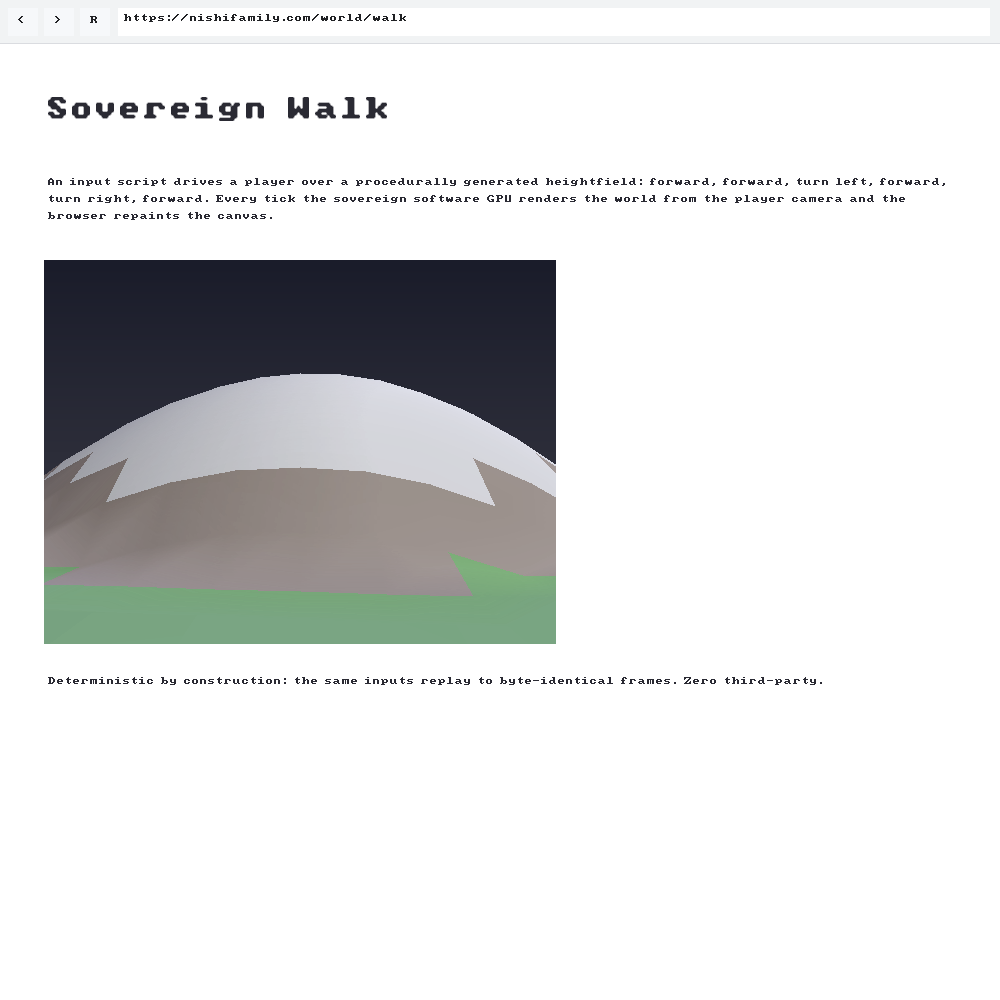
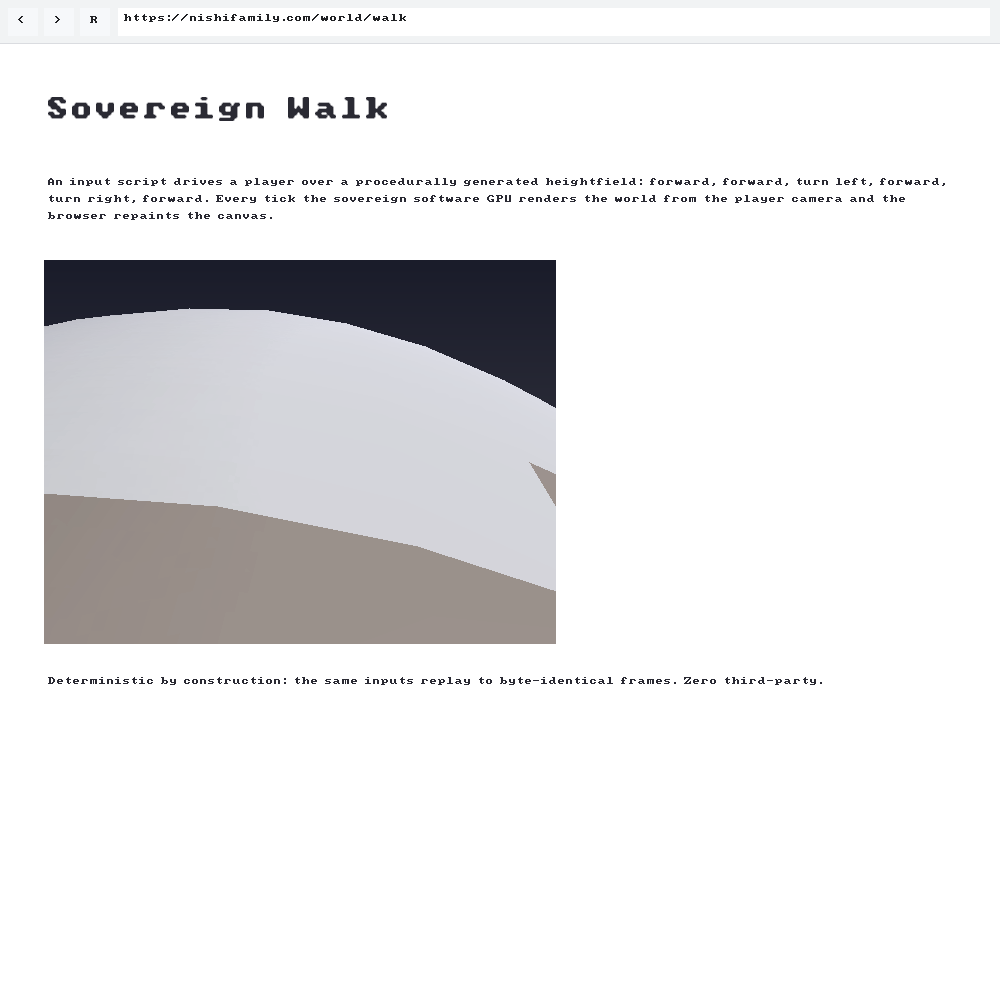
The substrate now carries a game. An input script — forward, forward, turn left, forward, turn right, forward — drives a player across a generated heightfield world; every tick reads input → advances player state (position, heading, eye riding the ground) → builds the player-relative mesh → renders it through the real nx_swgpu pipeline in three altitude-band material passes (grass, rock, snow) sharing one z-buffer → blits into the page's canvas → the browser repaints. Gate nx_gx4_walk_gate GREEN 6/6 + eyeballed; both upstream gates (nx_swgpu_gate 5/5, nx_gx1c_canvas_gate 7/7) re-run GREEN, so the new multi-pass renderer is proven additive.
The sovereign exceed, demonstrated: the gate replays the identical input script twice and gets a byte-identical frame checksum (19,387,962 both runs). All-integer, no float, no GPU driver non-determinism — deterministic replay by construction, which is what makes lockstep multiplayer, replay files, and reproducible testing free rather than hard. Measured: 20 ms per world tick (841-vert, 3-pass banded terrain at 512×384), with the full 1000×1000 browser repaint + PNG encode adding 187 ms on top — the PNG encode is the gate's evidence step, not something interactive play would pay.
Gx-9 — save/load, and a test only determinism makes possible
This one was chosen by measurement, not taste: our own gamebench ruler scores 26 capabilities against 12 real ingested game titles and ranks save/load persistence as the #1 blocker — it gates 11 of the 12. So it was next.
The test most engines cannot run. A normal save test checks that fields round-trip. Because our pipeline is bit-deterministic, we can assert something far stronger: saving and reloading must be indistinguishable from never having saved. Play seven ticks and keep playing to fourteen, checksumming every frame. Then play the same seven, save, load into a zeroed state, and resume — and require every frame of the resumed span to match. Result: identical checksums (10822020 both), 0 differing bytes, 0 differing state fields. That catches the whole class of "the save forgot a field" bugs, which round-trip tests structurally cannot see.
The other half is refusal. A damaged save must fail with a reason, never half-apply — a partially-loaded save strands the player in an impossible world and reads as a game bug forever. Corrupt a payload byte → refused with a checksum error and the caller's state left untouched. Claim a future format version → refused rather than misparsed. Missing file, undersized buffer → each its own code. The whole game state is 120 bytes.
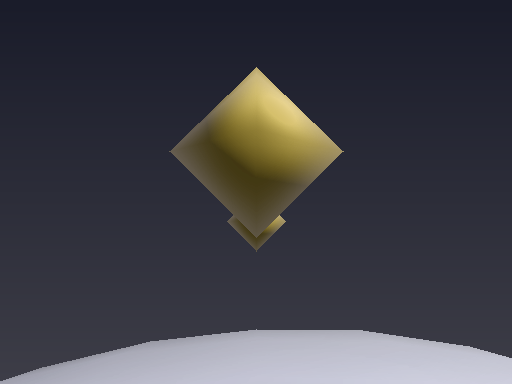
nx_gx9_saveload_gate GREEN 6/6.A test that first passed for the wrong reason. The initial version compared only the final frame of each run, got "0 differing bytes", and passed. It was hollow: at the last tick the player stands on the peak with the remaining terrain below the viewport, so it was comparing two identical empty skies. Adding a non-vacuity guard — the reference frame must contain real world, now 36,153 pixels of it — turned the pass RED and forced the honest fix: checksum every tick of the resumed span. A green gate that cannot fail is not evidence, and this one proved it on itself.
Gx-8 — ambient occlusion, and the trap it had to avoid
Direct light carries no proximity information, so a shape resting on a surface and one hovering above it shade identically — which is why our beacons and figures read as pasted onto the scene rather than sitting in it. sg_ssao adds cavity darkening from the finished depth buffer, so it costs nothing in the rasterizer's inner loop and cannot regress it.
The trap: the obvious implementation asks "is my neighbour nearer than me?", and that greys out every floor — on any receding surface the downhill neighbour is always nearer. Real engines dodge it with per-pixel normals, which we would have to write from the inner loop. Instead this samples opposite pairs: in a genuine cavity both sides are nearer; on a plane or slope one is nearer and the other is farther, scoring zero. Same effect, no normal buffer, no inner-loop cost. The gate proves both halves — the crevice-rich figure darkens, and a large receding plane comes back 0 darkened pixels out of 86,978. Passing either alone is easy; passing both is the point.
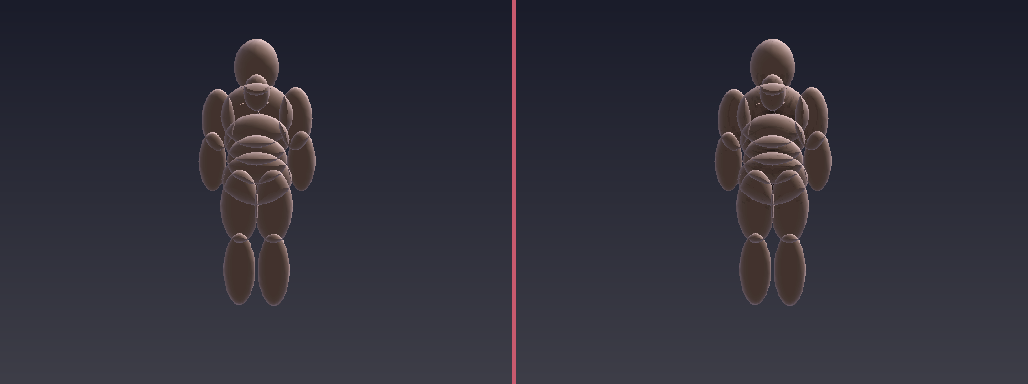
nx_gx8_ssao_gate GREEN 5/5. It costs ~4 ms/frame, which the game now pays.Landing this also let us pay down our own debt: the rasterizer body had been duplicated into the multi-pass variant (~100 lines, two places to fix any shading bug). It is now one function with a clear flag — and the refactor was proven rather than assumed, because the walk and game gates' determinism checksums held bit-exact across it.
Gx-7 — it becomes a game: entities, collision, a win condition
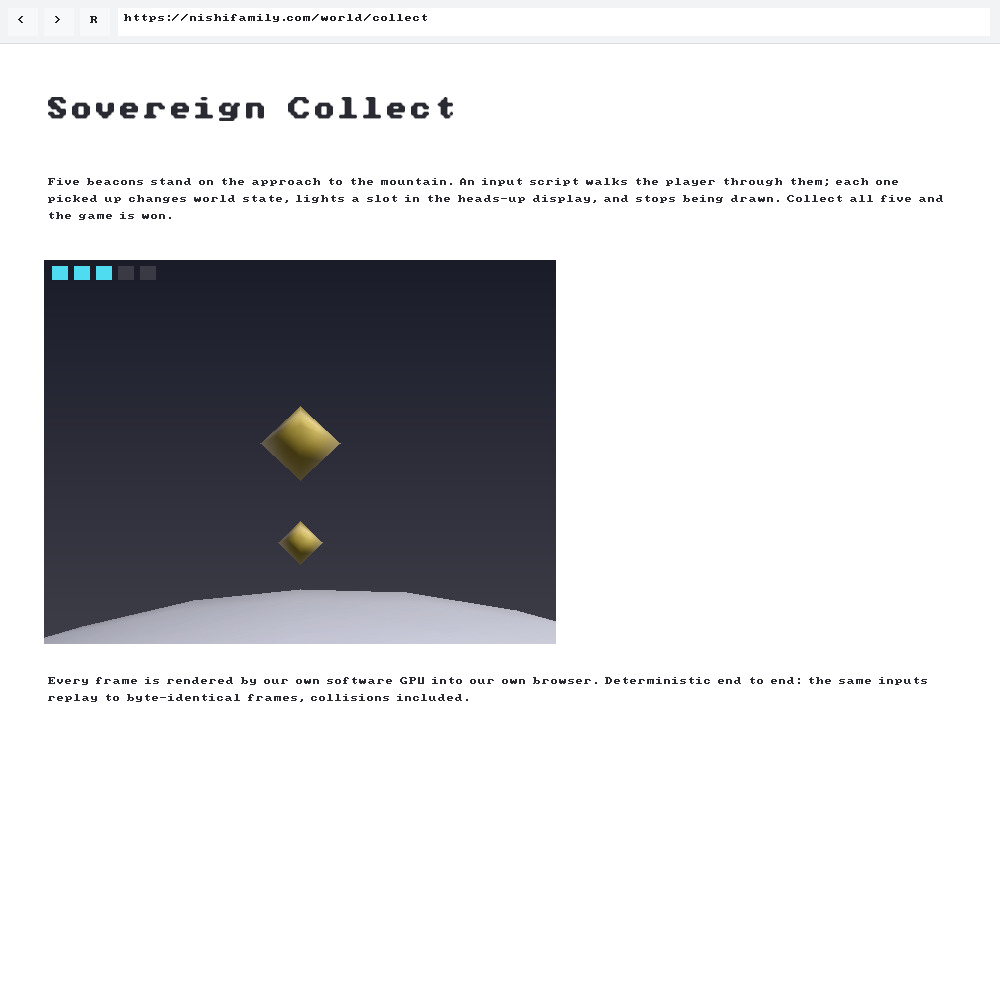
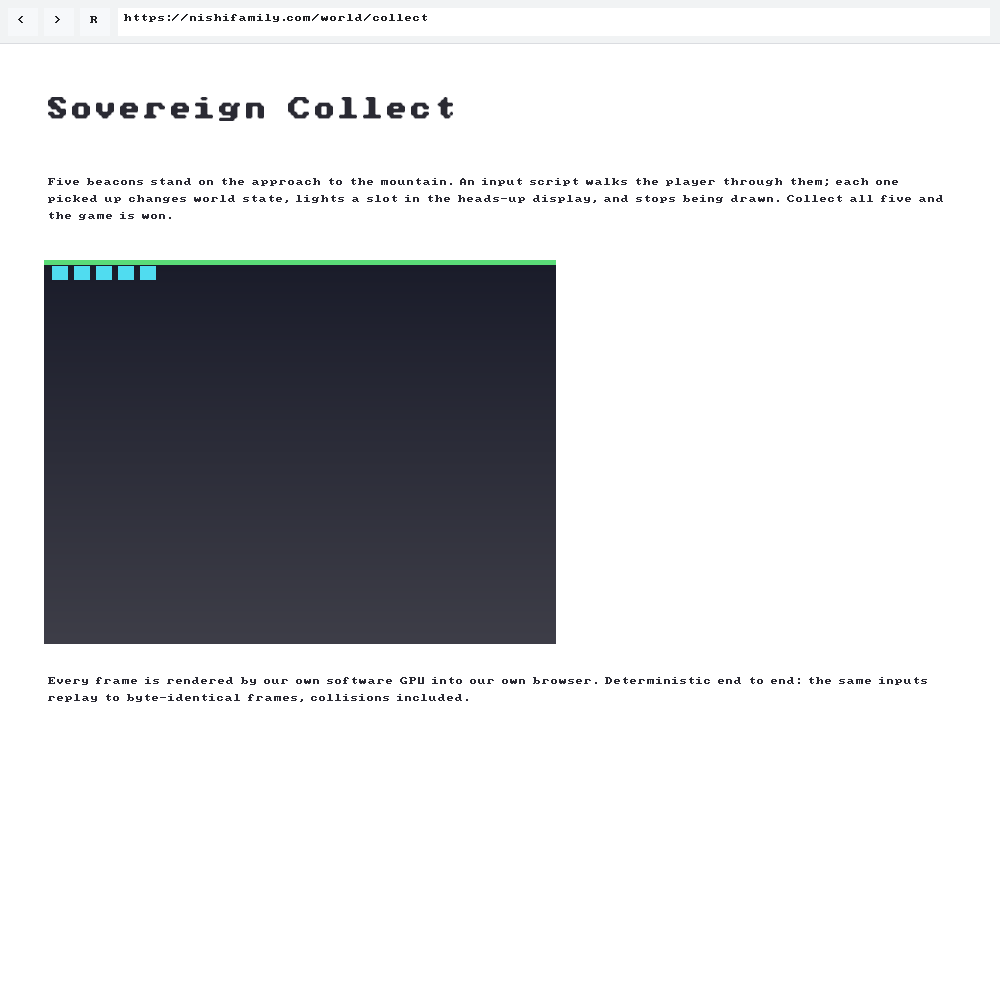
Walking around is not a game. Three things make it one, and all three are now live: entities that exist in world state, collision that changes that state, and a win condition the player can actually reach. Five beacons stand on the approach to the mountain; the loop each tick is input → player state → collision resolve → build the mesh from whatever is still alive → render → HUD → browser repaint. The render is a pure function of game state, so a beacon vanishing when you collect it is a rendering fact rather than a separate animation someone has to keep in sync. Gate nx_gx7_game_gate GREEN 7/7 at 17 ms/tick.
Determinism survives gameplay — the part that matters. Replaying the same input script reproduces byte-identical frames and identical collision outcomes (beacons collected on exactly the schedule 0→1→2→3→4→5). That is what makes lockstep multiplayer, replay files and reproducible bug reports free rather than hard, and it is not something a floating-point GPU pipeline gives you.

Gx-5 — real near-plane clipping, and a claim we had to retract
The pipeline used to cull triangles that crossed the camera plane: sg_project marks a vertex invisible once its view depth goes negative, and the rasterizer then dropped the whole triangle. sg_project_clip replaces that with real Sutherland–Hodgman clipping at the near plane, interpolating position and normal at the crossing (position-only would band the lighting along the cut) and emitting one or two replacement triangles. Gate nx_gx5_nearclip_gate GREEN 6/6; nx_swgpu_gate 5/5, nx_gx1b 4/4 and nx_gx1c 7/7 all re-run GREEN.

⚠ A claim we retracted, and how. This page previously stated that the white region in the Gx-4 tick-5 frame was near-plane culling. That was wrong, and our own gate refuted it. On a fine mesh the clipper still runs — it interpolated 112 new vertices on the walk terrain — yet moved zero pixels, because straddling triangles on a dense mesh project entirely off-screen. We proved it by switching the first playable to the clipper and checking its determinism checksum: it stayed bit-identical at 19387962. So near-plane culling could not have caused anything visible there. Measuring the frame instead found the true cause: half of it is clamped to pure white by unbounded highlights. The clipping fix is real and load-bearing for coarse geometry; the diagnosis attached to it was not. Both the fix and the correction are recorded, because a benchmark that quietly edits its own history is worth nothing.
Gx-6 — a tonemap, because half of every bright frame was being thrown away
The renderer used to end with a hard clamp: anything brighter than 255 simply became 255. On a real game frame that destroyed 50.4% of the image — every snow pixel collapsed onto one value, so a sunlit slope rendered as a flat white void. A blown-out surface scores worse than a dim one with any detail-scoring critic, so this was capping fidelity directly. sg_tonemap replaces the clamp with an extended Reinhard curve in fixed-point integer math, exposure-compensated so midtones keep their level, with the white point derived from the pipeline's own peak radiance so the brightest material lands just under 255 and cannot clip by construction.
| measurement | before (hard clamp) | after (tonemap) |
|---|---|---|
| distinct output levels across the radiance range that used to clip | 1 | 60 |
| pixels clamped to pure white, real game frame (Gx-4 tick 5) | 99,090 of 196,608 (50.4%) | 0 |
| distinct shading levels on the brightest material | flat | 160 |
| transfer curve (in→out) | 64→64, 255→255, 360→255 | 64→64, 128→115, 192→158, 255→196, 360→254 |
nx_gx6_tonemap_gate GREEN 7/7, including a monotonicity proof across the whole range — brighter in is never darker out, so no detail can invert — and a check that the curve does not crush ordinary materials while rescuing bright ones.What we did not do: we did not raise the fidelity number for this. Removing a defect that was destroying detail is not the same as proving new photoreal capability, and the honest judge of output reality is the independent realism loop, not us. Fidelity stays at 200 until that critic re-scores it. The transfer curve above is published in full precisely because tonemapping trades midtone brightness for highlight detail, and that trade should be visible rather than asserted.
Hard evidence — Gx-1: our 3D, in our browser

nx_gx1_browser3d_gate (GREEN 4/4, independently eyeballed): a z-buffered, hidden-surface 3D cube — 3 depth-sorted faces — composited into OUR browser chrome + content viewport framebuffer, written by our canonical PNG encoder. No WebGPU, no WebGL, no canvas, no third-party: every pixel is ours. This is the sovereign answer to “state of the art in the browser.”Hard evidence — Gx-1b: the LIVE browser renders a page with 3D

nx_gx1b_page3d_gate GREEN 4/4 + eyeballed. This is nishi-browser-3d-surface = HAVE: a fetched page drives the 3D, in our browser, zero third-party.Hard evidence — Gx-PBR: energy-conserving GGX materials
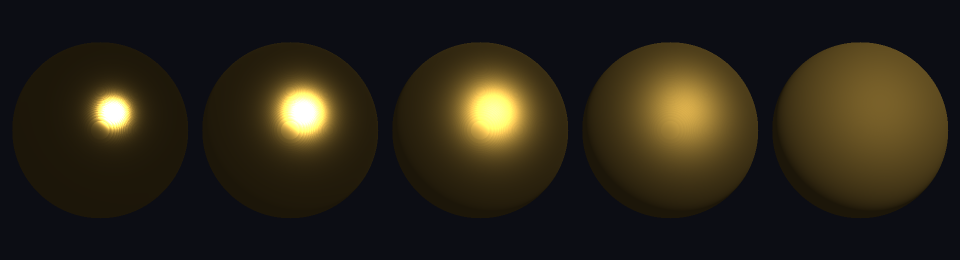
nx_gx_pbr_ggx_gate (GREEN 4/4 + eyeballed) with the full Cook-Torrance GGX microfacet BRDF — GGX/Trowbridge-Reitz normal distribution D, Schlick Fresnel F, Smith geometry G, spec = D·F·G / (4·N·V·N·L) — entirely in all-integer Q20 fixed-point (no float, deterministic), 2×2 supersampled. As roughness rises the highlight broadens and dims: energy is conserved — the microfacet-model hallmark. This is pbr-material = HAVE: the same energy-conserving BRDF UE5 / Unity / Filament use, rebuilt as ours, zero third-party. Residual: image-based lighting + scanned material maps.Evidence built on evidence — the chain
Atlas node: organ card for nx_graphics_board (parents · children · lineage) · recombination: nx_atlas_discover proposed 12 novel unproven pairs from this graph — discovery of new opportunities, built on the same evidence graph.
The 23 axes — each verdict is a rendered artifact
| axis | verdict | evidence artifact |
|---|---|---|
| software-raster-core | HAVE | nx_swgpu.png — tiled 512x384 per-pixel-lit SW GPU |
| sdf-raymarch | HAVE | nx_sdfbody.png — threaded raymarcher x13.15 |
| trimesh-zbuffer | HAVE | nx_trimesh.png — barycentric raster + exact z-buffer |
| smooth-shading | HAVE | nx_phong.png — Gouraud + Blinn-Phong |
| pbr-material | HAVE | nx_gx_pbr_ggx.png — Gx-PBR PROVEN: energy-conserving Cook-Torrance GGX BRDF (D·F·G), integer/deterministic |
| texture-mapping | HAVE | nx_boxtex.png — per-fragment UV on Khronos BoxTextured |
| anti-aliasing | HAVE | nx_aa.png — SSAA 2x |
| global-illumination | PARTIAL | nx_cornell.png — Cornell radiosity colour-bleed |
| skinning-animation | HAVE | nishi_being_walk.glb — 9-joint FK walk |
| asset-io | HAVE | nx_bunny.png — glTF/OBJ, Stanford bunny 35947v |
| scene-graph | HAVE | nx_scene_graph.txt — transform hierarchy |
| parametric-subdiv | PARTIAL | nx_bezier_patch.stl — Bezier + Loop subdivision |
| nishios-native-surface | HAVE | nx_swgpu.png — renders on our CPU/NishiOS, integer/deterministic |
| nishi-browser-3d-surface | HAVE | nx_gx1b_page3d.png — Gx-1b PROVEN: the LIVE browser laid out a fetched page + painted the 3D into its image element |
| game-loop-canvas-surface | HAVE | nx_gx1c_f0.png — Gx-1c PROVEN: first-class <canvas> + per-frame swgpu loop in the live browser (143 ms/frame measured) |
| first-playable-game | HAVE | nx_gx4_walk_t0.png — Gx-4 PROVEN: input-driven deterministic walk through a lit banded 3D world (20 ms/tick, byte-identical replay) |
| game-entities-collision-winstate | HAVE | nx_gx7_game_t0.png — Gx-7 PROVEN: entities in world state, collision that mutates it, a reachable win condition, deterministic |
| ambient-occlusion | HAVE | nx_gx8_ssao.png — Gx-8 PROVEN: cavity darkening that leaves receding planes untouched (0 of 86,978 neg-control px) |
| save-load-persistence | HAVE | nx_gx9_resumed.png — Gx-9 PROVEN: reload is byte-identical to never having saved; damaged saves refused with a reason |
| mobile-portability | GAP | Gx-2: hardware-agnostic ~25-op IR + aarch64 |
| windows-linux-gpu-accel | GAP | Gx-3: sovereign submit on the RTX 5080 native (Windows/Linux) — built vs spec models; no FPGA required |
| directx-compat-d3d11 | PARTIAL | warp_shaded.ppm — pixel-exact vs Microsoft WARP through the real D3D11 API (runs on Windows) |
| tensor-core-neural-render | GAP | HMMA/IMMA/QMMA ISA bit-exact vs NVIDIA (compute-proven); render-on-silicon pending |
Windows + Linux — no FPGA required
- Windows: our sovereign
d3d11.dllis loaded and called by a foreign Windows process through the real Direct3D 11 COM API — device, context, buffers, programmable shaders (executing real fxc-compiled DXBC), and textures all render pixel-exact versus Microsoft’s WARP reference (evidence: warp_shaded.ppm, warp_textured.ppm). It runs on Windows today. - Linux & NishiOS: the same all-integer, deterministic software GPU (
nx_swgpu/nx_sdfrender) runs on any CPU — no discrete GPU, no vendor driver, no FPGA. Bit-exact reproducible by construction. - Acceleration: real-silicon GPU exec targets the RTX 5080 natively on Windows/Linux (sovereign submit; the cross-vendor NVIDIA/AMD/Intel command stack is built + gated vs spec models). Not FPGA — your machines.
Beyond state of the art — research opportunities + what to fetch
VM-executed programmable shaders (our VM is the shader core — the unique sovereign move) · neural rendering via cooperative-vectors on our bit-exact tensor-core encoder · 3D Gaussian Splatting at SOTA · Nanite-class virtualized micropolygon geometry · Lumen-class real-time GI · PBR image-based lighting + scanned material maps (the energy-conserving GGX BRDF itself now shipped — Gx-PBR).
Fetch targets for the researcher: 3DGS real-time radiance fields · Nanite cluster-LOD / micropolygon software raster · Lumen GI (software + hardware RT) · cooperative vectors / neural shaders (DirectX SM6.9) · mesh shaders + GPU work graphs · ReSTIR · DirectSR / DLSS / FSR · OpenPBR / GGX reference.
Live instruments — verify it yourself
MCP tool nx_graphics_board → this benchmark as JSON
/compare/graphics/board
the QA-loop realism comp
/world/foundation
/swgpu
atlas card
procedural generation — the Infinigen direction
Honest ROI — non-fake
Realized today = $0 (graphics is FUNCTIONAL / pre-product, no revenue — the truth, not a gap). Projected savings, contingent on shipping a product (source-noted estimates, never measurements): avoids Unity Pro ~$2,200/yr/seat + runtime fee, Unreal 5% royalty above $1M revenue, cloud-GPU render ~$1-3/GPU-hr, and vendor lock-in. The measurable exceed today is strategic — bit-exact deterministic render (pixel-exact vs WARP), one-owner stack, never-brick — not yet monetized. The full basis is filed for the PM cockpit to price.
Measured, never asserted · every credited axis cites a real artifact · no-wave guard armed (all-HAVE = RED) · zero-JS, renders in Waterfox and any standards browser. Generated from gate-proven censuses, 2026-07-18/19/20.