Nishi Family › World › Procedural Generation
Sovereign Procedural Generation — the Infinigen direction
To reach state of the art for game development, digital twinning, product dev and companion work we must not overfit to one human or one environment. The answer is procedural generation: every asset built from randomized mathematical rules, no external assets, infinite parametric variation — the approach Infinigen (Princeton, arXiv:2306.09310) proved for photoreal natural worlds. It is deeply aligned with our stack: sovereign, deterministic, no neural black-box, no third-party assets. This page is honest about the gap: we have proven the principle, not yet Infinigen’s photoreal breadth.
Program map — every published surface, one front door (2026-08-13)
Operator standing order: the graphics/game program had published sprawl — evidence spread over many pages — and sessions resume from one place. This page is the front door. Every published surface of the program, its role, and its latest measured number:
| surface | role | latest measured state |
|---|---|---|
| /world/procgen (this page) | PROGRAM FRONT DOOR: the plan ladder (P/B/M/A/W/D/J), every rung’s evidence, resume here | procgen coverage 575‰ (board) |
| /world/craft · isle · beach · vale · crags | the LIVE playable worlds (W-ladder); worlds are data rows (W1), isle styled from data (W1b), crags TERRAIN from data (W1c); NPC dance demos ride ?npcasset= | dance clip salsa6 worst torso-clip 15mm, floor 0mm; isle styled sky (128,110,153) proven load-bearing |
| /world/anatomy_gpu | the character/anatomy pipeline carrier (§-numbered rungs; skull, face canon, soft tissue, TEXC) | skull fit 463 centi (autonomous beat); face 227 (binding); body detail ~344–389 |
| /world/metahuman | beyond-MetaHuman head/skull evidence lane | M2 sub-mm skull lane, bbox 145 |
| /world/graphics · foundation · gpu_evidence | graphics breadth + GX rung evidence + GPU lane | breadth 827‰ vs binding perceptual clay ~175 |
| snap_craft · snap_isle · snap_crags | native-engine judge frames (nx_world_snap; the honest instrument — the sovereign browser runs no JS/wasm; gen rows applied pre-init since W1c) | frame_score craft 804 / styled isle 750 / data-terrain crags 732 vs 628 noise floor |
| /games | the games hub (all playable surfaces) | gamebench ruler ranks save/load #1 gap |
| /papers | the research-papers library tab (CVF open access, compiled by nx_cvf_index from fetched listings; families tag the program’s ladders; coverage stated, PDFs preserving on-estate against link rot) | CVPR 2025 complete: 2,871 papers (worlds 99 · gsplat 185 · beings 175 · motion 76 · meshing 23). NATIVE FORMAT PROVEN, NOT PDF: nx_paper_native ingests the HTML sources (CVF citation metadata + abstract, arXiv LaTeXML full text) into NXPAP1 — a sovereign line-oriented document held on the estate — and renders the reader view from it, so the browser is served Nishi bytes end to end. First conversion live: DAGSM (CVPR 2025), 5 authors, 9 sections, 62,753 B native from 242 KB of source HTML, page a11y-clean. Measured reason to skip PDF: nx_pdf_text on the same paper returned font tables and undecoded binary — a print container is the wrong substrate for a sovereign library. Remaining 27 proceedings = the standing fetch beat |
| /compare | oracle comparisons (koikatsu, mangagen, …): external stacks as measuring sticks, never dependencies | mangagen lane opened 2026-08-13 (16-feature comp, R0–R10) |
| /world/breeders_sov · skull · frontier · drift · human_roadmap | earlier evidence surfaces (kept; superseded rungs point forward from their own text) | historical — load-bearing numbers restated here when they move |
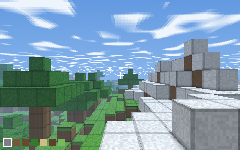
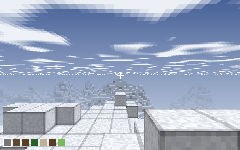
Consolidation discipline, standing: new rungs publish here first; satellite pages keep their depth but the headline number always lands on this page. Named follow-ons: home-pointer banners on every satellite page, and emitting this page from the publishing plane (today it is authored HTML — the same JS→NishiLang/emit ladder that owns the game surfaces owns this page too).
Hard evidence — rule-grounded, seed-diverse terrain with a real watershed
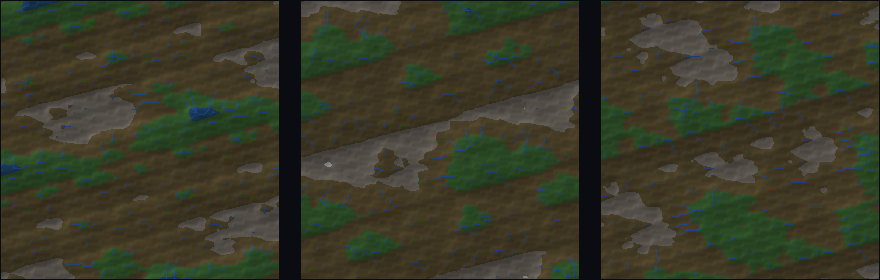
nx_procgen_terrain_gate (GREEN 4/4 + eyeballed). Pipeline, all sovereign integer: FBM value-noise heightfield → D8 flow direction → flow accumulation over an elevation-sorted pass (a real watershed) → rivers → hillshade + altitude colormap. The measured, non-negotiable claim: of 4,169 river cells, 100% flow to a strictly lower neighbour — water goes downhill by construction. That is the direct answer to the clay-audit failure “rivers that don’t flow downhill — noise bands, no watershed.” Three seeds diverge by avg Δheight 710/4000 = parametric diversity, not one memorised environment. Honest: this is a shaded-relief map, not photoreal ground — it proves coherence + diversity, the rung before fidelity.Parametric humans — the companion half (no overfit to one face)
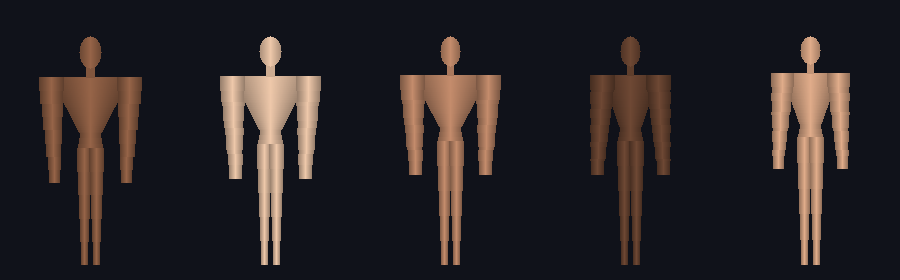
nx_procgen_human_gate (GREEN 4/4 + eyeballed), each from the eye-keystone anthropometric canon (phi / Vitruvian / Loomis): every measurement is a canon ratio of one keystone (head height), seed-varied within canon ranges. Measured canon-validity: all five have navel-to-height in the golden band (578–618, target 1/φ=618), 7.0–7.8 heads tall, shoulder>waist taper — yet they still differ (shoulder-width spread 22px, varied builds + skin tones). That is the companion answer to “don’t overfit to one human”: infinite canon-valid variety from rules, zero assets. Honest: these are proportion mannequins, not photoreal — no face, skin or hair yet; fidelity is the separate climb (same clay gap as /world/graphics).Composed scene + ground-truth labels — the digital-twin shape

nx_procgen_scene_gate, GREEN 4/4 + eyeballed): a 1D-FBM rolling-hill horizon + sky gradient + seed-placed procedural trees (depth-sorted) + a canon human, all on the procedural ground. The right panel is the ground-truth segmentation map — every pixel carries a class (sky / ground / tree / human), flat-coloured, exactly the per-pixel label an ML-training or digital-twin pipeline consumes (Infinigen’s signature output). This eats two named GAP axes at once: scene-composition and ground-truth labels. Honest: stylised, not photoreal — it proves the composition + label pipeline, not fidelity.Ground-truth trio from real geometry — depth + normals + segmentation
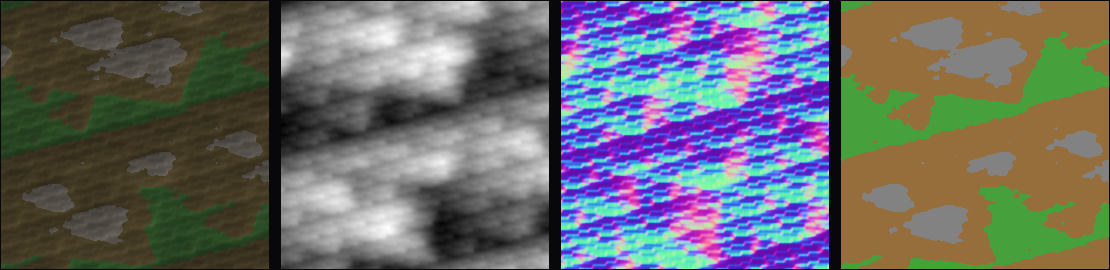
nx_procgen_gtlabels_gate (GREEN 4/4 + eyeballed): shaded relief · depth (elevation, grayscale) · surface normals (from the height gradient, standard tangent-space RGB) · semantic segmentation (class by altitude). The depth and normals are genuine geometry — computed from the heightfield, not painted — so this is a real per-pixel ground-truth stack, exactly what an ML-training or digital-twin pipeline ingests. This completes the ground-truth-labels axis (segmentation + depth + normals); advanced labels (optical flow, instance IDs) remain.Honest census — where we are vs Infinigen
| Infinigen-parity axis | verdict | evidence / gap |
|---|---|---|
| asset-free (from math rules, no external source) | HAVE | every value from integer noise + rules; sovereign by construction |
| rule-grounded coherence (not random noise) | PARTIAL | watershed PROVEN on terrain (100% downhill); other domains still random |
| parametric diversity (seed → infinite variation) | HAVE | 3 seeds diverge (Δ710); reproducible + deterministic |
| parametric humans (anthropometric canon) | PARTIAL | canon-valid diverse figures proven (navel φ-band, 7-8 heads); face/skin/hair photoreal is GAP |
| photoreal render of the procedural world | GAP | shaded-relief map, not photoreal — same clay gap as /world/graphics |
| breadth (plants, animals, weather, water, indoors) | PARTIAL | terrain-as-data (W1c) + species-parameterized trees (W2, 2026-08-13): a packed genome row (trunk/canopy/shape/density, individuals seed-varied in the species envelope) — the Infinigen species law, in the voxel art style; in-engine seasonal rain + flood water live; animals-in-world (W3) and rooms (W4, the constraint engine’s second consumer) remain the named gaps |
| ground-truth labels (depth, normals, segmentation) | HAVE | depth + normals + segmentation all emitted from real heightfield geometry (nx_procgen_gtlabels); optical-flow / instance-IDs remain |
| full-scene composition | PARTIAL | composed scene shipped (hills + trees + human, one frame); and since W1/W1b/W1c a LIVE WORLD composes terrain + style + species from ONE data row — the Houdini parameter-asset shape (a world as an HDA-class recipe), honest at voxel-art-style fidelity |
Infinigen renders photorealistic nature (plants, animals, fire/cloud/rain/snow) and Infinigen-Indoors (CVPR 2024) does rooms — with per-pixel ground-truth for computer-vision training. We have proven the generative principle (rule-grounded, diverse, coherent, asset-free) on terrain, in integer/sovereign code. The honest distance is photoreal render + breadth + labels.
Coordinated, not greenfield
This rung eats the standing “staged-procgen demoted for random content” debt with a measured watershed, and converges with the existing sovereign organs nx_worldgen, nx_water_erosion, nx_wind_erosion, nx_procgen_biome, nx_probiome, nx_worley_noise (convergence filed as debt). It shares the honesty spine with the graphics realism loop and the clay-audit rule (output reality ≥ capability presence).
What to fetch next (research targets)
Infinigen + Infinigen-Indoors (procedural rules per domain) · Blender-style geometry-node graphs (composable procedural ops) · L-systems + space-colonization (plants/trees) · hydraulic + thermal erosion (droplet & grid) · Wave-Function-Collapse (tiling/levels) · anthropometric parametric humans (eye-keystone canon — diverse companions, no overfit) · ground-truth label export (depth/normal/segmentation) for digital twins + training.
Method: prior art in, no guessing
Standing practice (2026-08-12): design decisions on this page start from prior art, not guesses — the papers and repos in the benchmark set above, plus the r/proceduralgeneration community feed as a literature-review stage. Each technique adopted names its source; each adoption becomes a hypothesis; each hypothesis gets a gate; results publish here. First harvest (top of month): graph-based maps with biome+elevation nodes (feeds the world-recipe format), fully-procedural and open-data city generators (feeds the city rung), biome-transition terrain, style-as-parameter map generators, heightmap-free ocean rendering, runtime weather.
CVF OPEN ACCESS INGESTION OPENED (2026-08-13, operator-directed): the whole CVF corpus (CVPR/ICCV/WACV 2013–2026, ~30k papers) is being ingested through two lanes. Breadth: the conference listings are seeded into the standing web crawler’s persistent frontier (baseline measured: the corpus held ZERO thecvf pages; the beat drains at its politeness pace — hostcap-governed, never hammering). Depth: the researcher’s fetch lane pulls full day listings on demand (CVPR 2025’s three days banked, 8.4MB), and the title battery is MEASURED, not browsed — day 1 of 3 alone: Splatting 121 · Avatar 110 · Motion 372 mentions — the families feeding our D-ladder oracles (3D/4DGS), B-ladder bars (avatar/human generation) and A-ladder (motion). Deep-reads ride nx_research_fetch → nx_pdf_text (sovereign PDF→text) → the papers registry; every adopted technique still names its source and earns a gate before it ships.
Why it matters
- Game dev: infinite, coherent, seed-reproducible worlds — no hand-authoring, no asset licences.
- Digital twinning: rule-grounded environments (real hydrology/geology) that can be fit to a real place, parametrically.
- Product dev: parametric variation from rules — explore a design space, not one fixed model.
- Companion: diverse procedural humans from the anthropometric canon — not one memorised face.
Measured, never asserted · every credited axis cites a rendered artifact + a gate · the honest gaps (photoreal, breadth, labels) are named, not hidden · zero-JS, renders in Waterfox and any standards browser. Sovereign integer, no third-party. 2026-07-19.
Direction (2026-08-12) — the isekai-multiverse frame
Operator direction, now standing: grow this lane in the Infinigen + Minecraft procgen style — voxel worlds are an art style, not the target — aiming at Houdini-match-then-exceed procedural generation of cities, nature, animals and people: anything that makes isekai worlds, a multiverse of travel-between experiences where each world declares its biome and its art style as generator parameters (the anime/stylize knob on the parametric humans is the precedent). Anchors this grows from, not greenfield: the canon humans above, the live voxel craft world (one art style), the terrain/erosion/biome organs, and the character pipeline at /world/anatomy_gpu.
Method pointer (operator-supplied): Infinigen Indoors (CVPR 2024) arranges rooms with a constraint DSL + a maximal-satisfaction solver. The transfer we intend to build: the same solver shape assembles the generated elements of a human — face and organ parts placed by declarative anatomical constraints (attached-to, inside-of, bilateral-symmetry, station-proportional, no-intersection) instead of typed coordinate tables, the exact class of defect §34 and §55 paid for — and later furnishes rooms and city blocks with the identical engine. One constraint engine for bodies and worlds is the sovereign exceed move.
Rung 1 LANDED same day (nx_part_solver, promoted + registered; gate GREEN 10/10): parts + declarative rows (attach / mirror / station / clear / inside) in a data file, solved by deterministic integer constraint projection. From deliberately garbage initial placements (one eye declared at 999,999,999) the constraints alone assembled the face: eyes exactly mirrored at (±53, 53, 30) inside their station band and clearance, nose and mouth exact at their attach offsets. The teeth the method demanded are in: an unsatisfiable set (attach forcing coincidence vs clear demanding distance) reports INCONSISTENT with the worst constraint named — it degrades loudly, never fabricates — and the bilateral-symmetry tooth asserts exact mirror equality no typed table passes by luck. Next rungs: orientation + extent (parts are points today), constraint weights/priorities, and driving the real face-part canon (§55) through it — graded by nx_facemark, the landmark-placement judge that already exists.
Rung 2 same day — BEAUTY AS PROPORTIONS. The aim (operator direction) is male, female, animal and environment beauty as proportion RANGES — canonical symmetry and φ-band ratios, not a random human. That needed one new primitive: the ratio constraint (a distance-to-distance band — aesthetic canons are relations, not absolute positions) plus a distance band. Both live in the constraint DATA: gate GREEN 13/13, and from garbage placements the beauty rows solved to interpupillary 106, mouth width 70, ratio 660‰ — inside the declared φ band (618 ± 80‰) — while an impossible-beauty set (a mouth band conflicting with the φ ratio) was refused with the worst constraint named. The specific numbers are placeholder canon rows pending calibration against privately-held references (the standing method: references are quality bars measured locally; we build look CLASSES parametrically and never replicate an identifiable person). Recalibrating beauty edits a data file, never code — and the same ratio rows will carry animal conformation canons and environment composition rules.
Rung 3 (2026-08-13) — THE SAME SOLVER FURNISHED ITS FIRST ROOM (W4 rung 0, the Infinigen-Indoors move). A cottage interior from constraint rows alone (knowledge/w4_room_cottage.conf): door+hearth as structure, bed/table/chairs/chest as garbage-initialized parts placed purely by relations — clear-of-the-door-swing, dine-near-the-fire, chairs mirrored at the table, chest at the bedside — SOLVED, residual 0, with the ratio row carrying the 8:5 composition proportion (the beauty primitive serving an ENVIRONMENT, as promised). The two refusals on the way were the method working: the first named the missing DATUM (violation 998,405 — a room, like a face, needs its midline; the envelope is the given, the furniture is solved), the second exposed mirror’s full-reflection semantics honestly rather than fabricating a layout. One constraint engine for faces, beauty and rooms — the city block is the same engine at the next scale (W4 R1: orientation + extents + the envelope as first-class parts).
Benchmark set sharpened (operator-supplied, all Princeton-vl): ProcFunc — function-oriented abstractions for procedural 3D (a Primitives API + a Blender-nodes-to-Python transpiler; Infinigen's generators are being rebuilt on it) — validates this lane's shape: generators as composable sovereign organs over one primitives contract, bits-up instead of transpiled. Plus OcMesher (view-dependent octree mesh extraction) and BinocMesher (temporally smooth mesh extraction) — the exact class our surface-nets/marching-tet meshers must reach (our documented defects: fused rest meshes, mm-quantized terracing, cap truncation) — and procedural human animation, the motion half of the same program.

Plumbing shipped toward this on 2026-08-12 (gates GREEN, detail in §57): the shipped character now carries a TEXC UV atlas with anatomical region tags and bakes + samples its own albedo per-fragment; the sovereign .glb loader is fail-closed with named refusals and loads multi-mesh / multi-primitive files — the ingest path for foreign avatars and worlds into the multiverse (donor acceptance awaits re-acquiring the reference VRM, stated on its gate).
Generation running — four look-classes from parameters, measured (2026-08-12)
The generative spine driven end to end through the sovereign tool surface, no hand-editing: nx_body_proc (parameters → anthropometric canon) → nx_body_gen (canon → 375,024-tri mesh, zero truncation) → nx_anat_sov (render) → nx_bodybench (measure). Four parameter sets, four distinct beings — the “male and female… beauty as proportions, vs just a random human” target, as look classes from one rule engine.

sex 900 build 300 musc 250

sex 800 build 450 musc 550

sex 100 build 600 musc 800

sex 850 stylize 800
Diversity is measured by two independent instruments, not asserted: silhouette coverage differs (foreground pixels: male-muscular 20,315 · female-athletic 18,643 · female-lean 18,154 · anime 17,986 — the muscular male carries the most mass, the stylized figure the least), and nx_bodybench cross-compares the geometries at front-IoU 873–909 / side-IoU 811–882 (self-compare 1000, so the ruler is not saturated) — the bodies are genuinely different shapes, the anime head diverging most (head-detail 276 vs 637). The shoulder-to-hip ratio flips between the male and female builds; muscle definition tracks the muscularity knob. Honest, unchanged: these are clay — faceless-smooth, ~130 perceptual beside a photograph, the same gap the whole page documents. What is proven here is the generative capability running and producing measurably diverse output, not photorealism. Beauty bands (calibrated from favorited references) will constrain which region of this parameter space is sampled — that is the next rung, not this one.
Later the same day — the favorites flywheel is wired end-to-end. The gallery's favorite flag (POST /fav, latest-vote-per-cid) is the curation signal; nx_galx_lora_export now reads that signal at its gallery-side source across the GALLERY≠VAULT tree boundary (absolute-path read of the SSOT — no mirror, no staleness — and the summary line prints favsrc= so the source actually read is announced on every run), resolves each favorite through the gallery's cid→path sidecar, extracts the image's own embedded prompt as its caption, and writes the LoRA training manifest. Verified this session: 1 live favorite exported (manifest row byte-checked against the sidecar), the override lane fixture-proven, and the export refreshed daily by clockjob favexport@86400. First judge-battery row banked: bilateral symmetry 588/1000 on the favorited reference (nx_image_beauty path lane, n=1). Pre-declared accept rule: beauty bands derive only from n ≥ 20 favorites — below that the calibration refuses rather than fabricates, and generation keeps sampling unconstrained exactly as the four look-classes above do. The unblock is curation, not code: favoriting images in the gallery is now literally the act of teaching the generator taste.
The primitives contract (P1, 2026-08-13) — what every generator composes over
The ProcFunc/Houdini claim, made concrete and measured: our generators are sovereign organs over one primitives contract, bits-up, no transpile. v1 of the contract, each primitive named with the proof that exercises it (a fuller catalog-derived sweep is the named follow-on):
| primitive | what it guarantees | proof in the fleet |
|---|---|---|
deterministic integer hash/noise (whash, bilinear 2D + trilinear 3D value noise) | every generated fact is a pure function of (absolute position, seed) — unbounded worlds, no stored state, replayable everywhere | craft gate T38 (window slides regen-identical), T24 exact world checksum |
| the watershed (D8 flow + elevation-sorted accumulation) | hydrology is rule-grounded, not painted | terrain gate: 4,169/4,169 river cells strictly downhill |
| the spec plane (64-slot world table) | identity is DATA: terrain, palette, calendar, rain, adverts, danger — one table the engine reads | whole-fleet: T41-T53 read it; gamefeel oracle bands every tunable |
| the GENP override plane (pre-init recipe rows, W1c) | gen-time parameters cross as data BEFORE worldgen; applied count is world truth (S_GENP) | craft gate T55; recipe gate T16/T17 (NXGP precedes init in page bytes) |
| species genomes (packed parameter envelopes + per-position seeded individuals, W2/W2b) | the Infinigen law as a primitive: species = parameters, individuals = seeded variation, zero assets | craft gate T56 (tree discrimination + genome-0 exactness), T57 (understory) |
| the recipe grammar (one world = one row; gen/style lanes split by slot) | worlds are rows; the refusal boundary is explicit and bites | recipe gate 18 teeth; 5 live worlds from world_recipes.conf |
the constraint solver (nx_part_solver: attach / mirror / station / clear / inside / ratio / band) | placement and BEAUTY are declarative data; unsatisfiable sets refuse with the worst constraint named | solver gate 13/13 (φ-band beauty rows from garbage inits; impossible-set refusal) |
| TEXC region atlas + bake | surface identity as tagged data; albedo baked and sampled per-fragment | §57 gates on /world/anatomy_gpu |
| retarget + two-bone IK (torso-frame effector placement, bend hints) | motion transfers between bodies preserving what must be preserved (clearance in the frame of the thing cleared) | clipcheck 122→15mm closed loop; bvh source control |
| the judge battery (frame_score, uiq_visual, clipcheck, bodybench, facemark, page_verify) | every claim re-measured by instruments that match their subject; composites carry their own calibration | this page: every number beside its ruler |
Contract discipline, standing: a new generator COMPOSES these (the incumbent-extension law); a capability that needs a new primitive adds it HERE with its proof, never as a private helper. Next: P2 every generator driven by data files (recipes/canons/genomes already are; the remainder enumerated by catalog sweep) · P3 trace/replay as a first-class artifact.
The plan (2026-08-12) — own the whole workflow, first bit up
The owned spine, end to end — every stage a sovereign organ over our own formats, every stage judged, external stacks used only as oracles: SEED/GENOME → WORLD RECIPE (biome + art style + beauty/conformation canons, all constraint DATA) → TERRAIN/NATURE → BEINGS (canon → constraint solver → emitter → TEXC/materials) → MOTION → MESHING/LOD → DELIVERY (renderer → wasm → WebXR life-size) → LIVING WORLD (persistent runtime-generated inhabitants) → JUDGES at every joint. Art style is a generator parameter; a world declares its biome and its look the same way.
| ladder | we hold today (measured) | next rungs, in order | SOTA bar |
|---|---|---|---|
| P · primitives | generators already compose as registered organs; deterministic by construction | P1 name the primitives contract (catalog-derived doc) · P2 everything generator-driven by DATA files · P3 trace/replay as a first-class artifact | ProcFunc (functions + transpiler; ours: bits-up, no transpile) |
| B · beings/beauty | solver 13/13 (assembly + φ-band beauty) · TEXC atlas + albedo bake live on the shipped character · body headline 380 geo / face 227 (binding) | B1 face-canon through the solver, graded by nx_facemark · B2 calibrate beauty bands vs private references (data edit) · B3 soft-tissue mass · B4 species canon #2 (animal conformation rows) · B5 genome-driven S/G/N materials | MetaHuman appearance; Infinigen creature genomes; beauty CLASSES not one human |
| M · meshing | surface-nets + marching-tets live; mm-terracing root FIXED 2026-08-12 (fixed-point field at SS_FQ=256, every instrument agrees — §58); remaining defects DOCUMENTED (fused rest meshes, cap truncation now demand-honest) | M2 LANDED · M1 build half LANDED (the fused SDF leaves the dance path entirely: real mocap now retargets INTO the rigged NXA body — nx_dance_emit nxa splices a chn-2 ANIM section the unchanged craft player plays; demo craft?npcasset=ref9d_salsa4; eye #4 "messy alpha, progressing" → native-rate keys shipped 510@30fps, was 128@8Hz; the clipping ruler now exists (nx_clipcheck, gate 6/6, planted depths exact): shipped clip measures floor 0mm clean, torso worst 138mm at key 78 joint 86 — the arm-through-chest class the eye called messy is now a named, ratchetable number; root-caused by the ruler's probe: dt exactly negates the bind x — the arm sweeps across AT the body plane because the bind-held torso removes the clearance real dancers get from lean/twist; torso tracking is the fix, decode byte-proven 7/7. Torso tracking SHIPPED same day — lean+twist chest frame from the mocap spine and shoulder axis, 24 torso tracks, arm pivots riding the tracked chest: worst 138→122mm, penetrating keys 3306→2211, and the key-78 event CLEARED (the worst moved to the mirror crossing). Demo salsa5. Honest: below ~60mm the coarse capsule cannot separate a clean close pass from a clip; next diagnostic = the mocap-self-clearance control — if the source skeleton clips its own capsule at the same keys, the retarget is faithful and the residual is ruler coarseness. THE CONTROL RAN 2026-08-13 AND THE ANSWER NAMES THE RETARGET: nx_clipcheck gained a bvh lane — the SAME capsule measure over the mocap source (FK composed from the proven incumbent: nx_bvhfk's core extracted to nx_bvhfk_lib on its second consumer, the bone-length-isometry KAT re-run as the extraction's value-identity proof; stature-bridged to the reference NXA, root position zeroed to mirror the rotations-only lane) — and the salsa SOURCE measures torso-CLEAN, worst 0mm over 10,200 measurements, against the retargeted clip's 122mm ⇒ the arm-through-chest class is INTRODUCED by the retarget; the clearance exists in the data to be recovered (named knobs: arm-chain bend-plane/twist lanes, per-vertebra chest distribution; debt 1786598036's <40mm closure now proven achievable in principle). Instrument honesty: the FIRST control run was measured with the capsule on its side — extent-based up-axis detection read the T-pose arm span as “up” (span exceeds height on exactly these skeletons) and reported source-clips-133mm; caught before publishing, root-caused, and replaced by bone-length-weighted alignment with an ambiguity REFUSAL — on the CMU skeleton the alignment is a near-tie (acc 41,308 vs 39,487), so the control runs on a data-verified up=y hint (head wy 24,823 vs feet ~400 at frame 0, read straight off nx_bvhfk pos). Gate 10/10 GREEN with a span-exceeds-height fixture the extent heuristic provably fails, the control census standing in the beat roster). THE ARM RUNG LANDED 2026-08-13 AND CLOSED THE CLASS: worst 122→15mm, penetrating keys 2,211→10 of 39,270, floor 0mm clean — and the first attempt FAILED ITS OWN ACCEPT GATE and taught the design: a shoulder-relative two-bone IK measured 124mm (two different arm solvers within 2mm of the same penetration = the arm shape was never the residual), and the probes + nx_bvhfk pos located the loss in the CHEST/SHOULDER relation — the source wrist crosses at 201mm from its axis while a faithful shoulder-relative offset, anchored on a shoulder that sits closer to OUR axis, landed ours at 40mm. The shipped solve retargets the wrist in the TORSO frame (hip-centre offset scaled by the spine-length ratio — the ruler’s own stature bridge), then a two-bone solve from OUR tracked shoulder pivot steered by the scaled mocap elbow position (a plane-only bend hint left the elbow at 71mm; targeting the elbow’s absolute torso-frame position closed it). Axis clearance is inherited from the data by construction; arm articulation adapts to our proportions. The lane announces itself on every emit (arm-ik keys=1020 fallback=0). Demo salsa6. Honest: 15mm is deep inside the capsule’s ~60mm honesty band — a bound, not a proof of zero contact; the eye verdict on salsa6 is pending; the gate’s regression-ratchet tooth is filed (debt 1786642293; salsa5 at 122mm is the free planted known-bad); forearm TWIST orientation and limb-vs-limb are the named next lanes (the mocap shoulder offsets are already banked in the wire for the twist lane). Debt 1786598036 EATEN at 15mm against its <40mm bar. · M3 view-dependent LOD · M4 temporal smoothness under animation (ruler = the absolute-excess spike tooth, already built) | OcMesher / BinocMesher |
| A · motion | /dance live: real mocap retargeted onto our being, 13-tooth proof, 6 ms/frame | A1 rest-frame adapter + root motion + deeper rig · A2 procedural motion from rules (walk/idle/gesture — no clip needed) · A3 animal motion through the same retarget engine | Procedural Animation for Humans |
| W · worlds | craft voxel world live (one art style) · terrain watershed 100% downhill · composed scene + ground-truth labels · W1 recipe plane LANDED 2026-08-12 (worlds = data rows; 4th world NISHI ISLE shipped from a row alone) · W1b STYLE rows LANDED 2026-08-12 (isle’s volcanic dusk is data; gate 14/14) · W1c GEN-TIME rows LANDED 2026-08-13: TERRAIN IS DATA — the engine gained a pre-init GENP override region (192B, genp_off() export): recipe rows 0..6/59/60 (base height, relief amplitudes, flood level, snowline, tree sparsity, cave threshold, tree ceiling, stage) are written by the page BEFORE init_v, applied after identity defaults and before genworld, with the applied count landing in world truth (S_GENP). Gate grew to 55/55: the new tooth proves overrides reach genworld (terrain height-sum moved 6231→5131 on the same identity+seed), a reserved idx is skipped, and the zero-region control changes nothing; the recipe gate grew to 18 teeth (gen rows load + land as page data BEFORE the init call, style-only pages stay byte-identical). The proof world: NISHI CRAGS — vale’s identity, but deep glacial lakes, towering shear walls, a low snowline and sparse pine belts, ALL from one conf row (8 gen pairs + 2 style pairs); only its page carries the NXGP block, the other four worlds re-emitted byte-clean. The native judge lane closed the same day: nx_world_snap now writes gen rows into GENP pre-init (announces gen_applied=8), and the mechanical A/B on the same identity+seed+style is decisive — with gen rows the spawn vista’s zenith pixel is snow-palette TERRAIN (235,239,245), a shear wall; without them it is open sky (174,186,210). The judged frame scores 732 on nx_frame_score (RICH; craft 804 / isle 750 vs the 628 random-squares floor — a structure floor, not a perceptual rank, per the ruler’s own calibration). The crags eye verdict is pending. W2 SPECIES VEGETATION LANDED same day: THE FOREST IS DATA TOO — the tree stamp became a species-parameterized grower: one packed genome row (P_TREESPEC, spec 61, riding the same GENP lane) declares trunk base/variance, canopy radius, shape (dome/pine) and leaf density; individuals vary per-position by seed hash inside the species envelope — the Infinigen species law (species = parameters, individuals = seeded variation, zero assets), in the voxel art style. Gate 56/56: T56 measures the discrimination at world scale on one identity+seed — legacy 26,362 leaf blocks, pine 39,929, dome 25,588, and a genome-0 row reproduces the legacy forest EXACTLY (the control that keeps every identity-only world unchanged; T1..T54 stdout byte-identical under the new engine = legacy behavior preserved to the checksum). NISHI CRAGS now grows sparse alpine pines from its row; the judge lane re-captured it with gen_applied=9. W2b UNDERSTORY landed the same day: ground vegetation (grass tufts / plus-clump shrubs / mixed) packed into bits 18-22 of the SAME genome — no new slots, the whole lane already routed it. Gate 57/57: T57 proves a tuft-only genome grows ground cover (leaves 26,362→33,456) while the forest stays EXACTLY legacy (wood equality) — and its first run caught the unguarded shrub clump eating 792 wood blocks from neighbor columns, fixed by the growth rule vegetation fills air, never replaces solids (shrubs now 52,433 leaves, wood untouched). Crags’ one row (61:598837) now declares pines AND ground tufts. | W2b crops-as-species (the remaining half) · W2c mesh-class flora (the same genomes driving real geometry, not voxels) · W3 animals in-world · W4 rooms/cities via the SAME constraint engine · W5 persistent inhabitants (LOD simulation; save/load parts already certified) · W6 travel between worlds | Infinigen breadth; Minecraft explorability; Houdini city/nature procgen; million-NPC persistence |
| D · delivery | sovereign PNG/APNG evidence · wasm viewers live · stereo VR pair with measured disparity proven | D1 compose being+performance+stereo into a WebXR life-size page on OUR site · D2 stream the PERFORMANCE as mesh+track data (generated, capture-free — our answer to volumetric replay) · D3 study Yang-lineage 4DGS (born/die spacetime primitives) as the streaming ORACLE, never the path | Vivid 4D (capture-replay; ours GENERATES both being and performance) |
| J · judges | gate fleet + bodybench/facemark/mhbench + perceptual minimum + page_verify; every claim on these pages re-runs | J1 wire FVD/LPIPS-class external metrics as oracles · J2 harden the structure-agreement detail judge · J3 world-level judges (coherence, per-world style consistency) | every external system used as a measuring stick, none as a dependency |
B1a landed (2026-08-12, gate GREEN 5/5): nx_canon_solver, promoted + registered + capability-minted + run against the real canon — the CANON’S BEAUTY LINTER. It reads the emitter’s own P/R canon format, emits part rows, appends a RULES file (stations, containment, clearance, φ-band ratios — all data), solves, and reports one of three outcomes exactly: CLEAN (typed canon already satisfies, zero deltas), ADJUSTED (each delta a named lint finding and a writeback candidate — proven on a planted band defect that moved only the defective part, in the correct direction), or INCONSISTENT (refused, worst constraint named). First real run: the 16-part face canon parses as 16 parts / 106 rings and lints CLEAN against the initial rules file — which is deliberately empty, because which index is the eye pair / lips / nose is not yet identity-verified, and a rule naming the wrong part is a confident wrong lint. Named next: part-identity census from the emitter, then the beauty bands land in the rules file as data, then writeback → emit → nx_facemark grading.
B1b first half landed same day (gate GREEN 8/8): the part-identity census is now gate-proven, not guessed — decoding every P header with the emitter’s own field semantics finds exactly one eye-material part at lateral offset 19 permil (≡ the documented 66 mm interpupillary) and forward offset 50 (≡ the §56 socket fix), a three-way cross-validation asserted mechanically in the gate; feet/toes/fingers/thumb match their GX-24/§32/§33 records, and the census independently confirms §56’s statement that this canon carries no separate lip/brow/nose parts. The rules file now guards the verified anatomy: documented placements sit as immovable anchor parts (containment moves only the child), so a canon edit that drifts the eye or foot placement lints with a named delta — bite-proven in both directions on planted drift. First live lint of the shipped canon: CLEAN, 16 parts / 106 rings. Beauty bands still await reference calibration — these rows are regression guards on gate-verified anatomy, not aesthetic claims.
W1 LANDED (2026-08-12, gate GREEN 10/10): the world-recipe plane is live — one isekai world = one data row. knowledge/world_recipes.conf declares every shipped world (name, engine identity, worldgen seed, path, title, controls) in a tab grammar; the sovereign emit lane (nx_craft_emit → gpe_build_s) consumes rows, announces recipe_src= on every run, and refuses the whole ship on any malformed row with the row named. The engine’s own gate had already proven seed-sensitivity (same identity, seeds 4242/777 diverge), so the fourth row shipped a genuinely new world with zero source edits: NISHI ISLE — THE FAR SHORE, the shore engine at far seed 20260812, live and page-verified. The legacy three worlds re-emitted through the same rows; the emitter’s byte-preservation is proven in-gate (the legacy entry is hash-identical to the seeded entry at the historic constant), and the re-emit also shipped the engine progress accumulated since their last manual emit, behind the 54/54 engine gate + feel oracle. Honest bound: recipe rows reach page identity + worldgen seed today; biome/style/canon parameters as first-class engine inputs are the next rung (W1b). Standing architecture order banked the same day: JS/HTML are an interop layer only — new world capability lands in the NishiLang wasm engine, never in page-script strings; the census of JS-resident logic and its migration ladder is the named follow-up.
W1b first half landed same day (gate GREEN 14/14): the recipe gained an optional style column — idx:val pairs poked into the engine’s live 64-row spec table after boot (pure data across the interop boundary, per the JS/HTML-interop-only order; the engine’s own spec vocabulary is the schema). Gen-time rows are refused by name at recipe load — post-boot they would be a silent no-op, and a silent no-op teaches a false knob. NISHI ISLE now declares a volcanic dusk look — black sand, ember horizon, dark teal sea — entirely from its data row (+241 bytes of page, zero source edits), while the spec-less worlds re-emitted byte-identically, the KAT holding through the change. Honest: the isle palette is an authored guess pending an eye/VLM verdict; terrain-shape recipe rows (the gen-time half) are W1c.
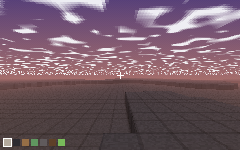
nx_world_snap (new, promoted+registered) renders any identity+seed+style natively through the same engine source the wasm compiles from, and the judge battery runs on the frame. Measured: unstyled isle sky (144,188,235) daylight → styled (128,110,153) dusk; mean luminance 191→97; ink 768→992‰; verdict RENDERED (nx_uiq_visual). Control: the craft frame — sunlit overworld, sky (186,210,240), luminance 152. Eye (flagged, one viewer): the dusk mood lands — violet zenith, ember horizon, ashy foreground into warm fog; a horizon glint speckle is noted for the style’s next data edit. Honest bounds: this judges COHERENCE and the style channel, not photorealism; the frame is the spawn vista at mid-morning tick 30.Sequencing by measured leverage: B1 (face is the binding judge at 227) → M1+M2 (the mesh defects block both beings and worlds) → A1 → W1 (the world-recipe format makes every later generator a data row) → D1 (the composable pieces already exist) → breadth. Ownership claim, honestly bounded: the whole spine above runs on our language, compiler, formats, renderer, site and judges today — what is NOT ours yet is the appearance bar (capture-class photorealism) and the breadth (plants, animals, cities), and this table is the measured path to both. 4DGS naming note for every future row: Wu CVPR'24 = canonical+deformation; Yang ICLR'24 = native spacetime primitives — name the lineage.