Nishi Family › Compare › Sovereign Model Lifecycle (Modelwright)
Nishi Compare · capabilities, evidence and delivery
Sovereign Model Lifecycle (Modelwright)
Compare capabilities and delivery evidence. Source discovery, qualification, deployment and accepted outcomes are separate; an open contract names work still to verify.
Nishi vs PyTorch and HuggingFace and llama.cpp and Megatron-LM
Overview
The purpose, declared position and evidence coverage of this domain. Source presence and completed acceptance are different measures.
Where we are. Measured 2026-08-19. The loop is REAL and toy-scale: autodiff, an integer no-float transformer that greedy-matches the float reference, BPE, K-quants, GGUF load of Qwen2.5-0.5B and an OpenAI-shaped serve. The matrix was last scored 2026-07-10 and the nofloat lane has since shipped a MoE forward, Muon and AdamW optimisers, distillation, linear and latent attention, MXFP4 and MXFP8 and a DDP autograd gate -- substrate the rungs below compose rather than re-create. What is still absent is alignment (SFT, DPO, LoRA), a standard eval harness, fused kernels, parallel training, GPU training and a model at real scale.
Where we need to go. Train and align a real model on our own substrate: alignment first (the cheapest path to a usable seat), then a harness that cannot be gamed, then kernels, parallelism and silicon, then a 100M-plus pretrain -- every step bit-exact reproducible, the structural exceed the float field cannot match.
Latest recorded release
No valid dated release entry is recorded for this domain.
Release entries describe recorded changes; they do not establish that every capability passed evaluation.
10 of 21 capability source symbols found|2 of them authored stronger-claims|11 open|coverage 476/1000|adoption 6 full / 4 partial
Evidence profile — what the gaps on this board actually are
Measured by nx_swcompare_evidence, read back by nx_evprofile_lib. Every figure is a count with its denominator — there is deliberately no score, no grade and no percentage anywhere in this band, because a stored scalar is a field a seat can edit and a counted partition is not.
evidence|grounded 10/10|unsupported 0|gates green 2/2|proven able to fail 2/2|never bitten 0|green at 0/0 0|open gaps 11|of them unnamed 0|of them proof withheld 0|flips ready 0
proven able to fail counts the gates that have a RECORDED RED — nx_gate_bite mutated the gate subject, rebuilt it, watched the gate go red, and that record is inside the shared TTL. never bitten is its complement over the same denominator: those gates ran and were green, and nothing has ever shown them able to detect anything, so their green is a statement about this run and not about the gate. green at 0/0 is a separate and much weaker observation — the gate printed GREEN on a zero denominator, so its own tooth counter says it examined nothing. A gate can be green, non-zero, and still never bitten; that is the common case and it is now visible instead of implied.
partition: grounded + unsupported = 10 vs present 10 · named + unnamed + withheld = 11 vs open 11 · both reconcile
liar-kill conj=GPQN · all four conjuncts held
graded document: BUILDROOT tree, 5831 bytes · gates map: PRIMARY · stamped 3d 10h ago · source ../knowledge/status/evstamp_modelwright.verdict
| Gap class | What it is, and the work it names |
|---|---|
| NONE | No gap class fires on this board: every published claim is grounded, the declared gates ran and were green, no watch contract is unnamed or already landed, and the stamp is inside its TTL. That is a statement about evidence, not about depth, scale or polish. |
nx_swcompare_evidence modelwright itself and are not carried on the stamp, so this page names the classes and the producer names the rows. That split is stated rather than hidden: a count without a worklist is not actionable, and this band is honest about which half of that it is.Production map
Follow the dependencies, declared acceptance criteria and recorded priorities. Inspect source binding before treating a rank as executable work.
Ranking source binding: STALE_OR_INVALID_BINDING. Recorded priorities require current acceptance evidence and resource checks before execution.
Recorded ranking withheld
Retained ranking is not bound to the current plan and matrix: STALE_OR_INVALID_BINDING. Historical data remains retained. Refresh the ranking after resolving the input differences. Latest execution outcome is unverified.
Declared roadmap — contract, acceptance, executor, effort
| Rung | Closes with | Definition of done (pre-declared) | Executor | Est. |
|---|---|---|---|---|
| Instruction SFT pipeline (R0) | sft_run | Supervised fine-tuning over the 100 percent integer LM on a banked instruction set; held-out exact-match beats the base model by a PRE-DECLARED margin; the run is bit-exact reproducible on a second CPU (the exceed this lane already holds extends to training) | Organ | 2 u |
| LoRA adapters (R1) after R0 | lora_apply | Rank-r adapters on the attention projections trained integer; merge reproduces the full-weight result bit-exact; the existing adapter pool registry (nx_lora_pool) is the store, not a new one | Organ | 1.5 u |
| DPO preference alignment (R2) after R0 | dpo_step | DPO loss over banked preference pairs; win-rate against the SFT model on held-out pairs PRE-DECLARED; a run that does not beat SFT stays unwired | Organ | 2 u |
| Standardized eval harness (R3) | eh_run | MMLU and HumanEval-class tasks run from banked datasets with exact-match and pass-at-1; the harness is shared with the referee domain (its std_bench row names the same capability) so one ruler grades every model | Organ | 2 u |
| Flash-attention class fused kernel (R4) | fa_fused | Tiled attention that never materialises the score matrix; bit-identical to nx_attention at every tested length; measured speedup over the plain path at 2k context is published as a number | Organ | 2 u |
| Mixture-of-experts training (R5) after R4 | moe_train_step | Router plus experts trained end to end in integer (the nofloat lane already ships the MoE forward and its arch gate); load-balance loss; held-out beats dense at equal active parameters, PRE-DECLARED | Organ | 2.5 u |
| Tensor and data-parallel training (R6) after R4 | tp_shard | Sharded GEMM across processes over the mesh transport; bit-exact against the single-process run (the nofloat DDP autograd gate is the precedent); scaling efficiency printed per worker count | Organ | 3 u |
| GPU training step (R7) after R4 | gpu_train_step | The integer train step executes on the 5080 through the sovereign GPU lane; step bits equal the CPU step; tokens per second published | Organ | 4 u |
| Speed published vs llama.cpp (R8) after R4,R7 | ts_bench | Decode and train tokens per second measured on the same box as llama.cpp with the same model; the ratio is a ratchet floor that refuses regression | Organ | 1 u |
| Model hub (R10) | mh_publish | Content-addressed model cards plus weights served from the estate with sha-verified pull; composes the container registry CAS already proven | Organ | 1 u |
| Pretraining at real scale (R9) after R5,R6,R7 | ps_run | A 100M-plus parameter integer model pretrained on the banked corpus to a PRE-DECLARED held-out perplexity; checkpoints content-addressed; the run is resumable and bit-exact | Local model | 5 u |
Milestones
| Milestone | Rungs | Cumulative |
|---|---|---|
| M0 · Align what we have | R0,R1,R2 | 5.5 u |
| M1 · Kernels and an honest harness | R3,R4 | 9.5 u |
| M2 · Scale architecture | R5,R6,R10 | 16 u |
| M3 · Silicon | R7,R8 | 21 u |
| M4 · A real model | R9 | 26 u |
| Class | Count | Note |
|---|---|---|
| bars | 0 | sotabar rows on the plan |
| fresh | 0 | the bar month is the current month |
| attested | 0 | an older bar with a this-month barscan reporting no newer entry |
| stale | 0 | a this-month scan saw a newer month the bar ignores |
| unattested | 0 | nobody looked this month |
| malformed | 0 | a sotabar row missing a field |
| duplicate | 0 | bar ids an earlier row already carries |
| bars, summed | 0 | RECONCILED: the parts sum to the total 0 |
| current month | 2026-10 | the month every bar is judged against |
Inspect a rung and its prerequisites
Declared nodes 11. Rank input binding: STALE_OR_INVALID_BINDING. Dependency order is authored. Implementation, acceptance evidence, authority and resource readiness are unverified. No action is recommended or dispatched here.
Plan SHA-256 501b6f2fd1c3dc6d5d358d1d4a52e3d24176e285f07632e055a4de50b6dd0251. Target rows 0; role rows 0. Existing risks and release worklog retain their own scope; no node completion is inferred.
Runtime observation coverage: 0 of 11 rungs have current, identity-bound execution observations. Observation may report RED. Accepted completion remains unknown; source presence, qualification and deployment do not establish it.
Use Enter or Space on a rung to inspect its contract. Prerequisite links locate another rung in this list; open its summary to inspect it. Estimates are authored effort, not forecasts.
R0 — Instruction SFT pipeline
Prerequisites: None declared; this does not establish execution eligibility.
Contract:
sft_runAcceptance: Supervised fine-tuning over the 100 percent integer LM on a banked instruction set; held-out exact-match beats the base model by a PRE-DECLARED margin; the run is bit-exact reproducible on a second CPU (the exceed this lane already holds extends to training)
Authored effort: 2. Executor kind: Organ. Responsible, accountable and verifier not established. Inspect retained worklog.
Runtime observation: UNKNOWN; outcome UNKNOWN; observed epoch -1. Declared owner: . Receipt
, SHA-256. Identity-bound observation is not accepted completion. Qualification and deployment remain unverified by this projection.R1 — LoRA adapters
Prerequisites: R0 (acceptance unverified)
Contract:
lora_applyAcceptance: Rank-r adapters on the attention projections trained integer; merge reproduces the full-weight result bit-exact; the existing adapter pool registry (nx_lora_pool) is the store, not a new one
Authored effort: 1.5. Executor kind: Organ. Responsible, accountable and verifier not established. Inspect retained worklog.
Runtime observation: UNKNOWN; outcome UNKNOWN; observed epoch -1. Declared owner: . Receipt
, SHA-256. Identity-bound observation is not accepted completion. Qualification and deployment remain unverified by this projection.R2 — DPO preference alignment
Prerequisites: R0 (acceptance unverified)
Contract:
dpo_stepAcceptance: DPO loss over banked preference pairs; win-rate against the SFT model on held-out pairs PRE-DECLARED; a run that does not beat SFT stays unwired
Authored effort: 2. Executor kind: Organ. Responsible, accountable and verifier not established. Inspect retained worklog.
Runtime observation: UNKNOWN; outcome UNKNOWN; observed epoch -1. Declared owner: . Receipt
, SHA-256. Identity-bound observation is not accepted completion. Qualification and deployment remain unverified by this projection.R3 — Standardized eval harness
Prerequisites: None declared; this does not establish execution eligibility.
Contract:
eh_runAcceptance: MMLU and HumanEval-class tasks run from banked datasets with exact-match and pass-at-1; the harness is shared with the referee domain (its std_bench row names the same capability) so one ruler grades every model
Authored effort: 2. Executor kind: Organ. Responsible, accountable and verifier not established. Inspect retained worklog.
Runtime observation: UNKNOWN; outcome UNKNOWN; observed epoch -1. Declared owner: . Receipt
, SHA-256. Identity-bound observation is not accepted completion. Qualification and deployment remain unverified by this projection.R4 — Flash-attention class fused kernel
Prerequisites: None declared; this does not establish execution eligibility.
Contract:
fa_fusedAcceptance: Tiled attention that never materialises the score matrix; bit-identical to nx_attention at every tested length; measured speedup over the plain path at 2k context is published as a number
Authored effort: 2. Executor kind: Organ. Responsible, accountable and verifier not established. Inspect retained worklog.
Runtime observation: UNKNOWN; outcome UNKNOWN; observed epoch -1. Declared owner: . Receipt
, SHA-256. Identity-bound observation is not accepted completion. Qualification and deployment remain unverified by this projection.R5 — Mixture-of-experts training
Prerequisites: R4 (acceptance unverified)
Contract:
moe_train_stepAcceptance: Router plus experts trained end to end in integer (the nofloat lane already ships the MoE forward and its arch gate); load-balance loss; held-out beats dense at equal active parameters, PRE-DECLARED
Authored effort: 2.5. Executor kind: Organ. Responsible, accountable and verifier not established. Inspect retained worklog.
Runtime observation: UNKNOWN; outcome UNKNOWN; observed epoch -1. Declared owner: . Receipt
, SHA-256. Identity-bound observation is not accepted completion. Qualification and deployment remain unverified by this projection.R6 — Tensor and data-parallel training
Prerequisites: R4 (acceptance unverified)
Contract:
tp_shardAcceptance: Sharded GEMM across processes over the mesh transport; bit-exact against the single-process run (the nofloat DDP autograd gate is the precedent); scaling efficiency printed per worker count
Authored effort: 3. Executor kind: Organ. Responsible, accountable and verifier not established. Inspect retained worklog.
Runtime observation: UNKNOWN; outcome UNKNOWN; observed epoch -1. Declared owner: . Receipt
, SHA-256. Identity-bound observation is not accepted completion. Qualification and deployment remain unverified by this projection.R7 — GPU training step
Prerequisites: R4 (acceptance unverified)
Contract:
gpu_train_stepAcceptance: The integer train step executes on the 5080 through the sovereign GPU lane; step bits equal the CPU step; tokens per second published
Authored effort: 4. Executor kind: Organ. Responsible, accountable and verifier not established. Inspect retained worklog.
Runtime observation: UNKNOWN; outcome UNKNOWN; observed epoch -1. Declared owner: . Receipt
, SHA-256. Identity-bound observation is not accepted completion. Qualification and deployment remain unverified by this projection.R8 — Speed published vs llama.cpp
Prerequisites: R4 (acceptance unverified), R7 (acceptance unverified)
Contract:
ts_benchAcceptance: Decode and train tokens per second measured on the same box as llama.cpp with the same model; the ratio is a ratchet floor that refuses regression
Authored effort: 1. Executor kind: Organ. Responsible, accountable and verifier not established. Inspect retained worklog.
Runtime observation: UNKNOWN; outcome UNKNOWN; observed epoch -1. Declared owner: . Receipt
, SHA-256. Identity-bound observation is not accepted completion. Qualification and deployment remain unverified by this projection.R10 — Model hub
Prerequisites: None declared; this does not establish execution eligibility.
Contract:
mh_publishAcceptance: Content-addressed model cards plus weights served from the estate with sha-verified pull; composes the container registry CAS already proven
Authored effort: 1. Executor kind: Organ. Responsible, accountable and verifier not established. Inspect retained worklog.
Runtime observation: UNKNOWN; outcome UNKNOWN; observed epoch -1. Declared owner: . Receipt
, SHA-256. Identity-bound observation is not accepted completion. Qualification and deployment remain unverified by this projection.R9 — Pretraining at real scale
Prerequisites: R5 (acceptance unverified), R6 (acceptance unverified), R7 (acceptance unverified)
Contract:
ps_runAcceptance: A 100M-plus parameter integer model pretrained on the banked corpus to a PRE-DECLARED held-out perplexity; checkpoints content-addressed; the run is resumable and bit-exact
Authored effort: 5. Executor kind: Local model. Responsible, accountable and verifier not established. Inspect retained worklog.
Runtime observation: UNKNOWN; outcome UNKNOWN; observed epoch -1. Declared owner: . Receipt
, SHA-256. Identity-bound observation is not accepted completion. Qualification and deployment remain unverified by this projection.
Learning and practice paths
No structured learning path is declared for this plan. Existing research, roadmap and worklog remain available above.
Rung dossiers — every record that bears on a rung, in one place
nx_swcompare_evidence modelwright writes it beside its stamp); every gate below reads UNRECORDED until it runs.knowledge/organ_gate.conf read from this working directory (1 rows) and from the estate root (196 rows); rows in both counted once: 0; declarations read: 197. Every declaration in either copy counts, so a stub beside the publisher can never hide the root.R0 Instruction SFT pipeline · cell WATCHING · gate NO-GATE-DECLARED
| Contract | sft_run · executor Organ · 2 u · stands on nothing |
|---|---|
| Definition of done | Supervised fine-tuning over the 100 percent integer LM on a banked instruction set; held-out exact-match beats the base model by a PRE-DECLARED margin; the run is bit-exact reproducible on a second CPU (the exceed this lane already holds extends to training) |
| Matrix cell | Instruction fine-tuning (SFT) pipeline · runtime/nx_sft.nx · WATCHING decl |
| Gate | NO-GATE-DECLARED — knowledge/organ_gate.conf carries no row for nx_sft; declare nx_sft TAB <gate> and the ship loop proves it and the verdict lands here. |
| Work log | no log row names this rung yet |
R1 LoRA adapters · cell WATCHING · gate NO-GATE-DECLARED
| Contract | lora_apply · executor Organ · 1.5 u · stands on R0 |
|---|---|
| Definition of done | Rank-r adapters on the attention projections trained integer; merge reproduces the full-weight result bit-exact; the existing adapter pool registry (nx_lora_pool) is the store, not a new one |
| Matrix cell | LoRA / parameter-efficient fine-tuning · runtime/nx_lora.nx · WATCHING decl |
| Gate | NO-GATE-DECLARED — knowledge/organ_gate.conf carries no row for nx_lora; declare nx_lora TAB <gate> and the ship loop proves it and the verdict lands here. |
| Work log | no log row names this rung yet |
R2 DPO preference alignment · cell WATCHING · gate NO-GATE-DECLARED
| Contract | dpo_step · executor Organ · 2 u · stands on R0 |
|---|---|
| Definition of done | DPO loss over banked preference pairs; win-rate against the SFT model on held-out pairs PRE-DECLARED; a run that does not beat SFT stays unwired |
| Matrix cell | RLHF / DPO preference alignment · runtime/nx_dpo.nx · WATCHING decl |
| Gate | NO-GATE-DECLARED — knowledge/organ_gate.conf carries no row for nx_dpo; declare nx_dpo TAB <gate> and the ship loop proves it and the verdict lands here. |
| Work log | no log row names this rung yet |
R3 Standardized eval harness · cell WATCHING · gate NO-GATE-DECLARED
| Contract | eh_run · executor Organ · 2 u · stands on nothing |
|---|---|
| Definition of done | MMLU and HumanEval-class tasks run from banked datasets with exact-match and pass-at-1; the harness is shared with the referee domain (its std_bench row names the same capability) so one ruler grades every model |
| Matrix cell | Standardized eval harness (MMLU / HumanEval) · runtime/nx_eval_harness.nx · WATCHING decl |
| Gate | NO-GATE-DECLARED — knowledge/organ_gate.conf carries no row for nx_eval_harness; declare nx_eval_harness TAB <gate> and the ship loop proves it and the verdict lands here. |
| Work log | no log row names this rung yet |
R4 Flash-attention class fused kernel · cell WATCHING · gate NO-GATE-DECLARED
| Contract | fa_fused · executor Organ · 2 u · stands on nothing |
|---|---|
| Definition of done | Tiled attention that never materialises the score matrix; bit-identical to nx_attention at every tested length; measured speedup over the plain path at 2k context is published as a number |
| Matrix cell | Flash-attention / fused training kernels · runtime/nx_flash_attn.nx · WATCHING decl |
| Gate | NO-GATE-DECLARED — knowledge/organ_gate.conf carries no row for nx_flash_attn; declare nx_flash_attn TAB <gate> and the ship loop proves it and the verdict lands here. |
| Work log | no log row names this rung yet |
R5 Mixture-of-experts training · cell WATCHING · gate NO-GATE-DECLARED
| Contract | moe_train_step · executor Organ · 2.5 u · stands on R4 |
|---|---|
| Definition of done | Router plus experts trained end to end in integer (the nofloat lane already ships the MoE forward and its arch gate); load-balance loss; held-out beats dense at equal active parameters, PRE-DECLARED |
| Matrix cell | Mixture-of-experts training · runtime/nx_moe_train.nx · WATCHING decl |
| Gate | NO-GATE-DECLARED — knowledge/organ_gate.conf carries no row for nx_moe_train; declare nx_moe_train TAB <gate> and the ship loop proves it and the verdict lands here. |
| Work log | no log row names this rung yet |
R6 Tensor and data-parallel training · cell WATCHING · gate NO-GATE-DECLARED
| Contract | tp_shard · executor Organ · 3 u · stands on R4 |
|---|---|
| Definition of done | Sharded GEMM across processes over the mesh transport; bit-exact against the single-process run (the nofloat DDP autograd gate is the precedent); scaling efficiency printed per worker count |
| Matrix cell | Distributed tensor-parallel training · runtime/nx_tensor_parallel.nx · WATCHING decl |
| Gate | NO-GATE-DECLARED — knowledge/organ_gate.conf carries no row for nx_tensor_parallel; declare nx_tensor_parallel TAB <gate> and the ship loop proves it and the verdict lands here. |
| Work log | no log row names this rung yet |
R7 GPU training step · cell WATCHING · gate NO-GATE-DECLARED
| Contract | gpu_train_step · executor Organ · 4 u · stands on R4 |
|---|---|
| Definition of done | The integer train step executes on the 5080 through the sovereign GPU lane; step bits equal the CPU step; tokens per second published |
| Matrix cell | GPU / CUDA training · runtime/nx_gpu_train.nx · WATCHING decl |
| Gate | NO-GATE-DECLARED — knowledge/organ_gate.conf carries no row for nx_gpu_train; declare nx_gpu_train TAB <gate> and the ship loop proves it and the verdict lands here. |
| Work log | no log row names this rung yet |
R8 Speed published vs llama.cpp · cell WATCHING · gate NO-GATE-DECLARED
| Contract | ts_bench · executor Organ · 1 u · stands on R4, R7 |
|---|---|
| Definition of done | Decode and train tokens per second measured on the same box as llama.cpp with the same model; the ratio is a ratchet floor that refuses regression |
| Matrix cell | Competitive train and inference speed · runtime/nx_train_speed.nx · WATCHING decl |
| Gate | NO-GATE-DECLARED — knowledge/organ_gate.conf carries no row for nx_train_speed; declare nx_train_speed TAB <gate> and the ship loop proves it and the verdict lands here. |
| Work log | no log row names this rung yet |
R10 Model hub · cell WATCHING · gate NO-GATE-DECLARED
| Contract | mh_publish · executor Organ · 1 u · stands on nothing |
|---|---|
| Definition of done | Content-addressed model cards plus weights served from the estate with sha-verified pull; composes the container registry CAS already proven |
| Matrix cell | Model hub and distribution · runtime/nx_model_hub.nx · WATCHING decl |
| Gate | NO-GATE-DECLARED — knowledge/organ_gate.conf carries no row for nx_model_hub; declare nx_model_hub TAB <gate> and the ship loop proves it and the verdict lands here. |
| Work log | no log row names this rung yet |
R9 Pretraining at real scale · cell WATCHING · gate NO-GATE-DECLARED
| Contract | ps_run · executor Local model · 5 u · stands on R5, R6, R7 |
|---|---|
| Definition of done | A 100M-plus parameter integer model pretrained on the banked corpus to a PRE-DECLARED held-out perplexity; checkpoints content-addressed; the run is resumable and bit-exact |
| Matrix cell | Large-scale pretraining (billions of params, trillions of tokens) · runtime/nx_pretrain_scale.nx · WATCHING decl |
| Gate | NO-GATE-DECLARED — knowledge/organ_gate.conf carries no row for nx_pretrain_scale; declare nx_pretrain_scale TAB <gate> and the ship loop proves it and the verdict lands here. |
| Work log | no log row names this rung yet |
dossiers=11 cells_joined=11 no_matrix_row=0 (sum 11) gates_recorded=0 gates_unrecorded=0 no_gate_declared=11 (sum 11 of cells_joined) evgates=UNSTAMPED
Capability comparisons
Compare the field, search individual capabilities and open their source and adoption evidence. Documented presence does not establish comparative quality.
Position map — centrality and distinctiveness
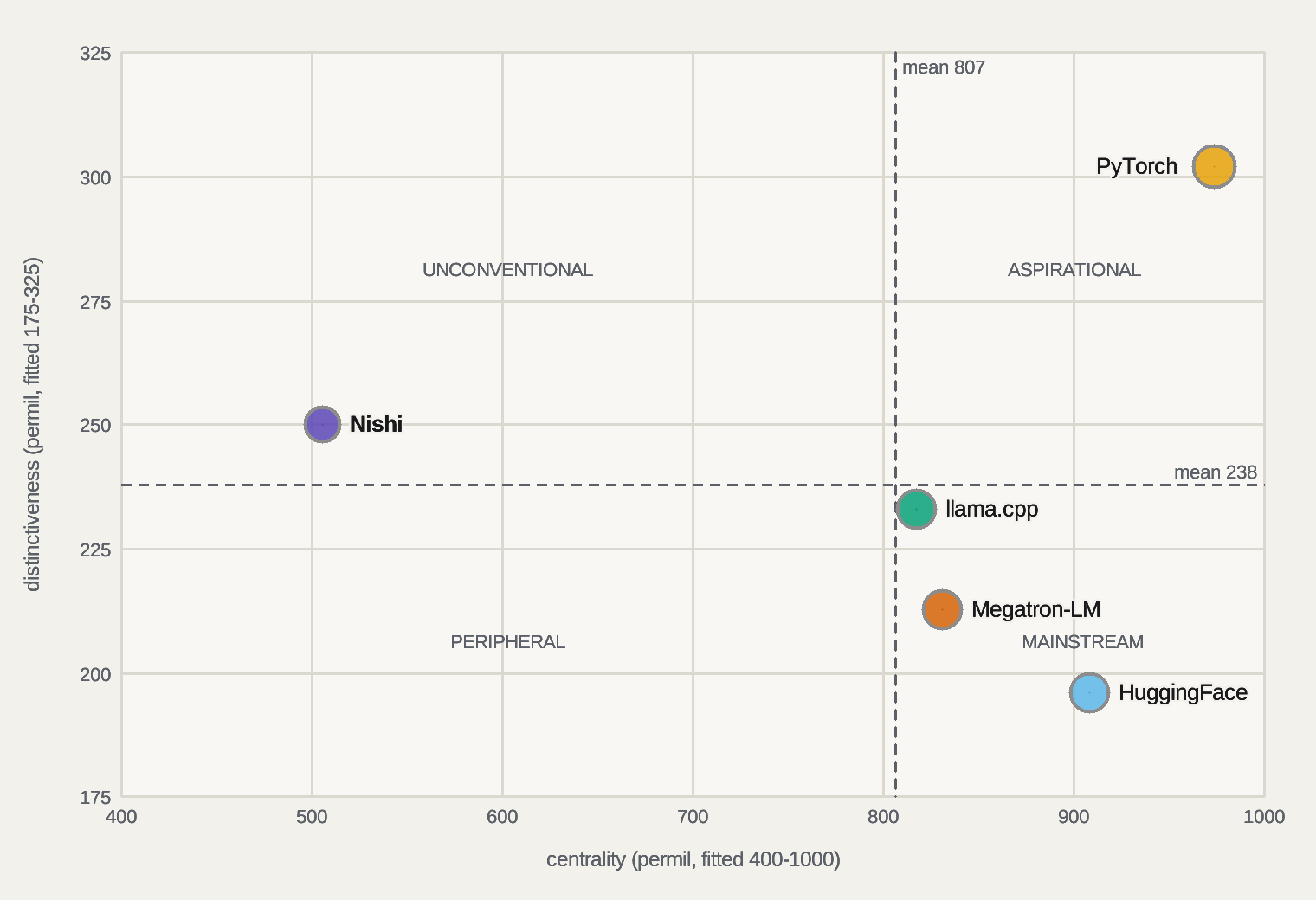
The four-quadrant map the field uses for brand strategy (Dawar and Bagga, HBR June 2015), re-derived from this matrix on every publish. Centrality is the share of the category's feature mass a player covers, each feature weighted by how many hold it; distinctiveness is the average lead over each rival on the rows the player holds; breadth is the depth-weighted share of the whole matrix (the bubble); depth is how deeply the rows held are held; momentum is the day-over-day move off the spine (green rising, red falling, grey until day two); the dashed path runs first day → previous day → today. Dividers are the category means. Axes are fitted to the field of play, so read the tick numerals, not the frame. Rival marks are documented presence, so a rival's position reads the record, never its quality. The picture grades its own readability below; the table beside it is the same data for a screen reader or a second method.
knowledge/compare/modelwright.cdmap (cut|x|y, cube|x|y|z); absent = the HBR defaultsbubble area = breadth · ring = momentum (green rising, red falling, grey until day two) · dashed = category means · axes fitted to the field of play: centrality 400–1000, distinctiveness 175–325 of 0–1000 permil (the full range put every player in one corner)
readability of the 2D cut, self-graded by the layout ruler: label overlaps 0 · labels over marks 0 · off-canvas 0 · unresolved labels 0 · mark overlaps 0 (a fact of the data: two players that close are that close) · data spread 743 permil of the plot · quadrant words unseated 0
text contrast, measured with wcag2-ratio (floors from contrast.conf), light theme: labels 16.24 (floor 4.50) · notes 16.24 (floor 4.50) · quadrant words 5.89 (floor 4.50) · tick numerals 5.89 (floor 4.50) · axis titles 5.59 (floor 4.50) · dark theme: labels 13.78 (floor 4.50) · quadrant words 5.55 (floor 4.50) · axis titles 5.97 (floor 4.50) · dark classes under their floor 0 (one figure serves both themes: a dark shortfall is a token to fix, never a class to hide) · classes refused under their floor 0 (a refused class is not drawn; the scale classes are measured, never hidden) · export: SVG PNG (receipt, rendered by the estate's own rasteriser from this page)

readability of the 3D cube, self-graded by the layout ruler: label overlaps 0 · labels over marks 0 · off-canvas 1 · unresolved labels 0 · mark overlaps 0 (a fact of the data: two players that close are that close) · data spread 322 permil of the plot
10 panels over 5 registered axes, every pair once (the lower axis on x, the higher on y) · each panel fitted to its own field of play, first and last tick numerals shown · no labels in a small cut, the legend names the colours; the grade below reports the mark terms only (MM summed over the panels, spread averaged)
readability of the small multiples, self-graded by the layout ruler: label overlaps 0 · labels over marks 0 · off-canvas 0 · unresolved labels 0 · mark overlaps 2 (a fact of the data: two players that close are that close) · data spread 565 permil of the plot
| Player | Quadrant | centrality | distinctiveness | breadth | depth | momentum | Rows held | Days on spine | First seen |
|---|---|---|---|---|---|---|---|---|---|
| Nishi | Unconventional | 506 | 250 | 349 | 733 | 0 since 2026-09-23 | 10 | 10 | 2026-09-15 |
| PyTorch | Aspirational | 974 | 302 | 714 | 789 | 0 since 2026-09-23 | 19 | 10 | 2026-09-15 |
| HuggingFace | Mainstream | 909 | 196 | 555 | 686 | 0 since 2026-09-23 | 17 | 10 | 2026-09-15 |
| llama.cpp | Mainstream | 818 | 233 | 555 | 777 | 0 since 2026-09-23 | 15 | 10 | 2026-09-15 |
| Megatron-LM | Mainstream | 831 | 213 | 507 | 666 | 0 since 2026-09-23 | 16 | 10 | 2026-09-15 |
| Day | Matrix rows reviewed | Players recorded |
|---|---|---|
| 2026-09-15 | 21 | 5 |
| 2026-09-16 | 21 | 5 |
| 2026-09-17 | 21 | 5 |
| 2026-09-18 | 21 | 5 |
| 2026-09-19 | 21 | 5 |
| 2026-09-20 | 21 | 5 |
| 2026-09-21 | 21 | 5 |
| 2026-09-22 | 21 | 5 |
| 2026-09-23 | 21 | 5 |
| 2026-10-08 | 21 | 5 |
players 5|matrix rows 21|feature mass 77|centrality mean 807|distinctiveness mean 238|axes 5|spine days 10 (shown 10)|rows written today 0|readability defects 2D 0 cube 1|spine knowledge/status/cdmap/modelwright.spine
Capability matrix — measured against source
◉ authored stronger claim; source present● present◐ partial○ absent? unassessed; excluded from relative comparison · click any capability for its evidence
Peer cell coverage: authored assessed 84, unassessed 0. Authored assessments are not verified outcomes.
No capabilities match this filter or search.
| Capability | Nishi | PyTorch | HuggingFace | llama.cpp | Megatron-LM |
|---|---|---|---|---|---|
Reverse-mode autodiff training substrateMeasured:ta_new exists in runtime/nx_autograd_tensor.nx, verified at emit. Tensor reverse-mode autograd; the first sovereign LM trained from scratch beat the analytic midpoint bit-exact (role scorecard MODELWRIGHT, 2026-06-10); PyTorch autograd is the bar [pytorch-autograd] Adoption: SOURCE-ONLY — PARTIAL: source exists, never compiled: /api/build it.Pros Implementing source symbol found; runtime acceptance separate; ahead of llama.cppCons behind PyTorch (leads); not adopted yet: source exists, never compiled: /api/build it | ● | ◉ | ● | ○ | ● |
Transformer forward (100 percent integer no-float)Measured:qmul exists in runtime/nx_nofloat_llm.nx, verified at emit. The core forward every model has, done with zero floating point rival marks uncited — the Yes, Best or Part codes on this row are an observation read with no reference mark behind them Adoption: LIB-WIRED importers=34 nonval=8 — fully adopted (top of its ladder).Pros Implementing source symbol found; runtime acceptance separate; fully adopted on the estate ladderCons none on the measured axes (rival marks are documented presence, not depth) | ● | ● | ● | ● | ● |
BPE tokenizer trainingMeasured:nx_bpe_vocab_new exists in runtime/nx_bpe.nx, verified at emit. Own byte-pair tokenizer + vocab training rival marks uncited — the Yes, Best or Part codes on this row are an observation read with no reference mark behind them Adoption: SOURCE-ONLY — PARTIAL: source exists, never compiled: /api/build it.Pros Implementing source symbol found; runtime acceptance separateCons not adopted yet: source exists, never compiled: /api/build it | ● | ● | ● | ● | ● |
Integer K-quant weightsMeasured:nx_q4k_dot_row_col exists in runtime/nx_q4k_matmul.nx, verified at emit. Q4-K dot kernels; llama.cpp K-quants are the CPU bar [llamacpp]; TRT/Megatron are GPU-float Adoption: LIB-WIRED importers=15 nonval=9 — fully adopted (top of its ladder).Pros Implementing source symbol found; runtime acceptance separate; ahead of Megatron-LM; fully adopted on the estate ladderCons behind llama.cpp (leads) | ● | ● | ● | ◉ | ○ |
SIMD integer GEMMMeasured:i32x8_hsum exists in runtime/nx_nofloat_gemm.nx, verified at emit. AVX2 integer GEMM (7x pooled); the field's GEMM is float/cuBLAS rival marks uncited — the Yes, Best or Part codes on this row are an observation read with no reference mark behind them Adoption: LIB-GATE-ONLY importers=3 — PARTIAL: imported only by validation organs (gates, tests, benches): wire it into a shipping program.Pros Implementing source symbol found; runtime acceptance separateCons behind PyTorch (leads), llama.cpp (leads); not adopted yet: imported only by validation organs (gates, tests, benches): wire it into a shipping program | ● | ◉ | ● | ◉ | ● |
Open-weights GGUF loadingMeasured:nx_gguf_load_model_weights exists in runtime/nx_gguf_load_model.nx, verified at emit. Real Qwen2.5-0.5B loads and greedy-matches the float reference 4-for-4 (2026-07-09); llama.cpp is the GGUF home rival marks uncited — the Yes, Best or Part codes on this row are an observation read with no reference mark behind them Adoption: LIB-WIRED importers=2 nonval=1 — fully adopted (top of its ladder).Pros Implementing source symbol found; runtime acceptance separate; fully adopted on the estate ladderCons behind PyTorch (leads), HuggingFace (leads), llama.cpp (leads) | ● | ◉ | ◉ | ◉ | ● |
Served chat API (OpenAI-shaped)Measured:ls_extract_prompt exists in runtime/nx_f32_llm_serve.nx, verified at emit. Sovereign seat on :11434 serving real Qwen; vLLM/llama.cpp lead production serving rival marks uncited — the Yes, Best or Part codes on this row are an observation read with no reference mark behind them Adoption: RUN-BY:daemon — fully adopted (top of its ladder).Pros Implementing source symbol found; runtime acceptance separate; ahead of Megatron-LM; fully adopted on the estate ladderCons behind HuggingFace (leads), llama.cpp (leads) | ● | ● | ◉ | ◉ | ○ |
Attention and layernorm forwardMeasured:nx_attn_score_matrix exists in runtime/nx_attention.nx, verified at emit. Score-matrix attention + softmax; the transformer core rival marks uncited — the Yes, Best or Part codes on this row are an observation read with no reference mark behind them Adoption: LIB-WIRED importers=8 nonval=5 — fully adopted (top of its ladder).Pros Implementing source symbol found; runtime acceptance separate; fully adopted on the estate ladderCons none on the measured axes (rival marks are documented presence, not depth) | ● | ● | ● | ● | ● |
Large-scale pretraining (billions of params, trillions of tokens)Open — watchingruntime/nx_pretrain_scale.nx : ps_run, re-measured on every compare beat. Ship that symbol and this mark flips itself; the comparewatch- plane row flips with it. Megatron/PyTorch FSDP pretrain frontier models; ours is a toy LM rival marks uncited — the Yes, Best or Part codes on this row are an observation read with no reference mark behind themPros none measured yetCons behind PyTorch (leads), HuggingFace, llama.cpp, Megatron-LM; open contract; expected source declaration not established | ○ | ◉ | ● | ● | ◐ |
GPU / CUDA trainingOpen — watchingruntime/nx_gpu_train.nx : gpu_train_step, re-measured on every compare beat. Ship that symbol and this mark flips itself; the comparewatch- plane row flips with it. CUDA/ROCm training is the bar; Nishi trains CPU-integer by design today rival marks uncited — the Yes, Best or Part codes on this row are an observation read with no reference mark behind themPros none measured yetCons behind PyTorch (leads), llama.cpp, Megatron-LM; open contract; expected source declaration not established | ○ | ◉ | ○ | ● | ◐ |
Distributed tensor-parallel trainingOpen — watchingruntime/nx_tensor_parallel.nx : tp_shard, re-measured on every compare beat. Ship that symbol and this mark flips itself; the comparewatch- plane row flips with it. Megatron-LM 3D parallelism is the bar [megatron-lm]; Nishi single-processPros none measured yetCons behind PyTorch, Megatron-LM (leads); open contract; expected source declaration not established | ○ | ● | ○ | ○ | ◉ |
Instruction fine-tuning (SFT) pipelineOpen — watchingruntime/nx_sft.nx : sft_run, re-measured on every compare beat. Ship that symbol and this mark flips itself; the comparewatch- plane row flips with it. HuggingFace TRL SFTTrainer is the bar [trl]; no SFT loop herePros none measured yetCons behind PyTorch, HuggingFace, Megatron-LM; open contract; expected source declaration not established | ○ | ● | ◐ | ○ | ● |
RLHF / DPO preference alignmentOpen — watchingruntime/nx_dpo.nx : dpo_step, re-measured on every compare beat. Ship that symbol and this mark flips itself; the comparewatch- plane row flips with it. TRL DPO/PPO alignment is the bar [trl] [dpo2023]; the models run un-alignedPros none measured yetCons behind PyTorch, HuggingFace, Megatron-LM; open contract; expected source declaration not established | ○ | ● | ◐ | ○ | ● |
LoRA / parameter-efficient fine-tuningOpen — watchingruntime/nx_lora.nx : lora_apply, re-measured on every compare beat. Ship that symbol and this mark flips itself; the comparewatch- plane row flips with it. PEFT/LoRA adapters are the bar [lora2021]; absent herePros none measured yetCons behind PyTorch, HuggingFace, llama.cpp, Megatron-LM; open contract; expected source declaration not established | ○ | ● | ◐ | ● | ● |
Standardized eval harness (MMLU / HumanEval)Open — watchingruntime/nx_eval_harness.nx : eh_run, re-measured on every compare beat. Ship that symbol and this mark flips itself; the comparewatch- plane row flips with it. lm-eval-harness is the field standard [lm-eval-harness]; ours is qabench (referee census) not a model-eval harnessPros none measured yetCons behind PyTorch, HuggingFace (leads), llama.cpp, Megatron-LM; open contract; expected source declaration not established | ○ | ● | ◉ | ● | ● |
Flash-attention / fused training kernelsOpen — watchingruntime/nx_flash_attn.nx : fa_fused, re-measured on every compare beat. Ship that symbol and this mark flips itself; the comparewatch- plane row flips with it. FlashAttention fused kernels are the bar [flashattn2022]; ours is a plain score matrixPros none measured yetCons behind PyTorch (leads), HuggingFace, llama.cpp, Megatron-LM; open contract; expected source declaration not established | ○ | ◉ | ● | ● | ◐ |
Mixture-of-experts trainingOpen — watchingruntime/nx_moe_train.nx : moe_train_step, re-measured on every compare beat. Ship that symbol and this mark flips itself; the comparewatch- plane row flips with it. Sparse MoE training (Megatron/DeepSpeed); Nishi dense-only rival marks uncited — the Yes, Best or Part codes on this row are an observation read with no reference mark behind themPros none measured yetCons behind PyTorch, HuggingFace, llama.cpp, Megatron-LM (leads); open contract; expected source declaration not established | ○ | ● | ● | ● | ◉ |
Competitive train and inference speedOpen — watchingruntime/nx_train_speed.nx : ts_bench, re-measured on every compare beat. Ship that symbol and this mark flips itself; the comparewatch- plane row flips with it. Measured 2.4 tok/s CPU decode = 8-25x behind llama.cpp-class; GPU stacks train orders faster rival marks uncited — the Yes, Best or Part codes on this row are an observation read with no reference mark behind themPros none measured yetCons behind PyTorch (leads), HuggingFace, llama.cpp (leads), Megatron-LM (leads); open contract; expected source declaration not established | ○ | ◉ | ● | ◉ | ◉ |
Model hub and distributionOpen — watchingruntime/nx_model_hub.nx : mh_publish, re-measured on every compare beat. Ship that symbol and this mark flips itself; the comparewatch- plane row flips with it. HuggingFace Hub is the bar [hf-transformers]; our models live on the NAS, not a public hubPros none measured yetCons behind PyTorch, HuggingFace (leads), llama.cpp; open contract; expected source declaration not established | ○ | ● | ◉ | ● | ○ |
100 percent integer no-float train and inference (bit-exact reproducible by construction)Source present; authored stronger claim:qmul in runtime/nx_nofloat_llm.nx, verified at emit. A 100 percent integer LLM greedy-matches the float reference 4-for-4 and reproduces bit-identically on any CPU; the entire field is float and nondeterministic across runs/hardware Adoption: LIB-WIRED importers=34 nonval=8 — fully adopted (top of its ladder).Pros Source symbol found; stronger capability claim is authored; ahead of PyTorch, HuggingFace, llama.cpp, Megatron-LM; fully adopted on the estate ladderCons none on the measured axes (rival marks are documented presence, not depth) | ◉ | ○ | ○ | ○ | ○ |
Sovereign whole training-and-serving loop (own language, compiler, kernels; zero PyTorch/CUDA/BLAS)Source present; authored stronger claim:ta_new in runtime/nx_autograd_tensor.nx, verified at emit. Train + quantize + serve entirely on our own stack bits-up; PyTorch/Megatron sit on CUDA + cuBLAS, llama.cpp on foreign C++ toolchain -- our brain runs on OUR substrate, the literal own-the-loop Adoption: SOURCE-ONLY — PARTIAL: source exists, never compiled: /api/build it.Pros Source symbol found; stronger capability claim is authored; ahead of PyTorch, HuggingFace, llama.cpp, Megatron-LMCons not adopted yet: source exists, never compiled: /api/build it | ◉ | ○ | ○ | ○ | ○ |
| Class | Count | Note |
|---|---|---|
| rows with rival marks | 19 | rows carrying a Yes, Best or Part in a rival column |
| cited | 9 | a reference mark resolves to a pinned mirror |
| uncited | 10 | an observation read, badged until a reference lands |
| rows, summed | 19 | RECONCILED: the parts sum to the total 19 |
Delivery and evidence
Inspect risks, technical debt, rendered observations, experiments and references. Read scope and limitations alongside every result.
Person · product · place — not yet measured for this domain
knowledge/compare/modelwright.ppp (rows surface|nishi or c1..c4|label|url|connect naming OUR live surface and each rival's front door), run nx_ppp_probe domain modelwright, and this section fills itself on the next beat: the same ruler on both sides — privacy and CX (third-party hosts, tracker classes, cookies, security headers), design and longevity (design hygiene, computed WCAG contrast, render-blocking resources, unsized media, script weight, theme and motion queries), findability (landmarks, skip link, on-site search, breadcrumb, headings, internal links).The field — discovered, not chosen
Rows written by nx_field_discover from modelwright.seeds: the industry's own lists (Wikipedia wikitext, GitHub topics, awesome lists) read mechanically, every candidate counted across seeds. The matrix columns above are a SEAT'S pick; this band is the population they were picked from, and the stats line measures one against the other. A rival here is a lead, never a verdict — it earns a column when its capabilities are read and pinned.
| Class | Count | Note |
|---|---|---|
| seeds | 4 | |
| scanned | 4 | |
| fetched | 4 | |
| reused | 0 | |
| failed | 0 | |
| named | 4 | |
| candidates | 4 | |
| mentions | 4 | |
| capped | 0 |
| Rank | Rival | Seeds | Mentions | First seed | Kind | Link |
|---|---|---|---|---|---|---|
| 1 | PyTorch | 1 | 1 | col0-pytorch | named | https://pytorch.org/docs/2.13/autograd.html |
| 2 | HuggingFace | 1 | 1 | col1-huggingface | named | https://huggingface.co/docs/transformers/index |
| 3 | llama.cpp | 1 | 1 | col2-llama | named | https://github.com/ggml-org/llama.cpp |
| 4 | Megatron-LM | 1 | 1 | col3-megatron | named | https://github.com/NVIDIA/Megatron-LM |
field candidates 4|shown 4 of 4|matrix columns in the field 4 of 4|discovered rivals with no column 0|malformed rows 0 (counted, never rendered)|read-capped 0
Exclusive and shared capabilities
This board grades 19 capabilities: 10 exclusive to it and 9 shared with other boards. Shared rows on this page: 9 = home here 0 + home elsewhere 4 + ambiguous 1 + undecided 4 + refused 0 (partition 9); undecided = unmapped 0 + unproven 4 + unevidenced 0; homonyms 0; since the previous census: new 0, resolved 0. Census FRESH age_s=6518.
| Capability | Organ | Boards grading it | Home | Rule | Evidence | Standing on this board |
|---|---|---|---|---|---|---|
| qmul | nx_nofloat_llm.nx | llm*, lang, modelwright | llm | rung | plan | home elsewhere adopt: @xrow llm|qmul|home by rung (fleet duplicate census) |
| nx_attn_score_matrix | nx_attention.nx | llm, modelwright | — | none | unproven | undecided |
| nx_bpe_vocab_new | nx_bpe.nx | llm, modelwright | — | none | unproven | undecided |
| nx_gguf_load_model_weights | nx_gguf_load_model.nx | llm, modelwright | — | none | unproven | undecided |
| nx_q4k_dot_row_col | nx_q4k_matmul.nx | llm*, modelwright | llm | rung | plan | home elsewhere adopt: @xrow llm|nx_q4k_dot_row_col|home by rung (fleet duplicate census) |
| i32x8_hsum | nx_nofloat_gemm.nx | llm*, modelwright | llm | rung | plan | home elsewhere adopt: @xrow llm|i32x8_hsum|home by rung (fleet duplicate census) |
| ls_extract_prompt | nx_f32_llm_serve.nx | llm*, modelwright | llm | rung | plan | home elsewhere adopt: @xrow llm|ls_extract_prompt|home by rung (fleet duplicate census) |
| ta_new | nx_autograd_tensor.nx | llm, modelwright | — | none | unproven | undecided |
| sft_run | nx_sft.nx | modelwright*, engineshift* | — | ambiguous | plan | ambiguous |
Gaps from the record — what the estate does that no board carries
The record census (nx_goalmap record) reads the invoked-tool population and every plan queue row and files each organ or directive that NO matrix, plan or gates row names. A row here is a callout the boards missed: adjudicate it onto a board or declare it infrastructure. Census state STALE (age 1395623 s), sources read 4 of 7 declared — a BLIND census is a FLOOR: unread sources can only add rows.
| kind | name | board | source | evidence |
|---|
rows shown 0|this board's directives 0|estate-wide un-boarded organs 452 (listed in full on /compare/ecosystem)|census rows 639|malformed 0 (counted, never rendered)
References
- [pytorch-autograd] PyTorch. Automatic differentiation package -- torch.autograd. PyTorch 2.13 documentation. Accessed August 2026. publisher · read in our library
knowledge/fetched/cmp_modelwright_pytorch-autograd.html· pinh6a11d941924bc30f6b0bda0181b07a7df63c84650e9bd97e7efd0b8408c14c6f· accessed 2026-08-18 · vendor-docGrounds: The PyTorch column and the BARS line (PyTorch v2.13.0): the Reverse-mode autodiff training substrate row (PyTorch autograd is the bar nx_autograd_tensor is graded against) and the GPU / CUDA training and Large-scale pretraining cells where PyTorch reads Best. - [hf-transformers] Hugging Face. Transformers documentation (state-of-the-art pretrained models for inference and training; the Hub-backed model library). Accessed August 2026. publisher · read in our library
knowledge/fetched/cmp_modelwright_hf-transformers.html· pinh6047febd65c25a6bd5744107f0f82c0b62517dd6e709469431bdb7f1d431b8d5· accessed 2026-08-18 · vendor-docGrounds: The HuggingFace column and the BARS line (Transformers v5.13.0): Model hub and distribution Best (HuggingFace Hub is the bar; our models live on the NAS), Open-weights GGUF loading and Served chat API cells, and the Standardized eval harness column code. - [trl] Hugging Face. TRL -- Transformer Reinforcement Learning: SFTTrainer, DPOTrainer, PPO/GRPO and reward-model training documentation. Accessed August 2026. publisher · read in our library
knowledge/fetched/cmp_modelwright_trl.html· pinhdd3f645f67ca35d24e6f7dd736e2000cb9377df1a052a59c362553e494e519c8· accessed 2026-08-18 · vendor-docGrounds: The BARS line (TRL v1.8.0) and two absent rows: Instruction fine-tuning (SFT) pipeline (HuggingFace TRL SFTTrainer is the bar; no SFT loop here) and RLHF / DPO preference alignment (TRL DPO/PPO alignment is the bar; the models run un-aligned). - [llamacpp] ggml-org. llama.cpp: LLM inference in C/C++ (project README, GitHub). Accessed August 2026. publisher · read in our library
knowledge/fetched/cmp_llm_llamacpp.html· pinh8f4ccd064eee25e9c5294a49af67e94126cf3c7c21070677fc7c0eb55eb8a1a0· accessed 2026-08-18 · vendor-docGrounds: The llama.cpp column and BARS line: Integer K-quant weights Best (llama.cpp K-quants are the CPU bar), Open-weights GGUF loading (llama.cpp is the GGUF home), SIMD integer GEMM Best, and the Competitive train and inference speed row (measured CPU decode 8-25x behind llama.cpp-class). - [megatron-lm] NVIDIA. Megatron-LM and Megatron Core: GPU-optimized library for training transformer models at scale -- tensor, pipeline, sequence, context and expert parallelism (project README, GitHub). Accessed August 2026. publisher · read in our library
knowledge/fetched/cmp_modelwright_megatron.html· pinh20fd935ac0734062eec78ab73cfcfbcb93946803031f531a893f73e68aa4a163· accessed 2026-08-18 · vendor-docGrounds: The Megatron-LM column and BARS line: Distributed tensor-parallel training (Megatron-LM 3D parallelism is the bar; Nishi single-process), Large-scale pretraining (Megatron/PyTorch FSDP pretrain frontier models) and Mixture-of-experts training (sparse MoE training, Megatron/DeepSpeed). - [lora2021] Hu, Shen, Wallis, Allen-Zhu, Li, Wang, Wang, Chen. LoRA: Low-Rank Adaptation of Large Language Models. ICLR 2022. arXiv:2106.09685. publisher · read in our library
knowledge/fetched/cmp_modelwright_lora2021.html· pinh70bb70b4fd6d41b8a0f53fc5148017bf6ef5b73acba822027397f861aee135c6· accessed 2026-08-18 · published-paperGrounds: The LoRA / parameter-efficient fine-tuning row (PEFT/LoRA adapters are the bar; absent here) and the verdict line naming no LoRA as a scale gap: this paper defines the low-rank adapter the nx_lora contract would implement. - [dpo2023] Rafailov, Sharma, Mitchell, Ermon, Manning, Finn. Direct Preference Optimization: Your Language Model is Secretly a Reward Model. NeurIPS 2023. arXiv:2305.18290. publisher · read in our library
knowledge/fetched/cmp_modelwright_dpo2023.html· pinhc213a47bb5c67ad1983741bec43fc5e6ab252ae9737bd3e6c8daa2edbf5a3fe3· accessed 2026-08-18 · published-paperGrounds: The RLHF / DPO preference alignment row: DPO is the reward-model-free preference objective TRL ships as DPOTrainer, i.e. the alignment bar the nx_dpo contract is named after; the models run un-aligned today. - [flashattn2022] Dao, Fu, Ermon, Rudra, Re. FlashAttention: Fast and Memory-Efficient Exact Attention with IO-Awareness. NeurIPS 2022. arXiv:2205.14135. publisher · read in our library
knowledge/fetched/cmp_modelwright_flashattn2022.html· pinh070112e924e64cb514df26ecf174263f5d3343560438a88086d4a7c478547f64· accessed 2026-08-18 · published-paperGrounds: The Flash-attention / fused training kernels row (FlashAttention fused kernels are the bar; ours is a plain score matrix) and the Attention and layernorm forward row it is measured beside -- IO-aware tiling is what nx_attention lacks. - [lm-eval-harness] EleutherAI. Language Model Evaluation Harness: a unified framework for few-shot evaluation of language models (MMLU, HumanEval-class tasks, 60+ benchmarks; project README, GitHub). Accessed August 2026. publisher · read in our library
knowledge/fetched/cmp_modelwright_lm-eval.html· pinhb67a0fef3d08e781f2a2093997dde3f809f793714a5638dc0355a6823dfd4455· accessed 2026-08-18 · vendor-docGrounds: The Standardized eval harness (MMLU / HumanEval) row: lm-eval-harness is the field standard the nx_eval_harness contract is measured against; ours is qabench (referee census), not a model-eval harness.
generated by nx_swcompare_matrix (sovereign NishiLang organ) from knowledge/compare/modelwright.matrix · source checks show implementation presence; runtime and user-outcome evidence are reported separately · JavaScript supports page controls