Nishi Family › Compare › Anatomical Ground Truth and Provenance
Nishi Compare · capabilities, evidence and delivery
Anatomical Ground Truth and Provenance
Compare capabilities and delivery evidence. Source discovery, qualification, deployment and accepted outcomes are separate; an open contract names work still to verify.
Nishi vs Z-Anatomy and the AnatomyTOOL Open 3D Model and the NLM Visible Human Project and BioDigital and SciePro -- not who renders a body best, but what anyone is measuring against and whether they may lawfully keep the result. Measured 2026-08-25 across 22 axes: 12 are grounded in a named function that exists today and 10 are watch contracts naming a symbol nobody has written. Zero rows claim an exceed. What we own is a pair of geometry rulers, a feature registry and a licence verdict organ that has never been invoked; what we do not own is a lexicon, a structure identity, a review ledger, a coverage account against a reviewed atlas, voxel ground truth, or any mechanism that keeps a share-alike obligation from reaching a shipped mesh.
Overview
The purpose, declared position and evidence coverage of this domain. Source presence and completed acceptance are different measures.
Where we are. Measured 2026-08-25, not asserted, and the honest headline is that this estate has anatomy GEOMETRY and no anatomy GROUND TRUTH. WORKING: two real geometry rulers -- a silhouette and normal-field bench with a subdivision-proof detail judge, and an exact point-to-triangle millimetre deviation ruler over every vertex in both directions; an eight-system internal renderer with peel, explode and stereo; a forward-kinematic rig with bit-identical replay on the 662k-triangle BodyParts3D skeleton; a pose-legality verdict answered before render; a feature registry with bone anchors and sliders; a placement check for surface features; a figure-readability critic; and a licence shippability organ with three named exits including a REVIEW state that refuses to settle a human decision. OPEN, and this is the whole story: every one of those rulers compares a mesh with a mesh. Nothing in the estate can say that a structure IS the structure it claims to be, nothing joins a generated part to a published anatomical name, nothing records who reviewed what against which atlas, nothing accounts for which anatomical regions are covered, and nothing can read cadaver voxel data at all. The token Terminologia and the token Visible Human are both ABSENT-PROVEN across the entire compare corpus with corpus_complete=1. And the single oracle everything is measured against is one whose successors, staffed by university anatomists, changed an estimated 70 percent of all shapes when they reviewed it for anatomical correctness.
Where we need to go. Anatomical claims this estate publishes must be TRUE, NAMED and LAWFUL -- true because they are scored against more than one independently sourced atlas and carry the disagreement between those atlases as a stated uncertainty, named because every generated structure joins to a published anatomical nomenclature rather than to our private vocabulary, and lawful because every reference dataset carries a pinned licence row and a mechanical fence that keeps a share-alike obligation from ever reaching a shipped mesh. Z-Anatomy, the AnatomyTOOL Open 3D Model, the Visible Human Project, BioDigital and SciePro appear ONLY as oracles and benchmarks, never as dependencies and never as product -- the rule this estate already states in prose and does not yet enforce with an organ.
Research bar. AnatomyTOOL Open 3D Model (Leiden UMC and partners, CC BY-SA) is measured on THE bar for this board and the closest thing in the world to what we should be measuring against: an open-source free 3D model of human anatomy built by the anatomy departments of Leiden UMC, UMC Utrecht, Maastricht UMC and KU Leuven KULAK with anatomists from Amsterdam UMC location VUmc, Radboud UMC Nijmegen and the University of Gent, funded by an initial grant from the Dutch Ministry of Education Culture and Science, built on the BodyParts and Z-Anatomy predecessors, retopologized throughout, and reviewed structure by structure by one to three anatomists against Moore, Gray, Netter, Prometheus and Terminologia. Theirs: primary page and about page fetched pinned and read 2026-08-25 [anatomytool] [o3dabout]. Ours: It is ahead of us on every axis this board measures and it is also the most adoptable, because it is openly licensed and it is the direct successor of the oracle we already use. Our opening is not content, it is that they publish an atlas and we can build an instrument: nobody in this list scores a subject against their model and reports a bounded error..
Research bar. Z-Anatomy (CC BY-SA model, GPL3 viewer) is measured on the first open-source 3D atlas of human anatomy -- BodyParts3D restructured and republished with structures added, meshes retopologized, vessels and nerves converted to curves and material properties applied, intended for use in Blender and later given a browser viewer. Theirs: the site itself is a Unity WebGL shell and is cited for existence and self-description ONLY [zanatomy]; its substance here is taken from the successor project's about page which describes its provenance licence and intent [o3dabout]. Ours: The provenance link that matters to us: it sits directly between the oracle we use and the bar above it, and it is share-alike, so adopting anything downstream of it inherits the obligation AN2 exists to contain..
Research bar. NLM Visible Human Project (US public domain) is measured on cryosection CT and MRI data from one male and one female cadaver -- the male at 1 mm axial intervals over 1871 cross-sections at 0.33 mm pixels and about 15 GB, the female at 0.33 mm Z spacing giving cubic voxels over 5189 images and about 40 GB; the page carries DC.Rights Public Domain and records that as of 2019 a license is no longer required to access the datasets. Theirs: primary NLM page fetched pinned and read 2026-08-25 [visiblehuman]. Ours: THE ONE SOURCE ON THIS BOARD WITH NO SHARE-ALIKE OBLIGATION AT ALL, and the only one that is not an interpretation. It is the correct ground truth for any claim we want to make without a viral licence attached, and we cannot read it today..
Research bar. BioDigital Human (commercial platform) is measured on a commercial platform for visualizing anatomy disease and treatment across web mobile VR and AR with developer toolkits, self-reporting over 1000 mapped health conditions and over 100 million health conversations powered. Theirs: vendor front page fetched pinned and read 2026-08-25 [biodigital]. Ours: The bar for AN9 pathology breadth and for productised delivery. Not adoptable and not a dependency; it is the demonstration that condition-level anatomy is a product category we have no representation of..
Research bar. SciePro (commercial anatomy model library) is measured on a ready-to-license medical 3D anatomy library founded in 2005 by medical illustrator Sebastian Kaulitzki, covering male and female anatomy, body types and ethnic variants, pregnancy anatomy and fetuses, juvenile anatomy and pathology and conditions, with models reviewed by medical experts and one-time licensing. Theirs: vendor front page fetched pinned and read 2026-08-25 [sciepro]. Ours: The bar for AN10 lifespan and sex coverage and the reminder that expert review is a commercial differentiator others charge for. Named deliberately so no row here reads open-licence as a quality win..
Research bar. 4DDT 2026 workshop is measured on the field's framing of a digital twin as real-to-sim-to-real for physical AI [@4ddt2026]. Theirs: UNPINNED -- a workshop page with no version feed, declared. Ours: ours is an atlas-fed generator with physics organs unbound to any twin state; AN9-AN12 name the distance.
Latest recorded release
2026-09-27 · BOARD
2026-09-27: the government tier (DARPA VITAL, EU Virtual Human Twins, NIH) and the vendor tier (MetaHuman 5.8 notes) landed as dated bars with mirrored bytes; T-BIC-HUMAN is relinked from SB-MH-2606 to SB-MH-2609 the same session.
Release entries describe recorded changes; they do not establish that every capability passed evaluation.
14 of 31 capability source symbols found|0 of them authored stronger-claims|17 open|coverage 451/1000|adoption 6 full / 8 partial
Evidence profile — what the gaps on this board actually are
Measured by nx_swcompare_evidence, read back by nx_evprofile_lib. Every figure is a count with its denominator — there is deliberately no score, no grade and no percentage anywhere in this band, because a stored scalar is a field a seat can edit and a counted partition is not.
evidence|grounded 14/14|unsupported 0|gates green 4/4|proven able to fail 4/4|never bitten 0|green at 0/0 0|open gaps 17|of them unnamed 0|of them proof withheld 0|flips ready 1
proven able to fail counts the gates that have a RECORDED RED — nx_gate_bite mutated the gate subject, rebuilt it, watched the gate go red, and that record is inside the shared TTL. never bitten is its complement over the same denominator: those gates ran and were green, and nothing has ever shown them able to detect anything, so their green is a statement about this run and not about the gate. green at 0/0 is a separate and much weaker observation — the gate printed GREEN on a zero denominator, so its own tooth counter says it examined nothing. A gate can be green, non-zero, and still never bitten; that is the common case and it is now visible instead of implied.
partition: grounded + unsupported = 14 vs present 14 · named + unnamed + withheld = 17 vs open 17 · both reconcile
liar-kill conj=GPQN · all four conjuncts held
graded document: BUILDROOT tree, 22467 bytes · gates map: PRIMARY · stamped 0d 7h ago · source ../knowledge/status/evstamp_anatomy.verdict
| Gap class | What it is, and the work it names |
|---|---|
| FLIP-READY | A watch contract symbol is now present in the organ it named: the cell can flip on a pure data edit with no new code. These are the cheapest closures on this board and they belong before any new work. |
nx_swcompare_evidence anatomy itself and are not carried on the stamp, so this page names the classes and the producer names the rows. That split is stated rather than hidden: a count without a worklist is not actionable, and this band is honest about which half of that it is.Production map
Follow the dependencies, declared acceptance criteria and recorded priorities. Inspect source binding before treating a rank as executable work.
Ranking source binding: STALE_OR_INVALID_BINDING. Recorded priorities require current acceptance evidence and resource checks before execution.
Recorded ranking withheld
Retained ranking is not bound to the current plan and matrix: STALE_OR_INVALID_BINDING. Historical data remains retained. Refresh the ranking after resolving the input differences. Latest execution outcome is unverified.
Declared roadmap — contract, acceptance, executor, effort
| Rung | Closes with | Definition of done (pre-declared) | Executor | Est. |
|---|---|---|---|---|
| Dataset provenance ledger with a pinned licence per reference dataset (AN1) | lg_dataset_row | Every anatomical dataset the estate measures against gets a row carrying its identifier, the licence as STATED BY A PINNED PRIMARY SOURCE, the mirror and content hash of that source, and the permitted uses -- consumed by the existing nx_licgate_lib rather than by a second table beside it. THE CONCRETE DEFECT THIS CLOSES IS LIVE: graphics.refs and procgen.refs both publish BodyParts3D as CC BY-SA 2.1 JP with mirror and pin left as a dash, the DBCLS archive record pinned by this board states the licence as CC BY with no share-alike term, the successor project's anatomists state CC BY SA, and the original project site serves no licence statement at all. Done-rule: a gate proves that a dataset row whose licence field has no pinned mirror is REFUSED by name rather than defaulting to permissive, that the three-state verdict is preserved so an unsettled licence returns REVIEW and never SHIP_OK, and a neg-control proves a row asserting a licence its own pinned source contradicts is refused. Settling the BodyParts3D disagreement against a primary source is the first row written and the acceptance case. | Organ | 1 u |
| Share-alike containment fence on the emit path (AN2) after AN1 | lg_sharealike_fence | Make the estate's oracle-only-never-product rule MECHANICAL. Today it is prose in a refs note, and prose cannot refuse. The obligation read from the legal code rather than a summary is that if You Share Adapted Material You produce, the Adapter's License You apply must be a Creative Commons license with the same License Elements this version or later or a BY-SA Compatible License -- the trigger is Share, not create, which is exactly why measuring against a share-alike mesh is safe and emitting a derivative of one is not. Done-rule: a gate proves that a mesh whose provenance chain touches a share-alike dataset is REFUSED at the emit and publish path by name, that the SAME mesh is ALLOWED on the measurement path so the fence does not destroy the oracle lane it protects, and a neg-control proves a public-domain-sourced mesh emits clean. The positive control is not optional: a fence that refuses everything passes every negative test, and this estate has already paid for that lesson once. WIRE THE INCUMBENT, DO NOT BUILD A SECOND ONE: nx_licgate_lib is promoted and registered and its verdict has never been invoked. | Organ | 1.5 u |
| Terminologia Anatomica lexicon binding (AN3) | an_ta_bind | Join every named part in the anatomical feature registry to a published anatomical nomenclature entry, so a structure we generate has a name an anatomist recognises, an atlas can be looked up by, and a rival's structure of the same name can be compared with. Terminologia Anatomica is the international standard from FCAT and IFAA published through Thieme in 1998 and carried as TA2 in an open viewer, and it is one of the works the Open 3D Model anatomists checked every structure against. Done-rule: a gate proves every feature row in the registry resolves to exactly one lexicon entry or is reported UNBOUND by name rather than silently skipped, that the bound count and the unbound count SUM to the registry population so the coverage claim is a partition and not a headline, and a neg-control proves an invented name does not resolve. This is the foundational rung and the largest structural lift on the board; AN4 AN6 and AN7 all become expressible only after it. | Organ | 5 u |
| Per-structure identity in the bench rather than whole-mesh shape (AN4) after AN3 | bb_structure_id | Extend the existing bench so it scores NAMED STRUCTURES against named structures instead of one mesh against one mesh -- the difference between our shape agrees with the reference and our gluteus medius agrees with the reference gluteus medius. Compose bb_detail_score and md_measure; build no third ruler, the estate already refused that on dcc. Done-rule: a gate proves a per-structure score is produced for every bound structure, that a structure present in the subject and ABSENT from the oracle is reported as a named absence rather than scoring zero agreement, and an anti-vacuity tooth proves a subject with two structures SWAPPED scores worse than the correct assignment -- a whole-mesh ruler cannot tell those apart and that is precisely the blindness this rung removes. | Organ | 4 u |
| A second independently sourced oracle and the disagreement between oracles (AN5) after AN1,AN2 | bb_multi_oracle | THE RUNG THAT MAKES EVERY FIDELITY NUMBER ON FOUR BOARDS MEAN SOMETHING. Today the estate measures against exactly one anatomical oracle and therefore cannot separate our error from our oracle's error, and the successor project reports changing an estimated 70 percent of BodyParts3D shapes when reviewing them for anatomical correctness. Adopt the AnatomyTOOL Open 3D Model as a second oracle and report the ORACLE-TO-ORACLE disagreement as its own published number beside every subject score. Done-rule: a gate proves a subject is scored against both oracles, that the oracle-to-oracle disagreement is emitted as a distinct figure and is NOT folded into the subject score, and that a subject score quoted without its reference uncertainty is refused at the publish path. THE LICENCE PRECONDITION IS REAL AND IS NOT NEGOTIABLE: the second oracle is CC BY-SA, so this rung must not start before AN1 and AN2, or it doubles the exposure it is meant to make measurable. | Organ | 3 u |
| Region coverage ledger against a reviewed atlas (AN6) after AN3 | ac_region_coverage | Account for which anatomical regions we cover, to what standard, measured against a reference that publishes its own dated coverage -- the Open 3D Model states complete skeleton including skull and upper limb and lower limb in July 2025, pelvis and perineum in December 2025, the inguinal canal in January 2026, and the muscles of thorax abdomen and back in March 2026. We can currently say our renderer loads eight systems and cannot say which regions those cover. Done-rule: a gate proves the covered and uncovered region counts SUM to the declared region population, that a region claimed covered with no bound structure behind it is reported UNGROUNDED rather than counted, and that the ledger names the reference edition it was measured against so the claim cannot silently age. | Organ | 3 u |
| Anatomist review ledger per structure (AN7) after AN3 | ac_review_ledger | Record, per structure, who reviewed it against which reference work and what changed -- the artefact the Open 3D Model publishes and the estate has for nothing. Done-rule: a gate proves every structure carries either a review row or an explicit NOT-REVIEWED marker so the two states are distinguishable, that the reviewed and unreviewed counts sum to the structure population, and that a review row naming a reference work with no pinned citation is refused. THIS IS THE RUNG THAT MAKES A CLINICAL OR EDUCATIONAL CLAIM POSSIBLE AT ALL, and it is deliberately placed after AN3 because a review ledger keyed on private names is worth very little to anyone outside this estate. | Organ | 5 u |
| Cadaver voxel ground truth ingest (AN8) | as_voxel_ingest | Read the Visible Human cryosection CT and MRI stacks -- the only source on this board that is a body rather than an anatomist's reading of one, and the only one carrying no share-alike obligation. Done-rule: a gate proves a declared slice count is read with the read and declared counts reconciling, that the voxel spacing is DERIVED from the dataset rather than assumed so the male 1 mm and female 0.33 mm geometries cannot be silently confused, and that a partial read announces coverage rather than reporting a total. Size is the real constraint and it must be named rather than discovered: roughly 15 GB male and 40 GB female, so the ingest needs a declared and announcing work budget and must not be run on the request path. | Organ | 4 u |
| Pathology and condition variants (AN9) after AN3 | an_pathology_row | Represent a structure that is not canonical -- the axis on which both commercial rivals are strongest and on which we are wholly absent, with BioDigital self-reporting over 1000 mapped conditions and SciePro shipping pathology alongside pregnancy fetal and juvenile anatomy. Done-rule: a gate proves a variant is expressed as a DELTA against a named canonical structure rather than as a separate unrelated mesh, so the variant inherits the canonical structure's lexicon binding and review record, and a neg-control proves a variant whose canonical parent is unbound is refused rather than orphaned. | Organ | 3 u |
| Lifespan and sex-specific internal anatomy in the canon (AN10) after AN3 | bg_lifespan_canon | Extend the anthropometric canon so internal anatomy varies with age and sex rather than modelling one canonical adult. Our canon is parametric, which is architecturally the right shape for this and is the one place this board's future is genuinely better than an atlas that ships fixed meshes. The reference projects carry the opposite constraint and say so: the Open 3D Model is male only and its own about page records that the scanned subject was 22 years old, so epiphysial disks and fusion lines appear in a model intended as adult anatomy. Done-rule: a gate proves a requested age and sex produce internal structures that differ measurably through md_measure, that the difference is monotonic where the underlying anatomy is monotonic, and that a requested combination outside the canon's declared support is REFUSED by name rather than extrapolated in silence. | Organ | 6 u |
Milestones
| Milestone | Rungs | Cumulative |
|---|---|---|
| M1 · We know what we may lawfully use and the fence is mechanical | AN1,AN2 | 2.5 u |
| M2 · A fidelity number that carries its own reference uncertainty | AN5,AN4 | 7 u |
| M3 · Anatomy that is NAMED, covered and reviewed | AN3,AN6,AN7 | 11 u |
| M4 · Ground truth that is a body rather than a reading of one | AN8,AN9,AN10 | 9 u |
| Rung | Closes with | Definition of done (pre-declared) | Executor | Est. |
|---|---|---|---|---|
| A true digital twin is a LOOP, not an atlas: the operator's definition as the bar (AN13) | dt_loop_contract | OPERATOR 2026-09-02, pasted with sources: BodyParts3D is a pre-digital-twin anatomical foundation -- a static mesh of one standardised male, geometric only, generic, with no predictive power -- while a real medical digital twin is dynamic (data feeds from sensors, wearables and updated imaging), physiological (blood flow, metabolic rate, electrical pulses simulated), patient-specific (mapped to one person's anatomy, age and genome) and predictive (virtual trials, surgical response). The field frames it as real-to-sim-to-real [4ddt2026]. Done when this board carries the four axes as MEASURED rows against the estate's own organs (softbody tissue physics, nx_myo, nx_neuro, nx_fascia, nx_derm, nx_bodyfit, nx_realperson), each row coded by what runs today and each gap a watch contract, and the estate's fidelity numbers stop being quoted as twin numbers until AN10-AN12 land | Data | 0.5 u |
| Personalised layered body: bones, organs and skin fitted to ONE consented person (AN14) after AN5 | dt_person_fit | The published bar is a statistical shape model over bones, organs and skin learned from CT [boss2023]. Ours is the procgen inside-out body (bone, muscle, fat, skin as real layers, 21 dimorphism coefficients as data) plus nx_bodyfit; what is absent is the FIT: from a consented person's measurements (ANSUR-class anthropometry today, imaging or capture later) to that person's parameter vector, with the residual in millimetres per landmark published and a neg-control fit that must FAIL on a stature outside the plausible band. Fails closed behind nx_realperson until a licence and consent record resolve | Organ | 3 u |
| Physiology engines under the twin: tissue, muscle, nerve, skin and fluid models that RUN, with cited bands (AN11) after AN14 | dt_physiology | The estate already holds the parts as organs -- softbody tissue physics with cited bands, nx_myo, nx_neuro, nx_fascia, nx_derm -- and none is bound to a twin state. Done when a twin state plane (knowledge/store/twin-) carries the per-person parameters and every engine reads and writes it, with one referee per engine that ABSTAINS when its band is absent and never acquits, and the same engines drive the in-game figure so the game body and the medical body are one model rendered at two budgets | Organ | 4 u |
| The two-way loop: consented telemetry in, predictions out, both as plane rows (AN12) after AN11 | dt_two_way_loop | Ingest (wearable, imaging or capture rows under consent) updates the person's twin state; a prediction (a surgical outcome band, a load response, an ageing trajectory) is written as a row with its uncertainty and its citation, and later measurement closes the loop by scoring it. Done when one consented subject has three closed prediction-measurement pairs on the plane and the referee's calibration is published; the game engine reads the same state so the in-world figure ages, tires and heals from the same rows -- GTA-class rendering budgets are gameengine's lane (GE29, GE37), not this board's | Organ | 4 u |
| Board-level journal anchor for anatomy (BOARD) | - | BOARD-LEVEL JOURNAL ANCHOR, DECLARED 2026-09-04. This board already journals 2 log rows against the id BOARD, meaning the entry is about the BOARD rather than about one rung. The .plan schema says a log row's third field is a rung id, so until this row existed every one of those entries resolved to nothing and a session inheriting this board read a ledger pointing at an address that was never declared. Declaring the anchor is the additive fix: it changes no existing row, it makes the convention READABLE instead of implicit, and nx_board_idref_gate now resolves those entries instead of counting them as dangling. Journal board-wide findings here; journal rung work against its rung. | Board | 0 u |
Ladder to SOTA
| Rung | Closes with | Definition of done (pre-declared) | Executor | Est. |
|---|---|---|---|---|
| Tissue-class ledger: every generated structure joins a tissue class with a cited constitutive band (AN15) after AN3 | an_tissue_class | The bottom-up claim (every cell and bone) becomes a PARTITION: each structure in the feature registry carries a tissue class (bone, cartilage, muscle, tendon and fascia, adipose, skin, vessel, nerve, organ) and each class carries the cited band the softbody solver already banks (tissue_fn_mhz, tissue_zeta_permil, tissue_gland_adipose_ratio_permil in gamefeel_oracle.conf) or an honest UNBANDED marker. Done-rule: a gate proves classed plus unclassed SUM to the registry population, that a class without a band is reported UNBANDED rather than defaulting to skin, and a neg-control proves a structure assigned two classes is refused by name. Composes nx_anatomy an_add and the softbody conf; no second material table. | Organ | 2 u |
| The human liar-killer: nx_mhbench grows external rulers and a time spine, so the synth human is ranked against leaders the way search is ranked on BRIGHT (AN16) after AN4,AN5 | mh_leaderboard_spine | The operator asked for a BRIGHT-class leaderboard for our systems: an external, published ruler set that ranks our human against MetaHuman-class leaders with per-channel reasoning, never a self-grade. The incumbent is nx_mhbench (13 parity plus 6 exceed axes, verdicts computed against on-disk artifacts every call, live since 2026-07-25, reading 269 permil parity coverage on 2026-09-16). This rung grows it and never builds a second ruler: PhysScore-class motion channels (foot skate, ground penetration, float, joint limits, self-penetration, centre-of-mass balance) with every threshold declared in-band, the ICT FaceKit expression space for FACS morphs, a public strand dataset (HairCS 2026-09, Strands400) for hair, CIEDE2000 against measured captures per region for skin (skintwin ST1), and AN4 per-structure agreement for anatomy; every run appends one row to a time spine (knowledge/status/mhbench.jrnl) so improving and regressing are readable, and the beach ship loop reads the spine before it can ADOPT. Done-rule: a gate proves each channel carries its declared thresholds and source, that a planted regression on one channel moves the spine row and blocks ADOPT, and that the leaderboard names the leader per channel with its citation. | Organ | 4 u |
Milestones
| Milestone | Rungs | Cumulative |
|---|---|---|
| M5 · The synth human is judged like search on BRIGHT: an external leaderboard with per-channel reasoning, and the bottom-up claim is a partition | AN15,AN16 | 6 u |
| Rung | Role | Toward | Stands on | Why |
|---|---|---|---|---|
| AN1 | substrate | T-FR-TWIN | - | the licence ledger every reference dataset under the twin must carry before a second atlas is adopted |
| AN2 | substrate | T-FR-TWIN | AN1 | the share-alike fence on the emit path that makes measuring against a viral atlas safe and shipping a derivative impossible |
| AN3 | substrate | T-FR-TWIN | - | the Terminologia binding that gives every grown structure the name an atlas and an anatomist use |
| AN4 | arm | T-FR-TWIN | AN3 | the per-structure ruler: the anatomy channel of the leaderboard, composing bb_detail_score and md_measure |
| AN5 | arm | T-FR-TWIN | AN1,AN2 | the second oracle and the oracle-to-oracle disagreement, the number that makes every fidelity claim honest |
| AN6 | substrate | T-FR-TWIN | AN3 | the region coverage ledger against a reviewed atlas edition |
| AN7 | substrate | T-FR-TWIN | AN3 | the anatomist review ledger per structure, the artefact a clinical or educational consumer asks for first |
| AN8 | substrate | T-FR-TWIN | - | cadaver voxel ground truth, the only reference that is a body and carries no share-alike term |
| AN9 | substrate | T-FR-TWIN | AN3 | pathology and condition variants expressed as deltas on named canonical structures |
| AN10 | contender | T-FR-PROCGEN-HUMAN | AN3 | the parametric canon that varies internal anatomy with age and sex, the generative half no fixed-mesh atlas can offer |
| AN11 | contender | T-FR-TWIN | AN14 | the physiology engines that RUN under the twin state: tissue, muscle, nerve, skin and fluid |
| AN12 | contender | T-FR-TWIN | AN11 | the closed two-way loop with three scored prediction-measurement pairs on one consented subject |
| AN13 | substrate | T-FR-TWIN | - | the four-axis loop contract as measured rows |
| AN14 | contender | T-FR-PROCGEN-HUMAN | AN5 | the ingest-and-upconvert arm: a consented person fitted to the parameter vector with a millimetre residual per landmark, converging on the same representation procgen emits |
| AN15 | substrate | T-FR-TWIN | AN3 | the tissue-class ledger that makes every-cell-and-bone a partition with cited bands |
| AN16 | arm | T-BIC-HUMAN | AN4,AN5 | the human leaderboard on nx_mhbench: external rulers per channel and a time spine, the BRIGHT-class liar-killer the ship loop reads before ADOPT |
| BOARD | substrate | T-FR-TWIN | - | board-level journal anchor |
| Rung | Closes with | Definition of done (pre-declared) | Executor | Est. |
|---|---|---|---|---|
| The generated skull is layer zero of every twin: scored against a scanned oracle, learning on the clock, and consumed by the face layers (AN17) after AN3,AN15 | sk_emit | nx_skullgen stores the RULES of a skull (sex, seed, robusticity) and emits a P/R/F canon the proven emitter lofts into geometry; nx_skullsdf builds it as a fused shell with openings; the BodyParts3D skull (171,248 scanned triangles, CC BY-SA 2.1 Japan) is the ruler, never the product; nx_skullfit_beat is its recursive-learning cycle on the clock (row skullfitbeat, 21600 s). MEASURED 2026-09-18 from knowledge/status/skullfit_trend.jsonl, per region mean and worst mm against the oracle: vault 4 and 12, base 4 and 16, brow-orbits 4 and 17, zygomatic 3 and 11, mandible 4 and 25, maxilla 3 and 16, and the NASAL region reads n=0 in both meshes, so the nose has no bone to sit on; TUNE has read 463 to 463 and the trend file has gained no row since 1786766575 (Aug 14) while the clock row fires, so the beat runs and writes nothing or refuses silently. The organ was on no compare board until today (nx_absent skullgen over all 96 plans read ABSENT-PROVEN). DONE-RULE: the nasal aperture region carries samples in both meshes and its error is published beside the others; every beat appends a trend row or a named refusal; the worst-region error falls on the trend spine; and the aesthetictwin skin surface (aesthetictwin:AT46) is built ON this mesh, not beside it | Organ | 3 u |
| Rung | Role | Toward | Stands on | Why |
|---|---|---|---|---|
| AN17 | substrate | T-FR-TWIN | AN3,AN15 | the skull is the bone layer every twin target stands on: its ruler is the scanned oracle, its number is millimetres per region, and the face layers consume its mesh rather than competing for the target's number |
| Rung | Closes with | Definition of done (pre-declared) | Executor | Est. |
|---|---|---|---|---|
| The field-fit machinery and the implicit primitives are LIBRARIES every anatomy field composes: a skull, an arm, a foot, a muscle belly, a tissue layer fitted by one optimiser against its own scanned oracle (AN18) after AN17 | ff_descend | OPERATOR 2026-09-19: are the improvements reusable in the estate from the first byte up, so the skull work can work on arms or feet and muscles and soft tissue. nx_fieldfit_lib (a two-sided objective balanced over the consumer's named regions, an optional third term the consumer derives from its own stations against the ruler's oracle readings, coordinate descent over live stations, a prefix fit-file contract; the field, the region classifier and the live mask handed over as function values) and nx_sdfprim_lib (ellipsoid, capsule, swept arch, pitched plate, walled cylinder, element ring: integer millimetres in, sub-millimetre distance out) were EXTRACTED from nx_skullsdf and the skull recomposed on them, its emitted mesh byte-identical before and after (sha256 a35a4acc67af0be7) and its objective unchanged (445 centi, 72 live stations). nx_sdfprim_gate 30/30 holds every primitive to a closed-form distance and names the capsule's millimetre quantisation as a tooth; nx_fieldfit_gate 28/28 recovers a known sphere from a wrong start, leaves a retired decoy station untouched, will not move from the truth, charges a shrunken sphere more than the true one, and folds the third term as the three-way mean. Both GREEN on the NAS. DONE-RULE: a SECOND consumer -- a limb, a muscle belly or a tissue layer -- fits through the same two libraries against its own oracle with its own region classifier and publishes its own ruler's numbers; until it exists the interface is proven on one consumer only and this rung is BUILT, not done. The three implicit families (nx_sdf Q14 CSG, nx_sdfrender op tables, this) are named in the lib header and queued on ecosystem for consolidation, never a silent fourth copy | Organ | 3 u |
| Rung | Role | Toward | Stands on | Why |
|---|---|---|---|---|
| AN18 | substrate | T-FR-TWIN | AN17 | the libraries every bone, muscle and tissue field of the twin will be fitted through; the skull is their first consumer and the ruler-gated learning beat is their first loop |
| Rung | Closes with | Definition of done (pre-declared) | Executor | Est. |
|---|---|---|---|---|
| The skull as a genome of lofted parts: cranium, face and mandible as NurbsPart genes measured from the oracle, joined through the lattice, judged by the 18-quantity ruler (AN19) after AN18 | sg_skull_genome | OPERATOR 2026-09-19, verbatim: dont do dumb shit because of feedback and misunderstandings anywhere in the estate, the nishi estate should use best in class like infinigen 2 and then we research and improve piece by piece if we see opportunities with new research but this rand ellipsoids bullshit is retarteded. The AN17 field (ellipsoid and capsule unions with a fit) is RETIRED as the product path; its ruler (18 quantities), its ruler-gated beat and the two libraries stay. The baseline is Infinigen's creature method read from source [infinigen_generic_nurbs] [infinigen_lofting] [infinigen_creature], built on procgen PG61 (the part factory, gate 72/72, promoted 450b71fc), with the skull's parts as NXPART files MEASURED from the BodyParts3D oracle (procgen PG64) rather than hand-typed. FIRST EXPERIMENT: the mandible alone, lofted from measured sections, fused into the field, read by the ruler's bigonial breadth, chin height and prosthion quantities and shown as a render beside the blob mandible, UNMEASURED until the referee panel reads it. DONE-RULE: the three-part skull genome emits one watertight NXMSH2 with more of the 18 quantities in band than the 9 the field reached, referee-graded and operator-accepted | Organ | 4 u |
| Rung | Role | Toward | Stands on | Why |
|---|---|---|---|---|
| AN19 | contender | T-FR-TWIN | AN18 | the skull rebuilt on the best-in-class part method: a genome of measured lofted parts, with measured rather than sculpted part data as the exceed |
Ladder verdict, counted (17 rows, more than the 12-row disclosure bar)
| Class | Count | Note |
|---|---|---|
| targets | 3 | sotatarget rows on the plan |
| best in class | 1 | targets whose class is best-in-class, by code |
| frontier | 2 | targets whose class is frontier, by code |
| undated | 0 | targets naming no bar that exists |
| bad class | 0 | targets whose class is neither word |
| duplicate | 0 | target ids an earlier row already carries |
| rungs | 20 | rung rows on the plan |
| placed | 20 | rungs carrying a rungrole row |
| unplaced | 0 | rungs with no role toward any target |
| bad role | 0 | rungrole rows naming a role the ladder does not know |
| bad target | 0 | rungrole rows naming a target no sotatarget row declares |
| rungs, summed | 20 | RECONCILED: the parts sum to the total 20 |
| substrate | 12 | what the target's own methods consume |
| arm | 3 | a sovereign arm that triangulates without competing for the number |
| contender | 5 | its done-rule is a number against the target |
| superseded | 0 | kept as capability, retired as a claim |
| placed, summed | 20 | RECONCILED: the parts sum to the total 20 |
| Class | Count | Note |
|---|---|---|
| bars | 10 | sotabar rows on the plan |
| fresh | 0 | the bar month is the current month |
| attested | 10 | an older bar with a this-month barscan reporting no newer entry |
| stale | 0 | a this-month scan saw a newer month the bar ignores |
| unattested | 0 | nobody looked this month |
| malformed | 0 | a sotabar row missing a field |
| duplicate | 0 | bar ids an earlier row already carries |
| bars, summed | 10 | RECONCILED: the parts sum to the total 10 |
| current month | 2026-10 | the month every bar is judged against |
| Class | Count | Note |
|---|---|---|
| rows | 1 | treat rows declared on the plan |
| complete | 0 | every declared step verifies against the evidence |
| partial | 1 | a declared step is unmet |
| malformed | 0 | a treat row missing a field |
| rows, summed | 1 | RECONCILED: the parts sum to the total 1 |
| rungs | 20 | rungs on the plan |
| undeclared | 19 | rungs with no treat row |
| allowlist bytes read | 207076 | the MCP allowlist the ranker reads |
| roster bytes read | 119881 | the gate roster |
| clock plane bytes read | 0 | the clock DESIRED plane |
| Rung | MCP row | API route | Primitive | Workflow | Agent beat | Verdict |
|---|---|---|---|---|---|---|
| AN17 | nx_skullgen present | /api/tools/call name=nx_skullgen present | nx_skullsdf present | skullfitbeat present | skullfitbeat declared | PARTIAL |
Inspect a rung and its prerequisites
Declared nodes 20. Rank input binding: STALE_OR_INVALID_BINDING. Dependency order is authored. Implementation, acceptance evidence, authority and resource readiness are unverified. No action is recommended or dispatched here.
Plan SHA-256 2d265ea1de94dd885cebd15fbca4bef11dda4d88e71932af22c8ec5355a136ff. Target rows 3; role rows 20. Existing risks and release worklog retain their own scope; no node completion is inferred.
Runtime observation coverage: 0 of 20 rungs have current, identity-bound execution observations. Observation may report RED. Accepted completion remains unknown; source presence, qualification and deployment do not establish it.
Use Enter or Space on a rung to inspect its contract. Prerequisite links locate another rung in this list; open its summary to inspect it. Estimates are authored effort, not forecasts.
AN1 — Dataset provenance ledger with a pinned licence per reference dataset
Prerequisites: None declared; this does not establish execution eligibility.
Contract:
lg_dataset_rowAcceptance: Every anatomical dataset the estate measures against gets a row carrying its identifier, the licence as STATED BY A PINNED PRIMARY SOURCE, the mirror and content hash of that source, and the permitted uses -- consumed by the existing nx_licgate_lib rather than by a second table beside it. THE CONCRETE DEFECT THIS CLOSES IS LIVE: graphics.refs and procgen.refs both publish BodyParts3D as CC BY-SA 2.1 JP with mirror and pin left as a dash, the DBCLS archive record pinned by this board states the licence as CC BY with no share-alike term, the successor project's anatomists state CC BY SA, and the original project site serves no licence statement at all. Done-rule: a gate proves that a dataset row whose licence field has no pinned mirror is REFUSED by name rather than defaulting to permissive, that the three-state verdict is preserved so an unsettled licence returns REVIEW and never SHIP_OK, and a neg-control proves a row asserting a licence its own pinned source contradicts is refused. Settling the BodyParts3D disagreement against a primary source is the first row written and the acceptance case.
Authored effort: 1. Executor kind: Organ. Responsible, accountable and verifier not established. Inspect retained worklog.
Runtime observation: UNKNOWN; outcome UNKNOWN; observed epoch -1. Declared owner: . Receipt
, SHA-256. Identity-bound observation is not accepted completion. Qualification and deployment remain unverified by this projection.AN2 — Share-alike containment fence on the emit path
Prerequisites: AN1 (acceptance unverified)
Contract:
lg_sharealike_fenceAcceptance: Make the estate's oracle-only-never-product rule MECHANICAL. Today it is prose in a refs note, and prose cannot refuse. The obligation read from the legal code rather than a summary is that if You Share Adapted Material You produce, the Adapter's License You apply must be a Creative Commons license with the same License Elements this version or later or a BY-SA Compatible License -- the trigger is Share, not create, which is exactly why measuring against a share-alike mesh is safe and emitting a derivative of one is not. Done-rule: a gate proves that a mesh whose provenance chain touches a share-alike dataset is REFUSED at the emit and publish path by name, that the SAME mesh is ALLOWED on the measurement path so the fence does not destroy the oracle lane it protects, and a neg-control proves a public-domain-sourced mesh emits clean. The positive control is not optional: a fence that refuses everything passes every negative test, and this estate has already paid for that lesson once. WIRE THE INCUMBENT, DO NOT BUILD A SECOND ONE: nx_licgate_lib is promoted and registered and its verdict has never been invoked.
Authored effort: 1.5. Executor kind: Organ. Responsible, accountable and verifier not established. Inspect retained worklog.
Runtime observation: UNKNOWN; outcome UNKNOWN; observed epoch -1. Declared owner: . Receipt
, SHA-256. Identity-bound observation is not accepted completion. Qualification and deployment remain unverified by this projection.AN3 — Terminologia Anatomica lexicon binding
Prerequisites: None declared; this does not establish execution eligibility.
Contract:
an_ta_bindAcceptance: Join every named part in the anatomical feature registry to a published anatomical nomenclature entry, so a structure we generate has a name an anatomist recognises, an atlas can be looked up by, and a rival's structure of the same name can be compared with. Terminologia Anatomica is the international standard from FCAT and IFAA published through Thieme in 1998 and carried as TA2 in an open viewer, and it is one of the works the Open 3D Model anatomists checked every structure against. Done-rule: a gate proves every feature row in the registry resolves to exactly one lexicon entry or is reported UNBOUND by name rather than silently skipped, that the bound count and the unbound count SUM to the registry population so the coverage claim is a partition and not a headline, and a neg-control proves an invented name does not resolve. This is the foundational rung and the largest structural lift on the board; AN4 AN6 and AN7 all become expressible only after it.
Authored effort: 5. Executor kind: Organ. Responsible, accountable and verifier not established. Inspect retained worklog.
Runtime observation: UNKNOWN; outcome UNKNOWN; observed epoch -1. Declared owner: . Receipt
, SHA-256. Identity-bound observation is not accepted completion. Qualification and deployment remain unverified by this projection.AN4 — Per-structure identity in the bench rather than whole-mesh shape
Prerequisites: AN3 (acceptance unverified)
Contract:
bb_structure_idAcceptance: Extend the existing bench so it scores NAMED STRUCTURES against named structures instead of one mesh against one mesh -- the difference between our shape agrees with the reference and our gluteus medius agrees with the reference gluteus medius. Compose bb_detail_score and md_measure; build no third ruler, the estate already refused that on dcc. Done-rule: a gate proves a per-structure score is produced for every bound structure, that a structure present in the subject and ABSENT from the oracle is reported as a named absence rather than scoring zero agreement, and an anti-vacuity tooth proves a subject with two structures SWAPPED scores worse than the correct assignment -- a whole-mesh ruler cannot tell those apart and that is precisely the blindness this rung removes.
Authored effort: 4. Executor kind: Organ. Responsible, accountable and verifier not established. Inspect retained worklog.
Runtime observation: UNKNOWN; outcome UNKNOWN; observed epoch -1. Declared owner: . Receipt
, SHA-256. Identity-bound observation is not accepted completion. Qualification and deployment remain unverified by this projection.AN5 — A second independently sourced oracle and the disagreement between oracles
Prerequisites: AN1 (acceptance unverified), AN2 (acceptance unverified)
Contract:
bb_multi_oracleAcceptance: THE RUNG THAT MAKES EVERY FIDELITY NUMBER ON FOUR BOARDS MEAN SOMETHING. Today the estate measures against exactly one anatomical oracle and therefore cannot separate our error from our oracle's error, and the successor project reports changing an estimated 70 percent of BodyParts3D shapes when reviewing them for anatomical correctness. Adopt the AnatomyTOOL Open 3D Model as a second oracle and report the ORACLE-TO-ORACLE disagreement as its own published number beside every subject score. Done-rule: a gate proves a subject is scored against both oracles, that the oracle-to-oracle disagreement is emitted as a distinct figure and is NOT folded into the subject score, and that a subject score quoted without its reference uncertainty is refused at the publish path. THE LICENCE PRECONDITION IS REAL AND IS NOT NEGOTIABLE: the second oracle is CC BY-SA, so this rung must not start before AN1 and AN2, or it doubles the exposure it is meant to make measurable.
Authored effort: 3. Executor kind: Organ. Responsible, accountable and verifier not established. Inspect retained worklog.
Runtime observation: UNKNOWN; outcome UNKNOWN; observed epoch -1. Declared owner: . Receipt
, SHA-256. Identity-bound observation is not accepted completion. Qualification and deployment remain unverified by this projection.AN6 — Region coverage ledger against a reviewed atlas
Prerequisites: AN3 (acceptance unverified)
Contract:
ac_region_coverageAcceptance: Account for which anatomical regions we cover, to what standard, measured against a reference that publishes its own dated coverage -- the Open 3D Model states complete skeleton including skull and upper limb and lower limb in July 2025, pelvis and perineum in December 2025, the inguinal canal in January 2026, and the muscles of thorax abdomen and back in March 2026. We can currently say our renderer loads eight systems and cannot say which regions those cover. Done-rule: a gate proves the covered and uncovered region counts SUM to the declared region population, that a region claimed covered with no bound structure behind it is reported UNGROUNDED rather than counted, and that the ledger names the reference edition it was measured against so the claim cannot silently age.
Authored effort: 3. Executor kind: Organ. Responsible, accountable and verifier not established. Inspect retained worklog.
Runtime observation: UNKNOWN; outcome UNKNOWN; observed epoch -1. Declared owner: . Receipt
, SHA-256. Identity-bound observation is not accepted completion. Qualification and deployment remain unverified by this projection.AN7 — Anatomist review ledger per structure
Prerequisites: AN3 (acceptance unverified)
Contract:
ac_review_ledgerAcceptance: Record, per structure, who reviewed it against which reference work and what changed -- the artefact the Open 3D Model publishes and the estate has for nothing. Done-rule: a gate proves every structure carries either a review row or an explicit NOT-REVIEWED marker so the two states are distinguishable, that the reviewed and unreviewed counts sum to the structure population, and that a review row naming a reference work with no pinned citation is refused. THIS IS THE RUNG THAT MAKES A CLINICAL OR EDUCATIONAL CLAIM POSSIBLE AT ALL, and it is deliberately placed after AN3 because a review ledger keyed on private names is worth very little to anyone outside this estate.
Authored effort: 5. Executor kind: Organ. Responsible, accountable and verifier not established. Inspect retained worklog.
Runtime observation: UNKNOWN; outcome UNKNOWN; observed epoch -1. Declared owner: . Receipt
, SHA-256. Identity-bound observation is not accepted completion. Qualification and deployment remain unverified by this projection.AN8 — Cadaver voxel ground truth ingest
Prerequisites: None declared; this does not establish execution eligibility.
Contract:
as_voxel_ingestAcceptance: Read the Visible Human cryosection CT and MRI stacks -- the only source on this board that is a body rather than an anatomist's reading of one, and the only one carrying no share-alike obligation. Done-rule: a gate proves a declared slice count is read with the read and declared counts reconciling, that the voxel spacing is DERIVED from the dataset rather than assumed so the male 1 mm and female 0.33 mm geometries cannot be silently confused, and that a partial read announces coverage rather than reporting a total. Size is the real constraint and it must be named rather than discovered: roughly 15 GB male and 40 GB female, so the ingest needs a declared and announcing work budget and must not be run on the request path.
Authored effort: 4. Executor kind: Organ. Responsible, accountable and verifier not established. Inspect retained worklog.
Runtime observation: UNKNOWN; outcome UNKNOWN; observed epoch -1. Declared owner: . Receipt
, SHA-256. Identity-bound observation is not accepted completion. Qualification and deployment remain unverified by this projection.AN9 — Pathology and condition variants
Prerequisites: AN3 (acceptance unverified)
Contract:
an_pathology_rowAcceptance: Represent a structure that is not canonical -- the axis on which both commercial rivals are strongest and on which we are wholly absent, with BioDigital self-reporting over 1000 mapped conditions and SciePro shipping pathology alongside pregnancy fetal and juvenile anatomy. Done-rule: a gate proves a variant is expressed as a DELTA against a named canonical structure rather than as a separate unrelated mesh, so the variant inherits the canonical structure's lexicon binding and review record, and a neg-control proves a variant whose canonical parent is unbound is refused rather than orphaned.
Authored effort: 3. Executor kind: Organ. Responsible, accountable and verifier not established. Inspect retained worklog.
Runtime observation: UNKNOWN; outcome UNKNOWN; observed epoch -1. Declared owner: . Receipt
, SHA-256. Identity-bound observation is not accepted completion. Qualification and deployment remain unverified by this projection.AN10 — Lifespan and sex-specific internal anatomy in the canon
Prerequisites: AN3 (acceptance unverified)
Contract:
bg_lifespan_canonAcceptance: Extend the anthropometric canon so internal anatomy varies with age and sex rather than modelling one canonical adult. Our canon is parametric, which is architecturally the right shape for this and is the one place this board's future is genuinely better than an atlas that ships fixed meshes. The reference projects carry the opposite constraint and say so: the Open 3D Model is male only and its own about page records that the scanned subject was 22 years old, so epiphysial disks and fusion lines appear in a model intended as adult anatomy. Done-rule: a gate proves a requested age and sex produce internal structures that differ measurably through md_measure, that the difference is monotonic where the underlying anatomy is monotonic, and that a requested combination outside the canon's declared support is REFUSED by name rather than extrapolated in silence.
Authored effort: 6. Executor kind: Organ. Responsible, accountable and verifier not established. Inspect retained worklog.
Runtime observation: UNKNOWN; outcome UNKNOWN; observed epoch -1. Declared owner: . Receipt
, SHA-256. Identity-bound observation is not accepted completion. Qualification and deployment remain unverified by this projection.AN13 — A true digital twin is a LOOP, not an atlas: the operator's definition as the bar
Prerequisites: None declared; this does not establish execution eligibility.
Contract:
dt_loop_contractAcceptance: OPERATOR 2026-09-02, pasted with sources: BodyParts3D is a pre-digital-twin anatomical foundation -- a static mesh of one standardised male, geometric only, generic, with no predictive power -- while a real medical digital twin is dynamic (data feeds from sensors, wearables and updated imaging), physiological (blood flow, metabolic rate, electrical pulses simulated), patient-specific (mapped to one person's anatomy, age and genome) and predictive (virtual trials, surgical response). The field frames it as real-to-sim-to-real [@4ddt2026]. Done when this board carries the four axes as MEASURED rows against the estate's own organs (softbody tissue physics, nx_myo, nx_neuro, nx_fascia, nx_derm, nx_bodyfit, nx_realperson), each row coded by what runs today and each gap a watch contract, and the estate's fidelity numbers stop being quoted as twin numbers until AN10-AN12 land
Authored effort: 0.5. Executor kind: Data. Responsible, accountable and verifier not established. Inspect retained worklog.
Runtime observation: UNKNOWN; outcome UNKNOWN; observed epoch -1. Declared owner: . Receipt
, SHA-256. Identity-bound observation is not accepted completion. Qualification and deployment remain unverified by this projection.AN14 — Personalised layered body: bones, organs and skin fitted to ONE consented person
Prerequisites: AN5 (acceptance unverified)
Contract:
dt_person_fitAcceptance: The published bar is a statistical shape model over bones, organs and skin learned from CT [@boss2023]. Ours is the procgen inside-out body (bone, muscle, fat, skin as real layers, 21 dimorphism coefficients as data) plus nx_bodyfit; what is absent is the FIT: from a consented person's measurements (ANSUR-class anthropometry today, imaging or capture later) to that person's parameter vector, with the residual in millimetres per landmark published and a neg-control fit that must FAIL on a stature outside the plausible band. Fails closed behind nx_realperson until a licence and consent record resolve
Authored effort: 3. Executor kind: Organ. Responsible, accountable and verifier not established. Inspect retained worklog.
Runtime observation: UNKNOWN; outcome UNKNOWN; observed epoch -1. Declared owner: . Receipt
, SHA-256. Identity-bound observation is not accepted completion. Qualification and deployment remain unverified by this projection.AN11 — Physiology engines under the twin: tissue, muscle, nerve, skin and fluid models that RUN, with cited bands
Prerequisites: AN14 (acceptance unverified)
Contract:
dt_physiologyAcceptance: The estate already holds the parts as organs -- softbody tissue physics with cited bands, nx_myo, nx_neuro, nx_fascia, nx_derm -- and none is bound to a twin state. Done when a twin state plane (knowledge/store/twin-) carries the per-person parameters and every engine reads and writes it, with one referee per engine that ABSTAINS when its band is absent and never acquits, and the same engines drive the in-game figure so the game body and the medical body are one model rendered at two budgets
Authored effort: 4. Executor kind: Organ. Responsible, accountable and verifier not established. Inspect retained worklog.
Runtime observation: UNKNOWN; outcome UNKNOWN; observed epoch -1. Declared owner: . Receipt
, SHA-256. Identity-bound observation is not accepted completion. Qualification and deployment remain unverified by this projection.AN12 — The two-way loop: consented telemetry in, predictions out, both as plane rows
Prerequisites: AN11 (acceptance unverified)
Contract:
dt_two_way_loopAcceptance: Ingest (wearable, imaging or capture rows under consent) updates the person's twin state; a prediction (a surgical outcome band, a load response, an ageing trajectory) is written as a row with its uncertainty and its citation, and later measurement closes the loop by scoring it. Done when one consented subject has three closed prediction-measurement pairs on the plane and the referee's calibration is published; the game engine reads the same state so the in-world figure ages, tires and heals from the same rows -- GTA-class rendering budgets are gameengine's lane (GE29, GE37), not this board's
Authored effort: 4. Executor kind: Organ. Responsible, accountable and verifier not established. Inspect retained worklog.
Runtime observation: UNKNOWN; outcome UNKNOWN; observed epoch -1. Declared owner: . Receipt
, SHA-256. Identity-bound observation is not accepted completion. Qualification and deployment remain unverified by this projection.BOARD — Board-level journal anchor for anatomy
Prerequisites: None declared; this does not establish execution eligibility.
Contract:
-Acceptance: BOARD-LEVEL JOURNAL ANCHOR, DECLARED 2026-09-04. This board already journals 2 log rows against the id BOARD, meaning the entry is about the BOARD rather than about one rung. The .plan schema says a log row's third field is a rung id, so until this row existed every one of those entries resolved to nothing and a session inheriting this board read a ledger pointing at an address that was never declared. Declaring the anchor is the additive fix: it changes no existing row, it makes the convention READABLE instead of implicit, and nx_board_idref_gate now resolves those entries instead of counting them as dangling. Journal board-wide findings here; journal rung work against its rung.
Authored effort: 0. Executor kind: Board. Responsible, accountable and verifier not established. Inspect retained worklog.
Runtime observation: UNKNOWN; outcome UNKNOWN; observed epoch -1. Declared owner: . Receipt
, SHA-256. Identity-bound observation is not accepted completion. Qualification and deployment remain unverified by this projection.AN15 — Tissue-class ledger: every generated structure joins a tissue class with a cited constitutive band
Prerequisites: AN3 (acceptance unverified)
Contract:
an_tissue_classAcceptance: The bottom-up claim (every cell and bone) becomes a PARTITION: each structure in the feature registry carries a tissue class (bone, cartilage, muscle, tendon and fascia, adipose, skin, vessel, nerve, organ) and each class carries the cited band the softbody solver already banks (tissue_fn_mhz, tissue_zeta_permil, tissue_gland_adipose_ratio_permil in gamefeel_oracle.conf) or an honest UNBANDED marker. Done-rule: a gate proves classed plus unclassed SUM to the registry population, that a class without a band is reported UNBANDED rather than defaulting to skin, and a neg-control proves a structure assigned two classes is refused by name. Composes nx_anatomy an_add and the softbody conf; no second material table.
Authored effort: 2. Executor kind: Organ. Responsible, accountable and verifier not established. Inspect retained worklog.
Runtime observation: UNKNOWN; outcome UNKNOWN; observed epoch -1. Declared owner: . Receipt
, SHA-256. Identity-bound observation is not accepted completion. Qualification and deployment remain unverified by this projection.AN16 — The human liar-killer: nx_mhbench grows external rulers and a time spine, so the synth human is ranked against leaders the way search is ranked on BRIGHT
Prerequisites: AN4 (acceptance unverified), AN5 (acceptance unverified)
Contract:
mh_leaderboard_spineAcceptance: The operator asked for a BRIGHT-class leaderboard for our systems: an external, published ruler set that ranks our human against MetaHuman-class leaders with per-channel reasoning, never a self-grade. The incumbent is nx_mhbench (13 parity plus 6 exceed axes, verdicts computed against on-disk artifacts every call, live since 2026-07-25, reading 269 permil parity coverage on 2026-09-16). This rung grows it and never builds a second ruler: PhysScore-class motion channels (foot skate, ground penetration, float, joint limits, self-penetration, centre-of-mass balance) with every threshold declared in-band, the ICT FaceKit expression space for FACS morphs, a public strand dataset (HairCS 2026-09, Strands400) for hair, CIEDE2000 against measured captures per region for skin (skintwin ST1), and AN4 per-structure agreement for anatomy; every run appends one row to a time spine (knowledge/status/mhbench.jrnl) so improving and regressing are readable, and the beach ship loop reads the spine before it can ADOPT. Done-rule: a gate proves each channel carries its declared thresholds and source, that a planted regression on one channel moves the spine row and blocks ADOPT, and that the leaderboard names the leader per channel with its citation.
Authored effort: 4. Executor kind: Organ. Responsible, accountable and verifier not established. Inspect retained worklog.
Runtime observation: UNKNOWN; outcome UNKNOWN; observed epoch -1. Declared owner: . Receipt
, SHA-256. Identity-bound observation is not accepted completion. Qualification and deployment remain unverified by this projection.AN17 — The generated skull is layer zero of every twin: scored against a scanned oracle, learning on the clock, and consumed by the face layers
Prerequisites: AN3 (acceptance unverified), AN15 (acceptance unverified)
Contract:
sk_emitAcceptance: nx_skullgen stores the RULES of a skull (sex, seed, robusticity) and emits a P/R/F canon the proven emitter lofts into geometry; nx_skullsdf builds it as a fused shell with openings; the BodyParts3D skull (171,248 scanned triangles, CC BY-SA 2.1 Japan) is the ruler, never the product; nx_skullfit_beat is its recursive-learning cycle on the clock (row skullfitbeat, 21600 s). MEASURED 2026-09-18 from knowledge/status/skullfit_trend.jsonl, per region mean and worst mm against the oracle: vault 4 and 12, base 4 and 16, brow-orbits 4 and 17, zygomatic 3 and 11, mandible 4 and 25, maxilla 3 and 16, and the NASAL region reads n=0 in both meshes, so the nose has no bone to sit on; TUNE has read 463 to 463 and the trend file has gained no row since 1786766575 (Aug 14) while the clock row fires, so the beat runs and writes nothing or refuses silently. The organ was on no compare board until today (nx_absent skullgen over all 96 plans read ABSENT-PROVEN). DONE-RULE: the nasal aperture region carries samples in both meshes and its error is published beside the others; every beat appends a trend row or a named refusal; the worst-region error falls on the trend spine; and the aesthetictwin skin surface (aesthetictwin:AT46) is built ON this mesh, not beside it
Authored effort: 3. Executor kind: Organ. Responsible, accountable and verifier not established. Inspect retained worklog.
Runtime observation: UNKNOWN; outcome UNKNOWN; observed epoch -1. Declared owner: . Receipt
, SHA-256. Identity-bound observation is not accepted completion. Qualification and deployment remain unverified by this projection.AN18 — The field-fit machinery and the implicit primitives are LIBRARIES every anatomy field composes: a skull, an arm, a foot, a muscle belly, a tissue layer fitted by one optimiser against its own scanned oracle
Prerequisites: AN17 (acceptance unverified)
Contract:
ff_descendAcceptance: OPERATOR 2026-09-19: are the improvements reusable in the estate from the first byte up, so the skull work can work on arms or feet and muscles and soft tissue. nx_fieldfit_lib (a two-sided objective balanced over the consumer's named regions, an optional third term the consumer derives from its own stations against the ruler's oracle readings, coordinate descent over live stations, a prefix fit-file contract; the field, the region classifier and the live mask handed over as function values) and nx_sdfprim_lib (ellipsoid, capsule, swept arch, pitched plate, walled cylinder, element ring: integer millimetres in, sub-millimetre distance out) were EXTRACTED from nx_skullsdf and the skull recomposed on them, its emitted mesh byte-identical before and after (sha256 a35a4acc67af0be7) and its objective unchanged (445 centi, 72 live stations). nx_sdfprim_gate 30/30 holds every primitive to a closed-form distance and names the capsule's millimetre quantisation as a tooth; nx_fieldfit_gate 28/28 recovers a known sphere from a wrong start, leaves a retired decoy station untouched, will not move from the truth, charges a shrunken sphere more than the true one, and folds the third term as the three-way mean. Both GREEN on the NAS. DONE-RULE: a SECOND consumer -- a limb, a muscle belly or a tissue layer -- fits through the same two libraries against its own oracle with its own region classifier and publishes its own ruler's numbers; until it exists the interface is proven on one consumer only and this rung is BUILT, not done. The three implicit families (nx_sdf Q14 CSG, nx_sdfrender op tables, this) are named in the lib header and queued on ecosystem for consolidation, never a silent fourth copy
Authored effort: 3. Executor kind: Organ. Responsible, accountable and verifier not established. Inspect retained worklog.
Runtime observation: UNKNOWN; outcome UNKNOWN; observed epoch -1. Declared owner: . Receipt
, SHA-256. Identity-bound observation is not accepted completion. Qualification and deployment remain unverified by this projection.AN19 — The skull as a genome of lofted parts: cranium, face and mandible as NurbsPart genes measured from the oracle, joined through the lattice, judged by the 18-quantity ruler
Prerequisites: AN18 (acceptance unverified)
Contract:
sg_skull_genomeAcceptance: OPERATOR 2026-09-19, verbatim: dont do dumb shit because of feedback and misunderstandings anywhere in the estate, the nishi estate should use best in class like infinigen 2 and then we research and improve piece by piece if we see opportunities with new research but this rand ellipsoids bullshit is retarteded. The AN17 field (ellipsoid and capsule unions with a fit) is RETIRED as the product path; its ruler (18 quantities), its ruler-gated beat and the two libraries stay. The baseline is Infinigen's creature method read from source [@infinigen_generic_nurbs] [@infinigen_lofting] [@infinigen_creature], built on procgen PG61 (the part factory, gate 72/72, promoted 450b71fc), with the skull's parts as NXPART files MEASURED from the BodyParts3D oracle (procgen PG64) rather than hand-typed. FIRST EXPERIMENT: the mandible alone, lofted from measured sections, fused into the field, read by the ruler's bigonial breadth, chin height and prosthion quantities and shown as a render beside the blob mandible, UNMEASURED until the referee panel reads it. DONE-RULE: the three-part skull genome emits one watertight NXMSH2 with more of the 18 quantities in band than the 9 the field reached, referee-graded and operator-accepted
Authored effort: 4. Executor kind: Organ. Responsible, accountable and verifier not established. Inspect retained worklog.
Runtime observation: UNKNOWN; outcome UNKNOWN; observed epoch -1. Declared owner: . Receipt
, SHA-256. Identity-bound observation is not accepted completion. Qualification and deployment remain unverified by this projection.
Learning and practice paths
No structured learning path is declared for this plan. Existing research, roadmap and worklog remain available above.
Rung dossiers — every record that bears on a rung, in one place
nx_swcompare_evidence anatomy writes it beside its stamp); every gate below reads UNRECORDED until it runs.knowledge/organ_gate.conf read from this working directory (1 rows) and from the estate root (196 rows); rows in both counted once: 0; declarations read: 197. Every declaration in either copy counts, so a stub beside the publisher can never hide the root.AN1 Dataset provenance ledger with a pinned licence per reference dataset · cell WATCHING · gate NO-GATE-DECLARED
| Contract | lg_dataset_row · executor Organ · 1 u · stands on nothing |
|---|---|
| Definition of done | Every anatomical dataset the estate measures against gets a row carrying its identifier, the licence as STATED BY A PINNED PRIMARY SOURCE, the mirror and content hash of that source, and the permitted uses -- consumed by the existing nx_licgate_lib rather than by a second table beside it. THE CONCRETE DEFECT THIS CLOSES IS LIVE: graphics.refs and procgen.refs both publish BodyParts3D as CC BY-SA 2.1 JP with mirror and pin left as a dash, the DBCLS archive record pinned by this board states the licence as CC BY with no share-alike term, the successor project's anatomists state CC BY SA, and the original project site serves no licence statement at all. Done-rule: a gate proves that a dataset row whose licence field has no pinned mirror is REFUSED by name rather than defaulting to permissive, that the three-state verdict is preserved so an unsettled licence returns REVIEW and never SHIP_OK, and a neg-control proves a row asserting a licence its own pinned source contradicts is refused. Settling the BodyParts3D disagreement against a primary source is the first row written and the acceptance case. |
| Matrix cell | licence-provenance-ledger-per-dataset · runtime/nx_licgate_lib.nx · WATCHING decl |
| Gate | NO-GATE-DECLARED — knowledge/organ_gate.conf carries no row for nx_licgate_lib; declare nx_licgate_lib TAB <gate> and the ship loop proves it and the verdict lands here. |
| Work log | no log row names this rung yet |
AN2 Share-alike containment fence on the emit path · cell WATCHING · gate NO-GATE-DECLARED
| Contract | lg_sharealike_fence · executor Organ · 1.5 u · stands on AN1 |
|---|---|
| Definition of done | Make the estate's oracle-only-never-product rule MECHANICAL. Today it is prose in a refs note, and prose cannot refuse. The obligation read from the legal code rather than a summary is that if You Share Adapted Material You produce, the Adapter's License You apply must be a Creative Commons license with the same License Elements this version or later or a BY-SA Compatible License -- the trigger is Share, not create, which is exactly why measuring against a share-alike mesh is safe and emitting a derivative of one is not. Done-rule: a gate proves that a mesh whose provenance chain touches a share-alike dataset is REFUSED at the emit and publish path by name, that the SAME mesh is ALLOWED on the measurement path so the fence does not destroy the oracle lane it protects, and a neg-control proves a public-domain-sourced mesh emits clean. The positive control is not optional: a fence that refuses everything passes every negative test, and this estate has already paid for that lesson once. WIRE THE INCUMBENT, DO NOT BUILD A SECOND ONE: nx_licgate_lib is promoted and registered and its verdict has never been invoked. |
| Matrix cell | sharealike-containment-fence-on-emit · runtime/nx_licgate_lib.nx · WATCHING decl |
| Gate | NO-GATE-DECLARED — knowledge/organ_gate.conf carries no row for nx_licgate_lib; declare nx_licgate_lib TAB <gate> and the ship loop proves it and the verdict lands here. |
| Work log | no log row names this rung yet |
AN3 Terminologia Anatomica lexicon binding · cell WATCHING · gate NO-GATE-DECLARED
| Contract | an_ta_bind · executor Organ · 5 u · stands on nothing |
|---|---|
| Definition of done | Join every named part in the anatomical feature registry to a published anatomical nomenclature entry, so a structure we generate has a name an anatomist recognises, an atlas can be looked up by, and a rival's structure of the same name can be compared with. Terminologia Anatomica is the international standard from FCAT and IFAA published through Thieme in 1998 and carried as TA2 in an open viewer, and it is one of the works the Open 3D Model anatomists checked every structure against. Done-rule: a gate proves every feature row in the registry resolves to exactly one lexicon entry or is reported UNBOUND by name rather than silently skipped, that the bound count and the unbound count SUM to the registry population so the coverage claim is a partition and not a headline, and a neg-control proves an invented name does not resolve. This is the foundational rung and the largest structural lift on the board; AN4 AN6 and AN7 all become expressible only after it. |
| Matrix cell | terminologia-anatomica-lexicon-binding · runtime/nx_anatomy.nx · WATCHING decl |
| Gate | NO-GATE-DECLARED — knowledge/organ_gate.conf carries no row for nx_anatomy; declare nx_anatomy TAB <gate> and the ship loop proves it and the verdict lands here. |
| Work log | 2026-09-19 measure 2026-09-19 native source audit: runtime/nx_ontology.nx nx_ontology_load is a generic TSV subject/predicate/object exact-lookup store, not a verified anatomy catalogue. Actual limits NX_ONT_MAX_TRIPLES4096 and NX_ONT_FIELD_CAP96 silently skip excess rows and long fields; missing input returns empty ontology. nx_ontology_test covers six algorithm triples, not anatomical coverage. The documented buildroot/nxc2/specs/nx_ontology.txt path was absent in this read; other deployment locations remain UNKNOWN. No full FMA/RadLex ingestion claim. 2026-09-19 measure 2026-09-19 supplied reference captured natively: knowledge/fetched/rf_ad4b8e0c.raw1061251B SHA85271c7c5a7cb80fc574d15d146547017fbe08ee30feff7f12ddc87fd3b71f7b declares version1.0.0-rc.1 and schema at commit09b1867a8c59e3914df454018436de9c60ead1cf. Pinned schema knowledge/fetched/rf_3857e424.raw2895B SHAdc6677fa45e9aa9d858c568348292c5ad6fa8b953cd3978aecc17f5beff8938e defines RadLex IDs, distinct containedById versus partOfId, laterality, sexSpecific and system/code crosscodes. Native whole-file lexical counts: radlexId2890, FMA-system tags1643; not validated unique record counts, not exhaustive human anatomy, not geometry or clinical validation. Licenses/provenance require separate review before adoption. 2026-09-19 measure 2026-09-19 actual local identity contracts: runtime/nx_anatomy.nx an_add stores private numeric feature,bone,local offset fx256,morph,detail and color references; an_save serializes NXA1 count+14i32 fields per row with no external identifier. runtime/nx_faceanat.nx already names FA_GLOBE_L/R18/19, FA_LID_L/R27/28 and FA_LIP_U/L10/11; these are generator-local slots, not published ontology IDs. No imported reference licenses or external-code mapping was established by this audit. |
AN4 Per-structure identity in the bench rather than whole-mesh shape · cell WATCHING · gate NO-GATE-DECLARED
| Contract | bb_structure_id · executor Organ · 4 u · stands on AN3 |
|---|---|
| Definition of done | Extend the existing bench so it scores NAMED STRUCTURES against named structures instead of one mesh against one mesh -- the difference between our shape agrees with the reference and our gluteus medius agrees with the reference gluteus medius. Compose bb_detail_score and md_measure; build no third ruler, the estate already refused that on dcc. Done-rule: a gate proves a per-structure score is produced for every bound structure, that a structure present in the subject and ABSENT from the oracle is reported as a named absence rather than scoring zero agreement, and an anti-vacuity tooth proves a subject with two structures SWAPPED scores worse than the correct assignment -- a whole-mesh ruler cannot tell those apart and that is precisely the blindness this rung removes. |
| Matrix cell | per-structure-identity-not-merely-shape · runtime/_hdl_build/nx_bodybench.nx · WATCHING decl |
| Gate | NO-GATE-DECLARED — knowledge/organ_gate.conf carries no row for nx_bodybench; declare nx_bodybench TAB <gate> and the ship loop proves it and the verdict lands here. |
| Work log | 2026-09-19 measure 2026-09-19 evaluator scope from actual functions: runtime/_hdl_build/nx_bodyparts.nx bp_run derives arms/legs/head from height-band clusters and explicitly labels named parts via skinning as next rung. runtime/_hdl_build/nx_anatomy_critic.nx ac2_score/ac2_quality measures image connectivity, head ratio, taper, vertical mass and limb span. runtime/nx_anatomy_measure.nx measures mask axes; runtime/nx_anatomy_placement.nx checks feature centroids against ratio zones. These do not establish canonical anatomical identity, 3D topology, material realism or clinical correctness; no heuristic HUMANOID verdict is full NPC acceptance. |
AN5 A second independently sourced oracle and the disagreement between oracles · cell WATCHING · gate NO-GATE-DECLARED
| Contract | bb_multi_oracle · executor Organ · 3 u · stands on AN1, AN2 |
|---|---|
| Definition of done | THE RUNG THAT MAKES EVERY FIDELITY NUMBER ON FOUR BOARDS MEAN SOMETHING. Today the estate measures against exactly one anatomical oracle and therefore cannot separate our error from our oracle's error, and the successor project reports changing an estimated 70 percent of BodyParts3D shapes when reviewing them for anatomical correctness. Adopt the AnatomyTOOL Open 3D Model as a second oracle and report the ORACLE-TO-ORACLE disagreement as its own published number beside every subject score. Done-rule: a gate proves a subject is scored against both oracles, that the oracle-to-oracle disagreement is emitted as a distinct figure and is NOT folded into the subject score, and that a subject score quoted without its reference uncertainty is refused at the publish path. THE LICENCE PRECONDITION IS REAL AND IS NOT NEGOTIABLE: the second oracle is CC BY-SA, so this rung must not start before AN1 and AN2, or it doubles the exposure it is meant to make measurable. |
| Matrix cell | oracle-disagreement-across-two-atlases · runtime/_hdl_build/nx_bodybench.nx · WATCHING decl |
| Gate | NO-GATE-DECLARED — knowledge/organ_gate.conf carries no row for nx_bodybench; declare nx_bodybench TAB <gate> and the ship loop proves it and the verdict lands here. |
| Work log | no log row names this rung yet |
AN6 Region coverage ledger against a reviewed atlas · cell WATCHING · gate NO-GATE-DECLARED
| Contract | ac_region_coverage · executor Organ · 3 u · stands on AN3 |
|---|---|
| Definition of done | Account for which anatomical regions we cover, to what standard, measured against a reference that publishes its own dated coverage -- the Open 3D Model states complete skeleton including skull and upper limb and lower limb in July 2025, pelvis and perineum in December 2025, the inguinal canal in January 2026, and the muscles of thorax abdomen and back in March 2026. We can currently say our renderer loads eight systems and cannot say which regions those cover. Done-rule: a gate proves the covered and uncovered region counts SUM to the declared region population, that a region claimed covered with no bound structure behind it is reported UNGROUNDED rather than counted, and that the ledger names the reference edition it was measured against so the claim cannot silently age. |
| Matrix cell | region-coverage-against-a-reviewed-atlas · runtime/_hdl_build/nx_anatomy_census.nx · WATCHING decl |
| Gate | NO-GATE-DECLARED — knowledge/organ_gate.conf carries no row for nx_anatomy_census; declare nx_anatomy_census TAB <gate> and the ship loop proves it and the verdict lands here. |
| Work log | 2026-09-19 queue 2026-09-19 smallest shared integration seam, proposed not implemented: preserve named generator part ID at emission and carry a versioned binding to source dataset+edition+canonical ID+relation+laterality; explicitly partition BOUND,UNBOUND,AMBIGUOUS against a declared scope. Join retained part ID to existing skeleton bone/parent and material/tissue rows, then existing per-structure and visual rulers. Current runtime/nx_person_field_candidate_t343.nx npf_build returns17body+35head source slot map; npf_eval collapses to one scalar field, so52 is only arena population. Published flattened GLB is not an exhaustive named atlas. Worker-reported nx_body_proc_semantic_candidate_t345.nx is a candidate seam, not yet asserted canonical. |
AN7 Anatomist review ledger per structure · cell WATCHING · gate NO-GATE-DECLARED
| Contract | ac_review_ledger · executor Organ · 5 u · stands on AN3 |
|---|---|
| Definition of done | Record, per structure, who reviewed it against which reference work and what changed -- the artefact the Open 3D Model publishes and the estate has for nothing. Done-rule: a gate proves every structure carries either a review row or an explicit NOT-REVIEWED marker so the two states are distinguishable, that the reviewed and unreviewed counts sum to the structure population, and that a review row naming a reference work with no pinned citation is refused. THIS IS THE RUNG THAT MAKES A CLINICAL OR EDUCATIONAL CLAIM POSSIBLE AT ALL, and it is deliberately placed after AN3 because a review ledger keyed on private names is worth very little to anyone outside this estate. |
| Matrix cell | anatomist-review-ledger-per-structure · runtime/_hdl_build/nx_anatomy_census.nx · WATCHING decl |
| Gate | NO-GATE-DECLARED — knowledge/organ_gate.conf carries no row for nx_anatomy_census; declare nx_anatomy_census TAB <gate> and the ship loop proves it and the verdict lands here. |
| Work log | no log row names this rung yet |
AN8 Cadaver voxel ground truth ingest · cell WATCHING · gate NO-GATE-DECLARED
| Contract | as_voxel_ingest · executor Organ · 4 u · stands on nothing |
|---|---|
| Definition of done | Read the Visible Human cryosection CT and MRI stacks -- the only source on this board that is a body rather than an anatomist's reading of one, and the only one carrying no share-alike obligation. Done-rule: a gate proves a declared slice count is read with the read and declared counts reconciling, that the voxel spacing is DERIVED from the dataset rather than assumed so the male 1 mm and female 0.33 mm geometries cannot be silently confused, and that a partial read announces coverage rather than reporting a total. Size is the real constraint and it must be named rather than discovered: roughly 15 GB male and 40 GB female, so the ingest needs a declared and announcing work budget and must not be run on the request path. |
| Matrix cell | cadaver-voxel-ground-truth-ingest · runtime/_hdl_build/nx_anat_sov.nx · WATCHING decl |
| Gate | NO-GATE-DECLARED — knowledge/organ_gate.conf carries no row for nx_anat_sov; declare nx_anat_sov TAB <gate> and the ship loop proves it and the verdict lands here. |
| Work log | no log row names this rung yet |
AN9 Pathology and condition variants · cell WATCHING · gate NO-GATE-DECLARED
| Contract | an_pathology_row · executor Organ · 3 u · stands on AN3 |
|---|---|
| Definition of done | Represent a structure that is not canonical -- the axis on which both commercial rivals are strongest and on which we are wholly absent, with BioDigital self-reporting over 1000 mapped conditions and SciePro shipping pathology alongside pregnancy fetal and juvenile anatomy. Done-rule: a gate proves a variant is expressed as a DELTA against a named canonical structure rather than as a separate unrelated mesh, so the variant inherits the canonical structure's lexicon binding and review record, and a neg-control proves a variant whose canonical parent is unbound is refused rather than orphaned. |
| Matrix cell | pathology-and-condition-variants · runtime/nx_anatomy.nx · WATCHING decl |
| Gate | NO-GATE-DECLARED — knowledge/organ_gate.conf carries no row for nx_anatomy; declare nx_anatomy TAB <gate> and the ship loop proves it and the verdict lands here. |
| Work log | no log row names this rung yet |
AN10 Lifespan and sex-specific internal anatomy in the canon · cell WATCHING · gate UNRECORDED
| Contract | bg_lifespan_canon · executor Organ · 6 u · stands on AN3 |
|---|---|
| Definition of done | Extend the anthropometric canon so internal anatomy varies with age and sex rather than modelling one canonical adult. Our canon is parametric, which is architecturally the right shape for this and is the one place this board's future is genuinely better than an atlas that ships fixed meshes. The reference projects carry the opposite constraint and say so: the Open 3D Model is male only and its own about page records that the scanned subject was 22 years old, so epiphysial disks and fusion lines appear in a model intended as adult anatomy. Done-rule: a gate proves a requested age and sex produce internal structures that differ measurably through md_measure, that the difference is monotonic where the underlying anatomy is monotonic, and that a requested combination outside the canon's declared support is REFUSED by name rather than extrapolated in silence. |
| Matrix cell | lifespan-and-sex-coverage · runtime/_hdl_build/nx_body_gen.nx · WATCHING decl |
| Gate | nx_chargen_param_gate · UNRECORDED — no recorded verdict for this gate (it is declared for the organ but the evidence referee's last run did not record it: it is not on this board's gates map, or the referee has not run since the per-gate record shipped) |
| Work log | 2026-09-03 lesson OPERATOR 2026-09-03, the mechanism that makes AN10 self-supervising: ANALYSIS BY SYNTHESIS -- photo to parameters to RE-RENDER to compare against the photo, where THE RESIDUAL IS THE SCORE. No human grader and no labels, and it is the same real-to-sim-to-real loop AN9's 4DDT citation frames. It generalises across every ingest modality as ONE loop with many front-ends: a photo scores in mm per landmark, a video adds temporal consistency, an STL or mesh scores by Chamfer through md_measure (the estate's ONE mesh ruler -- never a second), a rigged model by rig topology and weight distribution. THE SHARPEST USE IS AS A GENERATOR REFEREE, NOT ONLY AN INGEST PATH: if NishiGen or Infinigen output CANNOT be re-fit back to plausible parameters, the generator is outside the manifold -- which answers `are we outputting what we are looking for` per-sample and in millimetres, where a distributional metric answers only in aggregate. IT ALSO NAMES THE SUPERIOR FORMAT: the internal representation is PARAMETER VECTOR PLUS RESIDUAL DISPLACEMENT, not a mesh -- hundreds of numbers instead of megabytes, editable, interpolatable (which is procgen PG38's redemption arc for free) and riggable by construction. 2026-09-03 queue FIRST STEP NAMED, AND IT IS NOT THE OBVIOUS ONE. Classic analysis-by-synthesis needs gradients through pixels and this estate has NO differentiable renderer and is nofloat, so pixel-level fitting is NOT the v1 -- saying so here stops the next seat starting at the hard end. V1 IS LANDMARK-BASED FITTING, which needs neither rendering nor gradients: nx_facemark supplies 2D landmarks, GNM supplies the corresponding 3D landmark indices, and fitting the parameter vector to them is LEAST SQUARES. GNM ships fitting_utils/ (shared optimization helpers) under the same Apache-2.0 as the model, so the fit path is licensed substrate rather than a port. Pixel refinement is a later rung. TWO CONSTRAINTS CARRIED HONESTLY: (1) a single photo is ill-posed on depth -- multi-view or video materially improves the fit and should be preferred where consent allows; (2) GNM Head is HEAD ONLY and there is NO permissively-licensed BODY model (SMPL-X, SKEL and SUPR are all research-licence), so body fit is a NAMED GAP, not an assumed extension. Consent stays where AN10 already puts it: fails closed behind nx_realperson. |
AN13 A true digital twin is a LOOP, not an atlas: the operator's definition as the bar · cell WATCHING · gate UNRECORDED
| Contract | dt_loop_contract · executor Data · 0.5 u · stands on nothing |
|---|---|
| Definition of done | OPERATOR 2026-09-02, pasted with sources: BodyParts3D is a pre-digital-twin anatomical foundation -- a static mesh of one standardised male, geometric only, generic, with no predictive power -- while a real medical digital twin is dynamic (data feeds from sensors, wearables and updated imaging), physiological (blood flow, metabolic rate, electrical pulses simulated), patient-specific (mapped to one person's anatomy, age and genome) and predictive (virtual trials, surgical response). The field frames it as real-to-sim-to-real [4ddt2026]. Done when this board carries the four axes as MEASURED rows against the estate's own organs (softbody tissue physics, nx_myo, nx_neuro, nx_fascia, nx_derm, nx_bodyfit, nx_realperson), each row coded by what runs today and each gap a watch contract, and the estate's fidelity numbers stop being quoted as twin numbers until AN10-AN12 land |
| Matrix cell | DIGITAL TWIN: the four axes the field defines -- dynamic data feeds, simulated physiology, one person's anatomy, predictive power -- measured against what actually runs · runtime/_hdl_build/nx_body_proc.nx · WATCHING decl |
| Gate | nx_aesthetic_canon_gate · UNRECORDED — no recorded verdict for this gate (it is declared for the organ but the evidence referee's last run did not record it: it is not on this board's gates map, or the referee has not run since the per-gate record shipped) |
| Work log | no log row names this rung yet |
AN14 Personalised layered body: bones, organs and skin fitted to ONE consented person · cell WATCHING · gate UNRECORDED
| Contract | dt_person_fit · executor Organ · 3 u · stands on AN5 |
|---|---|
| Definition of done | The published bar is a statistical shape model over bones, organs and skin learned from CT [boss2023]. Ours is the procgen inside-out body (bone, muscle, fat, skin as real layers, 21 dimorphism coefficients as data) plus nx_bodyfit; what is absent is the FIT: from a consented person's measurements (ANSUR-class anthropometry today, imaging or capture later) to that person's parameter vector, with the residual in millimetres per landmark published and a neg-control fit that must FAIL on a stature outside the plausible band. Fails closed behind nx_realperson until a licence and consent record resolve |
| Matrix cell | DIGITAL TWIN: bones, organs and skin fitted to ONE consented person, residual in millimetres per landmark · runtime/_hdl_build/nx_body_gen.nx · WATCHING decl |
| Gate | nx_chargen_param_gate · UNRECORDED — no recorded verdict for this gate (it is declared for the organ but the evidence referee's last run did not record it: it is not on this board's gates map, or the referee has not run since the per-gate record shipped) |
| Work log | 2026-09-03 retract CORRECTION TO THE ROW BELOW, OPERATOR-PROMPTED AND MEASURED THE SAME MINUTE: it says `this estate has NO differentiable renderer and is nofloat`. THE SECOND HALF IS FALSE AND THE CLAIM MUST NOT PROPAGATE. NishiLang HAS floating point as a first-class type -- 15 runtime files declare `: f64`, with nx_f64_gate, nx_f64_adversary, nx_fx_f64_const and nx_fx_f64_lit beside them; nx_f32.nx and nx_f16.nx ship; nx_bigfloat120 carries a full transcendental suite (atan, div, erfc, exp, gamma, ln, pow, sinh, tan); and lang LN37/LN38 FIXED f64-compare codegen miscompiles in Sept 2026, which is not the profile of a language without floats. The ~50-organ nx_nofloat_* family is the ML INFERENCE LANE, integer BY DESIGN -- and the design reason is gameengine GE27, which requires BIT-IDENTICAL state digests across a phone browser, a desktop browser, the Nishi browser and NishiOS native for true crossplay. IEEE float is not reproducible across platforms and compilers, so integer is load-bearing THERE and nowhere else by default. THE CORRECT RULE IS NARROWER AND MORE USEFUL: float is unconstrained wherever its result does not enter the DETERMINISTIC TICK PATH. An offline one-shot fit is exactly that case -- the fit runs once, is never replicated, and its OUTPUT is a parameter vector that is quantised to fixed-point AT THE BOUNDARY when it enters the game or twin state. Determinism is preserved by that boundary, not by banning float estate-wide. CONSEQUENCE: a DIFFERENTIABLE RENDERER IS A LEGITIMATE CAPABILITY TO BUILD and pixel-level analysis-by-synthesis is NOT blocked; landmark-fit stays the v1 because it is the CHEAPEST path to a working fit, not because the alternative was forbidden. OPERATOR 2026-09-03: `im fine adding capabilities i didnt want to limit us because of some dumb random misunderstood rules` -- a seat inventing a constraint from a family NAME is exactly the misread that costs a capability, and this board now carries the discriminator so the next reader does not repeat it. |
AN11 Physiology engines under the twin: tissue, muscle, nerve, skin and fluid models that RUN, with cited bands · cell WATCHING · gate UNRECORDED
| Contract | dt_physiology · executor Organ · 4 u · stands on AN14 |
|---|---|
| Definition of done | The estate already holds the parts as organs -- softbody tissue physics with cited bands, nx_myo, nx_neuro, nx_fascia, nx_derm -- and none is bound to a twin state. Done when a twin state plane (knowledge/store/twin-) carries the per-person parameters and every engine reads and writes it, with one referee per engine that ABSTAINS when its band is absent and never acquits, and the same engines drive the in-game figure so the game body and the medical body are one model rendered at two budgets |
| Matrix cell | DIGITAL TWIN: tissue, muscle, nerve, skin and fluid engines that RUN against a twin state plane, one abstaining referee each · runtime/_hdl_build/nx_body_gen.nx · WATCHING decl |
| Gate | nx_chargen_param_gate · UNRECORDED — no recorded verdict for this gate (it is declared for the organ but the evidence referee's last run did not record it: it is not on this board's gates map, or the referee has not run since the per-gate record shipped) |
| Work log | 2026-09-16 retract DEPENDENCY EDGE CORRECTED: the 2026-09-02 renumber moved dt_person_fit from AN10 to AN14 but left AN11 dt_physiology depending on AN10, which then resolved to the atlas-era bg_lifespan_canon, exactly the silent repoint the 1788467100 row warned about. AN11 now depends on AN14. The ranker was computing nothing here because the board was REFUSED, so no published order was built on the wrong edge. |
AN12 The two-way loop: consented telemetry in, predictions out, both as plane rows · cell WATCHING · gate UNRECORDED
| Contract | dt_two_way_loop · executor Organ · 4 u · stands on AN11 |
|---|---|
| Definition of done | Ingest (wearable, imaging or capture rows under consent) updates the person's twin state; a prediction (a surgical outcome band, a load response, an ageing trajectory) is written as a row with its uncertainty and its citation, and later measurement closes the loop by scoring it. Done when one consented subject has three closed prediction-measurement pairs on the plane and the referee's calibration is published; the game engine reads the same state so the in-world figure ages, tires and heals from the same rows -- GTA-class rendering budgets are gameengine's lane (GE29, GE37), not this board's |
| Matrix cell | DIGITAL TWIN: the two-way loop -- consented telemetry in, scored predictions out, both as plane rows · runtime/_hdl_build/nx_body_proc.nx · WATCHING decl |
| Gate | nx_aesthetic_canon_gate · UNRECORDED — no recorded verdict for this gate (it is declared for the organ but the evidence referee's last run did not record it: it is not on this board's gates map, or the referee has not run since the per-gate record shipped) |
| Work log | no log row names this rung yet |
BOARD Board-level journal anchor for anatomy · cell NO-MATRIX-ROW · gate NO-MATRIX-ROW
| Contract | - · executor Board · 0 u · stands on nothing |
|---|---|
| Definition of done | BOARD-LEVEL JOURNAL ANCHOR, DECLARED 2026-09-04. This board already journals 2 log rows against the id BOARD, meaning the entry is about the BOARD rather than about one rung. The .plan schema says a log row's third field is a rung id, so until this row existed every one of those entries resolved to nothing and a session inheriting this board read a ledger pointing at an address that was never declared. Declaring the anchor is the additive fix: it changes no existing row, it makes the convention READABLE instead of implicit, and nx_board_idref_gate now resolves those entries instead of counting them as dangling. Journal board-wide findings here; journal rung work against its rung. |
| Matrix cell | NO-MATRIX-ROW — no matrix row carries -; the ranker reads this rung as unmapped and no cell can flip for it. Add the row and the join completes on the next publish. |
| Gate | the gate join needs a matrix row: no organ is named for this rung |
| Work log | 2026-09-03 measure DUPLICATE-ID ADJUDICATION PREPARED, NOT TAKEN -- the prior row reserved this call for this lane and that reservation is respected. Both pairs located by line: AN9 = L34 an_pathology_row (pathology and condition variants, deps AN3) vs L54 dt_loop_contract (the operator digital-twin loop, 2026-09-02). AN10 = L35 bg_lifespan_canon (lifespan and sex-specific canon, deps AN3) vs L55 dt_person_fit (personalised layered body, deps AN5). FINDING 1: NEITHER DUPLICATE IS STALE. Both members of both pairs are substantive live rungs from two eras of this board -- the atlas-era block and the digital-twin block appended 2026-09-02 onto ids the board already used. So the prior row's second remedy (delete if a stale duplicate) is DEFINITIVELY WRONG here; renumber is the only sound option. FINDING 2 -- THE HIDDEN SECOND HALF THE STATED REMEDY DOES NOT MENTION: renumbering the later AN10 (dt_person_fit) SILENTLY REPOINTS AN11 dt_physiology, whose dependency reads AN10 and would then resolve to the atlas-era bg_lifespan_canon instead of the twin rung it means. A rename that fixes the census and corrupts a dependency edge is worse than the duplicate, because the ranker would then compute a critical path from a wrong edge and nothing would look broken. So the edit is THREE parts, not two: twin AN9 -> a free id, twin AN10 -> a free id, AND AN11's dependency updated to that new id. Free ids must also be checked against any ms 2026-09-03 measure TWO DUPLICATE RUNG IDS ON THIS BOARD, FOUND BY THE NEW FLEET CENSUS AND LEFT FOR THIS LANE TO ADJUDICATE: anatomy.plan carries AN9 twice and AN10 twice. nx_compare_rank resolves a rung id by scanning until it matches, so with two rows sharing an id the ranker reads WHICHEVER COMES FIRST and the second is unreachable -- its cost, value and dependencies never enter the critical path. Found by nx_compare_rank_gate T9 (106 plans scanned, 3 duplicates fleet-wide; the third was the finder's own and is fixed). NOT renumbered here: which of each pair is the live rung and which is the stale copy is this lane's call, and silently editing another lane's ids is how a board loses the history it exists to carry. Remedy: pick a free id for the later row, or delete it if it is a stale duplicate, then the census floor tightens from 3 to 1. 2026-09-16 measure RANK REFUSED on this board 2026-09-16: AN1, AN3 and AN8 carried an EMPTY deps field (7 fields) and the ranker names an empty dep bad-dep-id; the same defect stood on dcc DC1, DC3 and DC11. Repaired by appending the declared-absent token, one size-CAS edit per row. skintwin rung rows were 6-field (video.plan grammar) and refused field-count; migrated to the 8-field rung grammar with DECLARED, not measured, costs. 2026-09-16 measure WHERE WE ARE, measured 2026-09-16 by the estate's own rulers: nx_mhbench parity coverage 269 permil (0 HAVE, 7 PARTIAL, 6 GAP of 13; exceed 2 HAVE, 2 PARTIAL, 2 GAP), gap queue head-identity 9, soft-tissue-form 9, procedural-village 9, strand-hair 8, facial-rig 8, beauty-manifold 8, inside-out-anatomy 8; nx_anatomy_census 500 permil (HAVE 7, PARTIAL 5, GAP 7) with the muscle and fat layer GAP and the skull-plus-tissue-depth path named BUILD FIRST; the operator accept plane carries five beach REJECT rows (garments, hair colour and wind, planted feet, overall photorealism) and one UNJUDGED (skin relief); the goal map over anatomy, dcc, charsim, skintwin and npcai reads every anatomy rung OPEN and its four digital-twin contracts DARK against nx_body_gen and nx_body_proc. 2026-09-16 lesson OPERATOR 2026-09-16, three standing orders for this lane: (1) the estate must produce repeatable reusable capabilities via MCP, API, composable primitives, workflows and agents, never seat-hand-crafted output; (2) INGEST and UPCONVERT of third-party assets are a PARALLEL arm to PROCGEN, and procgen is Infinigen-class first-byte-up mathematical generation; both arms converge on one sovereign representation (parameter vector plus residual, the NXA asset) and the same referees; (3) the lane runs like a production studio of agents keeping each other honest, ranked against leaders by a BRIGHT-class liar-killer with per-channel reasoning, never ship-and-forget. AN16 is that leaderboard; the beach ship loop is the studio. 2026-09-16 queue CRITICAL PATH AS THE RANKER WILL PRICE IT: AN1 then AN2 (licence ledger and share-alike fence, both adoption of nx_licgate_lib) unblock AN5 (second oracle); AN3 (Terminologia binding) unblocks AN4, AN6, AN7, AN9 and AN15; AN15 (tissue-class ledger) is the every-cell-and-bone partition; AN16 (leaderboard spine) reads AN4 and AN5. The two parallel arms: PROCGEN = AN10 lifespan and sex canon plus procgen PG32 id_param_core and PG38 gnm_head_fit (both UNMAPPED on procgen); INGEST-UPCONVERT = AN14 person fit plus gameengine GE62 to GE66 (scan ingest, landmark derive, chamfer, morf) and charsim R26 pmx_to_nxa, motion MO9 ci_gltf_anim. 2026-09-27 land 2026-09-27: the government tier (DARPA VITAL, EU Virtual Human Twins, NIH) and the vendor tier (MetaHuman 5.8 notes) landed as dated bars with mirrored bytes; T-BIC-HUMAN is relinked from SB-MH-2606 to SB-MH-2609 the same session. 2026-10-01 measure OCTOBER ATTESTATION 2026-10-01: nx_barfresh anatomy verdict FRESH, 10 of 10 bars ATTESTED. Six by nx_frontier_scan attest (job 1790822602, every listing re-read by this seat with nx_arxiv_digest): digital humans (ARS-Avatar 2609.27600, relightable head avatars 2609.24158), neuro-musculoskeletal twins (Mus siliconus 2609.02243), facial rigging (Seeing Speech 2609.30517, TopoRig 2609.15746), strand hair (FurE 2609.35770), physics-based control (LYRIC 2609.19688, InstantMimic 2609.09821), tissue and cloth (2609.18510, 2609.18109); nothing dated October. Four by the seat where the organ has no dated row: UE5 stable release still 5.8 of 2026-06-17, Infinigen newest release 2.0.0a2 of 2026-08-27, DARPA VITAL newest attachments 2026-04, MetaHuman notes still 5.8. RANK by nx_compare_rank (artefact sha256 5e34829a, target 0.1 milestone M1): #1 AN1 dataset provenance ledger with a pinned licence (lg_dataset_row, priority 5000), #2 AN2 share-alike containment fence (lg_sharealike_fence, 4000), then AN5 a second independent oracle (bb_multi_oracle, 3000), AN3 Terminologia Anatomica binding, AN14 the personalised layered body fitted to one consented person (dt_person_fit); FINISH AN17 sk_emit is REGISTERED-DARK; PM filed 2 of the top 3 |
AN15 Tissue-class ledger: every generated structure joins a tissue class with a cited constitutive band · cell WATCHING · gate NO-GATE-DECLARED
| Contract | an_tissue_class · executor Organ · 2 u · stands on AN3 |
|---|---|
| Definition of done | The bottom-up claim (every cell and bone) becomes a PARTITION: each structure in the feature registry carries a tissue class (bone, cartilage, muscle, tendon and fascia, adipose, skin, vessel, nerve, organ) and each class carries the cited band the softbody solver already banks (tissue_fn_mhz, tissue_zeta_permil, tissue_gland_adipose_ratio_permil in gamefeel_oracle.conf) or an honest UNBANDED marker. Done-rule: a gate proves classed plus unclassed SUM to the registry population, that a class without a band is reported UNBANDED rather than defaulting to skin, and a neg-control proves a structure assigned two classes is refused by name. Composes nx_anatomy an_add and the softbody conf; no second material table. |
| Matrix cell | every-structure-carries-a-tissue-class-with-a-cited-band · runtime/nx_anatomy.nx · WATCHING decl |
| Gate | NO-GATE-DECLARED — knowledge/organ_gate.conf carries no row for nx_anatomy; declare nx_anatomy TAB <gate> and the ship loop proves it and the verdict lands here. |
| Work log | 2026-09-19 queue 2026-09-19 reuse contracts rather than new framework: existing AN3/AN4/AN6/AN7/AN15 already own lexicon binding, named measurement, scope coverage, review and tissue class. runtime/nx_skeleton.nx sk_add_bone/sk_update/sk_skin owns actual parent/pose/weights; runtime/_hdl_build/nx_skelgen.nx sg_plan_human generates local joint plan. runtime/nx_licgate_lib.nx lg_ctx/lg_eval consumes knowledge/model_license.conf and preserves review/refuse distinction. Next tests should reject invented/ambiguous IDs, swapped left/right/part assignments, dropped export IDs and duplicate tissue classes, while material/anatomy/motion/contact remain independent evidence states. No implementation or deployment in this audit. |
AN16 The human liar-killer: nx_mhbench grows external rulers and a time spine, so the synth human is ranked against leaders the way search is ranked on BRIGHT · cell WATCHING · gate NO-GATE-DECLARED
| Contract | mh_leaderboard_spine · executor Organ · 4 u · stands on AN4, AN5 |
|---|---|
| Definition of done | The operator asked for a BRIGHT-class leaderboard for our systems: an external, published ruler set that ranks our human against MetaHuman-class leaders with per-channel reasoning, never a self-grade. The incumbent is nx_mhbench (13 parity plus 6 exceed axes, verdicts computed against on-disk artifacts every call, live since 2026-07-25, reading 269 permil parity coverage on 2026-09-16). This rung grows it and never builds a second ruler: PhysScore-class motion channels (foot skate, ground penetration, float, joint limits, self-penetration, centre-of-mass balance) with every threshold declared in-band, the ICT FaceKit expression space for FACS morphs, a public strand dataset (HairCS 2026-09, Strands400) for hair, CIEDE2000 against measured captures per region for skin (skintwin ST1), and AN4 per-structure agreement for anatomy; every run appends one row to a time spine (knowledge/status/mhbench.jrnl) so improving and regressing are readable, and the beach ship loop reads the spine before it can ADOPT. Done-rule: a gate proves each channel carries its declared thresholds and source, that a planted regression on one channel moves the spine row and blocks ADOPT, and that the leaderboard names the leader per channel with its citation. |
| Matrix cell | the-human-leaderboard-with-external-rulers-and-a-time-spine · runtime/_hdl_build/nx_mhbench.nx · WATCHING decl |
| Gate | NO-GATE-DECLARED — knowledge/organ_gate.conf carries no row for nx_mhbench; declare nx_mhbench TAB <gate> and the ship loop proves it and the verdict lands here. |
| Work log | 2026-09-16 queue BUILD ORDER for the liar-killer: grow nx_mhbench (the incumbent, never a second ruler) with the external channels named in the rung, append one row per run to knowledge/status/mhbench.jrnl, and make the beach ship loop (the nx_search_ship agent pattern: candidate, rulers, referees, NOCHANGE or ADOPT or HOLD, rollback to the bank) read the spine before ADOPT. September-2026 witnesses pinned on this board: HairCS strand dataset, TopoRig on ICT FaceKit, InstantMimic and CHIP, Fabric-101, Mus siliconus. 2026-09-23 queue INTAKE 1790172869 routed by nx_intake_route (nishi-review-via-codex, epoch 1790172936) from operator-via-codex: Multimodal reality measurement composer for the Nishi estate. Build one owned, reusable, versioned evaluation workflow that accepts a qualified asset or scene plus a declared style and domain (photore -- sponsor intake-1790172869 plus2 |
AN17 The generated skull is layer zero of every twin: scored against a scanned oracle, learning on the clock, and consumed by the face layers · cell LANDED · gate NO-GATE-DECLARED
| Contract | sk_emit · executor Organ · 3 u · stands on AN3, AN15 |
|---|---|
| Definition of done | nx_skullgen stores the RULES of a skull (sex, seed, robusticity) and emits a P/R/F canon the proven emitter lofts into geometry; nx_skullsdf builds it as a fused shell with openings; the BodyParts3D skull (171,248 scanned triangles, CC BY-SA 2.1 Japan) is the ruler, never the product; nx_skullfit_beat is its recursive-learning cycle on the clock (row skullfitbeat, 21600 s). MEASURED 2026-09-18 from knowledge/status/skullfit_trend.jsonl, per region mean and worst mm against the oracle: vault 4 and 12, base 4 and 16, brow-orbits 4 and 17, zygomatic 3 and 11, mandible 4 and 25, maxilla 3 and 16, and the NASAL region reads n=0 in both meshes, so the nose has no bone to sit on; TUNE has read 463 to 463 and the trend file has gained no row since 1786766575 (Aug 14) while the clock row fires, so the beat runs and writes nothing or refuses silently. The organ was on no compare board until today (nx_absent skullgen over all 96 plans read ABSENT-PROVEN). DONE-RULE: the nasal aperture region carries samples in both meshes and its error is published beside the others; every beat appends a trend row or a named refusal; the worst-region error falls on the trend spine; and the aesthetictwin skin surface (aesthetictwin:AT46) is built ON this mesh, not beside it |
| Matrix cell | the-generated-skull-scored-against-a-scanned-oracle · runtime/_hdl_build/nx_skullgen.nx · LANDED decl |
| Gate | NO-GATE-DECLARED — knowledge/organ_gate.conf carries no row for nx_skullgen; declare nx_skullgen TAB <gate> and the ship loop proves it and the verdict lands here. |
| Work log | 2026-09-18 measure The skull learning beat's silence, read from its own source (buildroot/runtime/_hdl_build/nx_skullfit_beat.nx main): it forks the serving-root nx_skullsdf three times (tune 3 passes steps 4,2,1 against knowledge/skull.nxmesh into knowledge/skull_fit.dat; emit to /tmp/skullfit_beat.nxmesh grid 3000; gapmap) and then appends ONE trend line UNCONDITIONALLY, on success and on every named failure (tune-rc, tune-unparsed, vacuous-objective-zero, objective-regressed, emit-rc, fit-not-loaded, gapmap-rc). knowledge/status/skullfit_trend.jsonl mtime 1786766575, age 3,000,084 s at 1789766659, while the live clock row skullfitbeat fires every 21600 s. A beat that appends unconditionally and has appended nothing for 35 days never reaches its append: either the scheduler kills it at the 900 s dispatch deadline mid-tune (a grid-3000 emit plus a 3-pass tune is minutes of work on a busy box) or it is never dispatched. The clock ledger now names its job (job=<row> since 1789760532), so the first ledger row after next_due 1789777143 settles it: exit=124 is the kill, ok is a run that appended, absence is a row never fired. Remedy after that reading is a rung of its own: the tune/emit/gapmap steps become separately journaled beats under the deadline, never a longer deadline. 2026-09-19 measure The beat's silence is SETTLED, not inferred: with the clock ledger naming its job since 1789760532, nx_rungclose reads operated=HOLDS run=1789778044 read_from=clock-ran-the-agent-by-its-job-name for agent skullfitbeat, and 1789778044 is the row's due time 1789777143 plus 901 s -- the scheduler's 900000 ms dispatch deadline. The trend file (mtime 1786766575) and the beat's step-2 artifact /tmp/skullfit_beat.nxmesh (mtime 1786766557) are untouched, so the run died inside step 1 (a 3-pass tune) before its unconditional append. A beat whose single run cannot fit the deadline appends nothing on every beat, forever, and reads exactly like a beat that never fires. Remedy assigned to the AN17 lane: per-beat work derived from the bound (passes per beat from a measured pass time, resumable through knowledge/skull_fit.dat), never a longer deadline. Also measured through the new skin layer (aesthetictwin AT46): our skull's pogonion sits 49 mm ahead of the glabella and its nasal aperture rim 38.5 mm above the canon base, while the oracle comparison reads 3-4 mm mean because its samples are 9335 vault + 8672 base of ~31,000 and the nasal region has zero -- a ruler blind where the face is. The lane builds the skull's own craniometric ruler (nx_skull_canon_gate) first. 2026-09-19 land treat wf field made real: plan_run plane knowledge/store/plan-skullfitbeat- seeded from /tmp/plan_skullfitbeat.tsv (1 step: nx_skullfit_beat, a GREEN tool_allowlist row), manifest seg-0. The ranker had refused this board TREATMENT-PARTIAL missing=wf:absent from the moment the treat row landed; a treat row names a workflow by its seeded plane, never by the beat's name alone 2026-09-19 measure THE ORACLE HAS BEEN READ IN THE WRONG FRAME SINCE THE FIRST TUNE. knowledge/skull.nxmesh (BodyParts3D) is a floor-origin z-UP body frame: the head sits at z 1.42..1.64 m, y runs antero-posterior with the face at -y, x lateral (first triangle x 18.7 y -156.9 z 1457.4 mm; bbox x 151 y 209 z 215 mm). ss_load_ref, gapmap and voxref in nx_skullsdf read it as y-up and only negate z, so the tuner has fitted an upright field to a skull lying on its back; the trend's 4 mm vault mean and nasal n=0 were measured against that pose, and the fit vector converged to an egg (vault half-height 92 spanning y -80..104, brow bar behind the maxilla, a negative nasal radius). Read as x, z, -y the midline profile from the front is a skull: forehead receding 110 mm over 126 mm to a glabella at z 1909 u10, an aperture floor 26 mm behind it, a chin 53 mm below the prosthion. Measured by the AN17 canon gate's profile dump on the laptop twin (nx_skull_canon_lib skc_dump_profile), 2026-09-18. 2026-09-19 land THE SKULL'S OWN RULER, source-landed both trees: buildroot/runtime/nx_skull_canon_lib.nx (sha 37c089b8) + nx_skull_canon_gate.nx (sha d2018af6). It composes nx_tissuefield_lib (tfl_profile, tfl_noisefloor, tfl_extrema, tfl_support, tfl_support_lat, tfl_front_at, tfl_crest, the welder) and adds: the oracle read in its true z-up frame; barycentric lattice densification at half the native edge (the scan's 5-8 mm triangles left one native band in eight empty and reading the frontal sinus wall); the aperture as the most PROMINENT midline minimum (tfl_locate takes the smallest absolute z, which on an upright scan is a notch by the vertex); glabella = most anterior point above the aperture floor, pogonion = most anterior maximum below the prosthion; orbits and aperture by rim crests (a front-map depth sees through an opening to the inner occiput); a translation-only alignment with the glabella-opisthocranion chord pitch REPORTED as a quantity; bands = re-location noise under a half-edge shift, a one-edge pitch and yaw, floored at half an edge, plus bilateral asymmetry; two held-out perturbations as the neg-control. 15 quantity teeth, 4 controls, 1.4 s on the laptop with a supplied mesh, 15 s with generation. 2026-09-19 measure BEFORE/AFTER through the canon ruler (mm; oracle 2026-09-19 land SHIPPED (built on the NAS by /api/build, contentdiff read, promoted with expect_sha256, _offc refreshed): nx_skullsdf 173,432 B sha 5b6bca78 (the oracle read in its z-up frame through ONE mapper ss_ref_map/ss_ref_map_normal in ss_fit, ss_load_ref, gapmap seeds/heat, vb_count/vb_build and the voxref crossings; SS_REF_H/D corrected to 215/209; the gapmap's nasal region derived from the field's own nasal primitives; contentdiff lost_from_live=0, a strict superset; the 31,901 B shrink is the NAS build lane against a laptop-lane promoted binary, banked at knowledge/status/bank/nx_skullsdf.elf.pre-b61178a4-1789783900); nx_skull_canon_gate 136,312 B sha 6a42c671, NEW, registered on the tools surface; nx_skullskin_gate 331,544 B sha a6e9256c (ONE lost run, the moved tooth's name substrate-skin-middle-third-equals-lower-third-within-the-table-spread, promoted with allow_capability_loss=yes naming it; pre-change bank nx_skullskin_gate.elf.pre-415e8588-1789783900); nx_skullfit_beat 46,936 B sha 8bba8bf1 (contentdiff strict superset; pre-change bank nx_skullfit_beat.elf.pre-3fe229c6-1789783900). knowledge/skull_fit.dat REPLACED by the two-pass corrected-frame vector (228 B, CAS h2b1139077157c9f0; the supine vector banked at knowledge/status/bank/skull_fit.dat.supine-fitted-1786766575). knowledge/skullfit_beat.conf NEW carries dispatch_deadline_ms with its provenance. knowledge/skull_res.dat is still the supine-derived residual: nx_fileop mv is outside this lane's caps; the beat regenerates it in the corrected frame on its first measure phase and the canon gate measures with the residual off. 2026-09-19 measure TRIALS on the heavy-roster path (nx_gate_roster_run trial, 450,000 ms): /tmp/skc_trial.jrnl = `1789784424 trial nx_skull_canon_gate RED exit=1 ms=56560 NX-nx_skull_canon_gate passed 16/24 verdict=RED` (the NAS generated the skull itself through the promoted nx_skullsdf with the corrected-frame vector, residual off: 56.6 s of the 450 s budget; the REDs are the substrate's, named per landmark class); /tmp/sks2_trial.jrnl = `1789784424 trial nx_skullskin_gate GREEN exit=0 ms=5674 NX-nx_skullskin_gate passed 33/33 verdict=GREEN` (the skin gate now measures the skin only; its substrate tooth lives in the canon gate). The results page carries the pair /compare/aesthetictwin/results/img/an17_before_views.png and an17_after_views.png (published, rows=21 live). COORDINATOR ADMISSIONS OWED: knowledge/organ_gate.conf anatomy:AN17 -> nx_skull_canon_gate (nx_rungclose still resolves nx_skullgen_gate by convention and reads tested=FAILS); the heavy roster row for nx_skull_canon_gate (56.6 s measured, generation included); nx_tissuefield_lib.tfl_locate: adopt the prominence rule for the aperture and the classic glabella/pogonion picks (skc_midline_locate carries them line for line, filed here, so the ruler's copy can be retired onto the locator); knowledge/skull_res.dat: rename the supine-derived residual to the bank (nx_fileop mv is outside this lane's caps) or let the beat's first measure phase rewrite it; the skullfitbeat clock row is unchanged at 21600 s and needs no change -- the beat now plans its own passes under the 900,000 ms bound. 2026-09-19 measure THE BEAT RAN TO COMPLETION FOR THE FIRST TIME SINCE 2026-08-14 (nx_skullfit_beat 8bba8bf1 via nx_job_run, 442 s wall): trend row 1789784865 = TUNE start_centi=629 final_centi=531 passes=1 step=4 tune_ms=406257 2026-09-19 land Coordinator close-out of the AN17 lane: organ_gate.conf anatomy:AN17 -> nx_skull_canon_gate declared (the oracle-vs-ours craniometric ruler in the oracle's TRUE z-up frame; 3/15 landmarks in band before the frame fix, 8/15 after; aperture height/width/depth, orbit width/depth, bigonial, prosthion depth and g-op pitch still OUTSIDE); nx_skullskin_gate 33/33 admitted to knowledge/gateroster.conf (trial 5,674 ms); nx_skull_canon_gate heavy-roster admission REJECTED by the admit verb because its trial is RED 16/24, which is the honest state of the generator, so its execution surface is the beat (nx_skullfit_beat runs canon every pass and journals CANON rc on the trend row); cap minted for both gates (nonce 1789785220). Queue: nx_tissuefield_lib.tfl_locate adopts skc_midline_locate's prominence pick so the ruler's copy retires (duplicate ruler); a landmark term in ss_score2 from the ruler's quantities (the surface objective fell 629 to 531 while chin depth moved +4 to +19.6 mm: the tuner cannot see a landmark) 2026-09-19 measure Coordinator LOOKED at an17_before_views, an17_after_views, an17_after_skin_pair, an17_after_skin_cutaway (seat attestation, one of three parties; NOT accepted). Before: an egg with a brow shelf, a see-through cage under the orbits and two sticks for arches. After the frame fix: the parts sit in the right PLACES (vault, brow, orbits, nasal bridge, maxilla, mandible, arches) but each is still a primitive: the orbits are two small drilled holes in a bar where the oracle has 28 x 7 mm rimmed openings, the nasal bone is a protruding peg, no piriform aperture, the maxilla is a stacked disc not an alveolar arch, the mandible a wide horseshoe (bigonial 101 vs oracle 78 mm) with no ramus or angle plane, the arches are pipes, and the vault dominates the face (thirds -20 mm). The skin over it reads as a cartoon (bulbous nose from the peg, tiny eyes, heavy muzzle): the operator's REJECT twin-face-renders-0918 stands, and the cause is now measurable in the ruler's own residuals rather than a blob. The layer MECHANISM (cutaway) works; the next rungs are the primitives (b)-(e): rimmed egg-shaped orbits, a piriform aperture as an opening, an alveolar U-arch, a mandible with body, ramus, angle and bigonial inside bizygomatic, arches as bridges over the temporal fossa, plus a landmark term in ss_score2 so the tuner optimises what the ruler measures 2026-09-19 retract The blob-union skull is retracted as the product path (operator 2026-09-19). A 2026-08 note about lofted tubes rendered as separate objects was read as a design decision, and a day went to making ellipsoid unions more parametric while the render stayed blobs; the seat's own read (reads as sockets, an arch and a jaw) is withdrawn. Kept: the 18-quantity ruler, the ruler-gated beat, nx_fieldfit_lib and nx_sdfprim_lib. 2026-09-19 measure THE OPENINGS AS SHAPES THE RULER READS (2026-09-19, laptop, cell 2 mm, ruler nx_skull_canon_gate on the emitted mesh, mm oracle vs ours). LIVE VECTOR THROUGH THE OLD FIELD: orbit radius had reached 0 (no orbits), aperture 8.2 wide as a 46.5 deep tunnel, orbit width 38.8 vs 28.3, 3 of 15 in band. THE NEW FIELD (orbit sockets; the piriform aperture hung from the nasal plate's lower edge with a floor 11 behind the rim and maxillary frontal processes either side; nasal bones a pitched plate; alveolar U-arch on the tooth arc; mandibular body one arc; ramus derived between angle and arch) through the same vector, untuned: aperture read as an OPENING 19.4 wide (oracle 23.1, band 3.5) and 20.0 deep (oracle 10.7), orbits as sockets 31.9 wide (oracle 28.3), orbit spacing 51.5 vs 49.8 IN BAND, chin depth -1.1 vs -7.6, and the locator STABLE on every quantity (bands 20 to 66 u10 where the old mesh read 1854). Still wrong by construction of the vector: nasion 30 mm too high (the plate 64 mm long), upper face 79 vs 28.5, thirds +75 vs -25, prosthion +4 vs -11.8. A first cut with the aperture as a typed station read ABSENT: the station sat 20 mm in front of the bone once the peg became a plate, an opening carved into air, and the maxilla shelf made the mouth gap the deepest midline notch so the ruler took it for the aperture and dragged every landmark to the jaw. 2026-09-19 measure THE SURFACE OBJECTIVE, BALANCED OVER REGIONS, STILL DELETES OPENINGS (2026-09-19). The tuner was given the mean of per-region means (vault, base, brow-orbits, nasal, zygomatic, mandible, maxilla: the nasal region's 1,458 samples weighing what the vault's 9,335 do; no weight typed) and a wide step ladder (16, 8, 4, 2, 1, 1). Objective 445 to 413 centi; the ruler read 4 of 15 in band; the render was WORSE: orbit socket height driven to 2 mm (slits), aperture depth to 35 (a tunnel), nasal plate thickness to 12, tooth width to -9. A surface objective cannot see an opening, and choosing which surface points count does not change that. REMEDY, in the estate's fit library: an optional third error mean from the field's own stations against the ruler's ORACLE readings (nx_skull_canon_gate now writes knowledge/status/skull_oracle_q.dat from its own measurement), folded as the three-way mean; the surrogate's predictions are printed beside the ruler's readings so its error is known (glabella = most anterior midline point above the aperture, not the brow bar; the aperture rim is the cylinder's edge, not the process crest; the ruler's nasospinale lands ~17 mm below the cylinder's bottom by its walk-down rule and is NOT modelled). First pass with the term: 957 to 607 centi; tune running. 2026-09-19 land REUSABLE FROM THE FIRST BYTE UP (operator 2026-09-19): the fit machinery and the implicit primitives are LIBRARIES now (anatomy AN18): nx_fieldfit_lib (field, region classifier and live mask as function values; two-sided region-balanced objective; optional landmark term; coordinate descent skipping retired stations; prefix fit file) and nx_sdfprim_lib (ellipsoid, capsule, swept arch, pitched plate, walled cylinder, element ring). nx_skullsdf recomposed on them: emitted mesh byte-identical (sha256 a35a4acc67af0be7, 3,397,592 B) and objective identical (445 centi, 72 live of 87 stations). Gates nx_sdfprim_gate 30/30 and nx_fieldfit_gate 28/28 GREEN on the NAS, promoted 1d053608 and cb2ba59e, registered, _offc, roster-admitted 2/2. nx_skull_canon_lib prints inband=N/15; nx_skull_canon_gate e6f28e8b promoted (strict superset); nx_skullfit_beat 72e260b6 promoted: banks the pre-tune vector and RESTORES it when the ruler's in-band count falls, the trend row carries RULER inband= inband_prev= pass_rejected=. nx_skullsdf source push waits on the landmark-term tune's ruler reading. 2026-09-19 lesson A TYPED OPENING STATION DRIFTS OFF THE BONE THE MOMENT THE BONE AROUND IT CHANGES SHAPE: an opening must be PLACED FROM the structure that bounds it (the aperture from the nasal plate's lower edge, the ramus between the body's angle and the arch's ear end), so the tuner cannot carve air. And A RULER'S LANDMARK CHAIN HAS ONE ROOT (here the deepest midline notch): a shape that manufactures a deeper notch elsewhere (a maxilla shelf) relocates every landmark at once, so the first quantity to read is the one the chain hangs from. 2026-09-19 measure THE LANDMARK TERM, WITH THE RULER GROWN TO EIGHTEEN QUANTITIES (2026-09-19, laptop, ruler nx_skull_canon_gate 8c3c4604 on the emitted mesh). The first landmark-steered tune (fifteen quantities) placed twelve of thirteen predicted quantities within a millimetre of the oracle by its own arithmetic and STILL drove the orbit sockets to 2 mm slits and the nasal plate to a 32 mm block: the ruler had no quantity for either. Three were added, each formed from landmarks the locator already places (orbit rim height, nasion depth, nasal projection), so no new walk and no typed number. Re-tuned from the same banked vector with the wide ladder: objective 867 to 336 centi (three-way mean), landmark error 19.8 to 13.1 mm, and the ruler on the emitted mesh reads 9 of 18 in band (3 of 15 on the live skull): chin depth -2.5 vs -7.6, aperture height 22.3 vs 22.4, orbit spacing 47.1 vs 49.8, prosthion -10.0 vs -11.8, nasion depth 5.1 vs 7.0, orbit rim height 36.6 vs 29.4, bigonial 72.5 vs 78.3 (band 5.4, just out). Outside: orbit width 39.9 vs 28.3, aperture width 33.0 vs 23.1, aperture depth 35.2 vs 10.7 (the ruler's floor reads the sinus behind the wall), upper face 45.9 vs 28.5, vault chord pitch -8 vs +25 permil. The socket height is 12 mm and the plate 4 mm thick again: the stations without a quantity were the ones that went wrong, and the ruler, not the field, was the thing to grow. Surrogate vs ruler on the same mesh is printed in the tune receipt (predicted_u10) beside the gate's q lines. Renders: /compare/aesthetictwin/results/img/an17b_before_views.png and an17b_after_views.png. Seat attestation only; the operator's REJECT stands. 2026-09-19 retract OPERATOR 2026-09-19 on the an17b renders: those look awful, are you sure you are doing things in an Infinigen or other procgen SOTA way with composable primitives and workflows and agents. ANSWER: no. The skull field is a smooth union of hand-authored analytic blobs (ellipsoids, capsules, arcs) with a numeric fit on top; the day's work made the blobs more parametric and the ruler stricter, and the result still reads as blobs. The SOTA shape (Infinigen, verified from source and already the operator's standing direction of 2026-08-12) is lofted single-surface parts from profile data measured on real references, a genome tree with attachment points, placement by a constraint solver (the Infinigen Indoors transfer: anatomy assembly as a constraint program), union and remesh into one surface, then detail. THE ESTATE ALREADY HELD FOUR OF THOSE PIECES AND TODAY WENT THE OTHER WAY: nx_skullgen emits per-bone control RINGS lofted by the shared emitter (the part-factory pattern), nx_profile_fit measures skull section priors (PROF 250 lifted the head detail judge 14 to 40 seam-neutral, 2026-07-30), nx_part_solver carries ratio and band constraint kinds (13/13), and nx_skullsdf already turns a mesh into a field (voxref) and fuses fields into one surface. The blob route was taken on 2026-08 because lofted tubes rendered as separate objects; the fusion problem has since been solved in the field and the lofting was never brought back. The seat attestation of the same day that the parts now read as sockets, an opening, a bridge, an arch and a jaw is WITHDRAWN as a progress claim: it was one judge (VLM-eyeball), and the operator's eye disagrees. 2026-09-19 queue THE PIVOT, as rungs to declare on this board if the operator takes it: (1) bones as lofted profile parts -- each bone a spine plus control rings (nx_skullgen's R rows) whose ring shapes come from per-bone measured section priors (nx_profile_fit on BodyParts3D's PER-BONE files, which exist upstream as separate FMA-id meshes; the prior must carry the residual per ring, the GX-31 lesson); (2) assembly by constraints -- a skull_assembly.conf of relations (condyle in fossa, arch endpoints, nasal bones on the frontal process, bilateral symmetry, clearance) solved by nx_part_solver, placements derived never typed; (3) fusion -- lofted part meshes to lattices by voxref, smooth-unioned in the field and isosurfaced, so parts read as one bone; the sp_* primitives stay for CARVES (orbits, aperture, foramina), never for bone bodies; (4) the residual layer stays data and its licence question (AN1, AN2 share-alike fence) is the board's to settle before the product path ships it; (5) the fit is unchanged -- nx_fieldfit_lib takes any field, the stations become ring controls, the ruler judges; (6) the beat's four hand-coded steps become a seeded plan (tune, emit, gapmap, canon) so nx_plan_run is the agent. What survives from 2026-09-19 regardless: the ruler's eighteen quantities and its oracle-readings file, the ruler-gated beat, the fit library with the landmark hook, the primitive library for carves, the two gates. First experiment if taken: ONE bone (the mandible, the worst part) lofted from nx_skullgen's rings with a measured section prior, voxref'd and fused into the current field, judged by the ruler's bigonial, chin and prosthion quantities and by the render. |
AN18 The field-fit machinery and the implicit primitives are LIBRARIES every anatomy field composes: a skull, an arm, a foot, a muscle belly, a tissue layer fitted by one optimiser against its own scanned oracle · cell PRESENT · gate NO-GATE-DECLARED
| Contract | ff_descend · executor Organ · 3 u · stands on AN17 |
|---|---|
| Definition of done | OPERATOR 2026-09-19: are the improvements reusable in the estate from the first byte up, so the skull work can work on arms or feet and muscles and soft tissue. nx_fieldfit_lib (a two-sided objective balanced over the consumer's named regions, an optional third term the consumer derives from its own stations against the ruler's oracle readings, coordinate descent over live stations, a prefix fit-file contract; the field, the region classifier and the live mask handed over as function values) and nx_sdfprim_lib (ellipsoid, capsule, swept arch, pitched plate, walled cylinder, element ring: integer millimetres in, sub-millimetre distance out) were EXTRACTED from nx_skullsdf and the skull recomposed on them, its emitted mesh byte-identical before and after (sha256 a35a4acc67af0be7) and its objective unchanged (445 centi, 72 live stations). nx_sdfprim_gate 30/30 holds every primitive to a closed-form distance and names the capsule's millimetre quantisation as a tooth; nx_fieldfit_gate 28/28 recovers a known sphere from a wrong start, leaves a retired decoy station untouched, will not move from the truth, charges a shrunken sphere more than the true one, and folds the third term as the three-way mean. Both GREEN on the NAS. DONE-RULE: a SECOND consumer -- a limb, a muscle belly or a tissue layer -- fits through the same two libraries against its own oracle with its own region classifier and publishes its own ruler's numbers; until it exists the interface is proven on one consumer only and this rung is BUILT, not done. The three implicit families (nx_sdf Q14 CSG, nx_sdfrender op tables, this) are named in the lib header and queued on ecosystem for consolidation, never a silent fourth copy |
| Matrix cell | one-fit-machinery-and-one-primitive-family-for-every-anatomy-field · runtime/nx_fieldfit_lib.nx · PRESENT decl |
| Gate | NO-GATE-DECLARED — knowledge/organ_gate.conf carries no row for nx_fieldfit_lib; declare nx_fieldfit_lib TAB <gate> and the ship loop proves it and the verdict lands here. |
| Work log | no log row names this rung yet |
AN19 The skull as a genome of lofted parts: cranium, face and mandible as NurbsPart genes measured from the oracle, joined through the lattice, judged by the 18-quantity ruler · cell WATCHING · gate NO-GATE-DECLARED
| Contract | sg_skull_genome · executor Organ · 4 u · stands on AN18 |
|---|---|
| Definition of done | OPERATOR 2026-09-19, verbatim: dont do dumb shit because of feedback and misunderstandings anywhere in the estate, the nishi estate should use best in class like infinigen 2 and then we research and improve piece by piece if we see opportunities with new research but this rand ellipsoids bullshit is retarteded. The AN17 field (ellipsoid and capsule unions with a fit) is RETIRED as the product path; its ruler (18 quantities), its ruler-gated beat and the two libraries stay. The baseline is Infinigen's creature method read from source [infinigen_generic_nurbs] [infinigen_lofting] [infinigen_creature], built on procgen PG61 (the part factory, gate 72/72, promoted 450b71fc), with the skull's parts as NXPART files MEASURED from the BodyParts3D oracle (procgen PG64) rather than hand-typed. FIRST EXPERIMENT: the mandible alone, lofted from measured sections, fused into the field, read by the ruler's bigonial breadth, chin height and prosthion quantities and shown as a render beside the blob mandible, UNMEASURED until the referee panel reads it. DONE-RULE: the three-part skull genome emits one watertight NXMSH2 with more of the 18 quantities in band than the 9 the field reached, referee-graded and operator-accepted |
| Matrix cell | skull-as-a-genome-of-measured-lofted-parts · runtime/nx_skullgenome.nx · WATCHING decl |
| Gate | NO-GATE-DECLARED — knowledge/organ_gate.conf carries no row for nx_skullgenome; declare nx_skullgenome TAB <gate> and the ship loop proves it and the verdict lands here. |
| Work log | 2026-09-19 land The part factory the skull will be rebuilt on: nx_partloft_lib + nx_partloft_gate on both trees, NAS build 121144 B sha 450b71fc PROMOTED, laptop 72/72 GREEN (procgen PG61). 2026-09-19 lesson Q12 fractions truncated per segment lost half a percent of a part's length and a Q12 cosine hid a 4 u10 lateral miss on the first gate run: the lib's fractions are Q16, every stored division rounds to nearest, and a quantisation defect looks like a geometry defect until the unit is named. 2026-09-19 queue Next: nx_genome_lib (procgen PG62); mandible sections measured from the oracle bone through nx_curveskel (PG64); the mandible lofted, fused into the field and read by the ruler beside a render; then cranium and face. |
dossiers=20 cells_joined=19 no_matrix_row=1 (sum 20) gates_recorded=0 gates_unrecorded=5 no_gate_declared=14 (sum 19 of cells_joined) evgates=UNSTAMPED
Capability comparisons
Compare the field, search individual capabilities and open their source and adoption evidence. Documented presence does not establish comparative quality.
Position map — centrality and distinctiveness
The four-quadrant map the field uses for brand strategy (Dawar and Bagga, HBR June 2015), re-derived from this matrix on every publish. Centrality is the share of the category's feature mass a player covers, each feature weighted by how many hold it; distinctiveness is the average lead over each rival on the rows the player holds; breadth is the depth-weighted share of the whole matrix (the bubble); depth is how deeply the rows held are held; momentum is the day-over-day move off the spine (green rising, red falling, grey until day two); the dashed path runs first day → previous day → today. Dividers are the category means. Axes are fitted to the field of play, so read the tick numerals, not the frame. Rival marks are documented presence, so a rival's position reads the record, never its quality. The picture grades its own readability below; the table beside it is the same data for a screen reader or a second method.
knowledge/compare/anatomy.cdmap (cut|x|y, cube|x|y|z); absent = the HBR defaultsbubble area = breadth · ring = momentum (green rising, red falling, grey until day two) · dashed = category means · axes fitted to the field of play: centrality 200–1000, distinctiveness 200–500 of 0–1000 permil (the full range put every player in one corner)
readability of the 2D cut, self-graded by the layout ruler: label overlaps 0 · labels over marks 0 · off-canvas 0 · unresolved labels 0 · mark overlaps 0 (a fact of the data: two players that close are that close) · data spread 668 permil of the plot · quadrant words unseated 0
text contrast, measured with wcag2-ratio (floors from contrast.conf), light theme: labels 16.24 (floor 4.50) · notes 16.24 (floor 4.50) · quadrant words 5.89 (floor 4.50) · tick numerals 5.89 (floor 4.50) · axis titles 5.59 (floor 4.50) · dark theme: labels 13.78 (floor 4.50) · quadrant words 5.55 (floor 4.50) · axis titles 5.97 (floor 4.50) · dark classes under their floor 0 (one figure serves both themes: a dark shortfall is a token to fix, never a class to hide) · classes refused under their floor 0 (a refused class is not drawn; the scale classes are measured, never hidden) · export: SVG PNG (receipt, rendered by the estate's own rasteriser from this page)

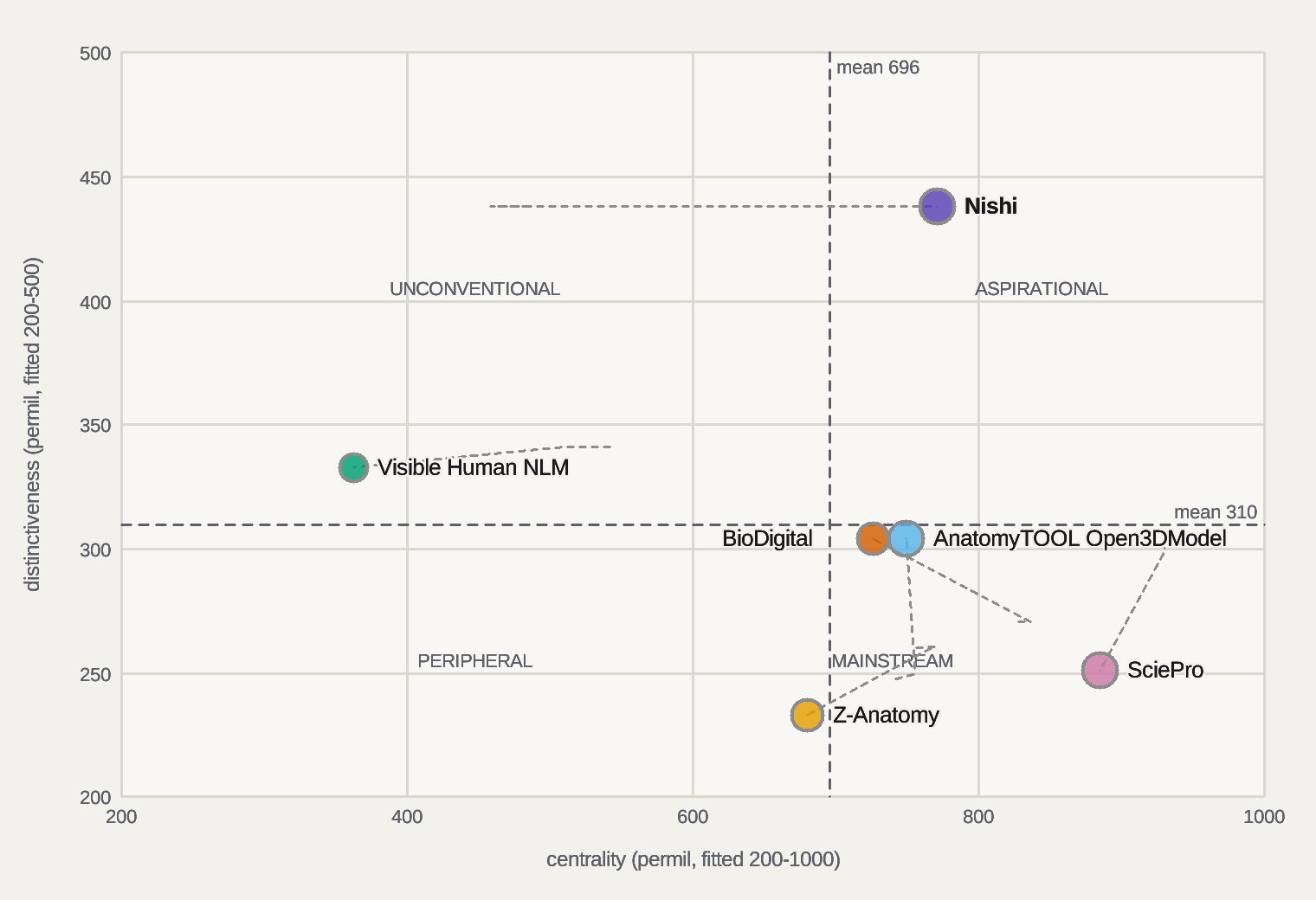
readability of the 3D cube, self-graded by the layout ruler: label overlaps 0 · labels over marks 0 · off-canvas 0 · unresolved labels 0 · mark overlaps 1 (a fact of the data: two players that close are that close) · data spread 272 permil of the plot
10 panels over 5 registered axes, every pair once (the lower axis on x, the higher on y) · each panel fitted to its own field of play, first and last tick numerals shown · no labels in a small cut, the legend names the colours; the grade below reports the mark terms only (MM summed over the panels, spread averaged)
readability of the small multiples, self-graded by the layout ruler: label overlaps 0 · labels over marks 0 · off-canvas 0 · unresolved labels 0 · mark overlaps 10 (a fact of the data: two players that close are that close) · data spread 546 permil of the plot
| Player | Quadrant | centrality | distinctiveness | breadth | depth | momentum | Rows held | Days on spine | First seen |
|---|---|---|---|---|---|---|---|---|---|
| Nishi | Aspirational | 772 | 438 | 400 | 666 | 0 since 2026-09-27 | 12 | 11 | 2026-09-15 |
| Z-Anatomy | Peripheral | 681 | 233 | 216 | 722 | 0 since 2026-09-27 | 6 | 11 | 2026-09-15 |
| AnatomyTOOL Open3DModel | Mainstream | 750 | 304 | 266 | 761 | 0 since 2026-09-27 | 7 | 11 | 2026-09-15 |
| Visible Human NLM | Unconventional | 363 | 333 | 116 | 777 | 0 since 2026-09-27 | 3 | 11 | 2026-09-15 |
| BioDigital | Mainstream | 727 | 304 | 250 | 714 | 0 since 2026-09-27 | 7 | 11 | 2026-09-15 |
| SciePro | Mainstream | 886 | 251 | 266 | 592 | 0 since 2026-09-27 | 9 | 11 | 2026-09-15 |
| Day | Matrix rows reviewed | Players recorded |
|---|---|---|
| 2026-09-15 | 22 | 6 |
| 2026-09-16 | 22 | 6 |
| 2026-09-17 | 28 | 6 |
| 2026-09-18 | 19 | 6 |
| 2026-09-19 | 19 | 6 |
| 2026-09-20 | 20 | 6 |
| 2026-09-21 | 20 | 6 |
| 2026-09-22 | 20 | 6 |
| 2026-09-23 | 20 | 6 |
| 2026-09-27 | 20 | 6 |
| 2026-10-08 | 20 | 6 |
players 6|matrix rows 20|feature mass 44|centrality mean 696|distinctiveness mean 310|axes 5|spine days 11 (shown 11)|rows written today 0|readability defects 2D 0 cube 0|spine knowledge/status/cdmap/anatomy.spine
Capability matrix — measured against source
◉ authored stronger claim; source present● present◐ partial○ absent? unassessed; excluded from relative comparison · click any capability for its evidence
Peer cell coverage: authored assessed 155, unassessed 0. Authored assessments are not verified outcomes.
No capabilities match this filter or search.
| Capability | Nishi | Z-Anatomy | AnatomyTOOL Open3DModel | Visible Human NLM | BioDigital | SciePro |
|---|---|---|---|---|---|---|
shape-agreement-ruler-vs-an-oracle-meshMeasured:bb_detail_score exists in runtime/_hdl_build/nx_bodybench.nx, verified at emit. Silhouette IoU plus a normal field plus a subdivision-proof detail judge, scored against an oracle mesh. DELIBERATELY NOT FLAGGED AN EXCEED HERE even though every rival column reads zero, for two separate reasons that both matter. First, the exceed for this organ is already priced on graphics and on procgen and pricing it a third time is the double-count C7 forbids. Second and more important, a zero in these columns is not a win: the rivals ship anatomical MODELS and we ship a ruler, so the columns are measuring absence of a different product rather than a deficiency. What this ruler cannot do is the whole reason this board exists -- it answers whether two meshes have the same SHAPE and can say nothing about whether the shape is anatomically right or whether the structure is the one it claims to be. [bodyparts3d] Adoption: REGISTERED-DARK — PARTIAL: callable, authorised, completed MCP invocation not established by supplied journal window; lifetime history unknown (direct execution may be recorded elsewhere; this scan does not establish lifetime use); no execution surface runs it either (clock, cron, daemon, roster, actlog and surfaced forks checked); only referenced by nx_bodydensity_gate -- a mention, not a run.Pros Implementing source symbol found; runtime acceptance separate; ahead of Z-Anatomy, AnatomyTOOL Open3DModel, Visible Human NLM, BioDigital, ScieProCons not adopted yet: callable, authorised, completed MCP invocation not established by supplied journal window; lifetime history unknown (direct execution may be recorded elsewhere; this scan does not establish lifetime use); no execution surface runs it either (clock, cron, daemon, roster, actlog and surfaced forks checked); only referenced by nx_bodydensity_gate -- a mention, not a run | ● | ○ | ○ | ○ | ○ | ○ |
millimetre-deviation-ruler-over-every-vertexMeasured:md_measure exists in runtime/nx_mmdev_lib.nx, verified at emit. Exact point-to-triangle deviation in tenths of a millimetre over every vertex in both directions, never sampled, gate-proven to read a known 5.0 mm lift as 5.0 mm and a self-compare as zero. The exceed is priced on dcc. Its relevance here is that it is the only instrument in the estate that could ever state an anatomical fidelity claim as a BOUND rather than an opinion -- but a bound against BodyParts3D is a bound against a reference whose own successors changed most of its shapes, so the number is precise and its subject is unsettled. [o3dabout] Adoption: LIB-WIRED importers=9 nonval=5 — fully adopted (top of its ladder).Pros Implementing source symbol found; runtime acceptance separate; ahead of Z-Anatomy, AnatomyTOOL Open3DModel, Visible Human NLM, BioDigital, SciePro; fully adopted on the estate ladderCons none on the measured axes (rival marks are documented presence, not depth) | ● | ○ | ○ | ○ | ○ | ○ |
internal-systems-rendered-inside-and-outMeasured:as_load_sites exists in runtime/_hdl_build/nx_anat_sov.nx, verified at emit. Eight internal systems loaded and rendered with peel, explode and stereo. Priced as an exceed on graphics against MetaHuman and Infinigen, which render no internals at all -- and that framing is correct against GAME rivals and wrong against the rivals on THIS board, every one of which is built around internal anatomy. BioDigital and SciePro are Best here on breadth of internal content [biodigital] [sciepro]; Z-Anatomy and the Open 3D Model carry segmented internal structures as separate named meshes, which is a capability our renderer does not have. Visible Human reads 1 because it supplies imagery of internals rather than rendered systems. Adoption: REGISTERED-DARK — PARTIAL: callable, authorised, completed MCP invocation not established by supplied journal window; lifetime history unknown (direct execution may be recorded elsewhere; this scan does not establish lifetime use); no execution surface runs it either (clock, cron, daemon, roster, actlog and surfaced forks checked).Pros Implementing source symbol found; runtime acceptance separate; ahead of BioDigital, ScieProCons behind Z-Anatomy (leads), AnatomyTOOL Open3DModel (leads); not adopted yet: callable, authorised, completed MCP invocation not established by supplied journal window; lifetime history unknown (direct execution may be recorded elsewhere; this scan does not establish lifetime use); no execution surface runs it either (clock, cron, daemon, roster, actlog and surfaced forks checked) | ● | ◉ | ◉ | ● | ◐ | ◐ |
articulated-rig-on-the-atlas-skeletonMeasured:rg_fk_y exists in runtime/_hdl_build/nx_anat_rig.nx, verified at emit. Forward-kinematic joint tree plus a damped-pendulum integrator on the 662k-triangle BodyParts3D skeleton with bit-identical replay on every frame checksum. SciePro is Best: it sells rigged anatomy as its product. Honest gaps carried over rather than restated as new: sagittal hinges only and no constrained rigid-body solver. rival marks uncited — the Yes, Best or Part codes on this row are an observation read with no reference mark behind them Adoption: SOURCE-ONLY — PARTIAL: source exists, never compiled: /api/build it.Pros Implementing source symbol found; runtime acceptance separate; ahead of Visible Human NLM, ScieProCons behind BioDigital (leads); not adopted yet: source exists, never compiled: /api/build it | ● | ● | ● | ○ | ◉ | ◐ |
pose-legality-answered-before-anything-rendersMeasured:sg_legal exists in runtime/_hdl_build/nx_skelgen.nx, verified at emit. Whether a joint angle is anatomically legal, answered as a verdict before a render is attempted. No rival on this board validates a pose, because none of them generates one -- they are atlases and libraries, not generators. Coded PRESENT and not an exceed for the same reason as the ruler rows: the zeros describe a different product, not a defeated one. Adoption: REGISTERED-DARK — PARTIAL: callable, authorised, completed MCP invocation not established by supplied journal window; lifetime history unknown (direct execution may be recorded elsewhere; this scan does not establish lifetime use); no execution surface runs it either (clock, cron, daemon, roster, actlog and surfaced forks checked).Pros Implementing source symbol found; runtime acceptance separate; ahead of Z-Anatomy, AnatomyTOOL Open3DModel, Visible Human NLM, BioDigital, ScieProCons not adopted yet: callable, authorised, completed MCP invocation not established by supplied journal window; lifetime history unknown (direct execution may be recorded elsewhere; this scan does not establish lifetime use); no execution surface runs it either (clock, cron, daemon, roster, actlog and surfaced forks checked) | ● | ○ | ○ | ○ | ○ | ○ |
surface-feature-placement-checkMeasured:nx_anatomy_placement_score exists in runtime/nx_anatomy_placement.nx, verified at emit. Out-of-place anatomy verification for surface features against their parent region. Narrow by construction and honestly so: it checks a handful of named surface features on a torso, and it is nowhere near a general is-this-structure-where-it-belongs test over a segmented atlas. Adoption: LIB-GATE-ONLY importers=1 — PARTIAL: imported only by validation organs (gates, tests, benches): wire it into a shipping program.Pros Implementing source symbol found; runtime acceptance separate; ahead of Z-Anatomy, AnatomyTOOL Open3DModel, Visible Human NLM, BioDigital, ScieProCons not adopted yet: imported only by validation organs (gates, tests, benches): wire it into a shipping program | ● | ○ | ○ | ○ | ○ | ○ |
named-axis-measurement-from-a-binary-maskMeasured:nx_anatomy_measure_body exists in runtime/nx_anatomy_measure.nx, verified at emit. Measures named anatomical axes from a binary mask, with eye width as the scale reference. This is anthropometry on a silhouette, not morphometry on a structure, and the distinction is the gap AN4 names. rival marks uncited — the Yes, Best or Part codes on this row are an observation read with no reference mark behind them Adoption: LIB-GATE-ONLY importers=2 — PARTIAL: imported only by validation organs (gates, tests, benches): wire it into a shipping program.Pros Implementing source symbol found; runtime acceptance separate; ahead of Z-Anatomy, AnatomyTOOL Open3DModel, Visible Human NLMCons not adopted yet: imported only by validation organs (gates, tests, benches): wire it into a shipping program | ● | ○ | ○ | ○ | ● | ● |
figure-readability-criticMeasured:ac2_verdict exists in runtime/_hdl_build/nx_anatomy_critic.nx, verified at emit. Does this shape read as a body at all -- a coarse component and mass test that catches a generator producing a tube. A floor, not a correctness instrument, and it is listed so the board cannot later mistake it for one. Adoption: LIB-WIRED importers=2 nonval=1 — fully adopted (top of its ladder).Pros Implementing source symbol found; runtime acceptance separate; ahead of Z-Anatomy, AnatomyTOOL Open3DModel, Visible Human NLM, BioDigital, SciePro; fully adopted on the estate ladderCons none on the measured axes (rival marks are documented presence, not depth) | ● | ○ | ○ | ○ | ○ | ○ |
anatomical-feature-registryMeasured:an_add exists in runtime/nx_anatomy.nx, verified at emit. A registry of anatomical features with bone anchor, offsets, morph and density sliders, saved and loaded as rows. It is a VOCABULARY layer and it is the natural host for AN1 -- but the names in it are ours, not Terminologia, so nothing in it can be joined to a published anatomical nomenclature today. rival marks uncited — the Yes, Best or Part codes on this row are an observation read with no reference mark behind them Adoption: LIB-GATE-ONLY importers=1 — PARTIAL: imported only by validation organs (gates, tests, benches): wire it into a shipping program.Pros Implementing source symbol found; runtime acceptance separate; ahead of Visible Human NLMCons behind Z-Anatomy (leads), AnatomyTOOL Open3DModel (leads), BioDigital (leads), SciePro (leads); not adopted yet: imported only by validation organs (gates, tests, benches): wire it into a shipping program | ● | ◉ | ◉ | ○ | ◉ | ◉ |
licence-shippability-verdictMeasured:lg_verdict exists in runtime/nx_licgate_lib.nx, verified at emit. The organ that already answers the question this board's whole licensing half turns on: given a set of licence terms, may this be shipped. Three named exits -- SHIP_OK, REVIEW meaning a human decision left unmade, and REFUSE -- and it appends the VERBATIM source row rather than a paraphrase, on the stated grounds that counsel should review the source and not a transcription. IT IS REGISTERED-DARK. nx_catalog reports it callable, authorised and with no invocation on record, and no anatomical dataset has a row in it. The mechanism exists and the estate has never pointed it at the one class of asset whose licence carries a viral term. SciePro is Best here only in the trivial sense that selling licences forces it to state terms [sciepro]. Adoption: LIB-WIRED importers=4 nonval=4 — fully adopted (top of its ladder).Pros Implementing source symbol found; runtime acceptance separate; ahead of Z-Anatomy, AnatomyTOOL Open3DModel, Visible Human NLM; fully adopted on the estate ladderCons behind SciePro (leads) | ● | ○ | ○ | ○ | ● | ◉ |
donor-mesh-becomes-a-measuring-stickMeasured:g2_convert exists in runtime/_hdl_build/nx_gltf2mesh.nx, verified at emit. Converts a donor glTF or VRM figure into the estate mesh format so it can serve as an oracle. Exceed priced on koikatsu. It is the intake path any new anatomical oracle would arrive through, and it is also precisely the path a share-alike obligation would travel along if nothing checks the licence at the door -- which today nothing does. rival marks uncited — the Yes, Best or Part codes on this row are an observation read with no reference mark behind them Adoption: RUN-BY:fork:nx_gltf2mesh_units_gate — fully adopted (top of its ladder).Pros Implementing source symbol found; runtime acceptance separate; ahead of Visible Human NLM, BioDigital; fully adopted on the estate ladderCons behind AnatomyTOOL Open3DModel (leads) | ● | ● | ◉ | ○ | ○ | ● |
mesh-validity-and-manifold-refusalMeasured:mv_manifold exists in runtime/nx_meshvalid_lib.nx, verified at emit. Six named defect classes each reported as a count plus the offending element index, with a refusal rather than a viewport overlay. Exceed priced on dcc. Relevant here because the Open 3D Model project retopologized every structure specifically to remove artificial hooked surface artefacts inherited from Z-Anatomy [o3dabout], which is a mesh-quality defect class our oracle mesh may still carry unmeasured. Adoption: LIB-WIRED importers=4 nonval=2 — fully adopted (top of its ladder).Pros Implementing source symbol found; runtime acceptance separate; ahead of Z-Anatomy, Visible Human NLM, BioDigital; fully adopted on the estate ladderCons none on the measured axes (rival marks are documented presence, not depth) | ● | ○ | ● | ○ | ○ | ● |
terminologia-anatomica-lexicon-bindingDARK —runtime/nx_anatomy.nx EXISTS but does not declare an_ta_bind: something shipped at this path under another name, and this mark would read open forever. Repoint the contract to the real entry point (the plan rung AND this row) or rename the function; the flip follows on the next beat, and the comparewatch- plane row reads DARK until then. THE FOUNDATIONAL GAP. Terminologia Anatomica is the international anatomical nomenclature, published by FCAT and IFAA through Thieme in 1998 and now carried as TA2 in an open viewer, and the Open 3D Model anatomists list it among the works they checked every structure against [o3dabout]. Nothing in this estate references it: the token Terminologia is ABSENT-PROVEN across the entire compare corpus with corpus_complete=1. Our feature registry names things in our own vocabulary, so a structure we generate cannot be joined to a published name, cannot be looked up in an atlas, and cannot be compared with a rival's structure of the same name. Z-Anatomy, the Open 3D Model and BioDigital are Best; SciePro labels its models but sells them rather than publishing the lexicon.Pros none measured yetCons behind Z-Anatomy, AnatomyTOOL Open3DModel, BioDigital, SciePro (leads); open contract; expected source declaration not established | ○ | ◐ | ◐ | ○ | ◐ | ◉ |
per-structure-identity-not-merely-shapeDARK —runtime/_hdl_build/nx_bodybench.nx EXISTS but does not declare bb_structure_id: something shipped at this path under another name, and this mark would read open forever. Repoint the contract to the real entry point (the plan rung AND this row) or rename the function; the flip follows on the next beat, and the comparewatch- plane row reads DARK until then. Our rulers compare a mesh with a mesh. They cannot say that a region IS the gluteus medius, only that it agrees in shape with whatever was in the oracle file at that location. Every rival here ships separately named, separately selectable structures -- the Open 3D Model viewer highlights and NAMES the selected structure [o3dabout] -- so on the axis of structure identity we are not behind by a margin, we are absent. Visible Human reads 1 because its base data is unlabelled imagery.Pros none measured yetCons behind Z-Anatomy, AnatomyTOOL Open3DModel, Visible Human NLM, BioDigital, SciePro; open contract; expected source declaration not established | ○ | ◐ | ◐ | ● | ◐ | ◐ |
anatomist-review-ledger-per-structureDARK —runtime/_hdl_build/nx_anatomy_census.nx EXISTS but does not declare ac_review_ledger: something shipped at this path under another name, and this mark would read open forever. Repoint the contract to the real entry point (the plan rung AND this row) or rename the function; the flip follows on the next beat, and the comparewatch- plane row reads DARK until then. The Open 3D Model is Best and it is not close: each structure was reviewed by one to three anatomists with expertise in the specific topic, checked against the anatomist's own experience, Moore's and Gray's, and the Netter, Prometheus and Terminologia atlases, and the project publishes the resulting change rate -- an estimated 70 percent of all shapes changed [o3dabout]. We have no review record of any kind for any structure, and the number they publish is the best available estimate of how wrong our own oracle is.Pros none measured yetCons behind Z-Anatomy, AnatomyTOOL Open3DModel, Visible Human NLM, BioDigital (leads), SciePro (leads); open contract; expected source declaration not established | ○ | ● | ◐ | ● | ◉ | ◉ |
region-coverage-against-a-reviewed-atlasDARK —runtime/_hdl_build/nx_anatomy_census.nx EXISTS but does not declare ac_region_coverage: something shipped at this path under another name, and this mark would read open forever. Repoint the contract to the real entry point (the plan rung AND this row) or rename the function; the flip follows on the next beat, and the comparewatch- plane row reads DARK until then. The Open 3D Model publishes a dated completion ledger region by region -- complete skeleton including skull, upper limb and lower limb in July 2025, pelvis and perineum in December 2025, the inguinal canal in January 2026, and the muscles of thorax, abdomen and back in March 2026 [anatomytool]. That is exactly the artefact this estate lacks: we can say our renderer loads eight systems and we cannot say which anatomical regions are covered, to what standard, or by whom.Pros none measured yetCons behind Z-Anatomy (leads), AnatomyTOOL Open3DModel, Visible Human NLM (leads), BioDigital, SciePro; open contract; expected source declaration not established | ○ | ◉ | ◐ | ◉ | ◐ | ◐ |
licence-provenance-ledger-per-datasetDARK —runtime/nx_licgate_lib.nx EXISTS but does not declare lg_dataset_row: something shipped at this path under another name, and this mark would read open forever. Repoint the contract to the real entry point (the plan rung AND this row) or rename the function; the flip follows on the next beat, and the comparewatch- plane row reads DARK until then. No dataset the estate measures against has a machine-readable provenance row carrying its licence, its pinned licence evidence and its permitted uses. The consequence is live and named in this file's header: two published boards assert BodyParts3D is CC BY-SA 2.1 JP with mirror and pin both a dash, while the DBCLS archive record pinned by this board states CC BY with no share-alike term [bodyparts3d] and the successor project's anatomists state CC BY SA [o3dabout]. The original site serves no licence statement at all [bp3dorig]. A ledger would have made that disagreement a refusal instead of a footnote.Pros none measured yetCons behind Z-Anatomy, AnatomyTOOL Open3DModel (leads), Visible Human NLM (leads), BioDigital, SciePro (leads); open contract; expected source declaration not established | ○ | ● | ◉ | ◉ | ● | ◉ |
sharealike-containment-fence-on-emitDARK —runtime/nx_licgate_lib.nx EXISTS but does not declare lg_sharealike_fence: something shipped at this path under another name, and this mark would read open forever. Repoint the contract to the real entry point (the plan rung AND this row) or rename the function; the flip follows on the next beat, and the comparewatch- plane row reads DARK until then. Every rival column is zero and NONE of that is a win -- it is a category difference, and stating it plainly is the point of the row. Z-Anatomy and the Open 3D Model are share-alike LICENSORS so the obligation flows outward from them; BioDigital and SciePro are proprietary so it never arises; Visible Human is public domain so there is nothing to contain. We are the only party on this board that consumes share-alike anatomical geometry and ships a product, so we are the only one that needs the fence, and we do not have it. The exact obligation, read from the legal code rather than a summary: if You Share Adapted Material You produce, the Adapter's License You apply must be a Creative Commons license with the same License Elements, this version or later, or a BY-SA Compatible License [ccbysa4]. The trigger is Share, not create, which is precisely why the estate's existing oracle-only-never-product rule is the correct mitigation -- and today that rule is prose in a refs note with no organ enforcing it.Pros none measured yetCons open contract; expected source declaration not established | ○ | ○ | ○ | ○ | ○ | ○ |
cadaver-voxel-ground-truth-ingestDARK —runtime/_hdl_build/nx_anat_sov.nx EXISTS but does not declare as_voxel_ingest: something shipped at this path under another name, and this mark would read open forever. Repoint the contract to the real entry point (the plan rung AND this row) or rename the function; the flip follows on the next beat, and the comparewatch- plane row reads DARK until then. Visible Human is Best and is a different KIND of evidence from every mesh on this board: cryosection, CT and MRI from one male and one female cadaver, the male at 1 mm axial intervals with 1871 cross-sections at 0.33 mm pixels and about 15 GB, the female at 0.33 mm Z spacing giving cubic voxels across 5189 anatomical images and about 40 GB [visiblehuman]. It is the only source here that is not somebody's interpretation of anatomy, and we cannot read it. Note the token Visible Human is ABSENT-PROVEN across the whole compare corpus with corpus_complete=1, so this is a gap the estate had not previously named.Pros none measured yetCons behind Visible Human NLM, BioDigital, SciePro; open contract; expected source declaration not established | ○ | ○ | ○ | ◐ | ● | ● |
oracle-disagreement-across-two-atlasesDARK —runtime/_hdl_build/nx_bodybench.nx EXISTS but does not declare bb_multi_oracle: something shipped at this path under another name, and this mark would read open forever. Repoint the contract to the real entry point (the plan rung AND this row) or rename the function; the flip follows on the next beat, and the comparewatch- plane row reads DARK until then. The estate measures against exactly one anatomical oracle and therefore cannot distinguish our error from our oracle's error -- the two-way comparison defect this estate has already banked in another lane, arriving here through anatomy. Every rival column is zero because none of them is trying to measure anything; they publish models. The contract is to score one subject against two independently sourced atlases and report the disagreement BETWEEN THE ORACLES as its own number, so a fidelity claim carries the reference uncertainty beside it.Pros none measured yetCons open contract; expected source declaration not established | ○ | ○ | ○ | ○ | ○ | ○ |
pathology-and-condition-variantsDARK —runtime/nx_anatomy.nx EXISTS but does not declare an_pathology_row: something shipped at this path under another name, and this mark would read open forever. Repoint the contract to the real entry point (the plan rung AND this row) or rename the function; the flip follows on the next beat, and the comparewatch- plane row reads DARK until then. BioDigital states it has mapped over 1000 health conditions [biodigital] and SciePro ships pathology and conditions alongside pregnancy, fetal and juvenile anatomy [sciepro]; both are Best. We model one canonical adult and have no representation of a pathological or variant structure at all. The Open 3D Model reads 0 by its own declared design decision: it aims at canonical adult anatomy, judged as within the range of appearances known to the anatomist [o3dabout].Pros none measured yetCons behind Z-Anatomy, Visible Human NLM, BioDigital, SciePro; open contract; expected source declaration not established | ○ | ● | ○ | ● | ◐ | ◐ |
lifespan-and-sex-coverageDARK —runtime/_hdl_build/nx_body_gen.nx EXISTS but does not declare bg_lifespan_canon: something shipped at this path under another name, and this mark would read open forever. Repoint the contract to the real entry point (the plan rung AND this row) or rename the function; the flip follows on the next beat, and the comparewatch- plane row reads DARK until then. SciePro is Best with male and female anatomy, body types and ethnic variants, pregnancy and fetuses and juvenile anatomy [sciepro]. Visible Human carries one male and one female cadaver. The Open 3D Model is explicitly male only in its present work [anatomytool], and its own about page records a real consequence of a single donor -- the scanned subject was 22 years old, so epiphysial disks and fusion lines appear in a model intended as adult anatomy [o3dabout]. Z-Anatomy inherits BodyParts3D, which is a whole-body model of one adult male [zanatomy]. Our canon is parametric, which is architecturally the right shape for this axis, and it carries no lifespan or sex-specific internal anatomy today.Pros none measured yetCons behind Z-Anatomy, AnatomyTOOL Open3DModel, Visible Human NLM (leads), BioDigital (leads), SciePro; open contract; expected source declaration not established | ○ | ● | ● | ◉ | ◉ | ◐ |
| DIGITAL TWIN | ||||||
the four axes the field defines -- dynamic data feeds, simulated physiology, one person's anatomy, predictive power -- measured against what actually runsDARK —runtime/_hdl_build/nx_body_proc.nx EXISTS but does not declare dt_loop_contract: something shipped at this path under another name, and this mark would read open forever. Repoint the contract to the real entry point (the plan rung AND this row) or rename the function; the flip follows on the next beat, and the comparewatch- plane row reads DARK until then. The AN9 watch cell. None of the four atlases is a twin (No): they are the scaffolding a twin is built on, which is exactly the operator's reading of BodyParts3D. The field frames a twin as real-to-sim-to-real [4ddt2026]. Ours is an atlas-fed parametric body with physics organs bound to no twin state. Done-rule anatomy.plan AN9.Pros none measured yetCons open contract; expected source declaration not established | ○ | ○ | ○ | ○ | ○ | ○ |
bones, organs and skin fitted to ONE consented person, residual in millimetres per landmarkDARK —runtime/_hdl_build/nx_body_gen.nx EXISTS but does not declare dt_person_fit: something shipped at this path under another name, and this mark would read open forever. Repoint the contract to the real entry point (the plan rung AND this row) or rename the function; the flip follows on the next beat, and the comparewatch- plane row reads DARK until then. The AN10 watch cell. The published bar is a statistical shape model over bones, organs and skin learned from CT [boss2023]; none of the atlases fits a person (No). Ours has the layered parametric body and no fit. Done-rule AN10, fails closed behind nx_realperson until consent resolves.Pros none measured yetCons open contract; expected source declaration not established | ○ | ○ | ○ | ○ | ○ | ○ |
tissue, muscle, nerve, skin and fluid engines that RUN against a twin state plane, one abstaining referee eachDARK —runtime/_hdl_build/nx_body_gen.nx EXISTS but does not declare dt_physiology: something shipped at this path under another name, and this mark would read open forever. Repoint the contract to the real entry point (the plan rung AND this row) or rename the function; the flip follows on the next beat, and the comparewatch- plane row reads DARK until then. The AN11 watch cell. The atlases are geometry only (No). The estate holds the engines as organs (softbody, nx_myo, nx_neuro, nx_fascia, nx_derm) bound to nothing; binding them to one state plane that also drives the in-game figure is the rung. Done-rule AN11.Pros none measured yetCons open contract; expected source declaration not established | ○ | ○ | ○ | ○ | ○ | ○ |
the two-way loop -- consented telemetry in, scored predictions out, both as plane rowsDARK —runtime/_hdl_build/nx_body_proc.nx EXISTS but does not declare dt_two_way_loop: something shipped at this path under another name, and this mark would read open forever. Repoint the contract to the real entry point (the plan rung AND this row) or rename the function; the flip follows on the next beat, and the comparewatch- plane row reads DARK until then. The AN12 watch cell. No atlas ingests a person's data or predicts anything (No). Done when one consented subject has three closed prediction-measurement pairs on the plane with the referee's calibration published. Done-rule AN12.Pros none measured yetCons open contract; expected source declaration not established | ○ | ○ | ○ | ○ | ○ | ○ |
every-structure-carries-a-tissue-class-with-a-cited-bandDARK —runtime/nx_anatomy.nx EXISTS but does not declare an_tissue_class: something shipped at this path under another name, and this mark would read open forever. Repoint the contract to the real entry point (the plan rung AND this row) or rename the function; the flip follows on the next beat, and the comparewatch- plane row reads DARK until then. The AN15 watch cell. The reviewed atlases publish material or tissue attributes per structure (Z-Anatomy applied material properties in its restructuring; the Open 3D Model, BioDigital and SciePro ship classed, reviewed structures); the Visible Human is voxels with no classes. Ours: structures with regions, tissue bands banked on the softbody conf, and no join between them. Done-rule anatomy.plan AN15. rival marks uncited — the Yes, Best or Part codes on this row are an observation read with no reference mark behind themPros none measured yetCons behind Z-Anatomy, AnatomyTOOL Open3DModel, BioDigital, SciePro; open contract; expected source declaration not established | ○ | ● | ● | ○ | ● | ● |
the-human-leaderboard-with-external-rulers-and-a-time-spineDARK —runtime/_hdl_build/nx_mhbench.nx EXISTS but does not declare mh_leaderboard_spine: something shipped at this path under another name, and this mark would read open forever. Repoint the contract to the real entry point (the plan rung AND this row) or rename the function; the flip follows on the next beat, and the comparewatch- plane row reads DARK until then. The AN16 watch cell. No anatomy rival publishes a ranked leaderboard of digital humans against external rulers; nx_mhbench is the incumbent ruler (269 permil parity coverage on 2026-09-16) and this cell flips when it carries the external channels (PhysScore-class motion, ICT FaceKit expressions, a public strand dataset, CIEDE2000 per region, AN4 per-structure agreement) and appends one row per run to a time spine. Done-rule anatomy.plan AN16.Pros none measured yetCons open contract; expected source declaration not established | ○ | ○ | ○ | ○ | ○ | ○ |
the-generated-skull-scored-against-a-scanned-oracleMeasured:sk_emit exists in runtime/_hdl_build/nx_skullgen.nx, verified at emit. The AN17 watch cell. Every rival ships a scanned or sculpted skull; ours is GENERATED from rules (sex, seed, robusticity) and scored per region in millimetres against the BodyParts3D scan, which is the ruler and never the product. MEASURED 2026-09-18 BY ITS OWN RULER nx_skull_canon_gate (mm, oracle vs ours, before the frame fix vs after two tune passes in the corrected frame): chin depth -7.6 vs +47.0 then +4.0 (band 13.2, now inside); nasal position 28.4 vs 67.5 then 28.5; bizygomatic 128.5 vs 132.0 then 120.7; orbit spacing 49.8 vs 51.5 then 55.6; 3 of 15 classes inside their bands before, 8 after; still outside: the aperture (a dent, 9 mm wide), the orbits (41 mm wide tunnels), the bigonial (101 vs 78), the prosthion (+16 vs -12). THE ORACLE HAD BEEN READ SUPINE SINCE THE FIRST TUNE (BodyParts3D is z-up), so the older gapmap figures (vault 4/12, base 4/16, brow-orbits 4/17, zygomatic 3/11, mandible 4/25, maxilla 3/16 (mean/worst mm); the NASAL region has no samples in either mesh, and the learning beat has appended nothing since Aug 14 while its clock row fires. The symbol is present, so this cell reads LANDED; the rung's done-rule (nasal region measured, beat appending, face layers built ON the mesh) is what closes it. rival marks uncited — the Yes, Best or Part codes on this row are an observation read with no reference mark behind them Adoption: REGISTERED-DARK — PARTIAL: callable, authorised, completed MCP invocation not established by supplied journal window; lifetime history unknown (direct execution may be recorded elsewhere; this scan does not establish lifetime use); no execution surface runs it either (clock, cron, daemon, roster, actlog and surfaced forks checked).Pros Implementing source symbol found; runtime acceptance separate; ahead of Z-Anatomy, AnatomyTOOL Open3DModel, Visible Human NLM, BioDigital, ScieProCons not adopted yet: callable, authorised, completed MCP invocation not established by supplied journal window; lifetime history unknown (direct execution may be recorded elsewhere; this scan does not establish lifetime use); no execution surface runs it either (clock, cron, daemon, roster, actlog and surfaced forks checked) | ● | ◐ | ◐ | ◐ | ◐ | ◐ |
one-fit-machinery-and-one-primitive-family-for-every-anatomy-fieldMeasured:ff_descend exists in runtime/nx_fieldfit_lib.nx, verified at emit. The AN18 cell. No rival on this board fits a parametric implicit field to a scan at all (they ship scanned or sculpted meshes), so the zeros describe a different product and this row claims no exceed. What it measures is OURS: whether the skull's fit machinery is reusable from the first byte up. MEASURED 2026-09-19: nx_skullsdf recomposed on nx_fieldfit_lib and nx_sdfprim_lib emits a byte-identical mesh (sha256 a35a4acc67af0be7) and the same 445 centi objective; nx_sdfprim_gate 30/30 and nx_fieldfit_gate 28/28 GREEN on the NAS. The symbol is present, so this cell reads LANDED; the rung's done-rule (a second consumer, a limb or a muscle, fitted through the same libraries) is what closes it. Adoption: LIB-WIRED importers=3 nonval=2 — fully adopted (top of its ladder).Pros Implementing source symbol found; runtime acceptance separate; ahead of Z-Anatomy, AnatomyTOOL Open3DModel, Visible Human NLM, BioDigital, SciePro; fully adopted on the estate ladderCons none on the measured axes (rival marks are documented presence, not depth) | ● | ○ | ○ | ○ | ○ | ○ |
skull-as-a-genome-of-measured-lofted-partsOpen — watchingruntime/nx_skullgenome.nx : sg_skull_genome, re-measured on every compare beat. Ship that symbol and this mark flips itself; the comparewatch- plane row flips with it. The AN19 cell. The rivals ship sculpted or scanned skulls, not a genome of parts measured from a scan, so the zeros describe a different product and this row claims no exceed until the mandible experiment is referee-graded. The contract: cranium, face and mandible as NXPART genes lofted through nx_partloft_lib (procgen PG61, promoted 450b71fc), joined through the lattice, judged by the 18-quantity ruler.Pros none measured yetCons open contract; expected source declaration not established | ○ | ○ | ○ | ○ | ○ | ○ |
| Class | Count | Note |
|---|---|---|
| rows with rival marks | 17 | rows carrying a Yes, Best or Part in a rival column |
| cited | 11 | a reference mark resolves to a pinned mirror |
| uncited | 6 | an observation read, badged until a reference lands |
| rows, summed | 17 | RECONCILED: the parts sum to the total 17 |
Delivery and evidence
Inspect risks, technical debt, rendered observations, experiments and references. Read scope and limitations alongside every result.
Debt register
| Id | Sev | What it is | Unblock |
|---|---|---|---|
| bodyparts3d-licence-unpinnednot in this scope | 6 | Two published boards assert BodyParts3D is CC BY-SA 2.1 JP with mirror and pin both a dash, and the DBCLS archive record pinned by this board states CC BY with no share-alike term. The claim on the published surface rests on nothing mirrored, and it is a claim about a viral licence term. | AN1 settles it against a primary source and writes the pinned row. Until it lands, treat the stricter of the two readings as binding and do not emit any derivative of that geometry. |
| licgate-registered-darknot in this scope | 5 | nx_licgate_lib is promoted registered and authorised and nx_catalog reports NO invocation on record. A licence verdict organ exists with three named exits and nothing in the estate calls it, which is the adoption gap rather than a missing capability. | AN2 wires it into the emit path. This is adoption of an incumbent and explicitly not a new organ. |
| single-oracle-fidelity-claimsnot in this scope | 6 | Every anatomical fidelity figure this estate publishes is measured against exactly one oracle whose successors changed an estimated 70 percent of its shapes on anatomical review, so our error and our oracle's error are not separable and the published numbers inherit an unbounded reference error. | AN5 adds the second oracle and publishes the oracle-to-oracle disagreement beside every subject score. Until then, quote anatomical fidelity numbers with the oracle named. |
Risk register
| Risk | Likelihood x impact | Mitigation |
|---|---|---|
| Publishing an anatomical correctness claim backed only by shape agreement | certain x high | A silhouette IoU and a millimetre deviation both produce authoritative-looking numbers about a mesh that could be the wrong structure entirely, and neither instrument can tell. Every row on this board that names a ruler states that limit in its own note, and AN4 is the rung that removes it. No anatomical CORRECTNESS claim may cite bb_detail_score or md_measure alone. |
| A share-alike obligation reaching a shipped mesh | possible x high | The estate consumes CC BY-SA anatomical geometry today and the only thing preventing a derivative from being shared is a prose rule in a refs note. The licence text is explicit that the trigger is Share rather than create, so the measurement lane is safe and the emit lane is not, and nothing currently distinguishes them mechanically. AN2 is the fence and AN1 is its input; both are named as prerequisites of AN5 for exactly this reason. |
| Adopting a second share-alike atlas before the fence exists | likely x high | AN5 is the highest-value measurement rung on this board and taking it early doubles the exposure AN1 and AN2 exist to contain. The dependency is declared in the rung row itself rather than left to a reader's judgement, and it is the reason the cheapest milestone is deliberately sequenced first. |
| Treating an open licence as evidence of anatomical quality | likely x medium | Open and correct are independent properties, and this board has the measurement that proves it: the successor to our openly licensed oracle changed an estimated 70 percent of its shapes on anatomist review. SciePro and BioDigital are on the bar list precisely so no row can read openly licensed as a quality win. |
| Rebuilding on this board what another board already prices | certain x medium | Four boards touch a body and the temptation to restate a generation or render capability here is constant. The scope boundary is stated at the head of both this file and the matrix, every organ that carries an exceed elsewhere is coded present here with the reason, and nx_domain_admit C7 is the mechanical check. A second deviation ruler or a second body factory on this board is a defect, not a feature. |
| The clinical or educational consumer is a regulated use | likely x high | Anatomy that informs a clinical decision is a regulated device under FDA SaMD and EU MDR, and an educational claim carries its own accuracy duty. AN7 the review ledger is the artefact any such consumer would ask for first, and it does not exist. Route any clinical or teaching pilot through the legal lane before a claim is published, and note that the AnatomyTOOL project itself publishes a medical disclaimer. |
| Voxel ingest saturating the box | likely x medium | The Visible Human male and female sets are roughly 15 GB and 40 GB. AN8's done-rule requires a declared announcing work budget and forbids the request path, per the estate's standing rule that an unbounded scan which never returns is indistinguishable from a crash. Ask the spend gate before any sweep. |
Release history and work log
| When | Rung | Kind | Entry |
|---|---|---|---|
| 2026-09-03 | AN10 | lesson | OPERATOR 2026-09-03, the mechanism that makes AN10 self-supervising: ANALYSIS BY SYNTHESIS -- photo to parameters to RE-RENDER to compare against the photo, where THE RESIDUAL IS THE SCORE. No human grader and no labels, and it is the same real-to-sim-to-real loop AN9's 4DDT citation frames. It generalises across every ingest modality as ONE loop with many front-ends: a photo scores in mm per landmark, a video adds temporal consistency, an STL or mesh scores by Chamfer through md_measure (the estate's ONE mesh ruler -- never a second), a rigged model by rig topology and weight distribution. THE SHARPEST USE IS AS A GENERATOR REFEREE, NOT ONLY AN INGEST PATH: if NishiGen or Infinigen output CANNOT be re-fit back to plausible parameters, the generator is outside the manifold -- which answers `are we outputting what we are looking for` per-sample and in millimetres, where a distributional metric answers only in aggregate. IT ALSO NAMES THE SUPERIOR FORMAT: the internal representation is PARAMETER VECTOR PLUS RESIDUAL DISPLACEMENT, not a mesh -- hundreds of numbers instead of megabytes, editable, interpolatable (which is procgen PG38's redemption arc for free) and riggable by construction. |
| 2026-09-03 | AN14 | retract | CORRECTION TO THE ROW BELOW, OPERATOR-PROMPTED AND MEASURED THE SAME MINUTE: it says `this estate has NO differentiable renderer and is nofloat`. THE SECOND HALF IS FALSE AND THE CLAIM MUST NOT PROPAGATE. NishiLang HAS floating point as a first-class type -- 15 runtime files declare `: f64`, with nx_f64_gate, nx_f64_adversary, nx_fx_f64_const and nx_fx_f64_lit beside them; nx_f32.nx and nx_f16.nx ship; nx_bigfloat120 carries a full transcendental suite (atan, div, erfc, exp, gamma, ln, pow, sinh, tan); and lang LN37/LN38 FIXED f64-compare codegen miscompiles in Sept 2026, which is not the profile of a language without floats. The ~50-organ nx_nofloat_* family is the ML INFERENCE LANE, integer BY DESIGN -- and the design reason is gameengine GE27, which requires BIT-IDENTICAL state digests across a phone browser, a desktop browser, the Nishi browser and NishiOS native for true crossplay. IEEE float is not reproducible across platforms and compilers, so integer is load-bearing THERE and nowhere else by default. THE CORRECT RULE IS NARROWER AND MORE USEFUL: float is unconstrained wherever its result does not enter the DETERMINISTIC TICK PATH. An offline one-shot fit is exactly that case -- the fit runs once, is never replicated, and its OUTPUT is a parameter vector that is quantised to fixed-point AT THE BOUNDARY when it enters the game or twin state. Determinism is preserved by that boundary, not by banning float estate-wide. CONSEQUENCE: a DIFFERENTIABLE RENDERER IS A LEGITIMATE CAPABILITY TO BUILD and pixel-level analysis-by-synthesis is NOT blocked; landmark-fit stays the v1 because it is the CHEAPEST path to a working fit, not because the alternative was forbidden. OPERATOR 2026-09-03: `im fine adding capabilities i didnt want to limit us because of some dumb random misunderstood rules` -- a seat inventing a constraint from a family NAME is exactly the misread that costs a capability, and this board now carries the discriminator so the next reader does not repeat it. |
| 2026-09-03 | AN10 | queue | FIRST STEP NAMED, AND IT IS NOT THE OBVIOUS ONE. Classic analysis-by-synthesis needs gradients through pixels and this estate has NO differentiable renderer and is nofloat, so pixel-level fitting is NOT the v1 -- saying so here stops the next seat starting at the hard end. V1 IS LANDMARK-BASED FITTING, which needs neither rendering nor gradients: nx_facemark supplies 2D landmarks, GNM supplies the corresponding 3D landmark indices, and fitting the parameter vector to them is LEAST SQUARES. GNM ships fitting_utils/ (shared optimization helpers) under the same Apache-2.0 as the model, so the fit path is licensed substrate rather than a port. Pixel refinement is a later rung. TWO CONSTRAINTS CARRIED HONESTLY: (1) a single photo is ill-posed on depth -- multi-view or video materially improves the fit and should be preferred where consent allows; (2) GNM Head is HEAD ONLY and there is NO permissively-licensed BODY model (SMPL-X, SKEL and SUPR are all research-licence), so body fit is a NAMED GAP, not an assumed extension. Consent stays where AN10 already puts it: fails closed behind nx_realperson. |
| 2026-09-03 | BOARD | measure | DUPLICATE-ID ADJUDICATION PREPARED, NOT TAKEN -- the prior row reserved this call for this lane and that reservation is respected. Both pairs located by line: AN9 = L34 an_pathology_row (pathology and condition variants, deps AN3) vs L54 dt_loop_contract (the operator digital-twin loop, 2026-09-02). AN10 = L35 bg_lifespan_canon (lifespan and sex-specific canon, deps AN3) vs L55 dt_person_fit (personalised layered body, deps AN5). FINDING 1: NEITHER DUPLICATE IS STALE. Both members of both pairs are substantive live rungs from two eras of this board -- the atlas-era block and the digital-twin block appended 2026-09-02 onto ids the board already used. So the prior row's second remedy (delete if a stale duplicate) is DEFINITIVELY WRONG here; renumber is the only sound option. FINDING 2 -- THE HIDDEN SECOND HALF THE STATED REMEDY DOES NOT MENTION: renumbering the later AN10 (dt_person_fit) SILENTLY REPOINTS AN11 dt_physiology, whose dependency reads AN10 and would then resolve to the atlas-era bg_lifespan_canon instead of the twin rung it means. A rename that fixes the census and corrupts a dependency edge is worse than the duplicate, because the ranker would then compute a critical path from a wrong edge and nothing would look broken. So the edit is THREE parts, not two: twin AN9 -> a free id, twin AN10 -> a free id, AND AN11's dependency updated to that new id. Free ids must also be checked against any ms |
| 2026-09-03 | BOARD | measure | TWO DUPLICATE RUNG IDS ON THIS BOARD, FOUND BY THE NEW FLEET CENSUS AND LEFT FOR THIS LANE TO ADJUDICATE: anatomy.plan carries AN9 twice and AN10 twice. nx_compare_rank resolves a rung id by scanning until it matches, so with two rows sharing an id the ranker reads WHICHEVER COMES FIRST and the second is unreachable -- its cost, value and dependencies never enter the critical path. Found by nx_compare_rank_gate T9 (106 plans scanned, 3 duplicates fleet-wide; the third was the finder's own and is fixed). NOT renumbered here: which of each pair is the live rung and which is the stale copy is this lane's call, and silently editing another lane's ids is how a board loses the history it exists to carry. Remedy: pick a free id for the later row, or delete it if it is a stale duplicate, then the census floor tightens from 3 to 1. |
| 2026-09-16 | BOARD | measure | RANK REFUSED on this board 2026-09-16: AN1, AN3 and AN8 carried an EMPTY deps field (7 fields) and the ranker names an empty dep bad-dep-id; the same defect stood on dcc DC1, DC3 and DC11. Repaired by appending the declared-absent token, one size-CAS edit per row. skintwin rung rows were 6-field (video.plan grammar) and refused field-count; migrated to the 8-field rung grammar with DECLARED, not measured, costs. |
| 2026-09-16 | AN11 | retract | DEPENDENCY EDGE CORRECTED: the 2026-09-02 renumber moved dt_person_fit from AN10 to AN14 but left AN11 dt_physiology depending on AN10, which then resolved to the atlas-era bg_lifespan_canon, exactly the silent repoint the 1788467100 row warned about. AN11 now depends on AN14. The ranker was computing nothing here because the board was REFUSED, so no published order was built on the wrong edge. |
| 2026-09-16 | BOARD | measure | WHERE WE ARE, measured 2026-09-16 by the estate's own rulers: nx_mhbench parity coverage 269 permil (0 HAVE, 7 PARTIAL, 6 GAP of 13; exceed 2 HAVE, 2 PARTIAL, 2 GAP), gap queue head-identity 9, soft-tissue-form 9, procedural-village 9, strand-hair 8, facial-rig 8, beauty-manifold 8, inside-out-anatomy 8; nx_anatomy_census 500 permil (HAVE 7, PARTIAL 5, GAP 7) with the muscle and fat layer GAP and the skull-plus-tissue-depth path named BUILD FIRST; the operator accept plane carries five beach REJECT rows (garments, hair colour and wind, planted feet, overall photorealism) and one UNJUDGED (skin relief); the goal map over anatomy, dcc, charsim, skintwin and npcai reads every anatomy rung OPEN and its four digital-twin contracts DARK against nx_body_gen and nx_body_proc. |
| 2026-09-16 | BOARD | lesson | OPERATOR 2026-09-16, three standing orders for this lane: (1) the estate must produce repeatable reusable capabilities via MCP, API, composable primitives, workflows and agents, never seat-hand-crafted output; (2) INGEST and UPCONVERT of third-party assets are a PARALLEL arm to PROCGEN, and procgen is Infinigen-class first-byte-up mathematical generation; both arms converge on one sovereign representation (parameter vector plus residual, the NXA asset) and the same referees; (3) the lane runs like a production studio of agents keeping each other honest, ranked against leaders by a BRIGHT-class liar-killer with per-channel reasoning, never ship-and-forget. AN16 is that leaderboard; the beach ship loop is the studio. |
| 2026-09-16 | AN16 | queue | BUILD ORDER for the liar-killer: grow nx_mhbench (the incumbent, never a second ruler) with the external channels named in the rung, append one row per run to knowledge/status/mhbench.jrnl, and make the beach ship loop (the nx_search_ship agent pattern: candidate, rulers, referees, NOCHANGE or ADOPT or HOLD, rollback to the bank) read the spine before ADOPT. September-2026 witnesses pinned on this board: HairCS strand dataset, TopoRig on ICT FaceKit, InstantMimic and CHIP, Fabric-101, Mus siliconus. |
| 2026-09-16 | BOARD | queue | CRITICAL PATH AS THE RANKER WILL PRICE IT: AN1 then AN2 (licence ledger and share-alike fence, both adoption of nx_licgate_lib) unblock AN5 (second oracle); AN3 (Terminologia binding) unblocks AN4, AN6, AN7, AN9 and AN15; AN15 (tissue-class ledger) is the every-cell-and-bone partition; AN16 (leaderboard spine) reads AN4 and AN5. The two parallel arms: PROCGEN = AN10 lifespan and sex canon plus procgen PG32 id_param_core and PG38 gnm_head_fit (both UNMAPPED on procgen); INGEST-UPCONVERT = AN14 person fit plus gameengine GE62 to GE66 (scan ingest, landmark derive, chamfer, morf) and charsim R26 pmx_to_nxa, motion MO9 ci_gltf_anim. |
| 2026-09-18 | AN17 | measure | The skull learning beat's silence, read from its own source (buildroot/runtime/_hdl_build/nx_skullfit_beat.nx main): it forks the serving-root nx_skullsdf three times (tune 3 passes steps 4,2,1 against knowledge/skull.nxmesh into knowledge/skull_fit.dat; emit to /tmp/skullfit_beat.nxmesh grid 3000; gapmap) and then appends ONE trend line UNCONDITIONALLY, on success and on every named failure (tune-rc, tune-unparsed, vacuous-objective-zero, objective-regressed, emit-rc, fit-not-loaded, gapmap-rc). knowledge/status/skullfit_trend.jsonl mtime 1786766575, age 3,000,084 s at 1789766659, while the live clock row skullfitbeat fires every 21600 s. A beat that appends unconditionally and has appended nothing for 35 days never reaches its append: either the scheduler kills it at the 900 s dispatch deadline mid-tune (a grid-3000 emit plus a 3-pass tune is minutes of work on a busy box) or it is never dispatched. The clock ledger now names its job (job=<row> since 1789760532), so the first ledger row after next_due 1789777143 settles it: exit=124 is the kill, ok is a run that appended, absence is a row never fired. Remedy after that reading is a rung of its own: the tune/emit/gapmap steps become separately journaled beats under the deadline, never a longer deadline. |
| 2026-09-19 | AN17 | measure | The beat's silence is SETTLED, not inferred: with the clock ledger naming its job since 1789760532, nx_rungclose reads operated=HOLDS run=1789778044 read_from=clock-ran-the-agent-by-its-job-name for agent skullfitbeat, and 1789778044 is the row's due time 1789777143 plus 901 s -- the scheduler's 900000 ms dispatch deadline. The trend file (mtime 1786766575) and the beat's step-2 artifact /tmp/skullfit_beat.nxmesh (mtime 1786766557) are untouched, so the run died inside step 1 (a 3-pass tune) before its unconditional append. A beat whose single run cannot fit the deadline appends nothing on every beat, forever, and reads exactly like a beat that never fires. Remedy assigned to the AN17 lane: per-beat work derived from the bound (passes per beat from a measured pass time, resumable through knowledge/skull_fit.dat), never a longer deadline. Also measured through the new skin layer (aesthetictwin AT46): our skull's pogonion sits 49 mm ahead of the glabella and its nasal aperture rim 38.5 mm above the canon base, while the oracle comparison reads 3-4 mm mean because its samples are 9335 vault + 8672 base of ~31,000 and the nasal region has zero -- a ruler blind where the face is. The lane builds the skull's own craniometric ruler (nx_skull_canon_gate) first. |
| 2026-09-19 | AN17 | land | treat wf field made real: plan_run plane knowledge/store/plan-skullfitbeat- seeded from /tmp/plan_skullfitbeat.tsv (1 step: nx_skullfit_beat, a GREEN tool_allowlist row), manifest seg-0. The ranker had refused this board TREATMENT-PARTIAL missing=wf:absent from the moment the treat row landed; a treat row names a workflow by its seeded plane, never by the beat's name alone |
| 2026-09-19 | AN17 | measure | THE ORACLE HAS BEEN READ IN THE WRONG FRAME SINCE THE FIRST TUNE. knowledge/skull.nxmesh (BodyParts3D) is a floor-origin z-UP body frame: the head sits at z 1.42..1.64 m, y runs antero-posterior with the face at -y, x lateral (first triangle x 18.7 y -156.9 z 1457.4 mm; bbox x 151 y 209 z 215 mm). ss_load_ref, gapmap and voxref in nx_skullsdf read it as y-up and only negate z, so the tuner has fitted an upright field to a skull lying on its back; the trend's 4 mm vault mean and nasal n=0 were measured against that pose, and the fit vector converged to an egg (vault half-height 92 spanning y -80..104, brow bar behind the maxilla, a negative nasal radius). Read as x, z, -y the midline profile from the front is a skull: forehead receding 110 mm over 126 mm to a glabella at z 1909 u10, an aperture floor 26 mm behind it, a chin 53 mm below the prosthion. Measured by the AN17 canon gate's profile dump on the laptop twin (nx_skull_canon_lib skc_dump_profile), 2026-09-18. |
| 2026-09-19 | AN17 | land | THE SKULL'S OWN RULER, source-landed both trees: buildroot/runtime/nx_skull_canon_lib.nx (sha 37c089b8) + nx_skull_canon_gate.nx (sha d2018af6). It composes nx_tissuefield_lib (tfl_profile, tfl_noisefloor, tfl_extrema, tfl_support, tfl_support_lat, tfl_front_at, tfl_crest, the welder) and adds: the oracle read in its true z-up frame; barycentric lattice densification at half the native edge (the scan's 5-8 mm triangles left one native band in eight empty and reading the frontal sinus wall); the aperture as the most PROMINENT midline minimum (tfl_locate takes the smallest absolute z, which on an upright scan is a notch by the vertex); glabella = most anterior point above the aperture floor, pogonion = most anterior maximum below the prosthion; orbits and aperture by rim crests (a front-map depth sees through an opening to the inner occiput); a translation-only alignment with the glabella-opisthocranion chord pitch REPORTED as a quantity; bands = re-location noise under a half-edge shift, a one-edge pitch and yaw, floored at half an edge, plus bilateral asymmetry; two held-out perturbations as the neg-control. 15 quantity teeth, 4 controls, 1.4 s on the laptop with a supplied mesh, 15 s with generation. |
| 2026-09-19 | AN17 | measure | BEFORE/AFTER through the canon ruler (mm; oracle |
| 2026-09-19 | AN17 | land | SHIPPED (built on the NAS by /api/build, contentdiff read, promoted with expect_sha256, _offc refreshed): nx_skullsdf 173,432 B sha 5b6bca78 (the oracle read in its z-up frame through ONE mapper ss_ref_map/ss_ref_map_normal in ss_fit, ss_load_ref, gapmap seeds/heat, vb_count/vb_build and the voxref crossings; SS_REF_H/D corrected to 215/209; the gapmap's nasal region derived from the field's own nasal primitives; contentdiff lost_from_live=0, a strict superset; the 31,901 B shrink is the NAS build lane against a laptop-lane promoted binary, banked at knowledge/status/bank/nx_skullsdf.elf.pre-b61178a4-1789783900); nx_skull_canon_gate 136,312 B sha 6a42c671, NEW, registered on the tools surface; nx_skullskin_gate 331,544 B sha a6e9256c (ONE lost run, the moved tooth's name substrate-skin-middle-third-equals-lower-third-within-the-table-spread, promoted with allow_capability_loss=yes naming it; pre-change bank nx_skullskin_gate.elf.pre-415e8588-1789783900); nx_skullfit_beat 46,936 B sha 8bba8bf1 (contentdiff strict superset; pre-change bank nx_skullfit_beat.elf.pre-3fe229c6-1789783900). knowledge/skull_fit.dat REPLACED by the two-pass corrected-frame vector (228 B, CAS h2b1139077157c9f0; the supine vector banked at knowledge/status/bank/skull_fit.dat.supine-fitted-1786766575). knowledge/skullfit_beat.conf NEW carries dispatch_deadline_ms with its provenance. knowledge/skull_res.dat is still the supine-derived residual: nx_fileop mv is outside this lane's caps; the beat regenerates it in the corrected frame on its first measure phase and the canon gate measures with the residual off. |
| 2026-09-19 | AN17 | measure | TRIALS on the heavy-roster path (nx_gate_roster_run trial, 450,000 ms): /tmp/skc_trial.jrnl = `1789784424 trial nx_skull_canon_gate RED exit=1 ms=56560 NX-nx_skull_canon_gate passed 16/24 verdict=RED` (the NAS generated the skull itself through the promoted nx_skullsdf with the corrected-frame vector, residual off: 56.6 s of the 450 s budget; the REDs are the substrate's, named per landmark class); /tmp/sks2_trial.jrnl = `1789784424 trial nx_skullskin_gate GREEN exit=0 ms=5674 NX-nx_skullskin_gate passed 33/33 verdict=GREEN` (the skin gate now measures the skin only; its substrate tooth lives in the canon gate). The results page carries the pair /compare/aesthetictwin/results/img/an17_before_views.png and an17_after_views.png (published, rows=21 live). COORDINATOR ADMISSIONS OWED: knowledge/organ_gate.conf anatomy:AN17 -> nx_skull_canon_gate (nx_rungclose still resolves nx_skullgen_gate by convention and reads tested=FAILS); the heavy roster row for nx_skull_canon_gate (56.6 s measured, generation included); nx_tissuefield_lib.tfl_locate: adopt the prominence rule for the aperture and the classic glabella/pogonion picks (skc_midline_locate carries them line for line, filed here, so the ruler's copy can be retired onto the locator); knowledge/skull_res.dat: rename the supine-derived residual to the bank (nx_fileop mv is outside this lane's caps) or let the beat's first measure phase rewrite it; the skullfitbeat clock row is unchanged at 21600 s and needs no change -- the beat now plans its own passes under the 900,000 ms bound. |
| 2026-09-19 | AN17 | measure | THE BEAT RAN TO COMPLETION FOR THE FIRST TIME SINCE 2026-08-14 (nx_skullfit_beat 8bba8bf1 via nx_job_run, 442 s wall): trend row 1789784865 = TUNE start_centi=629 final_centi=531 passes=1 step=4 tune_ms=406257 |
| 2026-09-19 | AN17 | land | Coordinator close-out of the AN17 lane: organ_gate.conf anatomy:AN17 -> nx_skull_canon_gate declared (the oracle-vs-ours craniometric ruler in the oracle's TRUE z-up frame; 3/15 landmarks in band before the frame fix, 8/15 after; aperture height/width/depth, orbit width/depth, bigonial, prosthion depth and g-op pitch still OUTSIDE); nx_skullskin_gate 33/33 admitted to knowledge/gateroster.conf (trial 5,674 ms); nx_skull_canon_gate heavy-roster admission REJECTED by the admit verb because its trial is RED 16/24, which is the honest state of the generator, so its execution surface is the beat (nx_skullfit_beat runs canon every pass and journals CANON rc on the trend row); cap minted for both gates (nonce 1789785220). Queue: nx_tissuefield_lib.tfl_locate adopts skc_midline_locate's prominence pick so the ruler's copy retires (duplicate ruler); a landmark term in ss_score2 from the ruler's quantities (the surface objective fell 629 to 531 while chin depth moved +4 to +19.6 mm: the tuner cannot see a landmark) |
| 2026-09-19 | AN17 | measure | Coordinator LOOKED at an17_before_views, an17_after_views, an17_after_skin_pair, an17_after_skin_cutaway (seat attestation, one of three parties; NOT accepted). Before: an egg with a brow shelf, a see-through cage under the orbits and two sticks for arches. After the frame fix: the parts sit in the right PLACES (vault, brow, orbits, nasal bridge, maxilla, mandible, arches) but each is still a primitive: the orbits are two small drilled holes in a bar where the oracle has 28 x 7 mm rimmed openings, the nasal bone is a protruding peg, no piriform aperture, the maxilla is a stacked disc not an alveolar arch, the mandible a wide horseshoe (bigonial 101 vs oracle 78 mm) with no ramus or angle plane, the arches are pipes, and the vault dominates the face (thirds -20 mm). The skin over it reads as a cartoon (bulbous nose from the peg, tiny eyes, heavy muzzle): the operator's REJECT twin-face-renders-0918 stands, and the cause is now measurable in the ruler's own residuals rather than a blob. The layer MECHANISM (cutaway) works; the next rungs are the primitives (b)-(e): rimmed egg-shaped orbits, a piriform aperture as an opening, an alveolar U-arch, a mandible with body, ramus, angle and bigonial inside bizygomatic, arches as bridges over the temporal fossa, plus a landmark term in ss_score2 so the tuner optimises what the ruler measures |
| 2026-09-19 | AN17 | retract | The blob-union skull is retracted as the product path (operator 2026-09-19). A 2026-08 note about lofted tubes rendered as separate objects was read as a design decision, and a day went to making ellipsoid unions more parametric while the render stayed blobs; the seat's own read (reads as sockets, an arch and a jaw) is withdrawn. Kept: the 18-quantity ruler, the ruler-gated beat, nx_fieldfit_lib and nx_sdfprim_lib. |
| 2026-09-19 | AN19 | land | The part factory the skull will be rebuilt on: nx_partloft_lib + nx_partloft_gate on both trees, NAS build 121144 B sha 450b71fc PROMOTED, laptop 72/72 GREEN (procgen PG61). |
| 2026-09-19 | AN19 | lesson | Q12 fractions truncated per segment lost half a percent of a part's length and a Q12 cosine hid a 4 u10 lateral miss on the first gate run: the lib's fractions are Q16, every stored division rounds to nearest, and a quantisation defect looks like a geometry defect until the unit is named. |
| 2026-09-19 | AN19 | queue | Next: nx_genome_lib (procgen PG62); mandible sections measured from the oracle bone through nx_curveskel (PG64); the mandible lofted, fused into the field and read by the ruler beside a render; then cranium and face. |
| 2026-09-19 | AN17 | measure | THE OPENINGS AS SHAPES THE RULER READS (2026-09-19, laptop, cell 2 mm, ruler nx_skull_canon_gate on the emitted mesh, mm oracle vs ours). LIVE VECTOR THROUGH THE OLD FIELD: orbit radius had reached 0 (no orbits), aperture 8.2 wide as a 46.5 deep tunnel, orbit width 38.8 vs 28.3, 3 of 15 in band. THE NEW FIELD (orbit sockets; the piriform aperture hung from the nasal plate's lower edge with a floor 11 behind the rim and maxillary frontal processes either side; nasal bones a pitched plate; alveolar U-arch on the tooth arc; mandibular body one arc; ramus derived between angle and arch) through the same vector, untuned: aperture read as an OPENING 19.4 wide (oracle 23.1, band 3.5) and 20.0 deep (oracle 10.7), orbits as sockets 31.9 wide (oracle 28.3), orbit spacing 51.5 vs 49.8 IN BAND, chin depth -1.1 vs -7.6, and the locator STABLE on every quantity (bands 20 to 66 u10 where the old mesh read 1854). Still wrong by construction of the vector: nasion 30 mm too high (the plate 64 mm long), upper face 79 vs 28.5, thirds +75 vs -25, prosthion +4 vs -11.8. A first cut with the aperture as a typed station read ABSENT: the station sat 20 mm in front of the bone once the peg became a plate, an opening carved into air, and the maxilla shelf made the mouth gap the deepest midline notch so the ruler took it for the aperture and dragged every landmark to the jaw. |
| 2026-09-19 | AN17 | measure | THE SURFACE OBJECTIVE, BALANCED OVER REGIONS, STILL DELETES OPENINGS (2026-09-19). The tuner was given the mean of per-region means (vault, base, brow-orbits, nasal, zygomatic, mandible, maxilla: the nasal region's 1,458 samples weighing what the vault's 9,335 do; no weight typed) and a wide step ladder (16, 8, 4, 2, 1, 1). Objective 445 to 413 centi; the ruler read 4 of 15 in band; the render was WORSE: orbit socket height driven to 2 mm (slits), aperture depth to 35 (a tunnel), nasal plate thickness to 12, tooth width to -9. A surface objective cannot see an opening, and choosing which surface points count does not change that. REMEDY, in the estate's fit library: an optional third error mean from the field's own stations against the ruler's ORACLE readings (nx_skull_canon_gate now writes knowledge/status/skull_oracle_q.dat from its own measurement), folded as the three-way mean; the surrogate's predictions are printed beside the ruler's readings so its error is known (glabella = most anterior midline point above the aperture, not the brow bar; the aperture rim is the cylinder's edge, not the process crest; the ruler's nasospinale lands ~17 mm below the cylinder's bottom by its walk-down rule and is NOT modelled). First pass with the term: 957 to 607 centi; tune running. |
| 2026-09-19 | AN17 | land | REUSABLE FROM THE FIRST BYTE UP (operator 2026-09-19): the fit machinery and the implicit primitives are LIBRARIES now (anatomy AN18): nx_fieldfit_lib (field, region classifier and live mask as function values; two-sided region-balanced objective; optional landmark term; coordinate descent skipping retired stations; prefix fit file) and nx_sdfprim_lib (ellipsoid, capsule, swept arch, pitched plate, walled cylinder, element ring). nx_skullsdf recomposed on them: emitted mesh byte-identical (sha256 a35a4acc67af0be7, 3,397,592 B) and objective identical (445 centi, 72 live of 87 stations). Gates nx_sdfprim_gate 30/30 and nx_fieldfit_gate 28/28 GREEN on the NAS, promoted 1d053608 and cb2ba59e, registered, _offc, roster-admitted 2/2. nx_skull_canon_lib prints inband=N/15; nx_skull_canon_gate e6f28e8b promoted (strict superset); nx_skullfit_beat 72e260b6 promoted: banks the pre-tune vector and RESTORES it when the ruler's in-band count falls, the trend row carries RULER inband= inband_prev= pass_rejected=. nx_skullsdf source push waits on the landmark-term tune's ruler reading. |
| 2026-09-19 | AN17 | lesson | A TYPED OPENING STATION DRIFTS OFF THE BONE THE MOMENT THE BONE AROUND IT CHANGES SHAPE: an opening must be PLACED FROM the structure that bounds it (the aperture from the nasal plate's lower edge, the ramus between the body's angle and the arch's ear end), so the tuner cannot carve air. And A RULER'S LANDMARK CHAIN HAS ONE ROOT (here the deepest midline notch): a shape that manufactures a deeper notch elsewhere (a maxilla shelf) relocates every landmark at once, so the first quantity to read is the one the chain hangs from. |
| 2026-09-19 | AN17 | measure | THE LANDMARK TERM, WITH THE RULER GROWN TO EIGHTEEN QUANTITIES (2026-09-19, laptop, ruler nx_skull_canon_gate 8c3c4604 on the emitted mesh). The first landmark-steered tune (fifteen quantities) placed twelve of thirteen predicted quantities within a millimetre of the oracle by its own arithmetic and STILL drove the orbit sockets to 2 mm slits and the nasal plate to a 32 mm block: the ruler had no quantity for either. Three were added, each formed from landmarks the locator already places (orbit rim height, nasion depth, nasal projection), so no new walk and no typed number. Re-tuned from the same banked vector with the wide ladder: objective 867 to 336 centi (three-way mean), landmark error 19.8 to 13.1 mm, and the ruler on the emitted mesh reads 9 of 18 in band (3 of 15 on the live skull): chin depth -2.5 vs -7.6, aperture height 22.3 vs 22.4, orbit spacing 47.1 vs 49.8, prosthion -10.0 vs -11.8, nasion depth 5.1 vs 7.0, orbit rim height 36.6 vs 29.4, bigonial 72.5 vs 78.3 (band 5.4, just out). Outside: orbit width 39.9 vs 28.3, aperture width 33.0 vs 23.1, aperture depth 35.2 vs 10.7 (the ruler's floor reads the sinus behind the wall), upper face 45.9 vs 28.5, vault chord pitch -8 vs +25 permil. The socket height is 12 mm and the plate 4 mm thick again: the stations without a quantity were the ones that went wrong, and the ruler, not the field, was the thing to grow. Surrogate vs ruler on the same mesh is printed in the tune receipt (predicted_u10) beside the gate's q lines. Renders: /compare/aesthetictwin/results/img/an17b_before_views.png and an17b_after_views.png. Seat attestation only; the operator's REJECT stands. |
| 2026-09-19 | AN17 | retract | OPERATOR 2026-09-19 on the an17b renders: those look awful, are you sure you are doing things in an Infinigen or other procgen SOTA way with composable primitives and workflows and agents. ANSWER: no. The skull field is a smooth union of hand-authored analytic blobs (ellipsoids, capsules, arcs) with a numeric fit on top; the day's work made the blobs more parametric and the ruler stricter, and the result still reads as blobs. The SOTA shape (Infinigen, verified from source and already the operator's standing direction of 2026-08-12) is lofted single-surface parts from profile data measured on real references, a genome tree with attachment points, placement by a constraint solver (the Infinigen Indoors transfer: anatomy assembly as a constraint program), union and remesh into one surface, then detail. THE ESTATE ALREADY HELD FOUR OF THOSE PIECES AND TODAY WENT THE OTHER WAY: nx_skullgen emits per-bone control RINGS lofted by the shared emitter (the part-factory pattern), nx_profile_fit measures skull section priors (PROF 250 lifted the head detail judge 14 to 40 seam-neutral, 2026-07-30), nx_part_solver carries ratio and band constraint kinds (13/13), and nx_skullsdf already turns a mesh into a field (voxref) and fuses fields into one surface. The blob route was taken on 2026-08 because lofted tubes rendered as separate objects; the fusion problem has since been solved in the field and the lofting was never brought back. The seat attestation of the same day that the parts now read as sockets, an opening, a bridge, an arch and a jaw is WITHDRAWN as a progress claim: it was one judge (VLM-eyeball), and the operator's eye disagrees. |
| 2026-09-19 | AN17 | queue | THE PIVOT, as rungs to declare on this board if the operator takes it: (1) bones as lofted profile parts -- each bone a spine plus control rings (nx_skullgen's R rows) whose ring shapes come from per-bone measured section priors (nx_profile_fit on BodyParts3D's PER-BONE files, which exist upstream as separate FMA-id meshes; the prior must carry the residual per ring, the GX-31 lesson); (2) assembly by constraints -- a skull_assembly.conf of relations (condyle in fossa, arch endpoints, nasal bones on the frontal process, bilateral symmetry, clearance) solved by nx_part_solver, placements derived never typed; (3) fusion -- lofted part meshes to lattices by voxref, smooth-unioned in the field and isosurfaced, so parts read as one bone; the sp_* primitives stay for CARVES (orbits, aperture, foramina), never for bone bodies; (4) the residual layer stays data and its licence question (AN1, AN2 share-alike fence) is the board's to settle before the product path ships it; (5) the fit is unchanged -- nx_fieldfit_lib takes any field, the stations become ring controls, the ruler judges; (6) the beat's four hand-coded steps become a seeded plan (tune, emit, gapmap, canon) so nx_plan_run is the agent. What survives from 2026-09-19 regardless: the ruler's eighteen quantities and its oracle-readings file, the ruler-gated beat, the fit library with the landmark hook, the primitive library for carves, the two gates. First experiment if taken: ONE bone (the mandible, the worst part) lofted from nx_skullgen's rings with a measured section prior, voxref'd and fused into the current field, judged by the ruler's bigonial, chin and prosthion quantities and by the render. |
| 2026-09-19 | AN3 | measure | 2026-09-19 native source audit: runtime/nx_ontology.nx nx_ontology_load is a generic TSV subject/predicate/object exact-lookup store, not a verified anatomy catalogue. Actual limits NX_ONT_MAX_TRIPLES4096 and NX_ONT_FIELD_CAP96 silently skip excess rows and long fields; missing input returns empty ontology. nx_ontology_test covers six algorithm triples, not anatomical coverage. The documented buildroot/nxc2/specs/nx_ontology.txt path was absent in this read; other deployment locations remain UNKNOWN. No full FMA/RadLex ingestion claim. |
| 2026-09-19 | AN3 | measure | 2026-09-19 supplied reference captured natively: knowledge/fetched/rf_ad4b8e0c.raw1061251B SHA85271c7c5a7cb80fc574d15d146547017fbe08ee30feff7f12ddc87fd3b71f7b declares version1.0.0-rc.1 and schema at commit09b1867a8c59e3914df454018436de9c60ead1cf. Pinned schema knowledge/fetched/rf_3857e424.raw2895B SHAdc6677fa45e9aa9d858c568348292c5ad6fa8b953cd3978aecc17f5beff8938e defines RadLex IDs, distinct containedById versus partOfId, laterality, sexSpecific and system/code crosscodes. Native whole-file lexical counts: radlexId2890, FMA-system tags1643; not validated unique record counts, not exhaustive human anatomy, not geometry or clinical validation. Licenses/provenance require separate review before adoption. |
| 2026-09-19 | AN3 | measure | 2026-09-19 actual local identity contracts: runtime/nx_anatomy.nx an_add stores private numeric feature,bone,local offset fx256,morph,detail and color references; an_save serializes NXA1 count+14i32 fields per row with no external identifier. runtime/nx_faceanat.nx already names FA_GLOBE_L/R18/19, FA_LID_L/R27/28 and FA_LIP_U/L10/11; these are generator-local slots, not published ontology IDs. No imported reference licenses or external-code mapping was established by this audit. |
| 2026-09-19 | AN4 | measure | 2026-09-19 evaluator scope from actual functions: runtime/_hdl_build/nx_bodyparts.nx bp_run derives arms/legs/head from height-band clusters and explicitly labels named parts via skinning as next rung. runtime/_hdl_build/nx_anatomy_critic.nx ac2_score/ac2_quality measures image connectivity, head ratio, taper, vertical mass and limb span. runtime/nx_anatomy_measure.nx measures mask axes; runtime/nx_anatomy_placement.nx checks feature centroids against ratio zones. These do not establish canonical anatomical identity, 3D topology, material realism or clinical correctness; no heuristic HUMANOID verdict is full NPC acceptance. |
| 2026-09-19 | AN6 | queue | 2026-09-19 smallest shared integration seam, proposed not implemented: preserve named generator part ID at emission and carry a versioned binding to source dataset+edition+canonical ID+relation+laterality; explicitly partition BOUND,UNBOUND,AMBIGUOUS against a declared scope. Join retained part ID to existing skeleton bone/parent and material/tissue rows, then existing per-structure and visual rulers. Current runtime/nx_person_field_candidate_t343.nx npf_build returns17body+35head source slot map; npf_eval collapses to one scalar field, so52 is only arena population. Published flattened GLB is not an exhaustive named atlas. Worker-reported nx_body_proc_semantic_candidate_t345.nx is a candidate seam, not yet asserted canonical. |
| 2026-09-19 | AN15 | queue | 2026-09-19 reuse contracts rather than new framework: existing AN3/AN4/AN6/AN7/AN15 already own lexicon binding, named measurement, scope coverage, review and tissue class. runtime/nx_skeleton.nx sk_add_bone/sk_update/sk_skin owns actual parent/pose/weights; runtime/_hdl_build/nx_skelgen.nx sg_plan_human generates local joint plan. runtime/nx_licgate_lib.nx lg_ctx/lg_eval consumes knowledge/model_license.conf and preserves review/refuse distinction. Next tests should reject invented/ambiguous IDs, swapped left/right/part assignments, dropped export IDs and duplicate tissue classes, while material/anatomy/motion/contact remain independent evidence states. No implementation or deployment in this audit. |
| 2026-09-23 | AN16 | queue | INTAKE 1790172869 routed by nx_intake_route (nishi-review-via-codex, epoch 1790172936) from operator-via-codex: Multimodal reality measurement composer for the Nishi estate. Build one owned, reusable, versioned evaluation workflow that accepts a qualified asset or scene plus a declared style and domain (photore -- sponsor intake-1790172869 plus2 |
| 2026-09-27 | BOARD | land | 2026-09-27: the government tier (DARPA VITAL, EU Virtual Human Twins, NIH) and the vendor tier (MetaHuman 5.8 notes) landed as dated bars with mirrored bytes; T-BIC-HUMAN is relinked from SB-MH-2606 to SB-MH-2609 the same session. |
| 2026-10-01 | BOARD | measure | OCTOBER ATTESTATION 2026-10-01: nx_barfresh anatomy verdict FRESH, 10 of 10 bars ATTESTED. Six by nx_frontier_scan attest (job 1790822602, every listing re-read by this seat with nx_arxiv_digest): digital humans (ARS-Avatar 2609.27600, relightable head avatars 2609.24158), neuro-musculoskeletal twins (Mus siliconus 2609.02243), facial rigging (Seeing Speech 2609.30517, TopoRig 2609.15746), strand hair (FurE 2609.35770), physics-based control (LYRIC 2609.19688, InstantMimic 2609.09821), tissue and cloth (2609.18510, 2609.18109); nothing dated October. Four by the seat where the organ has no dated row: UE5 stable release still 5.8 of 2026-06-17, Infinigen newest release 2.0.0a2 of 2026-08-27, DARPA VITAL newest attachments 2026-04, MetaHuman notes still 5.8. RANK by nx_compare_rank (artefact sha256 5e34829a, target 0.1 milestone M1): #1 AN1 dataset provenance ledger with a pinned licence (lg_dataset_row, priority 5000), #2 AN2 share-alike containment fence (lg_sharealike_fence, 4000), then AN5 a second independent oracle (bb_multi_oracle, 3000), AN3 Terminologia Anatomica binding, AN14 the personalised layered body fitted to one consented person (dt_person_fit); FINISH AN17 sk_emit is REGISTERED-DARK; PM filed 2 of the top 3 |
Person · product · place — not yet measured for this domain
knowledge/compare/anatomy.ppp (rows surface|nishi or c1..c4|label|url|connect naming OUR live surface and each rival's front door), run nx_ppp_probe domain anatomy, and this section fills itself on the next beat: the same ruler on both sides — privacy and CX (third-party hosts, tracker classes, cookies, security headers), design and longevity (design hygiene, computed WCAG contrast, render-blocking resources, unsized media, script weight, theme and motion queries), findability (landmarks, skip link, on-site search, breadcrumb, headings, internal links).The field — discovered, not chosen
Rows written by nx_field_discover from anatomy.seeds: the industry's own lists (Wikipedia wikitext, GitHub topics, awesome lists) read mechanically, every candidate counted across seeds. The matrix columns above are a SEAT'S pick; this band is the population they were picked from, and the stats line measures one against the other. A rival here is a lead, never a verdict — it earns a column when its capabilities are read and pinned.
| Class | Count | Note |
|---|---|---|
| seeds | 5 | |
| scanned | 5 | |
| fetched | 5 | |
| reused | 0 | |
| failed | 0 | |
| named | 5 | |
| candidates | 5 | |
| mentions | 5 | |
| capped | 0 |
| Rank | Rival | Seeds | Mentions | First seed | Kind | Link |
|---|---|---|---|---|---|---|
| 1 | Z-Anatomy | 1 | 1 | col0-anatomy | named | https://anatomytool.org/open3dmodel |
| 2 | AnatomyTOOL Open3DModel | 1 | 1 | col1-anatomytool | named | https://anatomytool.org/open3dmodel |
| 3 | Visible Human NLM | 1 | 1 | col2-visible | named | https://www.nlm.nih.gov/research/visible/visible_human.html |
| 4 | BioDigital | 1 | 1 | col3-biodigital | named | https://www.biodigital.com/ |
| 5 | SciePro | 1 | 1 | col4-sciepro | named | https://www.sciepro.com/ |
field candidates 5|shown 5 of 5|matrix columns in the field 5 of 5|discovered rivals with no column 0|malformed rows 0 (counted, never rendered)|read-capped 0
Exclusive and shared capabilities
This board grades 31 capabilities: 21 exclusive to it and 10 shared with other boards. Shared rows on this page: 10 = home here 1 + home elsewhere 3 + ambiguous 0 + undecided 6 + refused 0 (partition 10); undecided = unmapped 0 + unproven 6 + unevidenced 0; homonyms 0; since the previous census: new 0, resolved 0. Census FRESH age_s=6899.
| Capability | Organ | Boards grading it | Home | Rule | Evidence | Standing on this board |
|---|---|---|---|---|---|---|
| sg_legal | nx_skelgen.nx | mangagen, charsim, anatomy, gameengine | — | none | unproven | undecided |
| as_load_sites | nx_anat_sov.nx | graphics, anatomy | — | none | unproven | undecided |
| rg_fk_y | nx_anat_rig.nx | graphics, procgen, anatomy | — | none | unproven | undecided |
| bb_detail_score | nx_bodybench.nx | graphics, procgen, anatomy, aesthetictwin | — | none | unproven | undecided |
| g2_convert | nx_gltf2mesh.nx | koikatsu, dcc, anatomy, gameengine | — | none | unproven | undecided |
| md_measure | nx_mmdev_lib.nx | procgen*+, softbody+, dcc, anatomy+ | procgen | rung | plan | home elsewhere adopt: @xrow procgen|md_measure|home by rung (fleet duplicate census) |
| lg_verdict | nx_licgate_lib.nx | sharehub, phototwin, anatomy, modding | — | none | unproven | undecided |
| mv_manifold | nx_meshvalid_lib.nx | dcc*+, anatomy+ | dcc | rung | plan | home elsewhere adopt: @xrow dcc|mv_manifold|home by rung (fleet duplicate census) |
| nx_anatomy_measure_body | nx_anatomy_measure.nx | anatomy, aesthetictwin+ | aesthetictwin | gates | gates | home elsewhere adopt: @xrow aesthetictwin|nx_anatomy_measure_body|home by gates (fleet duplicate census) |
| sk_emit | nx_skullgen.nx | anatomy*, aesthetictwin | anatomy | rung | plan | home here |
Gaps from the record — what the estate does that no board carries
The record census (nx_goalmap record) reads the invoked-tool population and every plan queue row and files each organ or directive that NO matrix, plan or gates row names. A row here is a callout the boards missed: adjudicate it onto a board or declare it infrastructure. Census state STALE (age 1396004 s), sources read 4 of 7 declared — a BLIND census is a FLOOR: unread sources can only add rows.
| kind | name | board | source | evidence |
|---|---|---|---|---|
| directive | nx_person_field_candidate_t343 | anatomy | plan-queue | rung=AN6 |
| directive | nx_body_proc_semantic_candidate_t345 | anatomy | plan-queue | rung=AN6 |
rows shown 2|this board's directives 2|estate-wide un-boarded organs 452 (listed in full on /compare/ecosystem)|census rows 639|malformed 0 (counted, never rendered)
References
- [anatomytool] AnatomyTOOL. The Open 3D Man -- Open 3D Model of Human Anatomy. Leiden University Medical Center with UMC Utrecht, Maastricht UMC, KU Leuven KULAK, Amsterdam UMC location VUmc, Radboud UMC Nijmegen and University of Gent. Initial grant from the Dutch Ministry of Education, Culture and Science. publisher · read in our library
knowledge/fetched/cmp_anatomy_anatomytool.html· pinh1a7f868bc3e26ae54996427c93a354292d7bbc11aae7575479d93ad617156e4c· accessed 2026-08-25 · source-readGrounds: region-coverage-against-a-reviewed-atlas. The page states verbatim that the model will be licensed under Creative Commons Attribution ShareAlike CC BY SA, that it is based on predecessor models BodyParts and Z-Anatomy, and it publishes the dated region completion ledger this board cites -- skeleton and upper and lower limb July 2025, pelvis and perineum December 2025, inguinal canal January 2026, muscles of thorax abdomen and back March 2026. Also grounds the lifespan-and-sex-coverage row, which reads the present work as male only from this page. - [o3dabout] AnatomyTOOL. About the Open 3D Model Project -- provenance, method and the anatomist review process. Leiden University Medical Center. publisher · read in our library
knowledge/fetched/cmp_anatomy_o3dabout.html· pinheaa87562f016911c14d53588bff4541b59d28895eb4a319eb1f1ce13ad3d5259· accessed 2026-08-25 · source-readGrounds: anatomist-review-ledger-per-structure. THE LOAD-BEARING SOURCE ON THIS BOARD. It records that each structure was reviewed by one to three anatomists with expertise in the specific topic, checked against the anatomist's experience and Moore and Gray and the Netter Prometheus and Terminologia atlases, and that an estimated 70 percent of all shapes were changed. It also carries the full provenance chain BodyParts3D 2008 to Z-Anatomy Kervyn 2022 to Open3Dmodel with the licence at each step, the canonical-adult-anatomy design decision, the 22-year-old scanned subject and its epiphysial disk consequence, and the GPL3 viewer versus CC BY SA model distinction. - [zanatomy] Z-Anatomy. Open source 3D atlas of human anatomy, browser edition. Unity WebGL application, product version 1.0. publisher · read in our library
knowledge/fetched/cmp_anatomy_zanatomy.html· pinh92de88673e4a5d08660d3da6db0d355349bf3543c18648cbb08bfeabee3f3501· accessed 2026-08-25 · vendor-docGrounds: lifespan-and-sex-coverage. CITED FOR EXISTENCE AND SELF-DESCRIPTION ONLY -- the mirror is a 2875-byte Unity WebGL loader shell whose body is JS-rendered, so it witnesses that Z-Anatomy Web exists and is a Unity WebGL product and nothing more. Every substantive claim this board makes about Z-Anatomy is grounded on o3dabout instead. - [visiblehuman] US National Library of Medicine. The Visible Human Project. National Institutes of Health. publisher · read in our library
knowledge/fetched/cmp_anatomy_visiblehuman.html· pinhe09ee146e6e16bae0db5a94a26e3b75cd2dc9f7808efd9e256569c2054fee01d· accessed 2026-08-25 · datasetGrounds: cadaver-voxel-ground-truth-ingest. Carries DC.Rights Public Domain in its own metadata and states that as of 2019 a license is no longer required to access the VHP datasets -- the public-domain contrast that makes it the only share-alike-free reference on this board. Grounds the dataset geometry cited in the row and in AN8: cryosection CT and MRI from one male and one female cadaver, CT at 1 mm axial intervals at 512 by 512, male cryosections at 2048 by 1216 with 0.33 mm pixels over 1871 cross-sections at about 15 GB, female at 0.33 mm Z spacing giving cubic voxels over 5189 images at about 40 GB. - [ccbysa4] Creative Commons. Attribution-ShareAlike 4.0 International Public License, legal code. publisher · read in our library
knowledge/fetched/cmp_anatomy_ccbysa4.html· pinha7dbad04e9a44a69a06d2ea5f20cceccb163091550591ed41ac610f112789246· accessed 2026-08-25 · published-standardGrounds: sharealike-containment-fence-on-emit. The obligation quoted on that row and in AN2 is read from this legal code and not from a summary: if You Share Adapted Material You produce, the Adapter's License You apply must be a Creative Commons license with the same License Elements this version or later or a BY-SA Compatible License. The licence separately defines Share as providing material to the public, which is the basis for this board's position that the measurement lane is safe and the emit lane is not. - [bodyparts3d] Mitsuhashi N, Fujieda K, Tamura T, Kawamoto S, Takagi T, Okubo K. BodyParts3D -- 3D structure database for anatomical concepts. Database Center for Life Science. Archive record for the database, DOI 10.18908/lsdba.nbdc00837-000. publisher · read in our library
knowledge/fetched/cmp_anatomy_bodyparts3d.html· pinhdf04180f4d663e8e4c5d51cc8bf0ff9b8ad3284019a98d4986365b2a424d4784· accessed 2026-08-25 · datasetGrounds: licence-provenance-ledger-per-dataset. THE PIN THAT CREATED THE FINDING. The archive record's structured License field reads CC BY with no share-alike term, which CONTRADICTS both the successor project's account of CC BY SA and this estate's own unpinned graphics.refs and procgen.refs assertion of CC BY-SA 2.1 JP. The record also grounds the description of BodyParts3D as a dictionary-type database for anatomy over a whole-body model of an adult human male, funded by the MEXT Integrated Database Project, last updated 2013-05. - [bp3dorig] Database Center for Life Science. Anatomography -- the original BodyParts3D interactive site. publisher · read in our library
knowledge/fetched/cmp_anatomy_bp3dorig.html· pinhb8926f8dcfda211cb8fef33ce8dc1b356c9aef996e29d862cece135a50bffade· accessed 2026-08-25 · vendor-docGrounds: licence-provenance-ledger-per-dataset. CITED FOR ONE NEGATIVE FACT ONLY: the original project's served page publishes NO licence statement -- a probe of the 84659-byte mirror for the tokens by-sa, sharealike, share-alike and licence returned nothing. That absence is the most likely reason the two other sources here disagree about the licence, and it is why AN1 must settle the question against a primary source rather than by picking the more convenient reading. - [biodigital] BioDigital. The BioDigital Human -- interactive 3D anatomy, disease and treatment platform. publisher · read in our library
knowledge/fetched/cmp_anatomy_biodigital.html· pinh17bcc6189356c8de2d6f9a48d92be393c482d054510ebcee74330fd54b08edbb· accessed 2026-08-25 · vendor-docGrounds: pathology-and-condition-variants. Vendor self-description witnessed in the pinned mirror: a platform for visualizing anatomy disease and treatment across web mobile virtual and augmented reality with developer toolkits, self-reporting over 1000 mapped health conditions and over 100 million health conversations powered. Grounds the pathology row where BioDigital is coded Best, and the internal-systems row. - [sciepro] SciePro. Anatomy Models for Licensing -- ready-to-license medical 3D anatomy library. Founded 2005 by medical illustrator Sebastian Kaulitzki. publisher · read in our library
knowledge/fetched/cmp_anatomy_sciepro.html· pinhd77686659b020b33f4ba8d361c3b54ec4b3315f880304704d3c24dc293142472· accessed 2026-08-25 · vendor-docGrounds: lifespan-and-sex-coverage. Vendor self-description witnessed in the pinned mirror: male and female anatomy, body types and ethnic variants, pregnancy anatomy and fetuses, juvenile anatomy, and pathology and conditions, with models stated to be reviewed by medical experts and licensed one-time rather than by subscription. Grounds the lifespan row where SciePro is coded Best, and the pathology and licence-shippability rows. - [4ddt2026] NVIDIA Research. 4D Digital Twins (4DDT) 2026: Real-to-Sim-to-Real for Physical AI, workshop at CVPR 2026 (project page, fetched 2026-09-02 through the sovereign TLS client; the page title and description were read from the mirror, no talk content is claimed). publisher · read in our library
knowledge/fetched/rf_ff0918fc.raw· pinh8aafd808952f77193a877723c2d782ddea16620a8c2b1cdb42a434ed13d2f3c0· accessed 2026-09-02 · vendor-docGrounds: AN9-AN12 the digital-twin rungs: the field frames a twin as real-to-sim-to-real, a loop and not a mesh - [boss2023] BOSS: Bones, Organs and Skin Shape Model. arXiv 2303.04923 (2023). From the abstract as mirrored: a deformable human shape and pose model that combines skin, internal organs and bones, learned from CT, motivated by patient digital twins for workflow automation, dose optimisation, markerless tracking and navigation; the authors state most statistical shape models are restricted to a few organs or bones or do not represent the general population. publisher · read in our library
knowledge/fetched/rf_cdacec9c.raw· pinh757a28886549a55ad701d8593b4524976e0e181acc4c7cccec45b2ab7496afbf· accessed 2026-09-02 · published-paperGrounds: AN10 the personalised layered body: a statistical model over bones, organs and skin fitted to a person is the published bar - [arxiv_human_202609] arXiv API listing, digital human OR human avatar OR gaussian avatar OR avatar reconstruction, newest first, 20 entries, read 2026-09-16: FaceSnap 2608.31033, CQF-HMR 2609.00995, ECHO 2609.05506, Avatar-Forever 2608.12107, DSAR 2608.10500 publisher · read in our library
knowledge/fetched/cmp_anatomy_arxiv_avatar_202609.xml· pinhdb1e468e0d0b7fa6a6b2726847c154a3446bdc7aba1941224d6e50701a5db87b· accessed 2026-09-16 · mirrored-indexGrounds: SB-HUMAN-2609 - [arxiv_musculo_202609] arXiv API listing, musculoskeletal AND (avatar OR human body OR character OR animation OR motion synthesis), newest first, 20 entries, read 2026-09-16: Mus siliconus 2609.02243, MUSIC 2604.23886 publisher · read in our library
knowledge/fetched/cmp_anatomy_arxiv_musculo_202609.xml· pinh13fb69e2ee8f529296bf71383c896b03b9fa5a1cd28daf6eb94138572aeafb58· accessed 2026-09-16 · mirrored-indexGrounds: SB-TWIN-2609 - [arxiv_face_202609] arXiv API listing, facial AND (blendshape OR FACS OR face rig OR facial animation OR facial rig), newest first, 20 entries, read 2026-09-16: TopoRig 2609.15746 on the ICT FaceKit expression space publisher · read in our library
knowledge/fetched/cmp_charsim_arxiv_face_202609.xml· pinhe29a4d7615947f5ebc80408b4edd8726e67860089aca20cf1323bc70b6976e88· accessed 2026-09-16 · mirrored-indexGrounds: SB-FACE-2609 - [arxiv_hair_202609] arXiv API listing, hair AND strand, newest first, 20 entries, read 2026-09-16: HairCS 2609.16465 with a public strand dataset, strand hairstyle generation 2608.13679 publisher · read in our library
knowledge/fetched/cmp_charsim_arxiv_hair_202609.xml· pinh464a17f280ce33ac80d731b9f5b3013710c0f20e9ae1959a95befe2f7f7c6cf5· accessed 2026-09-16 · mirrored-indexGrounds: SB-HAIR-2609 - [arxiv_physchar_202609] arXiv API listing, (character OR humanoid) AND (physics-based OR physically based) AND (animation OR motion), newest first, 20 entries, read 2026-09-16: InstantMimic 2609.09821 and CHIP 2609.06591, both SIGGRAPH Asia 2026 publisher · read in our library
knowledge/fetched/cmp_motion_arxiv_physchar_202609.xml· pinh9421d3fa7995fca122eac1471158a607d90eea4964732f8942c8cefa7a9d1583· accessed 2026-09-16 · mirrored-indexGrounds: SB-PHYSCHAR-2609 - [arxiv_softbody_202609] arXiv API listing, (soft tissue OR cloth simulation OR garment OR soft body) AND simulation, newest first, 20 entries, read 2026-09-16: persistent wrinkle formation with Fabric-101 2609.13707, occupancy-guided soft-tissue resection 2609.16186 publisher · read in our library
knowledge/fetched/cmp_softbody_arxiv_202609.xml· pinh2aa5eccc1578ea8a629657f5b25d80292435e2f42c8aee792f61825afae0829d· accessed 2026-09-16 · mirrored-indexGrounds: SB-TISSUE-2609 - [infinigen_rel_202609] Infinigen release feed (princeton-vl infinigen releases.atom), read 2026-09-16: 2.0.0a2 dated 2026-08-27, nature-stable v1.3.3, indoors-stable v1.14.0, articulated-stable v1.19.0 dated 2026-08-05 publisher · read in our library
knowledge/fetched/cmp_procgen_infinigen_releases_202609.xml· pinh28467a73300629b451c3640fb0062dcd099d4d660e0bf3094a0f12b2ed568e21· accessed 2026-09-16 · vendor-docGrounds: SB-PROCGEN-2608 - [arxiv_procgen_202609] arXiv API listing, procedural AND (3D scene OR world generation OR scene generation OR terrain), newest first, 20 entries, read 2026-09-16: BenthicFlow 2608.23173, WorldClaw 2608.05248, SimWorlds 2607.01766, LTM terrain model 2607.08711 publisher · read in our library
knowledge/fetched/cmp_procgen_arxiv_202609.xml· pinhfd0282361e5124068ffea07ec36068e68dc76b4984ac4cf9687a32af72cda068· accessed 2026-09-16 · mirrored-indexGrounds: SB-PROCGEN-2608 - [infinigen_generic_nurbs] Infinigen nature-stable, infinigen/assets/creatures/parts/generic_nurbs.py: NurbsPart decompose_nurbs_handles and recompose_nurbs_handles, sample_params gene noise structure; source read 2026-09-19 publisher · read in our library
knowledge/fetched/infinigen_parts_generic_nurbs_naturestable.py· pinhd567dcf47ce3ef983264aa06fc3f149488ac61fab5d4b31b5430ce1172db8202· accessed 2026-09-19 · source-readGrounds: skull-as-lofted-parts - [infinigen_lofting] Infinigen nature-stable, infinigen/assets/creatures/util/geometry/lofting.py: factorize_nurbs_handles, skeleton_to_tangents, compute_profile_verts; source read 2026-09-19 publisher · read in our library
knowledge/fetched/infinigen_geometry_lofting_naturestable.py· pinh50275675f4d994edd630867d00f71e67146e73df151fa434c2cc555a8c2d4f6a· accessed 2026-09-19 · source-readGrounds: skull-as-lofted-parts - [infinigen_creature] Infinigen nature-stable, infinigen/assets/creatures/util/creature.py: apply_attach_transform surface coordinates (u, v, rad) by ray-cast, rotation basis, side mirror, genome_to_creature; source read 2026-09-19 publisher · read in our library
knowledge/fetched/infinigen_util_creature_naturestable.py· pinhb50188c378626e063a698351722ed45c74c3d473e8fa6474c9f8a97558014fd2· accessed 2026-09-19 · source-readGrounds: skull-as-lofted-parts - [wiki_ue5_202609] Unreal Engine 5, encyclopedia mirror read 2026-09-16: latest release 5.8 dated 2026-06-17; MetaHuman Creator from the 3Lateral, Cubic Motion and Quixel acquisitions; used by Clair Obscur Expedition 33 and Eriksholm publisher · read in our library
knowledge/fetched/cmp_gameengine_wiki_ue5_202609.html· pinhef983e30be9b58b0ebed7b253d5f00f6cf0716854db1623453b616075ed0f077· accessed 2026-09-16 · mirrored-indexGrounds: SB-MH-2606 - [darpa_vital_202609] DARPA programme page, Virtual-Integrated Twin for Autonomous Lifesaving (VITAL), mirrored 2026-09-27: cardiovascular digital twins that integrate a patient's real-time medical data with biological physics to forecast individual responses to treatment; solicitation DARPA-PS-26-26 publisher · read in our library
knowledge/fetched/cmp_anatomy_darpa_vital_202609.html· pinhaaa9a666338a493fa36bd1549f255bf8077ae4aa246ae827418f7bf3b38efb1a· accessed 2026-09-27 · vendor-docGrounds: SB-GOV-TWIN-2609 - [eu_vht_202609] European Commission, launch of the European Virtual Human Twins initiative (digital strategy news), mirrored 2026-09-27; the Horizon Europe VHT call funds multi-organ multi-scale twins for clinical decision support at 39.3 million euro, 10-12 million per consortium publisher · read in our library
knowledge/fetched/cmp_anatomy_eu_vht_202609.html· pinh64a62ce846285286371d632a1cc1ba42f66bb7a3597946d6e53c529f47bd2688· accessed 2026-09-27 · vendor-docGrounds: SB-GOV-TWIN-2609 - [metahuman_58_notes_202609] MetaHuman 5.8 release notes on the Epic developer documentation site, mirrored 2026-09-27 (259454 bytes): OpenRigLogic MIT release of the RigLogic and DNA libraries, a Devkit for use outside Unreal Engine, unbaked texture and material control, automatic palm and sole skin colour with overrides, nail parameters, a neck-seam skin-tone fix, skeletal meshes from hair guide curves, experimental single-camera body capture, an experimental crowd plugin, RTSP streaming and Android Live Link publisher · read in our library
knowledge/fetched/cmp_anatomy_metahuman_58_release_notes_202609.html· pinh19ff63681ba925d4a06cfcdc51cd16104b92160a846c5cc05aabe6b412d33953· accessed 2026-09-27 · vendor-docGrounds: SB-MH-2609
generated by nx_swcompare_matrix (sovereign NishiLang organ) from knowledge/compare/anatomy.matrix · source checks show implementation presence; runtime and user-outcome evidence are reported separately · JavaScript supports page controls