Nishi Family › Compare › Supima Cotton Value Chain
Nishi Compare · capabilities, evidence and delivery
Supima Cotton Value Chain
Compare capabilities and delivery evidence. Source discovery, qualification, deployment and accepted outcomes are separate; an open contract names work still to verify.
Nishi raw-to-end-product cotton analysis (fiber spot to finished goods, corridors priced by the live trade engines) vs commodity desks and fabric mills and DTC apparel brands and the licensing program -- Aug-2026 field
Overview
The purpose, declared position and evidence coverage of this domain. Source presence and completed acceptance are different measures.
Where we are. MEASURED 2026-08-19: the trade half is LIVE -- the landed-cost corridor engine (lc_calc, lc_rank) and the sourcing-mix reshore pricer (sp_mix) are built, promoted and in tree, plus the domestic supply-chain case lib (sc_weighted_risk). The cotton half is unbuilt: no price feed, no value ladder, no licensing rows. The field numbers are mirrored and dated: Pima 153.25 vs upland 77.15 cents per lb (2026-08-13), Supima-class knit near 7.50 dollars per kg.
Where we need to go. OPERATOR ASK (2026-08-19): the Supima cotton compare so we can look at building cotton product sales -- raw product to end product, with import-export. The deliverable: a stage-by-stage instrumented value ladder from dated fiber spot to finished-goods channels, corridors priced by the live trade engines, so WHICH cotton product to build is a computed verdict.
Research bar. The fiber premium, dated is measured on USDA daily spot quotations as reproduced 2026-08-13. Theirs: Pima 153.25 vs upland 77.15 cents per pound [spotprices]. Ours: CT2 must show, per candidate product, how much of that roughly two-to-one premium survives to retail -- a product that eats the premium in processing is a computed NO.
Business case
| Axis | Position | Figures | Decision |
|---|---|---|---|
| Investment | All organ work over live trade engines and mirrored prices; zero hardware, zero subscriptions | 6.5 u to a computed license-clean product decision | fund the ladder now -- it is the cheapest of the admitted lanes and unblocks a real sales decision |
| Market | The premium is dated and real at the fiber: two-to-one over upland [spotprices], visible at the knit stage [knitprice]; the guides document rising consumer literacy in the name [supimaguide] | the market question is retention per product, and CT2 computes it instead of guessing | no product is picked before M1 prints the shortlist |
| Opportunity cost | CT1 and CT2 generalize to ANY raw-to-product commodity ladder the operator considers next (the raw-product-to-end-product ask verbatim) | the ladder organ is the reusable asset; cotton is its first subject | charge the ladder to the value-chain program |
| Go to market | DTC under the licensed mark vs white-label supply to brands vs raw-stage trading are three different channel shapes | the GTM facade ranks them once CT3 hands it product rows [fiberguide] | the channel decision is downstream of retention math, not upstream |
| Buy vs build | Fiber and processing: BUY (we are not planting cotton or building a mill). Trade math: BUILT and live. Ladder and compliance: BUILD -- they do not exist to buy | the only build is the instrument; production stays bought until the shortlist proves a vertical case [knitprice] | instrument first, verticalize only on computed evidence |
| One-call investment acceptance pilot, 2026-09-12 | U.S.-made Supima women's intimates exported to Japan, living wages across the supply chain and superior functional/aesthetic quality | Operator target, NOT verified feasibility or a current quotation | Compose the existing analyst, sourcing/landed-cost, research, product/testing, finance and Compare capabilities into one tracked workflow; Beach retains primary execution priority. |
Latest recorded release
No valid dated release entry is recorded for this domain.
Release entries describe recorded changes; they do not establish that every capability passed evaluation.
6 of 10 capability source symbols found|1 of them authored stronger-claims|4 open|coverage 600/1000|adoption 2 full / 4 partial
Evidence profile — what the gaps on this board actually are
Measured by nx_swcompare_evidence, read back by nx_evprofile_lib. Every figure is a count with its denominator — there is deliberately no score, no grade and no percentage anywhere in this band, because a stored scalar is a field a seat can edit and a counted partition is not.
evidence|grounded 6/6|unsupported 0|gates green 0/0|proven able to fail n/a — no gate ran|green at 0/0 0|open gaps 3|of them unnamed 0|of them proof withheld 0|flips ready 0
proven able to fail counts the gates that have a RECORDED RED — nx_gate_bite mutated the gate subject, rebuilt it, watched the gate go red, and that record is inside the shared TTL. never bitten is its complement over the same denominator: those gates ran and were green, and nothing has ever shown them able to detect anything, so their green is a statement about this run and not about the gate. green at 0/0 is a separate and much weaker observation — the gate printed GREEN on a zero denominator, so its own tooth counter says it examined nothing. A gate can be green, non-zero, and still never bitten; that is the common case and it is now visible instead of implied.
partition: grounded + unsupported = 6 vs present 6 · named + unnamed + withheld = 3 vs open 3 · both reconcile
liar-kill conj=GPqN · first failing conjunct: quorum
graded document: BUILDROOT tree, 4562 bytes · gates map: NONE · stamped 37d 6h ago · STALE against the shared TTL of 604800s — this is evidence about a build nobody can vouch for now · source ../knowledge/status/evstamp_supimacotton.verdict
| Gap class | What it is, and the work it names |
|---|---|
| CLAIM-ONLY | No declared gate ran for this board, so every capability mark here rests on a symbol existing in source and on nothing executing. The remedy is to WRITE a .gates map naming gates that already run — authoring, not research. |
| STALE | This profile is older than the shared TTL, or its clock ran backwards. It is reported as unusable rather than as fresh, because being wrong in the direction of refusing is the safe direction. |
nx_swcompare_evidence supimacotton itself and are not carried on the stamp, so this page names the classes and the producer names the rows. That split is stated rather than hidden: a count without a worklist is not actionable, and this band is honest about which half of that it is.Production map
Follow the dependencies, declared acceptance criteria and recorded priorities. Inspect source binding before treating a rank as executable work.
Ranking source binding: STALE_OR_INVALID_BINDING. Recorded priorities require current acceptance evidence and resource checks before execution.
Recorded ranking withheld
Retained ranking is not bound to the current plan and matrix: STALE_OR_INVALID_BINDING. Historical data remains retained. Refresh the ranking after resolving the input differences. Latest execution outcome is unverified.
Declared roadmap — contract, acceptance, executor, effort
| Rung | Closes with | Definition of done (pre-declared) | Executor | Est. |
|---|---|---|---|---|
| Spot price feed (CT1) | ct_price_feed | dated Pima and upland rows on the beat; a verdict computed from a stale row REFUSES and says so [spotprices] | Organ | 1 u |
| Value ladder (CT2) after CT1 | ct_value_ladder | stage rows (fiber, yarn, knit, garment) with cost, yield and premium retention as DATA [knitprice]; partition must sum; neg-control stage set that cannot sum MUST refuse | Organ | 2 u |
| Corridor-priced product shortlist (CT3) after CT2 | ct_product_rank | candidate products through lc_rank corridors and sp_mix domestic paths; shortlist prints retention, landed cost and domestic-content permil per product | Organ | 2 u |
| License and sourcing compliance rows (CT4) after CT3 | ct_license_rule | the trademark and verified-sourcing chain as DATA [supimaguide]; the shortlist refuses a product without its license chain | Organ | 1.5 u |
| Property-to-product map (CT5) | ct_fiber_spec | which finished-good properties actually consume ELS staple advantages [fiberguide], as decomposer input rows | Organ | 1 u |
Milestones
| Milestone | Rungs | Cumulative |
|---|---|---|
| M0 · Instrumented ladder | CT1,CT2 | 3 u |
| M1 · Computed product shortlist | CT3 | 5 u |
| M2 · License-clean go decision | CT4,CT5 | 6.5 u |
| Rung | Closes with | Definition of done (pre-declared) | Executor | Est. |
|---|---|---|---|---|
| Graphic apparel line: exploded-view car artwork on tee and sweater backs (CT6) after CT3,dcc:DC17 | ct_graphic_product | INTAKE 1790106111 (operator 2026-09-22, verbatim: a graphic design explode view of a car well artisted of different products like favorite cars of all time to have on the back of a tshirt or sweater): product rows for a printed line (tee back, sweater back) whose artwork is the dcc DC17 exploded-view render over stem R7; placement and print method (screen-print separations vs DTG) as DATA per garment; landed cost and premium retention per SKU through CT2 and CT3; a rights row per car likeness through nx_asset_prov before any SKU is listed (a production car's shape and badges carry design rights and trade dress, so a likeness without a rights row REFUSES); done-rule: one SKU row prints landed cost, retention permil, print method and its rights verdict, and the shortlist refuses a SKU whose rights row is absent | Organ | 1.5 u |
Milestones
| Milestone | Rungs | Cumulative |
|---|---|---|
| M3 · Printed graphic line | CT6 | 8 u |
| Class | Count | Note |
|---|---|---|
| bars | 0 | sotabar rows on the plan |
| fresh | 0 | the bar month is the current month |
| attested | 0 | an older bar with a this-month barscan reporting no newer entry |
| stale | 0 | a this-month scan saw a newer month the bar ignores |
| unattested | 0 | nobody looked this month |
| malformed | 0 | a sotabar row missing a field |
| duplicate | 0 | bar ids an earlier row already carries |
| bars, summed | 0 | RECONCILED: the parts sum to the total 0 |
| current month | 2026-10 | the month every bar is judged against |
Inspect a rung and its prerequisites
Declared nodes 6. Rank input binding: STALE_OR_INVALID_BINDING. Dependency order is authored. Implementation, acceptance evidence, authority and resource readiness are unverified. No action is recommended or dispatched here.
Plan SHA-256 9f96eb056fce185e5366d314b856f04a69204a4d12a540bfcb7bfd76b8eabbe4. Target rows 0; role rows 0. Existing risks and release worklog retain their own scope; no node completion is inferred.
Runtime observation coverage: 0 of 6 rungs have current, identity-bound execution observations. Observation may report RED. Accepted completion remains unknown; source presence, qualification and deployment do not establish it.
Use Enter or Space on a rung to inspect its contract. Prerequisite links locate another rung in this list; open its summary to inspect it. Estimates are authored effort, not forecasts.
CT1 — Spot price feed
Prerequisites: None declared; this does not establish execution eligibility.
Contract:
ct_price_feedAcceptance: dated Pima and upland rows on the beat; a verdict computed from a stale row REFUSES and says so [@spotprices]
Authored effort: 1. Executor kind: Organ. Responsible, accountable and verifier not established. Inspect retained worklog.
Runtime observation: UNKNOWN; outcome UNKNOWN; observed epoch -1. Declared owner: . Receipt
, SHA-256. Identity-bound observation is not accepted completion. Qualification and deployment remain unverified by this projection.CT2 — Value ladder
Prerequisites: CT1 (acceptance unverified)
Contract:
ct_value_ladderAcceptance: stage rows (fiber, yarn, knit, garment) with cost, yield and premium retention as DATA [@knitprice]; partition must sum; neg-control stage set that cannot sum MUST refuse
Authored effort: 2. Executor kind: Organ. Responsible, accountable and verifier not established. Inspect retained worklog.
Runtime observation: UNKNOWN; outcome UNKNOWN; observed epoch -1. Declared owner: . Receipt
, SHA-256. Identity-bound observation is not accepted completion. Qualification and deployment remain unverified by this projection.CT3 — Corridor-priced product shortlist
Prerequisites: CT2 (acceptance unverified)
Contract:
ct_product_rankAcceptance: candidate products through lc_rank corridors and sp_mix domestic paths; shortlist prints retention, landed cost and domestic-content permil per product
Authored effort: 2. Executor kind: Organ. Responsible, accountable and verifier not established. Inspect retained worklog.
Runtime observation: UNKNOWN; outcome UNKNOWN; observed epoch -1. Declared owner: . Receipt
, SHA-256. Identity-bound observation is not accepted completion. Qualification and deployment remain unverified by this projection.CT4 — License and sourcing compliance rows
Prerequisites: CT3 (acceptance unverified)
Contract:
ct_license_ruleAcceptance: the trademark and verified-sourcing chain as DATA [@supimaguide]; the shortlist refuses a product without its license chain
Authored effort: 1.5. Executor kind: Organ. Responsible, accountable and verifier not established. Inspect retained worklog.
Runtime observation: UNKNOWN; outcome UNKNOWN; observed epoch -1. Declared owner: . Receipt
, SHA-256. Identity-bound observation is not accepted completion. Qualification and deployment remain unverified by this projection.CT5 — Property-to-product map
Prerequisites: None declared; this does not establish execution eligibility.
Contract:
ct_fiber_specAcceptance: which finished-good properties actually consume ELS staple advantages [@fiberguide], as decomposer input rows
Authored effort: 1. Executor kind: Organ. Responsible, accountable and verifier not established. Inspect retained worklog.
Runtime observation: UNKNOWN; outcome UNKNOWN; observed epoch -1. Declared owner: . Receipt
, SHA-256. Identity-bound observation is not accepted completion. Qualification and deployment remain unverified by this projection.CT6 — Graphic apparel line: exploded-view car artwork on tee and sweater backs
Prerequisites: CT3 (acceptance unverified)
Contract:
ct_graphic_productAcceptance: INTAKE 1790106111 (operator 2026-09-22, verbatim: a graphic design explode view of a car well artisted of different products like favorite cars of all time to have on the back of a tshirt or sweater): product rows for a printed line (tee back, sweater back) whose artwork is the dcc DC17 exploded-view render over stem R7; placement and print method (screen-print separations vs DTG) as DATA per garment; landed cost and premium retention per SKU through CT2 and CT3; a rights row per car likeness through nx_asset_prov before any SKU is listed (a production car's shape and badges carry design rights and trade dress, so a likeness without a rights row REFUSES); done-rule: one SKU row prints landed cost, retention permil, print method and its rights verdict, and the shortlist refuses a SKU whose rights row is absent
Authored effort: 1.5. Executor kind: Organ. Responsible, accountable and verifier not established. Inspect retained worklog.
Runtime observation: UNKNOWN; outcome UNKNOWN; observed epoch -1. Declared owner: . Receipt
, SHA-256. Identity-bound observation is not accepted completion. Qualification and deployment remain unverified by this projection.
Learning and practice paths
No structured learning path is declared for this plan. Existing research, roadmap and worklog remain available above.
Rung dossiers — every record that bears on a rung, in one place
nx_swcompare_evidence supimacotton writes it beside its stamp); every gate below reads UNRECORDED until it runs.knowledge/organ_gate.conf read from this working directory (1 rows) and from the estate root (196 rows); rows in both counted once: 0; declarations read: 197. Every declaration in either copy counts, so a stub beside the publisher can never hide the root.CT1 Spot price feed · cell WATCHING · gate NO-GATE-DECLARED
| Contract | ct_price_feed · executor Organ · 1 u · stands on nothing |
|---|---|
| Definition of done | dated Pima and upland rows on the beat; a verdict computed from a stale row REFUSES and says so [spotprices] |
| Matrix cell | PRICE: Fiber spot intelligence, Pima vs upland · runtime/nx_cotton_chain.nx · WATCHING decl |
| Gate | NO-GATE-DECLARED — knowledge/organ_gate.conf carries no row for nx_cotton_chain; declare nx_cotton_chain TAB <gate> and the ship loop proves it and the verdict lands here. |
| Work log | no log row names this rung yet |
CT2 Value ladder · cell WATCHING · gate NO-GATE-DECLARED
| Contract | ct_value_ladder · executor Organ · 2 u · stands on CT1 |
|---|---|
| Definition of done | stage rows (fiber, yarn, knit, garment) with cost, yield and premium retention as DATA [knitprice]; partition must sum; neg-control stage set that cannot sum MUST refuse |
| Matrix cell | CHAIN: Raw-to-finished margin ladder, fiber to yarn to knit to garment · runtime/nx_cotton_chain.nx · WATCHING decl |
| Gate | NO-GATE-DECLARED — knowledge/organ_gate.conf carries no row for nx_cotton_chain; declare nx_cotton_chain TAB <gate> and the ship loop proves it and the verdict lands here. |
| Work log | no log row names this rung yet |
CT3 Corridor-priced product shortlist · cell NO-MATRIX-ROW · gate NO-MATRIX-ROW
| Contract | ct_product_rank · executor Organ · 2 u · stands on CT2 |
|---|---|
| Definition of done | candidate products through lc_rank corridors and sp_mix domestic paths; shortlist prints retention, landed cost and domestic-content permil per product |
| Matrix cell | NO-MATRIX-ROW — no matrix row carries ct_product_rank; the ranker reads this rung as unmapped and no cell can flip for it. Add the row and the join completes on the next publish. |
| Gate | the gate join needs a matrix row: no organ is named for this rung |
| Work log | 2026-09-12 requirement 2026-09-12 pilot acceptance extends the cotton ladder into a full business plan: define customer segment and Japanese demand evidence; benchmark fit, comfort, durability, wash behavior, aesthetics and willingness to pay; verify fiber identity and authorized brand/provenance chain; trace actual suppliers, labor hours, compensation, benefits and local living-wage methodology (minimum wage is not a substitute); evaluate buy/build/rent/partner alternatives for manufacturing/tooling/software/logistics; model BOM, yields, rejects, returns, FX, transport, duties, labeling/compliance by exact product/classification/date, inventory and working capital; compare direct/wholesale/distribution channels and acquisition cost. Funding alternatives must include terms, eligibility, timing, dilution/control, obligations and application cost. Show cash flow, runway, first revenue, break-even/payback and sensitivity, with milestone investment decisions. Reuse lc_calc/lc_rank/sp_mix where runtime-qualified; source presence does not validate assumptions. Historical price rows remain dated references, not today's quotes. No blanket claim of living wages, superior quality, legal readiness, revenue or profit without independent evidence. 2026-09-12 requirement Every business-case input needs value/unit/currency/date/source/version/geography/product identity, observed versus quoted versus estimated status, uncertainty and owner. Evidence contradictions, missing suppliers, unsupported coverage, double-counted benefits and stale rules must surface and prevent unqualified GO. Produce a conditional recommendation and concrete next research/prototype/quote step when evidence is incomplete. One-call means durable orchestration with visible internal steps and reviewable outcomes, not bypassing supplier checks or making commitments. Same framework must handle both recovery pilots and new domains. 2026-09-28 queue INTAKE 1790625310 routed by nx_intake_route (trade-research-seat, epoch 1790625365) from trade-research-seat: TRADE COMPLIANCE FROM THE ONE LAW ENGINE (operator standing order 2026-09-28, ETHICS IS THE LAW, APPLIED NEUTRALLY): every import and export quote screens its parties against the OFAC SDN list, the EU -- sponsor intake-1790625310 plus2 |
CT4 License and sourcing compliance rows · cell WATCHING · gate NO-GATE-DECLARED
| Contract | ct_license_rule · executor Organ · 1.5 u · stands on CT3 |
|---|---|
| Definition of done | the trademark and verified-sourcing chain as DATA [supimaguide]; the shortlist refuses a product without its license chain |
| Matrix cell | BRAND: Licensing and verified-sourcing compliance · runtime/nx_cotton_chain.nx · WATCHING decl |
| Gate | NO-GATE-DECLARED — knowledge/organ_gate.conf carries no row for nx_cotton_chain; declare nx_cotton_chain TAB <gate> and the ship loop proves it and the verdict lands here. |
| Work log | no log row names this rung yet |
CT5 Property-to-product map · cell NO-MATRIX-ROW · gate NO-MATRIX-ROW
| Contract | ct_fiber_spec · executor Organ · 1 u · stands on nothing |
|---|---|
| Definition of done | which finished-good properties actually consume ELS staple advantages [fiberguide], as decomposer input rows |
| Matrix cell | NO-MATRIX-ROW — no matrix row carries ct_fiber_spec; the ranker reads this rung as unmapped and no cell can flip for it. Add the row and the join completes on the next publish. |
| Gate | the gate join needs a matrix row: no organ is named for this rung |
| Work log | no log row names this rung yet |
CT6 Graphic apparel line: exploded-view car artwork on tee and sweater backs · cell WATCHING · gate NO-GATE-DECLARED
| Contract | ct_graphic_product · executor Organ · 1.5 u · stands on CT3, dcc:DC17 (UNRESOLVED: no such rung on this plan) |
|---|---|
| Definition of done | INTAKE 1790106111 (operator 2026-09-22, verbatim: a graphic design explode view of a car well artisted of different products like favorite cars of all time to have on the back of a tshirt or sweater): product rows for a printed line (tee back, sweater back) whose artwork is the dcc DC17 exploded-view render over stem R7; placement and print method (screen-print separations vs DTG) as DATA per garment; landed cost and premium retention per SKU through CT2 and CT3; a rights row per car likeness through nx_asset_prov before any SKU is listed (a production car's shape and badges carry design rights and trade dress, so a likeness without a rights row REFUSES); done-rule: one SKU row prints landed cost, retention permil, print method and its rights verdict, and the shortlist refuses a SKU whose rights row is absent |
| Matrix cell | PRODUCT: printed graphic apparel line, artwork to SKU with a rights row per likeness · runtime/nx_cotton_chain.nx · WATCHING decl |
| Gate | NO-GATE-DECLARED — knowledge/organ_gate.conf carries no row for nx_cotton_chain; declare nx_cotton_chain TAB <gate> and the ship loop proves it and the verdict lands here. |
| Work log | 2026-09-22 queue 2026-09-22 declared from intake 1790106111 by the PM tier: the apparel product half of the operator's car exploded-view artwork ask; the ladder's CT2 and CT3 price it, dcc DC17 draws it, stem R7 explodes it; the rights row per car likeness is the refusal that keeps a SKU honest 2026-09-22 queue INTAKE 1790106111 routed by nx_intake_route (operator, epoch 1790108121) from operator: EXPLODED-VIEW CAR ART FOR APPAREL: a series of well-artisted exploded-view illustrations of favourite cars of all time, print-ready for the back of a t-shirt or sweater (operator 2026-09-22, verbatim: -- sponsor intake-1790106111 plus2 |
dossiers=6 cells_joined=4 no_matrix_row=2 (sum 6) gates_recorded=0 gates_unrecorded=0 no_gate_declared=4 (sum 4 of cells_joined) evgates=UNSTAMPED
Capability comparisons
Compare the field, search individual capabilities and open their source and adoption evidence. Documented presence does not establish comparative quality.
Position map — centrality and distinctiveness
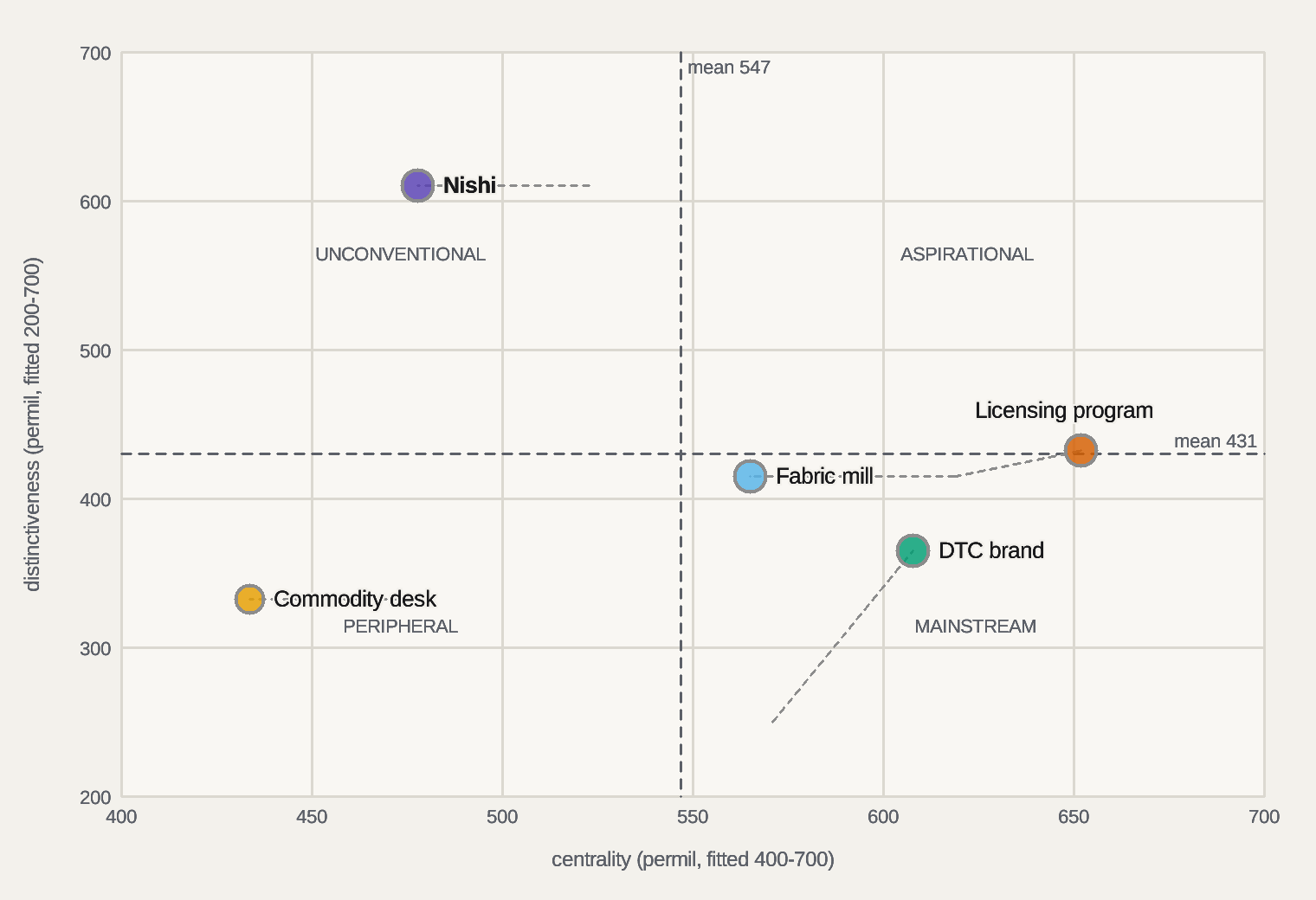
The four-quadrant map the field uses for brand strategy (Dawar and Bagga, HBR June 2015), re-derived from this matrix on every publish. Centrality is the share of the category's feature mass a player covers, each feature weighted by how many hold it; distinctiveness is the average lead over each rival on the rows the player holds; breadth is the depth-weighted share of the whole matrix (the bubble); depth is how deeply the rows held are held; momentum is the day-over-day move off the spine (green rising, red falling, grey until day two); the dashed path runs first day → previous day → today. Dividers are the category means. Axes are fitted to the field of play, so read the tick numerals, not the frame. Rival marks are documented presence, so a rival's position reads the record, never its quality. The picture grades its own readability below; the table beside it is the same data for a screen reader or a second method.
knowledge/compare/supimacotton.cdmap (cut|x|y, cube|x|y|z); absent = the HBR defaultsbubble area = breadth · ring = momentum (green rising, red falling, grey until day two) · dashed = category means · axes fitted to the field of play: centrality 400–700, distinctiveness 200–700 of 0–1000 permil (the full range put every player in one corner)
readability of the 2D cut, self-graded by the layout ruler: label overlaps 0 · labels over marks 0 · off-canvas 0 · unresolved labels 0 · mark overlaps 0 (a fact of the data: two players that close are that close) · data spread 641 permil of the plot · quadrant words unseated 0
text contrast, measured with wcag2-ratio (floors from contrast.conf), light theme: labels 16.24 (floor 4.50) · notes 16.24 (floor 4.50) · quadrant words 5.89 (floor 4.50) · tick numerals 5.89 (floor 4.50) · axis titles 5.59 (floor 4.50) · dark theme: labels 13.78 (floor 4.50) · quadrant words 5.55 (floor 4.50) · axis titles 5.97 (floor 4.50) · dark classes under their floor 0 (one figure serves both themes: a dark shortfall is a token to fix, never a class to hide) · classes refused under their floor 0 (a refused class is not drawn; the scale classes are measured, never hidden) · export: SVG PNG (receipt, rendered by the estate's own rasteriser from this page)

readability of the 3D cube, self-graded by the layout ruler: label overlaps 0 · labels over marks 0 · off-canvas 1 · unresolved labels 0 · mark overlaps 1 (a fact of the data: two players that close are that close) · data spread 308 permil of the plot
10 panels over 5 registered axes, every pair once (the lower axis on x, the higher on y) · each panel fitted to its own field of play, first and last tick numerals shown · no labels in a small cut, the legend names the colours; the grade below reports the mark terms only (MM summed over the panels, spread averaged)
readability of the small multiples, self-graded by the layout ruler: label overlaps 0 · labels over marks 0 · off-canvas 0 · unresolved labels 0 · mark overlaps 1 (a fact of the data: two players that close are that close) · data spread 557 permil of the plot
| Player | Quadrant | centrality | distinctiveness | breadth | depth | momentum | Rows held | Days on spine | First seen |
|---|---|---|---|---|---|---|---|---|---|
| Nishi | Unconventional | 478 | 611 | 433 | 722 | 0 since 2026-09-23 | 6 | 10 | 2026-09-15 |
| Commodity desk | Peripheral | 434 | 333 | 200 | 666 | 0 since 2026-09-23 | 3 | 10 | 2026-09-15 |
| Fabric mill | Mainstream | 565 | 416 | 300 | 750 | 0 since 2026-09-23 | 4 | 10 | 2026-09-15 |
| DTC brand | Mainstream | 608 | 366 | 300 | 600 | 0 since 2026-09-23 | 5 | 10 | 2026-09-15 |
| Licensing program | Aspirational | 652 | 433 | 366 | 733 | 0 since 2026-09-23 | 5 | 10 | 2026-09-15 |
| Day | Matrix rows reviewed | Players recorded |
|---|---|---|
| 2026-09-15 | 9 | 5 |
| 2026-09-16 | 9 | 5 |
| 2026-09-17 | 9 | 5 |
| 2026-09-18 | 9 | 5 |
| 2026-09-19 | 9 | 5 |
| 2026-09-20 | 9 | 5 |
| 2026-09-21 | 9 | 5 |
| 2026-09-22 | 9 | 5 |
| 2026-09-23 | 10 | 5 |
| 2026-10-08 | 10 | 5 |
players 5|matrix rows 10|feature mass 23|centrality mean 547|distinctiveness mean 431|axes 5|spine days 10 (shown 10)|rows written today 0|readability defects 2D 0 cube 1|spine knowledge/status/cdmap/supimacotton.spine
Capability matrix — measured against source
◉ authored stronger claim; source present● present◐ partial○ absent? unassessed; excluded from relative comparison · click any capability for its evidence
Peer cell coverage: authored assessed 40, unassessed 0. Authored assessments are not verified outcomes.
No capabilities match this filter or search.
| Capability | Nishi | Commodity desk | Fabric mill | DTC brand | Licensing program |
|---|---|---|---|---|---|
| PRICE | |||||
Fiber spot intelligence, Pima vs uplandOpen — watchingruntime/nx_cotton_chain.nx : ct_price_feed, re-measured on every compare beat. Ship that symbol and this mark flips itself; the comparewatch- plane row flips with it. USDA quotations: Pima 153.25 cents per lb vs upland 77.15 on 2026-08-13 [spotprices]. Contract = the sovereign spot-feed intake on the beat, so the ladder always prices from a dated fiber rowPros none measured yetCons behind Commodity desk (leads), Fabric mill, Licensing program; open contract; expected source declaration not established | ○ | ◉ | ● | ○ | ● |
| CHAIN | |||||
Raw-to-finished margin ladder, fiber to yarn to knit to garmentOpen — watchingruntime/nx_cotton_chain.nx : ct_value_ladder, re-measured on every compare beat. Ship that symbol and this mark flips itself; the comparewatch- plane row flips with it. Supima-class knit near 7.50 dollars per kg [knitprice]. Contract = the ladder as DATA: cost, yield and premium retention per stage, answering WHERE the fiber premium survivesPros none measured yetCons behind Commodity desk, Fabric mill (leads), DTC brand, Licensing program; open contract; expected source declaration not established | ○ | ● | ◉ | ● | ● |
| TRADE | |||||
Landed-cost corridor pricing, duties, MPF, HMF, corridor rankMeasured:lc_rank exists in runtime/_hdl_build/nx_landed_cost.nx, verified at emit. LIVE: the trade-corridor engine prices any import-export corridor with entry fees and ranks corridors -- the import-export half of the raw-to-product question is in tree today, sovereign and auditable rival marks uncited — the Yes, Best or Part codes on this row are an observation read with no reference mark behind them Adoption: RUN-BY:clock — fully adopted (top of its ladder).Pros Implementing source symbol found; runtime acceptance separate; ahead of Commodity desk, DTC brand, Licensing program; fully adopted on the estate ladderCons none on the measured axes (rival marks are documented presence, not depth) | ● | ◐ | ● | ○ | ○ |
Sourcing mix and reshore pathSource present; authored stronger claim:sp_mix in runtime/_hdl_build/nx_sourcing_path.nx, verified at emit. LIVE: prices the path from import-heavy to full-domestic BOM step by step with incentives as data -- built for the market-competitive American supply-chain ask, and Supima is an American fiber by definition Adoption: REGISTERED-DARK — PARTIAL: callable, authorised, completed MCP invocation not established by supplied journal window; lifetime history unknown (direct execution may be recorded elsewhere; this scan does not establish lifetime use); no execution surface runs it either (clock, cron, daemon, roster, actlog and surfaced forks checked).Pros Source symbol found; stronger capability claim is authored; ahead of Commodity desk, Fabric mill, DTC brand, Licensing programCons not adopted yet: callable, authorised, completed MCP invocation not established by supplied journal window; lifetime history unknown (direct execution may be recorded elsewhere; this scan does not establish lifetime use); no execution surface runs it either (clock, cron, daemon, roster, actlog and surfaced forks checked) | ◉ | ○ | ○ | ○ | ○ |
| CASE | |||||
Domestic supply-chain and good-jobs business caseMeasured:sc_weighted_risk exists in runtime/_hdl_build/nx_supplychain_case.nx, verified at emit. LIVE lib: origin class, energy risk, single-source and value roll into weighted risk and domestic-content permil -- the government-facing case a domestic cotton-products play leads with Adoption: LIB-WIRED importers=3 nonval=2 — fully adopted (top of its ladder).Pros Implementing source symbol found; runtime acceptance separate; ahead of Commodity desk, Fabric mill, DTC brand, Licensing program; fully adopted on the estate ladderCons none on the measured axes (rival marks are documented presence, not depth) | ● | ○ | ○ | ○ | ○ |
| PRODUCT | |||||
End-product decomposition, which goods carry the premiumMeasured:pd_parse exists in runtime/_hdl_build/nx_product_decompose.nx, verified at emit. The guides document where staple length and fineness matter to the finished good [supimaguide] [fiberguide]; DTC brands pick products by taste. The decomposer maps outcome to capability gaps over the planes Adoption: REGISTERED-DARK — PARTIAL: callable, authorised, completed MCP invocation not established by supplied journal window; lifetime history unknown (direct execution may be recorded elsewhere; this scan does not establish lifetime use); no execution surface runs it either (clock, cron, daemon, roster, actlog and surfaced forks checked).Pros Implementing source symbol found; runtime acceptance separate; ahead of Commodity desk, Fabric mill, DTC brandCons not adopted yet: callable, authorised, completed MCP invocation not established by supplied journal window; lifetime history unknown (direct execution may be recorded elsewhere; this scan does not establish lifetime use); no execution surface runs it either (clock, cron, daemon, roster, actlog and surfaced forks checked) | ● | ○ | ○ | ◐ | ● |
| BRAND | |||||
Licensing and verified-sourcing complianceOpen — watchingruntime/nx_cotton_chain.nx : ct_license_rule, re-measured on every compare beat. Ship that symbol and this mark flips itself; the comparewatch- plane row flips with it. Supima is a licensed trademark with verified sourcing; selling under the name requires the license chain [supimaguide]. Contract = the compliance rows as DATA before any product ships under the markPros none measured yetCons behind Fabric mill, DTC brand, Licensing program (leads); open contract; expected source declaration not established | ○ | ○ | ● | ◐ | ◉ |
| GTM | |||||
Channel engine for cotton end-productsMeasured:gtm_channel_best exists in runtime/nx_gtm_svc.nx, verified at emit. The GTM facade ranks channels per product today in an adjacent domain; cotton end-product channel rows are a data admission rival marks uncited — the Yes, Best or Part codes on this row are an observation read with no reference mark behind them Adoption: REGISTERED-DARK — PARTIAL: callable, authorised, completed MCP invocation not established by supplied journal window; lifetime history unknown (direct execution may be recorded elsewhere; this scan does not establish lifetime use); no execution surface runs it either (clock, cron, daemon, roster, actlog and surfaced forks checked).Pros Implementing source symbol found; runtime acceptance separate; ahead of Commodity desk, Fabric mill, Licensing programCons not adopted yet: callable, authorised, completed MCP invocation not established by supplied journal window; lifetime history unknown (direct execution may be recorded elsewhere; this scan does not establish lifetime use); no execution surface runs it either (clock, cron, daemon, roster, actlog and surfaced forks checked) | ● | ○ | ○ | ● | ○ |
| EVIDENCE | |||||
Sovereign mirrored and pinned reference register for this fieldMeasured:knowledge/fetched/cmp_supimacotton exists in knowledge/compare/supimacotton.refs, verified at emit. Every rival claim on this page resolves to a mirror in the estate evidence store, content-pinned by hash and re-measured on every emit Adoption: ABSENT — PARTIAL: no source and no binary: this is a build contract, not a partial deploy.Pros Implementing source symbol found; runtime acceptance separate; ahead of Commodity desk, Fabric mill, DTC brand, Licensing programCons not adopted yet: no source and no binary: this is a build contract, not a partial deploy | ● | ○ | ○ | ○ | ○ |
| PRODUCT | |||||
printed graphic apparel line, artwork to SKU with a rights row per likenessOpen — watchingruntime/nx_cotton_chain.nx : ct_graphic_product, re-measured on every compare beat. Ship that symbol and this mark flips itself; the comparewatch- plane row flips with it. watch contract for CT6 (intake 1790106111): DTC brands run printed lines as their core product (Best), the licensing program governs the mark not the artwork (Yes), desks and mills do not sell printed goods; the sovereign twin refuses a SKU without its rights row rival marks uncited — the Yes, Best or Part codes on this row are an observation read with no reference mark behind themPros none measured yetCons behind DTC brand (leads), Licensing program; open contract; expected source declaration not established | ○ | ○ | ○ | ◉ | ● |
| Class | Count | Note |
|---|---|---|
| rows with rival marks | 7 | rows carrying a Yes, Best or Part in a rival column |
| cited | 4 | a reference mark resolves to a pinned mirror |
| uncited | 3 | an observation read, badged until a reference lands |
| rows, summed | 7 | RECONCILED: the parts sum to the total 7 |
Delivery and evidence
Inspect risks, technical debt, rendered observations, experiments and references. Read scope and limitations alongside every result.
Risk register
| Risk | Likelihood x impact | Mitigation |
|---|---|---|
| Trade prices in the ladder go stale and the verdict silently ages | probable x medium | CT1 refuses on stale rows; every ladder verdict prints its price dates |
| The licensing chain is assumed rather than verified | possible x high | CT4 rows carry the program requirements with sources [supimaguide]; the shortlist refuses without the chain |
| A watch contract flips on symbol existence, so a stub reads green | possible x high | the flip is the receipt, the rung gate is the proof |
Release history and work log
| When | Rung | Kind | Entry |
|---|---|---|---|
| 2026-09-12 | CT3 | requirement | 2026-09-12 pilot acceptance extends the cotton ladder into a full business plan: define customer segment and Japanese demand evidence; benchmark fit, comfort, durability, wash behavior, aesthetics and willingness to pay; verify fiber identity and authorized brand/provenance chain; trace actual suppliers, labor hours, compensation, benefits and local living-wage methodology (minimum wage is not a substitute); evaluate buy/build/rent/partner alternatives for manufacturing/tooling/software/logistics; model BOM, yields, rejects, returns, FX, transport, duties, labeling/compliance by exact product/classification/date, inventory and working capital; compare direct/wholesale/distribution channels and acquisition cost. Funding alternatives must include terms, eligibility, timing, dilution/control, obligations and application cost. Show cash flow, runway, first revenue, break-even/payback and sensitivity, with milestone investment decisions. Reuse lc_calc/lc_rank/sp_mix where runtime-qualified; source presence does not validate assumptions. Historical price rows remain dated references, not today's quotes. No blanket claim of living wages, superior quality, legal readiness, revenue or profit without independent evidence. |
| 2026-09-12 | CT3 | requirement | Every business-case input needs value/unit/currency/date/source/version/geography/product identity, observed versus quoted versus estimated status, uncertainty and owner. Evidence contradictions, missing suppliers, unsupported coverage, double-counted benefits and stale rules must surface and prevent unqualified GO. Produce a conditional recommendation and concrete next research/prototype/quote step when evidence is incomplete. One-call means durable orchestration with visible internal steps and reviewable outcomes, not bypassing supplier checks or making commitments. Same framework must handle both recovery pilots and new domains. |
| 2026-09-22 | CT6 | queue | 2026-09-22 declared from intake 1790106111 by the PM tier: the apparel product half of the operator's car exploded-view artwork ask; the ladder's CT2 and CT3 price it, dcc DC17 draws it, stem R7 explodes it; the rights row per car likeness is the refusal that keeps a SKU honest |
| 2026-09-22 | CT6 | queue | INTAKE 1790106111 routed by nx_intake_route (operator, epoch 1790108121) from operator: EXPLODED-VIEW CAR ART FOR APPAREL: a series of well-artisted exploded-view illustrations of favourite cars of all time, print-ready for the back of a t-shirt or sweater (operator 2026-09-22, verbatim: -- sponsor intake-1790106111 plus2 |
| 2026-09-28 | CT3 | queue | INTAKE 1790625310 routed by nx_intake_route (trade-research-seat, epoch 1790625365) from trade-research-seat: TRADE COMPLIANCE FROM THE ONE LAW ENGINE (operator standing order 2026-09-28, ETHICS IS THE LAW, APPLIED NEUTRALLY): every import and export quote screens its parties against the OFAC SDN list, the EU -- sponsor intake-1790625310 plus2 |
Person · product · place — not yet measured for this domain
knowledge/compare/supimacotton.ppp (rows surface|nishi or c1..c4|label|url|connect naming OUR live surface and each rival's front door), run nx_ppp_probe domain supimacotton, and this section fills itself on the next beat: the same ruler on both sides — privacy and CX (third-party hosts, tracker classes, cookies, security headers), design and longevity (design hygiene, computed WCAG contrast, render-blocking resources, unsized media, script weight, theme and motion queries), findability (landmarks, skip link, on-site search, breadcrumb, headings, internal links).The field — discovered, not chosen
Rows written by nx_field_discover from supimacotton.seeds: the industry's own lists (Wikipedia wikitext, GitHub topics, awesome lists) read mechanically, every candidate counted across seeds. The matrix columns above are a SEAT'S pick; this band is the population they were picked from, and the stats line measures one against the other. A rival here is a lead, never a verdict — it earns a column when its capabilities are read and pinned.
| Class | Count | Note |
|---|---|---|
| seeds | 1 | |
| scanned | 1 | |
| fetched | 1 | |
| reused | 0 | |
| failed | 0 | |
| named | 1 | |
| candidates | 1 | |
| mentions | 1 | |
| capped | 0 |
| Rank | Rival | Seeds | Mentions | First seed | Kind | Link |
|---|---|---|---|---|---|---|
| 1 | Fabric mill | 1 | 1 | col1-fabric | named | https://www.fabricbuys.com/supima-vs-regular-cotton-knit/ |
field candidates 1|shown 1 of 1|matrix columns in the field 1 of 4|discovered rivals with no column 0|malformed rows 0 (counted, never rendered)|read-capped 0
Exclusive and shared capabilities
This board grades 10 capabilities: 7 exclusive to it and 3 shared with other boards. Shared rows on this page: 3 = home here 0 + home elsewhere 0 + ambiguous 0 + undecided 3 + refused 0 (partition 3); undecided = unmapped 1 + unproven 2 + unevidenced 0; homonyms 0; since the previous census: new 0, resolved 0. Census FRESH age_s=6717.
| Capability | Organ | Boards grading it | Home | Rule | Evidence | Standing on this board |
|---|---|---|---|---|---|---|
| pd_parse | nx_product_decompose.nx | appliancemove, braketool, soilscience, alignbiz, realestate, supimacotton, butterchurn, phototwin | — | none | unproven | undecided |
| sp_mix | nx_sourcing_path.nx | appliancemove, braketool, supimacotton | — | none | unmapped | undecided |
| gtm_channel_best | nx_gtm_svc.nx | appliancemove, braketool, soilscience, alignbiz, carflip, supimacotton, butterchurn, phototwin | — | none | unproven | undecided |
Gaps from the record — what the estate does that no board carries
The record census (nx_goalmap record) reads the invoked-tool population and every plan queue row and files each organ or directive that NO matrix, plan or gates row names. A row here is a callout the boards missed: adjudicate it onto a board or declare it infrastructure. Census state STALE (age 1395822 s), sources read 4 of 7 declared — a BLIND census is a FLOOR: unread sources can only add rows.
| kind | name | board | source | evidence |
|---|
rows shown 0|this board's directives 0|estate-wide un-boarded organs 452 (listed in full on /compare/ecosystem)|census rows 639|malformed 0 (counted, never rendered)
References
- [spotprices] IndexBox reproduction of USDA daily spot cotton quotations, 13 August 2026 -- upland spot average 77.15 cents per pound, American Pima average 153.25 cents per pound: the fiber-level premium, dated. publisher · read in our library
knowledge/fetched/cmp_supimacotton_spotprices.html· pinhb80aea642c7dbb3ad6969060b1224299d8e576a8b033f505775989cc83ea1379· accessed 2026-08-19 · datasetGrounds: The fiber spot row and the verdict: the dated two-to-one premium the whole ladder starts from. - [knitprice] FabricBuys. Supima vs regular cotton knit -- is the premium worth it. Trade fabric guide -- Supima-class combed knit priced near 7.50 dollars per kilogram against standard combed cotton knit, the first processing stage where premium retention is visible. publisher · read in our library
knowledge/fetched/cmp_supimacotton_knitprice.html· pinh7e5bc9e8f060c7fd6fcab9d6157563b6b9bc4073755abdb49142887853d6d5e1· accessed 2026-08-19 · vendor-docGrounds: The margin-ladder row: the knit-stage price point the ct_value_ladder contract banks as its first non-fiber rung. - [supimaguide] Essential Layers. What is Supima cotton -- the complete guide (2026). Consumer-facing guide -- extra-long staple properties (length, strength, fineness), the licensed trademark program and verified sourcing behind the name. publisher · read in our library
knowledge/fetched/cmp_supimacotton_supimaguide.html· pinh9dea5d0ce3cd695478d857a9c577a2faca94b4e5277eb5643c3f57c6dd1b0f1b· accessed 2026-08-19 · mirrored-indexGrounds: The end-product decomposition and licensing rows: which product properties carry the premium and what the mark requires. - [fiberguide] PuraFabric. Supima cotton fabric -- a practical guide to the American premium fiber. Trade guide -- fiber properties and their consequences in finished fabric: hand-feel, durability and color retention. publisher · read in our library
knowledge/fetched/cmp_supimacotton_fiberguide.html· pinhf06b48d5789a7e3a7eed72adcd39a400ecc59c9ed8e1e21e8df4a11279c9e360· accessed 2026-08-19 · mirrored-indexGrounds: The end-product decomposition row: the property-to-product mapping the decomposer consumes as data.
generated by nx_swcompare_matrix (sovereign NishiLang organ) from knowledge/compare/supimacotton.matrix · source checks show implementation presence; runtime and user-outcome evidence are reported separately · JavaScript supports page controls